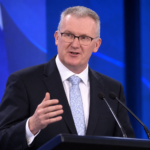
Australia’s housing market has suffered its steepest monthly decline in almost four years, but Treasurer Jim Chalmers says the downturn does not alter the government’s long-term expectation that property values will continue to rise—albeit at a slower pace than Australians have become accustomed to.
Fresh figures from property analytics firm Cotality showed national dwelling values fell by 0.7 per cent in July, marking the largest monthly decline since December 2022 and extending the current downturn to four consecutive months. The latest data has intensified concerns that some recent home buyers could slip into negative equity if prices continue to weaken.
The decline has been most pronounced in Australia’s largest housing markets.
Sydney recorded a 1.7 per cent fall in house prices during July, while Melbourne dropped 1.4 per cent. Brisbane also posted another monthly decline after ending a three-year run of uninterrupted growth, Adelaide slipped for a second consecutive month, and Perth’s once-booming market slowed dramatically, recording only modest growth.
The figures represent a significant shift from the rapid gains experienced during recent years and suggest the national property market is adjusting to a combination of higher borrowing costs, softer investor demand and major changes to Australia’s property taxation system.
Despite the market weakness, Dr Chalmers rejected suggestions that the Federal Budget had triggered an unexpected collapse.
Speaking to ABC Radio National, the Treasurer said the government’s forecasts had always anticipated more moderate growth rather than continuing rapid price increases.
“Housing is a long-term investment, and we continue to expect over the course of the coming years that prices will continue to rise, but more modestly than before,” Dr Chalmers said.
He acknowledged that several factors are influencing today’s market, including interest rates, inflation, global economic uncertainty and evolving investor behaviour.
According to the Treasurer, it would be incorrect to attribute the current downturn solely to the Federal Budget or any single government policy.
The government’s 2026 Budget introduced sweeping reforms to property investment taxation, including ending negative gearing for newly purchased existing residential properties from July 2027 and replacing the longstanding 50 per cent capital gains tax discount with a new minimum 30 per cent tax framework for investment properties.
The measures were promoted as part of Labor’s broader strategy to improve housing affordability and encourage investment into new housing supply rather than existing homes.
Critics, however, argue the policy changes have contributed to a sharp decline in investor confidence.
Industry observers note that many investors have delayed purchasing decisions while reassessing the long-term returns available under the new tax settings. Higher interest rates have also reduced borrowing capacity across much of the market, placing additional downward pressure on prices.
Cotality’s latest research suggests Sydney and Melbourne have borne the brunt of the correction, largely because both markets experienced stronger price growth in previous years and remain more sensitive to changes in borrowing costs.
The slowdown has spread beyond the two largest capitals.
Brisbane, Adelaide and Perth—all standout performers during the post-pandemic housing boom—have also begun losing momentum as affordability pressures intensify and demand softens.
Economists say the market is now entering a very different phase from the extraordinary growth seen during 2023, 2024 and much of 2025.
Rather than widespread double-digit annual gains, many analysts expect a prolonged period of weaker prices, lower turnover and slower investment activity while households adjust to higher mortgage repayments.
Even so, several economists continue to argue that Australia’s long-term structural housing shortage remains unresolved.
Population growth, continued migration and years of underbuilding continue to support underlying housing demand, factors that many analysts believe will eventually place upward pressure on prices once financial conditions become more favourable.
The Reserve Bank’s interest rate decisions remain one of the biggest variables influencing the outlook.
Successive rate increases during 2026 have significantly increased mortgage repayments for many borrowers, reducing affordability and cooling buyer demand across much of the country.
Market participants will be closely watching future RBA meetings for any indication that the tightening cycle has reached its peak. Reuters reported that the recent housing slowdown has become one of several indicators being monitored as policymakers assess broader economic conditions.
For recent first-home buyers, the latest price falls have renewed discussion about negative equity—the situation where a property’s market value falls below the outstanding mortgage balance.
While this risk generally affects only a relatively small proportion of borrowers, households that purchased with very small deposits during periods of elevated prices are considered the most vulnerable if the downturn deepens further.
Government ministers have nevertheless argued that improving affordability for future buyers requires a moderation in house price growth.
Housing Minister Tanya Plibersek recently defended the government’s broader housing reforms, saying slower price growth could create greater opportunities for Australians seeking to enter the property market for the first time.
Opposition politicians and sections of the property industry continue to argue that reducing investor incentives risks discouraging investment and could place additional pressure on rental supply over the coming years.
The debate highlights the difficult balancing act facing policymakers.
Rapid house price growth benefits existing homeowners but makes entering the market increasingly difficult for younger Australians. Conversely, falling prices may improve affordability but can reduce household wealth, weaken consumer confidence and increase risks for highly leveraged borrowers.
Despite the current correction, Dr Chalmers maintains that the government’s long-term outlook has not fundamentally changed.
His message is that housing should continue to be viewed as a long-term investment rather than judged by short-term monthly fluctuations.
Whether the current downturn proves to be a temporary correction or develops into a more prolonged adjustment is likely to depend on several factors, including future interest rate decisions, economic growth, inflation, investor confidence and the market’s response to Labor’s property tax reforms over the next two years.