The Reserve Bank of Australia is facing political scrutiny after officials told a parliamentary committee they had not modelled the inflation impact of a hypothetical 2 per cent reduction in government spending, prompting a fresh argument over how monetary and fiscal policy share the burden of bringing prices under control.
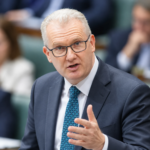
The exchange occurred during the RBA’s appearance before the House of Representatives Standing Committee on Economics in Canberra. Liberal MP Simon Kennedy pressed Governor Michele Bullock and senior economic officials on whether the central bank had calculated what a sizeable reduction in public spending might do to inflation.
The RBA officials said they had not run the specific scenario Kennedy proposed. That answer has since been described in some commentary as an admission that the bank had never examined the effect of government spending on inflation. That is broader than what the evidence supports.
The key point from the hearing is narrower: the RBA had not produced a modelled estimate for the particular hypothetical put to it — a 2 per cent cut in government spending. The bank routinely assesses public demand, fiscal settings and their contribution to economic conditions as part of its forecasts, but it does not model every possible fiscal-policy package that governments might adopt.
Kennedy argued that this gap deserved attention because higher interest rates reduce private household spending, particularly for borrowers with mortgages. His broader political point was that governments should be asked to restrain their own spending before relying so heavily on monetary policy to slow demand.
That argument is not new in Australian economic policy. When inflation is too high, both fiscal policy and monetary policy can affect aggregate demand. Interest-rate increases work by making borrowing more expensive, changing saving incentives and reducing spending and investment. Government decisions on taxation and expenditure can also add to or subtract from demand.
But the two arms of policy are controlled by different institutions. The Reserve Bank sets monetary policy independently within its statutory framework, while elected governments and parliaments make spending and taxation decisions. The RBA can analyse fiscal policy and incorporate it into forecasts, but it does not decide how much a government should spend on health, defence, infrastructure, welfare or other programs.
Bullock’s appearance came at a difficult time for borrowers. The cash rate is 4.35 per cent after three increases in 2026, a cumulative rise of 75 basis points. The bank has been responding to persistent inflation and has warned that some upside risks are materialising.
In her opening statement to the committee, Bullock emphasised the RBA’s responsibility to achieve low and stable inflation and full employment while supporting the stability of the financial system. She said the hearings were an important part of the bank’s accountability to parliament and the public.
Separate comments from the RBA have pointed to global energy prices, geopolitical tensions and the investment boom associated with artificial intelligence infrastructure as factors that could keep inflation elevated. The bank is also watching domestic demand, the labour market, productivity and wage growth.
That wider picture matters because a simple “cut spending by 2 per cent” scenario does not specify where the reduction would occur, how quickly it would happen or what other economic effects would follow. A cut to recurrent consumption, a delay to infrastructure, a reduction in transfers and a fall in public-sector wages could all have different effects on demand, capacity and inflation.
The size of the inflation response would also depend on the state of the economy. Fiscal tightening introduced during a period of weak private demand can have different consequences from the same nominal cut during an overheated expansion.
That does not make Kennedy’s question irrelevant. A modelled scenario can be useful for understanding the scale of policy trade-offs, even when the scenario is simplified. Economists routinely use hypothetical changes to test how an economy might respond.
The dispute is therefore partly about what the RBA should prioritise with its modelling resources. Critics say the bank should be able to give parliament clearer estimates of how fiscal restraint might affect inflation when households are being asked to absorb higher mortgage costs.
Defenders of the bank argue that detailed fiscal-policy modelling is primarily the responsibility of Treasury and government, and that the RBA’s task is to understand the overall economic outlook and set the cash rate accordingly. On that view, it would be unrealistic for the central bank to produce bespoke estimates for every proposed spending change.
The hearing also highlights a recurring political tension around interest rates. Monetary policy is highly visible because rate rises flow quickly into variable mortgage repayments and new borrowing costs. Government spending is more diffuse, covering services and investments that can be politically difficult to cut.
As a result, calls for fiscal restraint often become arguments about which programs should be reduced rather than an abstract debate about percentages. A government can promise to spend less overall, but the economic and social consequences depend on the composition of the cuts.
Likewise, higher interest rates do not affect all households equally. Borrowers with large variable-rate mortgages experience the impact directly, while outright homeowners and savers can be affected differently. Businesses also face higher financing costs, and housing demand can weaken.
This distributional impact explains why Kennedy framed the issue around mortgage holders. His contention was that households should not bear the full responsibility for reducing demand if public spending is also contributing to inflationary pressure.
The government can respond that not all public spending is discretionary stimulus. Some expenditure is driven by population growth, indexed payments, health and disability costs, defence commitments or infrastructure needs. Cutting spending in one area can also create costs elsewhere or reduce the economy’s productive capacity.
The RBA, for its part, has to set policy based on the economy it faces, not the fiscal settings it might prefer. If demand and inflation remain too strong, the bank can tighten monetary policy even if some of that pressure originates in the public sector.
That institutional separation is a feature of the Australian system. An independent central bank reduces the risk that short-term political considerations directly determine interest rates, while elected governments remain accountable for budgets and taxation.
The latest committee exchange does not establish that a 2 per cent spending cut would remove the need for further rate rises. No such estimate was produced, and any credible answer would require assumptions about the timing and composition of the fiscal change.
It does, however, sharpen the question of policy coordination. If inflation remains above the RBA’s 2 to 3 per cent target band for longer than expected, pressure will grow on both the bank and the government to explain how their respective decisions are helping return inflation to target.
The next monetary-policy decisions will depend on incoming data rather than the political argument alone. Markets and economists are watching inflation, employment, wages, household spending and global price pressures for signs of whether the current cash rate is restrictive enough.
For borrowers, the practical concern is straightforward: interest rates have already risen sharply and could remain high if inflation proves persistent. For policymakers, the question is more complicated. Monetary policy can restrain demand, fiscal policy can influence it, and neither operates in isolation.
The parliamentary hearing has exposed a specific gap in the RBA’s scenario modelling, but it should not be confused with evidence that the bank ignores government spending. The more useful debate is whether Australia’s fiscal and monetary settings are working together effectively — and whether the institutions responsible can explain those trade-offs clearly to households carrying the cost.