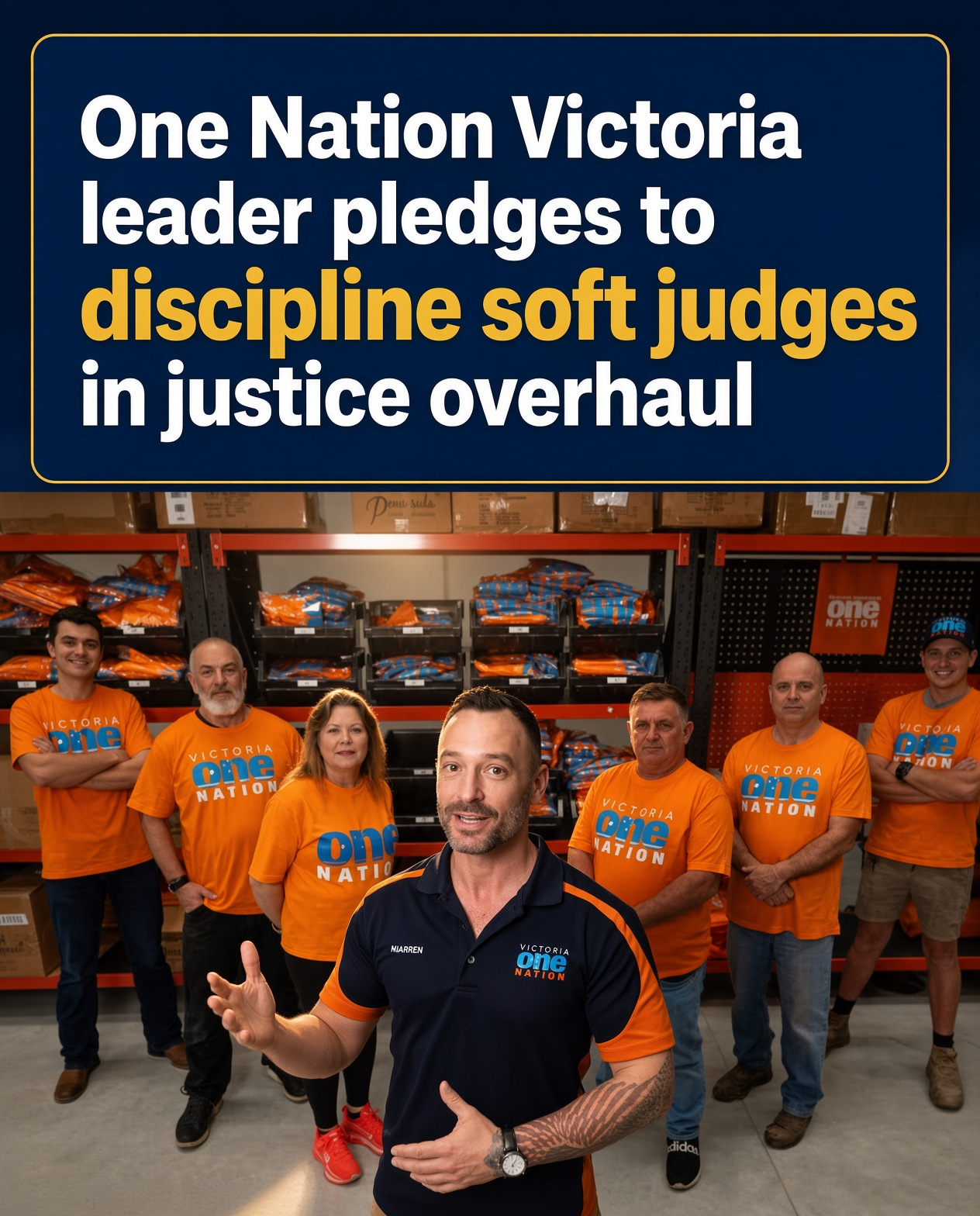
One Nation’s new Victorian leader Warren Pickering has revealed plans for ordinary citizens to help scrutinise court sentences and for judges deemed repeatedly too lenient to face disciplinary action, as the party prepares to make crime and government accountability central battlegrounds at November’s state election.
In his first major sit-down interview since becoming the party’s Victorian leader, Pickering outlined an ambitious justice agenda that could place One Nation on a collision course with the state’s legal establishment.
His proposal would establish a panel containing qualified legal representatives alongside community members and ordinary Victorians.
That panel would examine court sentences on a case-by-case basis and consider whether the punishment imposed properly reflected the crime.
Pickering then went further.
Judges he considers repeat offenders in delivering inadequate sentences would be “disciplined”, he said — a proposal that immediately raises major questions about how One Nation intends to preserve the independence of Victoria’s courts.
Pickering wants ‘everyday Victorians’ involved
The One Nation leader said details of the justice policy would be formally released in coming weeks.
But he has already revealed its central concept.
A panel would combine legal expertise with community representation to examine whether individual punishments fit the offences committed.
And judges themselves would come under scrutiny
Pickering’s most consequential declaration concerns what would happen if the same judges repeatedly produced sentences One Nation considered inadequate.
“Repeat offender judges will be disciplined,” he told the Herald Sun.
Exactly what “disciplined” would mean has not yet been explained.
That missing detail is crucial
There is a considerable difference between allowing a community panel to review and report on sentencing patterns and giving a political or quasi-political body power to punish judicial officers for decisions made in court.
Pickering has not yet publicly detailed the panel’s legal powers, appointment process, review standards or disciplinary mechanisms.
Those details will determine whether the proposal amounts primarily to greater public scrutiny or something considerably more radical.
Judicial independence would immediately become an issue
Australia’s democratic system relies on courts operating independently of elected governments.
Parliament makes laws, including sentencing legislation.
Courts apply those laws to individual cases according to the evidence, legislation, precedent and circumstances before them.
A government seeking to punish judges because it dislikes individual sentencing outcomes would therefore enter constitutionally and institutionally sensitive territory.
Victoria is already having this argument
Pickering’s intervention comes only days after the Victorian Coalition announced its own controversial plan to restructure the state’s Court of Appeal.
Opposition Leader Jess Wilson wants to divide the existing appeals structure into separate criminal and civil appeal courts and appoint additional judges with specialist criminal-law experience.
The Liberals say tougher sentencing is needed
The Coalition argues the proposed criminal appeals court would help establish precedents producing sentences more closely aligned with community expectations.
It plans to combine the reform with tougher bail and sentencing legislation if it wins government in November.
Legal organisations are already pushing back
Liberty Victoria, the Australian Lawyers Alliance and Law Institute of Victoria have raised concerns about the Coalition proposal.
The central objection is that governments should not attempt to engineer judicial outcomes by selecting or restructuring courts according to the sentencing results politicians want.
Pickering has already attacked ‘bleeding heart judges’
The policy is consistent with rhetoric the One Nation leader used earlier this month.
He said the party wanted to make judges he characterised as too lenient accountable and remove those he believed consistently failed to meet community expectations.
His latest interview begins to reveal how One Nation intends to turn that political message into policy.
Youth crime is central to the pitch
Pickering is framing sentencing reform as a response to community anger over crime, particularly offending involving young people and repeat offenders.
One Nation’s Victorian crime campaign calls for stronger penalties for repeat offenders, tighter bail rules, youth intervention programs emphasising responsibility and consequences, and greater resources for police.
But Labor has already hardened its laws
The political battle over crime is not occurring against a static policy backdrop.
Victoria’s Labor government has already passed tougher bail laws and its controversial “adult time for violent crime” reforms.
The government is also undertaking a sentencing review.
The November election is increasingly becoming a contest over which party can convince voters it will go furthest on law and order.
One Nation wants to go further than tougher laws
That is what makes Pickering’s proposal distinctive.
Governments routinely increase maximum penalties, alter bail tests and create new criminal offences.
One Nation is proposing scrutiny of the people who apply those laws.
It represents a fundamentally different approach to the sentencing debate.
Pickering has a second target: the Big Build
The Victorian leader also used his interview to escalate One Nation’s campaign over allegations surrounding major government infrastructure projects and the CFMEU.
Asked whether a One Nation government would seek criminal investigations into Labor figures associated with allegations of Big Build corruption, Pickering answered in the affirmative.
He says Victoria Police and IBAC should be involved
Pickering said he would not devise detailed policy on the spot but indicated any process would involve the appropriate authorities, including Victoria Police and the Independent Broad-based Anti-corruption Commission.
If evidence implicated individuals in potential corruption, he argued there should be a full investigation.
That does not mean anyone has been found guilty
The distinction is essential.
Pickering is calling for investigations into alleged or potential corruption.
His comments should not be read as establishing that unnamed Labor politicians or officials have committed criminal offences.
Whether conduct amounts to corruption or criminal wrongdoing is a matter for properly empowered investigative bodies and ultimately the courts.
One Nation has already promised a royal commission
The party’s Victorian organisation has gone further in its formal election campaigning.
It has pledged that, if elected, it would establish a Royal Commission into CFMEU contracts associated with Victoria’s Big Build program.
Victorian Labor’s involvement would also be examined
One Nation’s published policy specifically says the proposed inquiry would examine the involvement of the Victorian Labor Party.
The party says taxpayers deserve greater transparency about major infrastructure contracts and any connections between public money, union conduct and alleged criminal activity.
Big Build controversies have become potent political ammunition
Victoria has spent enormous sums on major transport infrastructure during Labor’s long period in government.
Projects have transformed Melbourne’s rail and road networks but have also generated fierce debate about cost overruns, debt, union influence and project governance.
One Nation sees that combination as an opportunity.
Pickering is trying to connect crime and corruption
Although youth offending and Big Build contracting appear to be separate issues, they fit neatly within the political message Pickering is constructing.
His argument is fundamentally about accountability.
Offenders should face consequences.
Judges should face scrutiny.
Politicians and officials should face investigation where credible corruption allegations arise.
It is a deliberately confrontational agenda
Pickering is not campaigning as a conventional minor-party leader seeking a handful of upper-house seats.
One Nation says it intends to govern Victoria.
And even if that ambition falls short, the party could emerge with substantial leverage in a hung parliament.
That possibility is no longer being dismissed
Earlier polling has placed One Nation in serious contention across Victoria, particularly in regional and outer-suburban electorates.
ABC analysis has identified seats including Ripon, Murray Plains, Bendigo East, Bendigo West and Gippsland East as areas where the party could make significant gains.
One Nation is targeting voters frustrated with both major parties
The party’s rise has been particularly disruptive because it is not drawing support exclusively from one side of politics.
Its campaign combines traditional conservative issues such as crime, Treaty opposition and energy policy with economic populism and hostility towards established political institutions.
That creates problems for both Labor and the Coalition.
But the Coalition faces the more immediate strategic dilemma
If Labor fails to secure a majority in November but the Coalition also falls short, One Nation MPs could become pivotal to determining who governs.
Pickering is openly thinking about that possibility.
He says a hung parliament could give his party leverage to force action on policies it considers priorities.
He believes the Coalition is already borrowing One Nation policies
Pickering argues the Liberals and Nationals have moved towards One Nation on several issues as voters have shifted to Pauline Hanson’s party.
He singled out opposition to Victoria’s Treaty arrangements and resistance to controversial transmission infrastructure as examples.
One Nation wants the Treaty torn up
Pickering said that if One Nation held leverage after the election, abandoning the Treaty would be among the policy commitments it would seek to enforce.
The issue has become a major dividing line in Victorian politics.
One Nation has positioned itself unequivocally against the process.
The VNI transmission lines are another priority
Pickering also identified the proposed Victoria-New South Wales Interconnector transmission infrastructure as a policy battleground.
Opposition to major transmission projects has become particularly potent in regional communities affected by proposed routes.
One Nation wants the controversial lines cancelled.
Pickering wants discussions with Jess Wilson
Despite the possibility of post-election cooperation, Pickering revealed he had not spoken directly with Victorian Liberal leader Jess Wilson since May.
He said he would like conversations to occur but stressed One Nation has its own campaign to run.
The relationship could become crucial after election night
If neither major bloc can command a lower-house majority, the personal and political relationship between Wilson and Pickering could suddenly become central to the formation of government.
That would give One Nation the opportunity to demand policy concessions in exchange for support.
Pickering is already signalling what some of those demands could be.
But Pauline Hanson remains the party’s dominant national figure
Pickering has also faced questions over how much control Hanson exercises over the Victorian campaign.
He rejected suggestions that the Queensland senator was making unilateral decisions for the state organisation.
“She’s never made a captain’s call in Victoria,” he told the Herald Sun.
His own candidacy created questions
Pickering had initially been expected to pursue an upper-house position in Eastern Victoria.
He is now running for the lower-house seat of Pakenham.
Reports that Hanson instructed him to make the switch prompted questions about who was directing strategy.
Pickering says the decision was his
He rejected the suggestion that Hanson ordered the move.
According to Pickering, he had already made the decision and subsequently discussed it with Hanson, who agreed with the approach.
Candidate selection is still unfinished
With the Victorian election only months away, One Nation has yet to publicly unveil most of its candidates.
Pickering said approximately 78 candidates had been tentatively endorsed.
That represents a substantial organisational challenge for a party attempting to contest broadly across the state.
One Nation’s ambitions have expanded rapidly
Only months ago, the idea that Pauline Hanson’s party could play a central role in determining the Victorian government appeared highly improbable.
Strong polling changed the political calculation.
ABC analysis earlier this year concluded that a One Nation-influenced hung parliament had become a scenario being taken seriously inside both major political camps.
Pickering was formally unveiled this month
One Nation announced Pickering as its Victorian state leader in early August.
Previously the party’s Victorian president, he is an army veteran and has become the public face of its campaign to dramatically expand its representation at Spring Street.
His first major interview shows where the fight is heading
Cost of living, energy and housing will remain important.
But Pickering clearly intends to make crime, sentencing and institutional accountability defining issues.
That strategy places pressure on the Coalition because Jess Wilson is simultaneously attempting to convince voters that the Liberals offer the tougher alternative to Labor.
The two opposition forces could end up competing over toughness
The Coalition wants a specialist criminal appeals court and tougher bail and sentencing laws.
One Nation wants community participation in sentence reviews and potential disciplinary consequences for judges.
Both are appealing to dissatisfaction with criminal justice outcomes.
But One Nation’s proposal pushes into much more contentious territory concerning the relationship between government and courts.
That could become one of the election’s defining legal debates
The details Pickering has yet to reveal will matter enormously.
Who appoints the proposed panel?
What criteria would it use?
Would its findings be advisory or binding?
Who determines that a judge is a “repeat offender”?
What disciplinary action could legally follow?
And how would judicial independence be protected?
Until those questions are answered, this remains a political proposal
Pickering has outlined the architecture of his idea, not a complete legislative framework.
It would therefore be premature to assume a One Nation government could simply establish such a system exactly as described without confronting significant legal and institutional questions.
The party says more detail is coming.
The Big Build promise requires similar precision
A government can establish inquiries, refer information and support investigative agencies.
It cannot legitimately predetermine the result of a criminal investigation or prosecution.
Pickering’s commitment is therefore most accurately understood as a promise to pursue investigation and accountability where evidence warrants it — not a declaration that particular Labor figures are guilty.
But politically, the message is unmistakable
Pickering wants voters to believe that institutions which have failed to deliver consequences will themselves face consequences under One Nation.
That applies to repeat youth offenders.
It applies to judges he considers too lenient.
And it applies to anyone potentially implicated in corruption surrounding taxpayer-funded infrastructure.
The question is how far Victorians want government to go
Calls for tougher sentences can be enacted through parliament.
Calls for corruption investigations can be pursued through independent authorities.
But disciplining judges over sentencing decisions touches a different democratic principle altogether.
The judiciary’s independence exists precisely to prevent judges from deciding cases according to what elected politicians want.
That tension is now headed straight into the election campaign
Victoria’s law-and-order debate is rapidly moving beyond whether penalties should simply become tougher.
The Coalition is proposing structural changes to the appeals system.
One Nation is proposing direct community scrutiny of sentencing outcomes and consequences for judges it believes repeatedly get those outcomes wrong.
Legal groups are already warning against politicising the courts.
And One Nation may have leverage even without winning government
That could ultimately be the most consequential element of Pickering’s interview.
His policies do not necessarily require One Nation to win a majority in its own right to influence Victoria.
A sufficiently large bloc in a hung parliament could allow the party to demand concessions from a Coalition seeking to form government.
Pickering has now begun telling Victorians what those concessions could look like: tougher criminal justice, scrutiny of judges, investigations into alleged Big Build corruption, an end to Treaty and opposition to major transmission projects.
Whether those policies become law will depend on November’s voters. But the prospect that One Nation could have enough seats to force the major parties to negotiate over them means Pickering’s proposals can no longer be treated merely as rhetoric from the political fringe.