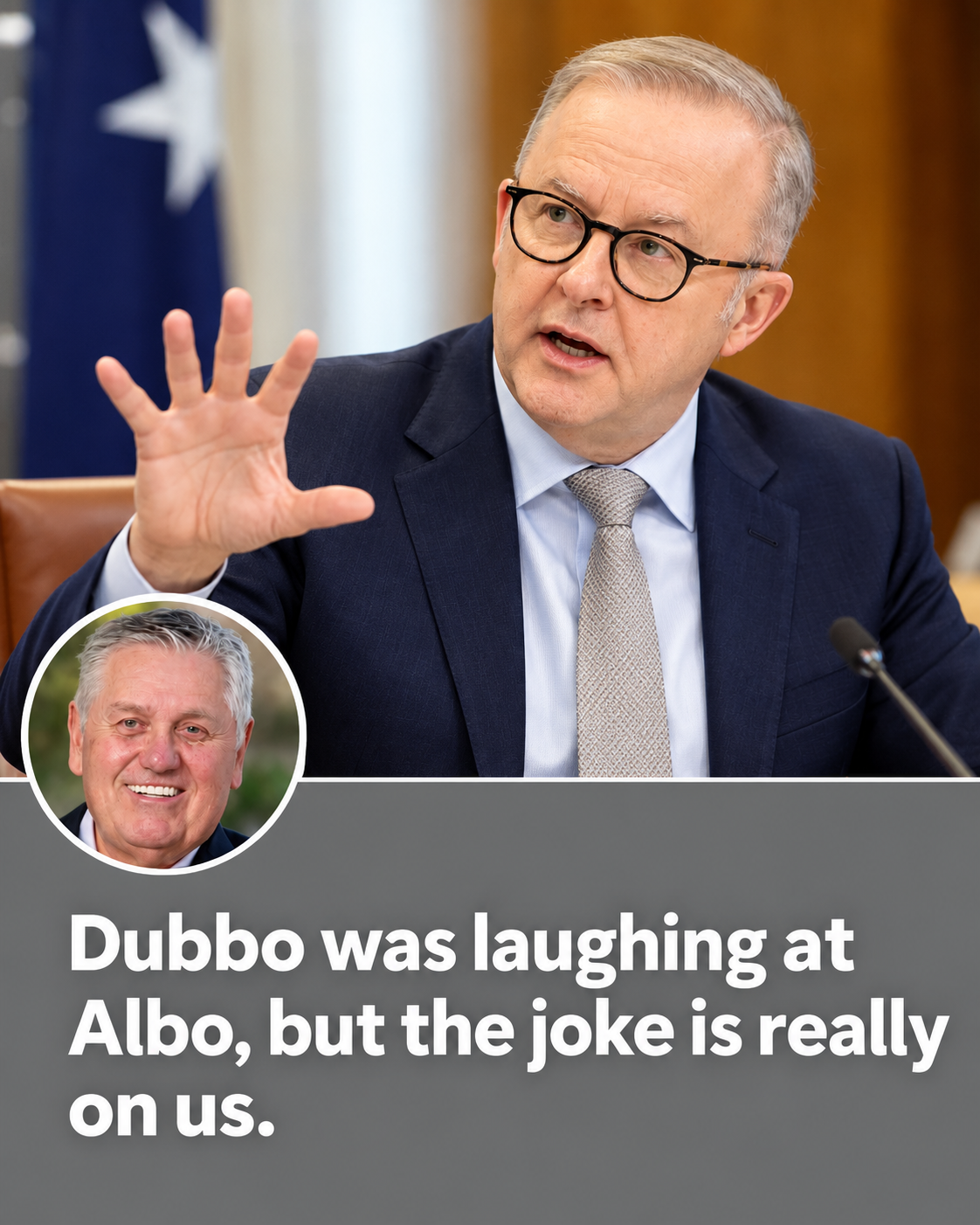
Anthony Albanese arrived at the National Bush Summit in Dubbo to sell his government’s record to regional Australia. Instead, the Prime Minister found himself facing jeers, laughter and pointed questions from an audience increasingly frustrated by energy policy, regulation, migration and the cost of living — a reception broadcaster Ray Hadley says should serve as a warning to Labor about how ordinary Australians are feeling.
Hadley’s assessment is unmistakably political.
He argues the reaction in Dubbo crystallised a broader national dissatisfaction with the Albanese government and says Australians are paying the price for what he regards as years of economic mismanagement.
Whether the Bush Summit audience represents the entire country is impossible to establish from one event. But the frustration in the room was real, and it landed at a particularly difficult moment for the government.
Inflation remains above target. Interest rates have risen three times this year. Economic growth is slowing. Housing costs remain elevated. Migration has become one of the country’s most contentious political issues, and regional communities are demanding a greater say over the infrastructure being built around them as Australia pursues its energy transition.
That combination turned what could have been a routine regional policy appearance into an unusually uncomfortable encounter for the Prime Minister.
Albanese confronted by a sceptical Dubbo audience
The National Bush Summit brought political leaders, farmers, regional businesses and community representatives together in Dubbo to discuss the issues confronting rural and regional Australia.
For Albanese, the appearance provided an opportunity to defend Labor’s economic and regional agenda.
But parts of the audience were plainly unconvinced.
The Prime Minister faced jeers as he discussed the government’s renewable energy rollout and was challenged over whether regional communities were receiving adequate consultation before major transmission, solar and wind projects were developed.
At one point, Albanese acknowledged that consultation around some projects had not been good enough.
He argued that community engagement had improved and that the government recognised landholders and regional communities needed to be properly consulted as new energy infrastructure was rolled out.
That concession went directly to one of the strongest complaints emerging from the summit.
Regional Australia hosts much of the infrastructure required for the energy transition. Transmission lines, renewable energy zones, solar developments and wind projects inevitably have a much greater physical impact on communities outside the major capitals than on inner-city voters who consume much of the electricity.
Supporters of the transition argue these investments can bring jobs, lease payments and new industries to regional communities while replacing ageing coal-fired generation.
Critics say the benefits are frequently overstated while local communities bear the landscape, land-use and infrastructure consequences.
The Dubbo reception demonstrated that the political argument is far from settled.
Hadley sees a much wider warning for Labor
For Hadley, the significance of the summit goes beyond renewables.
The veteran broadcaster argues that the laughter and hostility directed at Albanese reflected an electorate increasingly unwilling to accept government assurances that economic conditions are improving.
His contention is that households judge governments through their own bills, mortgages and living standards rather than through ministerial speeches or macroeconomic talking points.
That is a powerful political argument because the latest economic figures remain uncomfortable for Labor.
Annual inflation was 3.5 per cent in July.
Housing costs were 5.0 per cent higher than a year earlier, while food and non-alcoholic beverages increased 3.2 per cent.
Underlying inflation, measured by the trimmed mean, remained at 3.6 per cent.
Those figures matter because the Reserve Bank’s inflation target is 2 to 3 per cent.
After inflation accelerated again, the RBA raised interest rates three times earlier this year. The cash rate currently stands at 4.35 per cent.
For households with large mortgages, that means the cost-of-living problem has been compounded by substantially higher borrowing costs.
The Reserve Bank is explicit that inflation remains too high and that spending in the economy needs to slow further before price pressures can sustainably return to target.
The economy is slowing — but it is not collapsing
Hadley’s description of the government running the economy into the ground captures his political judgement, but the economic evidence is more nuanced.
Australia is not in an economic collapse.
The economy continues to grow and the labour market remains comparatively resilient.
But the direction of several important indicators explains why many households may not feel particularly prosperous.
The Reserve Bank expects year-ended GDP growth to slow from 1.9 per cent in June 2026 to about 1.4 per cent by December.
It expects growth to remain subdued through 2027 before gradually improving.
The unemployment rate was 4.4 per cent in the June quarter and is forecast to rise gradually to 4.5 per cent by the end of this year and 4.8 per cent by the end of 2028.
Employment is still expected to grow, but more slowly.
Productivity presents another challenge.
The RBA says historically weak productivity growth is constraining the economy’s ability to supply goods and services and assumes medium-term trend productivity growth of only 0.7 per cent a year.
That matters enormously for living standards.
Over the long run, sustainable real wage growth depends heavily on workers producing more value per hour. Governments can redistribute income or provide temporary cost-of-living assistance, but weak productivity eventually limits how quickly living standards can improve.
There is some better news.
Real household disposable income is recovering and employment remains relatively strong. Inflation has also eased from June’s 3.8 per cent headline rate to 3.5 per cent in July.
The problem for the government is that underlying inflation has remained stubborn and households have already endured several years of cumulative price increases.
A lower inflation rate does not mean prices return to their old levels. It means they are increasing more slowly.
That distinction goes a long way towards explaining the gap between improving economic indicators and continuing public frustration.
Energy became the pressure point
Nowhere was that gap more visible at the Bush Summit than energy.
The Albanese government argues its renewable transition is necessary to replace ageing coal-fired power stations, reduce emissions and build a modern electricity system.
Regional critics are increasingly questioning the cost, reliability and local impact of that transformation.
Those concerns are particularly potent in agricultural communities because the transition requires enormous amounts of land and new transmission infrastructure.
Farmers at the summit raised concerns about planning decisions and what they regard as inadequate consultation over projects affecting productive land.
The political danger for Labor is obvious.
If electricity prices remain high while communities are simultaneously being asked to accept major new energy infrastructure, promises that the transition will ultimately produce cheaper energy become harder to sell.
That does not establish that renewable energy is itself responsible for every increase in household power bills. Electricity prices reflect wholesale generation, network expenditure, retail costs, government policy and changing fuel markets.
But voters rarely divide their bills into those technical categories.
They see the amount they are paying.
That is the political reality Labor encountered in Dubbo.
Migration added another combustible issue
The summit also arrived as Labor struggles to settle the next phase of its migration policy.
Net overseas migration surged after Australia reopened its international borders and has since become deeply entangled with arguments over housing availability, infrastructure and population growth.
The government says migration is already falling substantially and wants net overseas migration to decline towards 225,000 by 2027–28.
But its messaging has recently been complicated by internal disagreements and conflicting explanations of individual migration programs.
Only this week, Albanese intervened to guarantee that Australia’s humanitarian intake would remain at 20,000 places a year after the Home Affairs Minister’s office had confirmed plans that would have seen it return to 13,750.
The government insists the 20,000 figure remained Labor policy and rejects suggestions that its broader migration decisions are being driven by the recent rise of Pauline Hanson’s One Nation.
At Dubbo, Albanese argued that his government had begun reducing migration before One Nation’s latest polling surge.
That may be chronologically true, but it does not remove the political pressure.
Migration has become one of the defining issues in Australian politics, particularly because it intersects with the housing shortage.
When Australians struggling to rent or buy a home hear population growth discussed in the hundreds of thousands, assurances that migration is economically beneficial are increasingly being met with demands for evidence that infrastructure and housing can keep pace.
One summit cannot speak for all Australians
Hadley’s central claim is that Dubbo showed how ordinary Australians feel.
There is an important limitation to that conclusion.
A Bush Summit audience is not a representative national opinion poll.
Regional communities have distinctive concerns around agriculture, water, telecommunications, energy infrastructure, health services and distance that do not necessarily mirror the priorities of voters in Sydney, Melbourne or Brisbane.
Nor does heckling a prime minister prove how those people will vote at the next federal election.
But dismissing the reception as merely an unfriendly crowd would be equally unwise.
The issues raised in Dubbo overlap heavily with concerns visible nationally: cost of living, housing, energy prices, migration, government spending and distrust of political institutions.
That is why the event matters beyond central-western NSW.
The summit did not prove Hadley’s entire economic argument.
It did provide a highly visible demonstration of the difficulty the government faces in convincing voters that its policies are improving their material circumstances.
The gap between Canberra and household experience is Labor’s real problem
Governments rarely lose political support because voters have carefully analysed quarterly national accounts.
They lose support when the official story of the economy stops matching everyday experience.
Labor can point to continued employment growth, recovering household incomes and inflation easing from previous peaks.
Its critics can point to a 4.35 per cent cash rate, 3.5 per cent inflation, weak productivity, slow economic growth and housing costs still rising faster than the headline CPI.
Both descriptions contain facts.
The political contest is over which one feels more recognisable to voters.
For a family refinancing a mortgage, a renter facing another increase, a farmer dealing with infrastructure across a property or a regional business confronting higher operating costs, macroeconomic improvement can seem abstract.
That is the territory Hadley is exploiting in his criticism.
His conclusion that Labor is destroying the economy is an opinion, not an economic finding. But his warning about political disconnection is harder for the government to dismiss.
Albanese went to Dubbo expecting difficult questions. What he encountered was something potentially more damaging: an audience willing to openly laugh and jeer at parts of his government’s message.
Labor now has to decide whether that reaction was simply the sound of a hostile regional room or evidence of a wider credibility problem.
The economic data do not support claims that Australia is collapsing, but neither do they offer the government much room for complacency. Inflation remains above target, interest rates are restrictive, growth is slowing and productivity is weak. In that environment, the laughter in Dubbo was more than an awkward moment for Anthony Albanese — it was a reminder that voters ultimately judge an economy not by what Canberra says is improving, but by what is left in their pockets after the bills are paid.