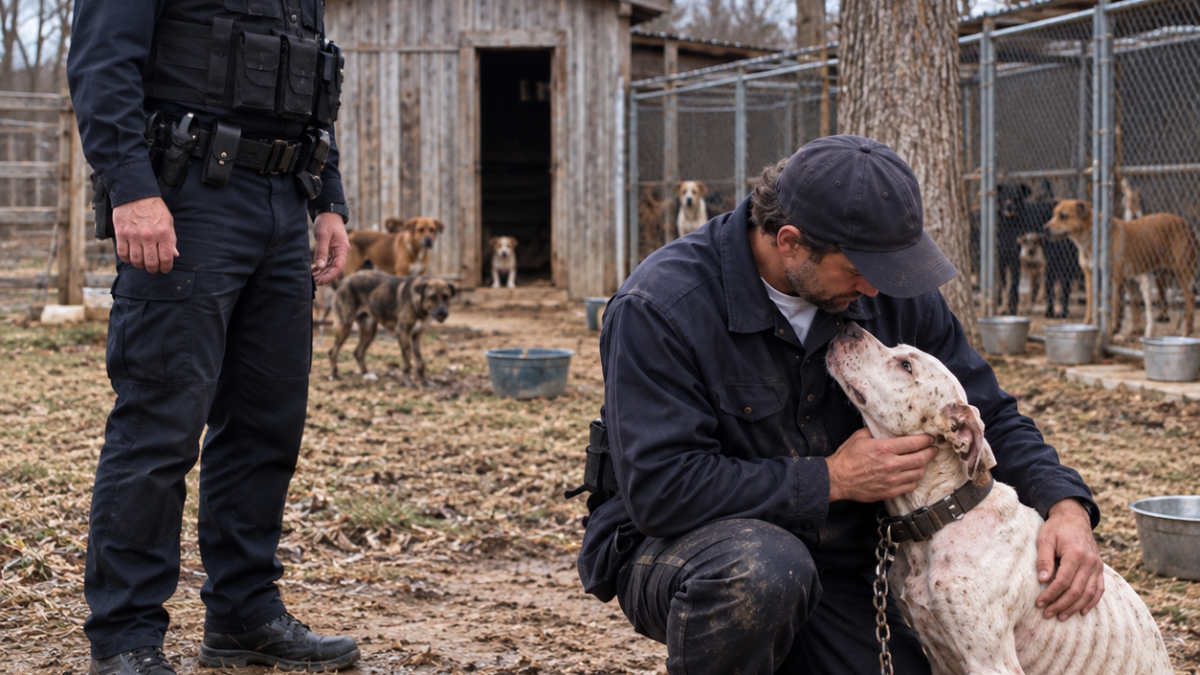
The little pit bull weighed almost nothing in my arms.
That was the first thing I noticed when I finally lifted her.
Not the scars.
Not the dirt ground into her coat.
Not the way her eyes followed every movement around us.
Her weight.
Or the lack of it.
I had carried evidence boxes heavier than that dog.
She should have been solid and muscular. Instead, I could feel every ridge of her spine beneath my forearm.
When I moved toward the animal-control vehicle, she didn’t struggle.
That frightened me more than if she had bitten me.
Animals fight when they still believe fighting can change something.
This dog had stopped believing.
The delivery driver was still standing beside the gate.
I later learned his name was Daniel Reed.
At the time, he was simply the man who had refused to keep walking.
He looked at the dog in my arms.
“That one was inside?”
“Yeah.”
“How many?”
“Eleven.”
His face changed.
“Eleven?”
“You only saw three?”
He nodded slowly.
“I saw the three outside from the driveway. The package required a photo by the front door. When I walked closer, I noticed the chains.”
He looked toward the building.
“I didn’t know there were more.”
“You made the right call.”
He glanced down.
“I almost left.”
That surprised me.
“What stopped you?”
Daniel looked at the three empty patches of dirt where the outside dogs had been chained.
“One of them looked at me.”
“That’s it?”
He nodded.
“I’ve got a dog at home. His name is Murphy. When I leave for work in the morning, he looks at me like I’m abandoning him forever. When I come back, he acts like I’ve returned from war.”
For the first time that afternoon, Daniel almost smiled.
Then the smile disappeared.
“That brown dog looked at me, and there was nothing in his face. No excitement. No curiosity. Nothing.”
He paused.
“I thought, if I drive away and find out later something happened here, I’ll know I saw it and chose convenience.”
I understood exactly what he meant.
Most terrible things don’t remain hidden because nobody ever sees a clue.
They remain hidden because the clue is inconvenient.
A sound behind a fence.
A child who stops talking when an adult enters the room.
An elderly neighbor whose mail keeps piling up.
An animal tied where nobody thinks to look twice.
People notice.
Then they tell themselves a story that gives them permission to continue walking.
Daniel didn’t.
That decision saved eleven lives.
But none of us knew yet how close we had come to losing one of them.
The small female pit bull was transported to a temporary veterinary facility that worked with the county on cruelty cases.
I followed later that evening after finishing the initial scene report.
Dr. Evelyn Parker met me in the hallway.
She had worked with our department for years.
Nothing impressed her easily.
Nothing shocked her easily either.
That night, she looked tired.
“How bad?” I asked.
She handed me a clipboard.
“Which dog?”
“The little female with white markings.”
Dr. Parker’s expression softened slightly.
“Room four.”
I walked with her.
The dog was lying on a blanket in a kennel.
An IV line had been placed in her front leg.
Someone had cleaned most of the dirt from her face.
Without the grime, she looked younger.
Much younger.
“How old?”
“Maybe two. Possibly three.”
I stared at her.
“She looks older.”
“Trauma does that.”
Dr. Parker opened the kennel carefully.
The dog immediately pressed herself against the back wall.
“She’s severely underweight,” the veterinarian said. “Dehydrated. Multiple old injuries. Some newer ones. Skin infection. Parasites. Her teeth suggest she may have spent a lot of time chewing or pulling against metal.”
I looked at the dog’s mouth.
“Chain?”
“Probably.”
I felt something hard settle in my chest.
“Will she make it?”
Dr. Parker didn’t answer immediately.
Then she said, “I think so.”
“You think?”
“She’s alive, James. Considering her condition, that’s already remarkable.”
The dog watched us.
Dr. Parker lowered her voice.
“Physically, I can treat a lot of this.”
“And the rest?”
“That depends.”
“On what?”
“Whether she decides people are safe enough to live around.”
I stared through the kennel door.
The dog lowered her head onto her front paws.
“What are you calling her?”
“We don’t have names yet. They came in as evidence numbers.”
I hated that.
Evidence number.
Technically, that was exactly what she was.
A living piece of evidence in an active criminal case.
But no animal should spend the first safe night of its life being called a number.
“Clover,” I said.
Dr. Parker looked at me.
“Clover?”
I shrugged.
“Lucky.”
Dr. Parker glanced at the dog.
“After what she survived, maybe she is.”
So that became her name.
Clover.
For the next several days, our investigation expanded.
Detectives processed the property.
The evidence confirmed what we had suspected.
The dogs had not simply been neglected.
The property had been used as part of an illegal operation involving organized animal cruelty.
I won’t describe everything investigators found.
Some details do not deserve to be repeated for entertainment.
What mattered was that we had enough evidence to move quickly.
A warrant was executed.
The owner was arrested.
Records connected him to other people.
Equipment was seized.
Veterinary reports documented the condition of every animal.
And through all of it, Daniel’s original phone call remained the first link in the chain.
He had seen three dogs.
We found eleven.
I assumed my role with them would end once the criminal case moved to investigators.
Usually, that’s how it works.
You respond.
You secure the scene.
You document.
You hand the case forward.
Then another call comes.
Another emergency.
Another report.
Life keeps moving.
But two days after the rescue, I found myself driving back to the veterinary facility after my shift.
I told myself I was checking on the case.
That wasn’t true.
I wanted to see Clover.
She was in the same kennel.
Same corner.
Same position.
Dr. Parker was updating a chart.
“Any improvement?”
“Physically? A little.”
“And otherwise?”
She shook her head.
“She eats only when the room is empty.”
“Won’t eat around you?”
“Not around anyone.”
I crouched outside the kennel.
Clover looked at me.
“Does she remember me?”
“Probably.”
“Good memory or bad memory?”
“With her, I’m not sure there is such a thing yet.”
I sat on the floor.
Dr. Parker raised an eyebrow.
“What are you doing?”
“Nothing.”
“That’s your therapeutic strategy?”
“Best one I’ve got.”
I opened my notebook.
I had paperwork to finish anyway.
For twenty minutes, I wrote reports while sitting outside Clover’s kennel.
I didn’t call her name.
I didn’t stare at her.
I didn’t extend my hand.
When I left, she hadn’t moved.
The next afternoon, I came back.
Then the next.
Somewhere around the fourth visit, Dr. Parker stopped asking why I was there.
I developed a routine.
I would finish my shift, buy coffee from the little place across from the station, drive to the facility, and sit beside Clover.
Sometimes I wrote.
Sometimes I read case notes aloud.
Not the disturbing ones.
Just whatever was in my notebook.
Traffic reports.
Property complaints.
A stolen bicycle.
Once I read an entire city council parking ordinance to her.
Dr. Parker walked past halfway through.
“You know she doesn’t understand zoning regulations.”
“Neither do I.”
That got a laugh.
Clover’s ears moved.
Just slightly.
It was the first voluntary response I had seen.
I looked at her.
She immediately lowered her head.
So I went back to reading.
No celebration.
No sudden movement.
No attempt to touch her.
The next day, she sat a little closer to the kennel door.
A week after the rescue, she ate while I was still in the room.
I wasn’t looking at her when it happened.
I heard the bowl move.
I kept my eyes on my notebook.
She took one bite.
Stopped.
Watched me.
I didn’t move.
She took another.
By the time I left, half the food was gone.
Dr. Parker met me outside.
“She ate with you there.”
“I noticed.”
“That’s the first time.”
I tried not to let my reaction show.
“Maybe she likes police reports.”
“Or maybe she trusts you.”
That word felt too big.
Trust.
Clover didn’t trust me.
Not yet.
She tolerated me.
There’s a difference.
But tolerance can be the first bridge toward trust.
During the second week, the rescued dogs began revealing individual personalities.
The brown male Daniel had first seen became Cooper.
Once he was hydrated and fed properly, he discovered tennis balls and seemed convinced that every person entering the room existed solely to throw one for him.
The black dog was named Otis.
He was older, perhaps seven or eight, and had several untreated injuries. Despite everything, he leaned against anyone who sat beside him.
Another female, Ruby, was terrified of doorways.
A brindle dog named Max hated the sound of metal clinking.
Two younger dogs had apparently spent most of their lives together and panicked whenever separated, so the staff kept them in adjacent runs.
Every one of them carried something invisible from that property.
Clover carried silence.
She never barked.
Not once.
Not when staff entered.
Not when other dogs barked.
Not when equipment fell in the hallway.
She simply disappeared into herself.
One evening, about two weeks after the rescue, I was tired enough that I nearly skipped my visit.
We had handled a domestic disturbance that afternoon followed by a collision involving three vehicles.
By the time I finished paperwork, it was after eight.
I sat in my patrol car staring at the dashboard.
Home was fifteen minutes in one direction.
The veterinary facility was twelve minutes in the other.
I thought about Clover waiting in that kennel.
Then I reminded myself that she wasn’t waiting for me.
That was me assigning human feelings to a frightened animal.
I drove to the facility anyway.
Clover was awake.
When I entered, she lifted her head.
Then something happened that made me stop.
Her tail moved.
Once.
Barely an inch against the blanket.
I stared at her.
She stared back.
“Was that for me?”
The tail didn’t move again.
“All right. We’ll pretend it didn’t happen.”
I sat down.
That night, I took off my jacket because the room was warm.
I folded it beside me.
An hour later, a nurse came in.
“James, they need you at the front desk. Investigator Collins is on the phone.”
I stood.
I forgot the jacket.
The phone call lasted about twenty minutes.
When I returned, I opened the door quietly.
Clover wasn’t in her usual corner.
For one terrible second, I thought something had happened.
Then I saw my jacket.
It was on the floor beside the kennel entrance.
Clover was lying on top of it.
Her head rested on the sleeve.
I stopped moving.
She raised her eyes.
Neither of us did anything.
Then she stood.
Slowly.
She walked toward me.
Not far.
Three steps.
Maybe four.
But they were her steps.
Her choice.
She stopped directly in front of me.
I knelt.
My heartbeat was ridiculous.
I had walked into armed confrontations with steadier hands.
“Hey, Clover.”
She watched my face.
I extended one hand.
Slowly.
Palm up.
She lowered her nose.
Sniffed my fingers.
Then she did something I can still feel whenever I remember that night.
She placed her head in my palm.
No flinch.
No recoil.
She simply let the weight of her head rest against me.
Then she closed her eyes.
I didn’t speak.
There are moments when words make something smaller.
That was one of them.
I stayed there with my hand beneath her head until my knees hurt.
Eventually Dr. Parker entered.
She stopped in the doorway.
Neither of us spoke.
She smiled.
Clover opened her eyes but didn’t move away.
After a minute, Dr. Parker whispered, “There she is.”
I knew exactly what she meant.
The dog had always been alive.
But for the first time, Clover had returned.
Not all at once.
Not completely.
But enough to say, I’m still here.
The next few weeks brought progress in inches.
Clover started eating while people were present.
She walked voluntarily into the exercise yard.
She discovered grass.
That sounds ridiculous until you watch an animal who may have spent most of her life standing on packed dirt experience a clean lawn.
The first time Dr. Parker opened the yard gate, Clover froze.
I was beside her.
The grass moved gently in the breeze.
She lowered her nose.
Took one step.
Then another.
She sniffed.
Her paw lifted slightly when the blades touched between her toes.
I crouched near the doorway.
“You’re allowed.”
She looked back at me.
I pointed toward the yard.
“Go ahead.”
Clover walked five feet.
Then ten.
Then twenty.
And suddenly she ran.
Not fast.
Her body was still rebuilding.
But she ran.
A strange, awkward little burst across the grass.
She stopped, turned, and ran back toward me.
Then past me.
Then around again.
Dr. Parker laughed.
I realized I was laughing too.
Clover’s mouth opened.
Her tongue hung out.
Her ears bounced as she moved.
For thirty seconds, she looked like a dog who had never known a chain.
Then a metal bucket fell somewhere inside the building.
The sound rang through the yard.
Clover dropped instantly.
Her body flattened against the ground.
The joy vanished.
I knelt several feet away.
I didn’t touch her.
“Clover.”
Her eyes locked on mine.
“You’re here.”
She trembled.
“Nothing’s going to happen.”
It took almost five minutes before she stood again.
Recovery is not a straight road.
People like stories where pain ends in a single beautiful moment.
The frightened dog accepts one gentle hand.
The wounded person hears one perfect sentence.
The family hugs.
Music plays.
Everything is healed.
Real recovery is messier.
Clover could run through the yard one day and refuse to leave her kennel the next.
She could rest her head against my leg, then panic when another man entered wearing heavy boots.
She learned that bowls contained food, but sometimes she still ate too quickly, as though she believed every meal might be the last.
She slept on soft blankets but often pushed them aside and curled against the wall.
She loved my jacket but feared leashes.
She trusted my hands but not sudden movements.
Every good day existed beside the memory of bad ones.
Dr. Parker taught me not to measure progress by what Clover still feared.
“Measure it by what she chooses,” she said.
“What do you mean?”
“Yesterday she hid when the maintenance man came in.”
“I saw.”
“But after he left, she came back out in three minutes.”
“Three minutes is good?”
“The week before, it took forty.”
That changed the way I watched her.
Instead of asking, Why is she still afraid?
I learned to ask, How quickly did she find safety again?
That mattered.
Meanwhile, the criminal case moved forward.
The property owner was charged with multiple counts related to animal cruelty and the organized activities investigators uncovered.
Other people became subjects of investigation.
Financial records were reviewed.
Photographs and physical evidence were catalogued.
Daniel came to the station to provide a full statement.
I sat in during part of it.
He seemed uncomfortable being treated like an important witness.
“I really didn’t see much,” he kept saying.
Detective Collins leaned back.
“You saw enough.”
“I only saw the dogs outside.”
“You noticed their condition.”
“Anyone would have.”
I shook my head.
“No.”
Daniel looked at me.
“Not everyone.”
He was quiet.
Then he said, “That bothers me.”
“It should.”
He looked toward the interview-room window.
“What if I hadn’t been assigned that route?”
“Someone else might have noticed.”
“Might.”
“That’s all any of us gets.”
He nodded slowly.
Before he left, I asked if he wanted to see photographs of the dogs recovering.
His face brightened immediately.
“You have some?”
I showed him Cooper with a tennis ball.
Otis sleeping beside a volunteer.
Ruby standing in the exercise yard.
Then Clover.
She was sitting beside my chair.
Daniel studied the picture.
“That’s the one you carried out.”
“Yeah.”
“She looks different.”
“She is.”
“Good different?”
“Getting there.”
Daniel handed back the phone.
“What happens to them after the case?”
“Eventually, adoption if the court releases them and the veterinarians approve.”
He hesitated.
“Could someone like me…”
“You thinking about adopting?”
“My wife would kill me if I came home with another dog without asking.”
I smiled.
“Ask first.”
“I might.”
He didn’t adopt one eventually.
Not because he didn’t care.
Murphy, his dog at home, had health problems and didn’t do well with other animals.
But Daniel visited several times.
And every time he did, he seemed almost embarrassed by the attention staff gave him.
To us, he was the person who had started everything.
To Daniel, he had made a phone call.
That difference fascinated me.
Months passed.
Clover gained weight.
Muscle gradually returned along her shoulders and legs.
The dullness disappeared from her coat.
Her eyes changed too.
That was harder to describe.
When we first found her, Clover looked at people as though we were weather.
Something dangerous that happened around her.
Something she had no power to influence.
Later, she began watching faces.
Learning voices.
Making decisions.
If she trusted you, she would come closer.
If she didn’t, she walked away.
The first time she walked away from someone, I celebrated.
Dr. Parker laughed.
“You understand most people want their dog to approach strangers.”
“She chose.”
“Exactly.”
Choice had been stolen from Clover for so long that even refusal was progress.
She was learning that she could say no.
She could move away.
She could leave a room.
Nobody would drag her back.
Around the same time, I learned something about Clover’s past.
Investigators had found records tied to several of the dogs.
Not complete histories.
Pieces.
Receipts.
Photographs.
Messages.
A previous owner’s name appeared in connection with Clover.
Detective Collins called me into his office.
“You’re attached to that dog.”
“That obvious?”
“Yes.”
He slid a printed document across the desk.
“What is it?”
“Possible prior ownership information.”
I read the name.
A woman named Melissa Grant.
Address in another county.
According to the records, Clover had originally been acquired as a puppy under a different name.
Daisy.
There was a photograph.
I almost didn’t recognize her.
Healthy little puppy.
White patch on the muzzle.
Oversized paws.
Sitting beside two children on a porch.
I stared at that picture for a long time.
“She had a family.”
“For a while.”
“What happened?”
“Still working on it.”
I took the photograph to Dr. Parker.
She looked at it and sighed.
“Daisy.”
“Apparently.”
“You changing her name back?”
“No.”
“Why?”
I watched Clover sleeping.
“Because Clover is who survived.”
We later learned that the first family had rehomed her when they moved.
They believed she was going to someone who had experience with the breed.
There was no evidence they knew where she eventually ended up.
When investigators contacted Melissa, she cried.
She told them Daisy had been affectionate.
Loved children.
Slept beneath her daughter’s bed.
Stole socks from the laundry basket.
She had believed the new owner’s story that Daisy had gone to another family after he could no longer keep her.
She had no idea.
When she learned what had happened, she asked to visit.
That created a difficult question.
Would seeing a person from Clover’s early life help?
Or confuse her?
Dr. Parker wasn’t sure.
Neither was I.
Eventually, Melissa came.
She brought no children.
No expectations.
Only a faded red collar she had kept in a box.
We met in the exercise yard.
Clover was beside me.
Melissa stopped twenty feet away.
Her hands began shaking.
“Oh my God.”
Clover stared.
Melissa covered her mouth.
“Daisy.”
Clover’s ears lifted.
I looked down at her.
Melissa started crying.
“I’m sorry.”
I held up one hand gently.
“Don’t come closer yet.”
She nodded quickly.
“I won’t.”
Clover sniffed the air.
Then she took several steps forward.
Stopped.
Melissa crouched.
“Hi, baby.”
Clover watched her.
For perhaps thirty seconds, nothing happened.
Then Clover walked closer.
Melissa held the old collar loosely in her hand.
Clover sniffed it.
Her tail moved once.
Melissa made a sound halfway between a laugh and a sob.
“You remember?”
Clover stepped closer.
Melissa didn’t touch her.
Then Clover pressed her nose against Melissa’s knee.
That was enough.
Melissa cried so hard she had to sit on the grass.
I turned away for a moment to give her privacy.
Later, she told me something I’ve never forgotten.
“I thought giving her away was the responsible choice.”
I didn’t answer.
“My husband had lost his job. We were moving into an apartment that didn’t allow dogs. The man who took her had references.”
She looked at Clover.
“I checked them.”
“You couldn’t know everything.”
“But I should have.”
“Maybe.”
She looked at me sharply, surprised that I didn’t immediately tell her she was blameless.
I continued.
“Maybe all of us should know more than we do. But guilt won’t change what happened. What you do after learning the truth matters too.”
Melissa wiped her face.
“What can I do?”
“Help us document her history. Tell investigators everything you know. And if you ever rehome another animal, make sure the next person understands why follow-up matters.”
She nodded.
“I will.”
She didn’t ask for Clover back.
I respected her for that.
She understood Clover had become someone different.
A dog with different needs.
A dog whose future needed to be decided around Clover, not around anybody’s guilt.
Before Melissa left, she placed the old red collar on the ground.
“For her,” she said.
Clover sniffed it again.
Then walked back to me.
I kept that collar with her records.
Not because Clover needed to wear it.
Because somewhere between Daisy and Clover was proof that cruelty had not been her whole life.
She had been loved once.
And someday, I hoped, she would be loved again.
The court proceedings began several months after the rescue.
By then, all eleven dogs had been medically stabilized.
The legal status mattered because the shelter could not permanently place them until ownership was resolved.
The defendant fought the charges.
His attorney argued about evidence.
Challenged procedures.
Questioned timelines.
Suggested some dogs had arrived at the property already injured.
The usual strategies.
But documentation was extensive.
Veterinary reports.
Photographs.
Recovered records.
Equipment.
Messages.
Witness testimony.
And Daniel.
The quiet delivery driver.
On the morning he testified, I saw him outside the courtroom.
He wore a button-down shirt instead of his work uniform.
“You nervous?” I asked.
“Terrified.”
“You don’t look terrified.”
“I deliver packages. Nobody objects.”
“Sometimes people object to packages.”
“Not under oath.”
I smiled.
“You’ll be fine.”
“What if I forget something?”
“Tell the truth about what you remember. If you don’t remember, say you don’t remember.”
“That simple?”
“That simple.”
Daniel looked through the courtroom doors.
“I keep thinking about that first dog.”
“Cooper.”
“That’s his name?”
“Yeah.”
“How is he?”
“Obsessed with tennis balls.”
Daniel laughed.
“Good.”
Then the bailiff called him.
I sat behind the prosecutor.
Daniel took the witness stand.
He didn’t perform.
He didn’t exaggerate.
That was why he was effective.
He described arriving with a delivery.
Walking toward the house.
Seeing three dogs attached to heavy chains.
Noticing their ribs.
Seeing empty bowls.
Watching one dog lift his eyes without rising.
He explained the moment he stopped.
The defense attorney asked, “Mr. Reed, are you trained in veterinary medicine?”
“No.”
“Animal behavior?”
“No.”
“Law enforcement?”
“No.”
“So when you say the dogs appeared unhealthy, that was simply your personal opinion.”
Daniel thought about it.
“Yes.”
The attorney nodded.
“No further—”
“But…”
Everyone looked at Daniel.
The judge raised his eyes.
The attorney frowned.
Daniel continued carefully.
“You don’t need medical training to know when something looks wrong.”
The defense attorney stepped closer.
“That’s your opinion.”
“Yes.”
“And instead of completing your delivery and leaving, you contacted police.”
“Yes.”
“Why?”
Daniel looked directly at him.
“Because I knew what I saw would bother me for the rest of my life if I did nothing.”
The courtroom became silent.
No dramatic reaction.
No gasp.
Just silence.
The attorney asked one final question.
“You had no idea there were eight additional dogs inside the building, correct?”
“No.”
“So your call was based only on the three animals outside.”
“Yes.”
Daniel paused.
“That was enough.”
I watched one of the jurors write something down.
The defense attorney returned to his table.
Months of legal arguments eventually produced a conviction on multiple charges.
The judge prohibited the defendant from possessing animals and imposed the penalties permitted under the applicable law.
Other investigations continued separately.
I had attended plenty of hearings by then.
Usually, when a verdict came down, I felt relief.
Sometimes satisfaction.
Often exhaustion.
That day I felt something else.
I kept seeing the original yard.
Three chains.
Three exhausted animals.
A delivery van parked beside the curb.
One ordinary man deciding not to leave.
Outside the courthouse, Daniel approached me.
“It’s over?”
“For this part.”
“What happens to the dogs?”
“They can finally move toward permanent placement.”
He exhaled.
“Good.”
“You did something important today.”
“I told what I saw.”
“That’s often what important things look like.”
He shook his head.
“I’m not some hero, Officer.”
“James.”
“What?”
“Call me James.”
He smiled.
“All right. James. I’m not a hero.”
I looked at him.
“You don’t get to decide that part.”
He laughed quietly.
Then his expression became serious.
“I really am glad I called.”
“I know.”
“I keep thinking about if I hadn’t.”
“Don’t.”
“How can I not?”
“Because you did.”
He considered that.
Then nodded.
“You’re right.”
After the legal release, adoption planning began.
The shelter received dozens of applications.
The case had received local attention, and people wanted to help.
That created another problem.
Sympathy is not always the same thing as readiness.
A traumatized dog does not need to become somebody’s emotional project.
They need stability.
Patience.
Structure.
A home willing to accept who the animal is now, not the inspirational version people imagine.
Cooper was adopted first.
A couple with a fenced property and an absurd collection of tennis balls met him twice before taking him home.
Otis went to a retired teacher who wanted an older dog.
The bonded younger pair went together to a family experienced with rescued animals.
Ruby needed longer, but eventually chose a quiet woman who lived alone and rarely had visitors.
Nine dogs found permanent homes.
One older dog remained at the shelter because he had become so comfortable there that the staff jokingly promoted him to “resident supervisor.”
Then there was Clover.
Applications came.
Some looked good.
None felt right.
One family had small children and a busy household.
Too much noise.
Another applicant lived downtown beside constant construction.
Not ideal for a dog terrified of metal sounds.
Another couple seemed wonderful but traveled often.
Clover needed consistency.
Weeks passed.
Dr. Parker noticed me becoming frustrated.
“She’ll find someone.”
“What if she doesn’t?”
“She already has.”
I looked at her.
“No.”
“I didn’t say you.”
“You were thinking it.”
“I was observing.”
“I work twelve-hour shifts.”
“So?”
“I live alone.”
“So?”
“I’m not adopting evidence from a case.”
“She’s not evidence anymore.”
“That isn’t helping.”
Dr. Parker smiled.
“Why not you?”
Because I had considered it.
That was the problem.
I had pictured Clover sleeping beside my couch.
Walking with me in the mornings.
Waiting at the door when I came home.
But wanting an animal and being the right home for that animal are different things.
My schedule was unpredictable.
Some nights I didn’t know when I’d return.
Clover had built trust with me, but she needed more than one person and an empty house.
She needed routine.
A yard.
Quiet.
Someone present.
“I’m not the right home,” I said.
Dr. Parker studied me.
“That might be the most loving decision you make for her.”
It didn’t feel loving.
It hurt.
Then Margaret and Thomas Hale submitted an application.
They were both in their late sixties.
Married for forty-two years.
Retired.
No children living at home.
Large fenced backyard.
Quiet neighborhood.
Their previous dog had died a year earlier at fourteen.
They had experience with fearful rescues.
Their application included a line Margaret had written by hand.
“We are not looking for a dog to entertain us. We are looking for a dog who needs time.”
That caught my attention.
They came to meet Clover.
I planned to observe.
Clover would decide the rest.
Margaret sat in a chair without looking directly at her.
Thomas sat several feet away.
No baby talk.
No reaching.
No treats held inches from Clover’s face.
They simply waited.
After ten minutes, Clover came closer.
She sniffed Margaret’s shoe.
Margaret didn’t move.
Clover walked away.
Five minutes later she returned.
This time she sniffed Thomas.
He whispered, “Hello there.”
Clover looked at him.
Then sat between them.
I felt something twist inside me.
Dr. Parker stood beside the observation window.
“She likes them.”
“Apparently.”
“Are you upset?”
“No.”
“You’re lying.”
“Yes.”
She smiled.
“That’s okay.”
Margaret and Thomas visited four more times.
On the third visit, Clover rested beside Margaret.
On the fourth, she took a treat from Thomas.
On the fifth, she followed them toward the exit before realizing I wasn’t coming.
She turned and looked at me.
I crouched.
“You like them?”
Clover walked back and pressed against my knee.
I rubbed the side of her neck.
For months, I had waited for this.
A home.
Safety.
A future.
Now that it was here, I wanted to delay it.
Human beings are selfish even when trying not to be.
A week later, Clover was approved for adoption.
I volunteered to drive her to Margaret and Thomas’s house.
Dr. Parker knew why.
“You want to inspect the place.”
“I already saw the home inspection.”
“You want to personally inspect the place.”
“Yes.”
“Officer control issues.”
“Veterinarian sarcasm.”
She handed me Clover’s folder.
Then her expression softened.
“James.”
“Yeah?”
“You gave her the bridge.”
I looked at Clover.
“Now let them give her the other side.”
The drive took thirty minutes.
Clover sat in the back seat on a blanket.
At red lights, I could see her in the mirror.
Alert.
Quiet.
But not frozen.
When we arrived, Margaret and Thomas were waiting by the front porch.
The yard was larger than I expected.
Grass.
A shade tree.
Low wooden fence with a reinforced inner barrier.
A covered patio.
Thomas had even removed a hanging metal decoration because he remembered Clover disliked clanging sounds.
I noticed immediately.
“You took down the wind chime.”
He shrugged.
“We can live without it.”
That told me more than the entire application.
Clover stepped out of the vehicle.
She stopped.
Looked at me.
Looked at the house.
Then at Margaret.
Nobody pulled the leash.
Margaret opened the gate.
“We’ll wait.”
Clover stood there for almost a minute.
Then she walked through.
Five steps.
Ten.
She reached the center of the yard.
Stopped.
Lifted her face.
The afternoon sun fell across her white markings.
A breeze moved through the grass.
Clover closed her eyes.
Her body relaxed.
Margaret approached slowly and sat on the lawn several feet away.
Clover opened her eyes.
Walked toward her.
Then rested her head across Margaret’s knees.
I had seen that gesture before.
My hand.
My jacket.
The first moment Clover chose trust.
Now she was choosing again.
Margaret’s eyes filled with tears.
“Hi, sweetheart.”
Thomas turned away and cleared his throat.
I pretended not to notice.
I knelt beside Clover.
She lifted her head and came to me.
I held her face gently.
“You’re okay.”
Her tail moved.
“You don’t have to wait for me anymore.”
That was the sentence that broke me.
I hadn’t expected it.
My throat closed.
I looked away.
Clover pushed her head against my chest.
For several seconds, I hugged her.
Not tightly.
Just enough.
Then I stood.
Margaret looked worried.
“Will she think you abandoned her?”
“No.”
I hoped I was right.
“She knows you.”
I handed Margaret the folder.
“Her food schedule is inside. Dr. Parker included all medical information. She still startles around metal noises. Thunder can be difficult. Don’t corner her if she hides. Let her choose when to come out.”
Margaret nodded seriously.
“I wrote everything down.”
“I know.”
Thomas shook my hand.
“You can visit whenever you want.”
“That might be a mistake.”
“Why?”
“You’ll never get rid of me.”
He smiled.
“I think Clover can handle that.”
I walked toward the gate.
Halfway there, I heard paws behind me.
Clover had followed.
I stopped.
She stood beside me.
Margaret remained where she was.
No calling.
No panic.
Clover looked through the gate toward my car.
Then back toward the yard.
Then up at me.
That choice mattered.
I crouched one last time.
“This is home.”
She stared.
I touched her chest lightly.
“Go.”
Clover turned.
She walked back to Margaret.
I stayed long enough to watch her settle beside the older woman.
Then I left.
I cried in the patrol car.
I’m not embarrassed to say that.
I didn’t sob.
I didn’t fall apart.
I just sat behind the wheel with both hands resting on it while tears ran down my face.
Because for months I had associated Clover’s trust with her survival.
If she needed me, she was safe.
Now she didn’t need me in the same way.
That was the victory.
It still hurt.
Three days later, Margaret sent a photograph.
Clover was asleep upside down on a couch.
Legs in the air.
Mouth slightly open.
I showed Dr. Parker.
“She looks ridiculous.”
“She looks safe,” Parker said.
She was right.
A week later came another photo.
Clover in the yard holding a yellow ball.
Then Clover asleep beside Thomas’s chair.
Then Clover standing in the kitchen looking offended because Margaret refused to give her another piece of chicken.
The silence inside her was disappearing.
A month after adoption, I visited.
I parked outside and barely made it through the gate before Clover saw me.
For the first time since I had known her, she barked.
One bark.
Loud.
I froze.
Margaret laughed from the porch.
“I think that means hello.”
Clover ran.
Actually ran.
Straight toward me.
She stopped at the last second and nearly collided with my legs.
Her tail whipped back and forth.
I dropped to one knee.
“There you are.”
She pressed against me.
I rubbed her shoulders.
“You bark now?”
Another bark.
I laughed.
“All right. Show-off.”
Margaret walked over.
“She does that when Thomas comes home too.”
“How is she?”
“Different every week.”
“Good different?”
Margaret looked at Clover.
“More herself.”
That phrase stayed with me.
More herself.
Not transformed into a different dog.
Not repaired like machinery.
Just given enough safety to uncover the personality fear had buried.
Clover loved sunbathing.
She hated the vacuum cleaner.
She carried one particular blanket from room to room.
She learned to open Thomas’s partially closed office door with her nose.
She stole gardening gloves.
She loved scrambled eggs.
She disliked rain.
And despite her history, she showed a strange fascination with children.
Whenever neighborhood kids passed the fence, Clover watched them.
She didn’t bark.
She simply watched.
One afternoon, nearly a year after the rescue, I took Clover on a walk while Margaret and Thomas attended a medical appointment.
We went through a nearby park.
The day was warm.
Families were scattered across the grass.
Kids rode bicycles.
Someone threw a Frisbee.
Clover trotted beside me.
At one point, she stopped.
Across the field, several children were playing with a dog.
They were laughing as the dog chased a ball.
Clover stared.
I remembered the photograph investigators had found.
A puppy named Daisy sitting between two children.
For a moment I wondered whether dogs remember their lives the way we do.
Specific scenes.
Faces.
Smells.
Voices.
I don’t know.
Maybe Clover remembered those children from years earlier.
Maybe she remembered being young before fear.
Maybe she simply wanted the ball.
She looked up at me.
Then her tail moved.
I smiled.
“That was a long time ago.”
Clover leaned against my leg.
“You’re here now.”
We kept walking.
A few weeks later, something happened that brought the entire story full circle.
I was leaving a grocery store when someone called my name.
“James?”
I turned.
Daniel Reed stood beside a delivery van.
Same company.
Same uniform.
A little more gray near his temples.
“Daniel.”
We shook hands.
“You still doing the route?”
“Every day.”
“How’s Murphy?”
“Old. Spoiled. Still acts like I’ve been missing for five years whenever I get home.”
“That sounds right.”
He hesitated.
“How are the dogs?”
I pulled out my phone.
I had photographs.
Of course I had photographs.
Cooper with a tennis ball.
Otis beside his retired teacher.
The bonded pair asleep together.
Ruby on a couch.
Then Clover.
Standing in Margaret and Thomas’s yard.
Healthy.
Shining coat.
Muscular shoulders.
Tongue hanging out.
Daniel stared.
“That’s her?”
“That’s Clover.”
He zoomed in.
“She doesn’t even look like the same dog.”
“She is and she isn’t.”
Daniel handed back the phone.
For a moment, he said nothing.
Then he looked toward his van.
“You know what I still remember?”
“What?”
“The package.”
“The package?”
“I was annoyed.”
“Why?”
“Customer had put the wrong instructions in the app. Said leave it by the side door, but the side gate was hard to find. I remember thinking I was already behind schedule.”
He laughed without humor.
“I was angry over maybe two minutes.”
I listened.
“If I had been in more of a hurry, I might have left it at the front door.”
“And you wouldn’t have seen them.”
“No.”
He shook his head.
“That scares me.”
I understood.
Daniel leaned against the van.
“People kept calling me a hero after the trial.”
“You hated that.”
“Still do.”
“Why?”
“Because I didn’t rescue them.”
“You started the rescue.”
“I made a call.”
“Exactly.”
He looked at me.
“I think calling someone a hero can sometimes make ordinary people believe the right thing requires something extraordinary.”
That was a better explanation than any I had come up with.
Daniel continued.
“I didn’t run into a fire. I didn’t fight anybody. I didn’t know there were eleven dogs. I just thought, I shouldn’t ignore this.”
He nodded toward my phone.
“That’s what I want people to understand.”
I smiled.
“I think Clover understands.”
Daniel laughed.
“Think she remembers me?”
“Probably not.”
“Good.”
That surprised him.
“Good?”
“She doesn’t need to remember the yard.”
He thought about that.
“No.”
Then he smiled.
“She doesn’t.”
Before we separated, Daniel asked one more question.
“Do you ever think about what would’ve happened if I drove away?”
“Yes.”
“Me too.”
“But I try not to.”
“How?”
I looked at the photograph of Clover on my screen.
“Because there are enough things in this job I wish had happened differently.”
I put the phone away.
“This one happened right.”
A year and a half after the rescue, Clover returned to the veterinary facility for a routine examination.
Dr. Parker called me.
“Your girlfriend is here.”
“My what?”
“Short. Four legs. Steals chicken.”
“I’ll come by.”
When I arrived, Clover was standing on the scale.
Margaret held the leash.
Dr. Parker read the number.
“Perfect.”
I looked at Clover.
“Remember when you weighed almost nothing?”
Clover sneezed.
“I’ll take that as no.”
Dr. Parker examined her teeth, joints, skin, and heart.
Everything looked good.
Then she listened to Clover’s chest longer than usual.
Margaret became nervous.
“What is it?”
Dr. Parker smiled.
“Nothing. I’m listening to a healthy heart.”
Margaret exhaled.
Clover jumped down from the table.
Dr. Parker scratched beneath her chin.
“Not bad for a miracle.”
Clover licked her wrist.
That surprised all of us.
Dr. Parker looked at me.
“She never used to do that.”
“I know.”
After the appointment, Margaret and I sat outside while Clover sniffed the grass.
“Thomas wants another dog,” Margaret said.
“Does he?”
“He says Clover needs a friend.”
“What does Clover say?”
“She hasn’t submitted a written opinion.”
“Important to consult her.”
Margaret smiled.
Then she became serious.
“James, can I ask something?”
“Sure.”
“Do you regret not keeping her?”
I watched Clover investigate a tree.
The answer was complicated.
“Yes.”
Margaret looked surprised.
“And no.”
“That’s fair.”
“I miss her.”
“You see her all the time.”
“I know.”
“Then why regret it?”
“Because sometimes you love something and want it close.”
Margaret nodded.
“But?”
“But sometimes loving it means knowing where it belongs.”
Clover turned and trotted back toward us.
She went to Margaret first.
Pressed against her knees.
Then came to me.
That answered the question better than I could.
Several months later, Margaret and Thomas adopted an older mixed-breed dog named Benny.
Clover ignored him for approximately twelve hours.
Then stole his bed.
Within a week, they slept beside each other.
Thomas sent me a photograph with the message:
“Clover says the house is now properly staffed.”
I laughed harder than I should have.
Life moved on.
Other calls came.
Other animals.
Other families.
Other scenes that stayed with me long after reports were filed.
But Clover changed something in the way I worked.
Before that case, I thought of policing mostly in terms of intervention.
You arrive after something happens.
You stop what you can.
Document what you can’t.
Arrest when necessary.
Protect when possible.
Clover taught me the importance of noticing what comes before intervention.
The small signs.
The person who says, “I don’t know what’s wrong, but something feels wrong.”
We are trained to ask for facts.
We should.
Facts matter.
But sometimes instinct is simply the brain noticing a pattern before we can explain it.
Daniel didn’t know the laws.
He didn’t know the veterinary signs of starvation.
He didn’t know what equipment was inside that building.
He knew only that three dogs looked wrong.
That was enough to make him ask someone else to look.
Years earlier, I might have considered a call like that low priority.
Now I knew better.
Sometimes the quietest call leads to the darkest place.
And sometimes it leads eleven animals out.
On the second anniversary of the rescue, Margaret invited me to their house for dinner.
Dr. Parker came.
Daniel and his wife came too.
At first he protested.
“This is weird.”
“What’s weird?”
“I delivered one package and now I’m going to a dog reunion.”
“You started it.”
“Stop saying that.”
Margaret had photographs from the other adoptive families printed and arranged on a table.
Cooper.
Otis.
Ruby.
Every dog we could track.
Healthy.
Safe.
Loved.
Daniel stood in front of the photographs for a long time.
His wife slipped her hand into his.
“That’s because of you,” she whispered.
He shook his head.
“Because of a lot of people.”
She smiled.
“Fine. But you were first.”
Clover approached Daniel.
He crouched.
“Hey there.”
She sniffed his hand.
For several seconds, she simply studied him.
Then she leaned forward and allowed him to touch her shoulder.
Daniel’s face changed.
He looked at me.
“She never met me properly.”
“No.”
“I only saw you carry her out.”
Clover stepped closer.
Daniel gently scratched behind her ear.
“Look at you.”
His voice broke.
He lowered his head.
Clover licked his chin.
Everyone laughed.
Daniel wiped his face.
“I’m blaming allergies.”
“Of course,” Dr. Parker said.
Later that evening, Thomas brought out the old red collar Melissa had once given us.
I had eventually passed it to Margaret with Clover’s records.
Margaret kept it in a small box.
Daniel looked at it.
“What’s that?”
“Her puppy collar,” I said.
He stared.
“She had one?”
“She had a family once.”
I told him the story.
Daniel looked toward Clover, who was lying between Margaret and Benny.
“So she was loved before.”
“Yes.”
“And then…”
“Yes.”
He nodded.
“Then she got loved again.”
That was Clover’s story in one sentence.
Not that cruelty never happened.
Not that love erased it.
Love does not rewrite history.
It gives history somewhere else to go.
When the evening ended, I stood by the gate preparing to leave.
Clover followed me.
She still did that.
I crouched.
“You staying?”
Her tail wagged.
“Good answer.”
She pressed her forehead against mine.
Then turned and ran back toward the house.
Margaret opened the door.
Warm light spilled across the porch.
Clover disappeared inside.
The door closed.
I stood there smiling.
For years, I had thought the most important moment in Clover’s story was the moment Daniel stopped.
Then I thought it was the moment we opened the building.
Then the moment she rested her head in my palm.
Then the moment the judge ruled.
Then the day she entered Margaret and Thomas’s yard.
I eventually realized there wasn’t one important moment.
There were dozens.
Daniel noticing.
Dispatch listening.
Officers responding.
Investigators documenting.
Veterinarians treating.
Volunteers waiting.
A witness testifying.
A judge acting.
Adopters preparing.
A frightened dog choosing, one person at a time, to believe the world might be different.
People often ask how eleven animals could have been hidden in plain sight.
That question still bothers me.
But there is another question worth asking.
How many terrible things end because one person refuses to pretend they didn’t see them?
Daniel was not a police officer.
He wasn’t an investigator.
He wasn’t a veterinarian.
He wasn’t an animal rescuer.
He was a delivery driver with another hundred stops left on his route.
He could have placed the package down, taken the required photograph, returned to his van, and driven away.
Nobody would have known he had noticed.
Nobody would have blamed him.
He stopped anyway.
That matters to me.
Because people sometimes imagine doing the right thing requires certainty.
It doesn’t.
Daniel wasn’t certain.
He didn’t accuse anyone.
He didn’t trespass deeper into the property.
He didn’t confront the owner.
He didn’t attempt to become a detective.
He simply recognized that something looked wrong and contacted people who could investigate safely.
That one responsible decision changed eleven lives.
Clover is older now.
There is silver beginning to appear around her muzzle.
She still lives with Margaret and Thomas.
Benny died peacefully last winter, and Clover spent several weeks searching for him in the rooms where he used to sleep.
Margaret told me she eventually began lying in his favorite patch of sunlight.
Maybe that was grief.
Maybe comfort.
Probably both.
Thomas built Clover a small ramp beside the back steps after her veterinarian noticed mild stiffness in one hip.
She was offended by the ramp and refused to use it for three days.
Then Margaret placed a piece of chicken at the top.
Clover suddenly became a strong supporter of accessibility improvements.
I still visit.
Not as often as I once did.
Life is busy.
Calls stack up.
Schedules change.
But when I pull into that driveway, Clover somehow knows my car.
Before I reach the gate, I usually hear her bark.
That same dog who once made no sound.
The same dog who sat in a dark corner as though silence might protect her.
Now she announces my arrival to the entire neighborhood.
I wouldn’t change it.
One autumn afternoon, I sat on Margaret’s porch with Clover lying beside my chair.
Leaves moved across the yard.
Thomas was inside making coffee.
Margaret had gone to visit her sister.
Clover rested her head on my boot.
I looked down at her.
“You know, you caused me a lot of paperwork.”
Her tail moved once.
“Thousands of pages.”
Another tail thump.
“No remorse.”
She closed her eyes.
I rubbed behind her ear.
For a moment, I remembered the first time I saw her.
Dark room.
Bare walls.
Heavy chains.
A dog who expected my hand to hurt.
I looked at the animal beside me now.
Healthy.
Warm.
Safe enough to sleep.
I thought about all the people who had touched her life after that gate opened.
Then I thought about the one man who touched none of it directly.
Daniel.
The person who stood outside the gate and said:
Something is wrong.
I’m a police officer.
I’ve spent much of my career arriving after somebody’s worst moment.
I’ve seen people at their angriest, most frightened, most desperate.
I’ve also seen what happens when ordinary people choose not to look away.
Clover taught me that rescue does not always begin with flashing lights.
Sometimes it begins with a delivery van.
A package.
A tired worker running behind schedule.
A dog lifting exhausted eyes from the dirt.
And one human being deciding that two minutes of inconvenience are worth more than a lifetime of regret.
Eleven dogs left that property alive.
Nine were adopted into families.
One became a permanent and much-loved resident at the shelter.
And Clover found Margaret and Thomas.
But whenever someone asks me who saved Clover, I never give them one name.
Daniel started it.
We opened the gate.
Dr. Parker helped heal her body.
The shelter taught her routine.
Margaret and Thomas gave her a home.
And Clover did the hardest part herself.
She chose to trust again.
That is why I will never forget the moment she first placed her head in my hand.
People thought I was rescuing her.
Maybe I was.
But Clover was teaching me something at the same time.
The world can hurt you badly without earning the right to define the rest of your life.
Fear can become familiar without becoming permanent.
Trust can return slowly.
Freedom can feel frightening before it feels good.
And sometimes the smallest human decision can break a chain nobody else knew existed.
My name is James.
I’m still a police officer.
Daniel is still delivering packages.
Margaret and Thomas are still spoiling Clover far more than any veterinarian would recommend.
And Clover?
Clover is no longer the silent dog in the corner.
She runs through grass.
She sleeps in sunlight.
She barks when people she loves come through the gate.
She steals gardening gloves.
She begs for chicken.
She chooses where she sleeps.
She chooses who touches her.
She chooses when she walks away.
Every simple choice is something she once didn’t have.
That is what freedom looks like for her.
Not dramatic.
Not perfect.
Just ordinary.
And after everything Clover survived, an ordinary life may be the most extraordinary ending we could have given her.
Sometimes, when I leave Margaret and Thomas’s house, Clover stands behind the gate watching my car pull away.
She doesn’t panic anymore.
She doesn’t follow.
She knows I can leave and still come back.
She knows Margaret will open the door behind her.
She knows dinner will arrive.
She knows her bed will still be there tonight.
She knows nobody is waiting with a chain.
And every time I see her turn away from my car and trot confidently back toward her house, I think about the frightened little dog I carried out of that yard.
Then I think about Daniel holding an empty package sleeve near the gate.
“I’m only a delivery driver,” he once told me.