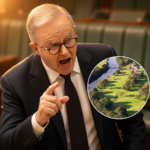
Prime Minister Anthony Albanese has accused the ABC of mishandling its reporting on his longstanding connection to Marrickville Golf Club after questions emerged over an honorary membership that does not appear on his parliamentary register of interests.

The controversy centres on the inner-west Sydney golf club, located in Mr Albanese’s electorate of Grayndler, and a $6.05 million federal commitment for upgrades to the club and surrounding community facilities.
Speaking on ABC News Breakfast on Wednesday, Mr Albanese pushed back strongly at the suggestion his connection to the club had not been properly disclosed, saying the honorary status dated back about 15 years and was not something he regarded as an active membership.
He said he did not have a membership card, did not play golf and had not been inside the clubhouse for years. After defending the funding and arguing the ABC had been given relevant information about his relationship with the club, the Prime Minister told the broadcaster: “The ABC should do better.”
The ABC’s original report said Marrickville Golf Club had Mr Albanese recorded as an honorary member and that the membership had not appeared on his register of interests. A club spokesperson told the broadcaster the arrangement was believed to date back at least 15 years and had not been reaffirmed in recent times.
The dispute has now become part of a broader argument over how the Albanese government selected hundreds of projects for a $560.9 million federal community infrastructure program established to deliver commitments made around the 2025 election.
Albanese says the funding is for a public community facility
Mr Albanese rejected any suggestion there was something improper about supporting the Marrickville project, stressing that the golf course is owned by Inner West Council and functions as public open space as well as a sporting facility.
He said the project was not simply about improving a golf clubhouse. According to the Prime Minister, ageing infrastructure near the Cooks River has created drainage and sewage problems during flooding, while the wider redevelopment is intended to improve accessibility and community use of the area.
Inner West Council records show the $6.05 million commitment was welcomed in May 2025 as funding for upgrades across the Marrickville golf club and parklands precinct. Proposed works included modernising club facilities, improving accessibility, expanding outdoor areas and improving stormwater and irrigation infrastructure.
The council also resolved to work with Marrickville Golf Club on detailed design, approvals and administration of the grant, while undertaking community consultation about how the money could benefit people using the broader parklands.
Mr Albanese said three community infrastructure commitments had been made in his electorate under the funding arrangements. The other projects he highlighted were improvements to the Leichhardt Women’s Health Centre and support for a St Vincent de Paul facility assisting women and children escaping domestic violence.
Later on Wednesday, while speaking to reporters at Tarro in New South Wales, the Prime Minister was pressed on whether he or his office had personally identified Marrickville Golf Club for the invitation-only program.
He did not accept the premise that the funding represented special treatment, describing it instead as an election commitment that the government was delivering. He again pointed to the public ownership and community use of the golf course and defended his previous campaigning to preserve the site as open space.
A decades-long connection to Marrickville
Mr Albanese’s association with the golf club predates the latest funding decision by many years.
He has previously spoken publicly about using the area while living nearby and was involved in a 2019 campaign opposing a proposal that could have reduced the 18-hole course to nine holes. At the time, he argued the site was an important community asset in Sydney’s densely populated inner west.
The ABC reported that a newspaper article from that period described him as holding a non-golfing honorary membership. The Prime Minister has emphasised that he is a tennis player rather than a golfer and says he had no active involvement associated with the honorary status.
That distinction is important because the controversy is not simply about whether his name appeared on a club membership list. The central question is whether the honorary relationship was an interest that should have been declared once a substantial federal funding commitment involving the club became relevant.
Federal MPs are required to register memberships of organisations where a conflict with their public duties could foreseeably arise, or could reasonably be seen to arise. That does not mean every membership of every community or sporting organisation must automatically be declared.
There has so far been no official finding that Mr Albanese breached those requirements.
The issue has nevertheless attracted political attention because Mr Albanese has declared other honorary memberships during his parliamentary career, including an honorary membership of Royal Sydney Golf Club granted in 2025, according to the ABC’s review of his interests.
Why the wider grants program is under pressure
The controversy surrounding Marrickville Golf Club comes as the government faces wider questions over the Major and Local Community Infrastructure Program, known as MLCI.
Department of Infrastructure guidelines describe the $560.9 million program as non-competitive and invitation-only. Organisations could not simply submit applications themselves; only projects identified by the Australian Government were invited to apply.
Once invited, projects were still required to undergo assessment, including consideration of value for money, community benefits, viability and the applicant’s capacity to deliver the work.
The government argues the arrangement was designed to deliver community infrastructure commitments announced during the 2025 election campaign and says the program was established in line with Commonwealth grants rules.
However, an analysis by the Centre for Public Integrity, reported by the ABC, has intensified scrutiny over how the initial list of invited projects was assembled.
Its examination of more than 220 projects found about 73 per cent of the program’s funding went to electorates notionally held by Labor, compared with 23 per cent going to Coalition-held seats and 4 per cent to other electorates.
It also found 45 electorates received no projects through the scheme.
According to the analysis, about $493 million of the $560 million examined went to seats considered safe, fairly safe or electorally competitive for Labor, compared with roughly $66 million going to seats where Labor was not considered competitive.
The Centre for Public Integrity has argued those figures raise serious concerns about political targeting. The government disputes the suggestion that the existence of election commitments makes the grants improper and says successful projects must still meet program requirements.
Infrastructure Minister Catherine King has also defended the scheme, saying it followed the relevant grants framework and noting that ministers do not approve applications located in their own electorates.
The government has further pointed to more than $1.7 billion made available through separate open and competitive infrastructure programs as evidence that MLCI should not be viewed in isolation from its wider community funding arrangements.
Only golf club invited under the program
Marrickville’s inclusion has attracted particular attention because it was the only golf club invited to participate in the MLCI program, according to the ABC investigation.
Independent MP Helen Haines has contrasted the decision with the situation facing Rutherglen Golf Club in her Victorian electorate of Indi, which she says requires significant repairs but was unable to seek MLCI funding because it was never invited to apply.
Ms Haines has described the wider scheme as pork-barrelling and called for stronger rules governing Commonwealth grants. Her characterisation remains a political and integrity watchdog allegation, rather than a finding that the Marrickville project or the program was unlawful.
The Coalition has also demanded more information about how the list of projects was generated and what role Labor MPs, candidates, ministerial offices or the Department of the Prime Minister and Cabinet had in identifying potential recipients.
Shadow Infrastructure Minister Bridget McKenzie has argued that the government needs to explain the decision-making process, particularly given the invitation-only structure of the fund.
The Greens, meanwhile, have called for Mr Albanese to explain the project-selection process before parliament’s Joint Standing Committee on Electoral Matters.
The political sensitivity has been heightened by comparisons with the former Coalition government’s sports grants controversy. In 2020, then-sports minister Bridget McKenzie resigned from cabinet after scrutiny of that program and a separate failure to disclose honorary membership of a shooting club that had received federal funding.
The circumstances are not identical. Mr Albanese was not the Infrastructure Minister responsible for approving the Marrickville application, and the current government says the MLCI program is specifically designed to deliver previously announced election commitments.
But the earlier controversy explains why questions about honorary memberships, political relationships and grant decisions remain particularly sensitive in Canberra.
For Mr Albanese, the immediate response has been unequivocal. He maintains the Marrickville project is a legitimate investment in public community infrastructure, says the honorary membership was an old and inactive arrangement, and has accused the ABC of failing to give sufficient weight to those facts.
The unresolved issue is now less about whether the golf club needs upgrading and more about transparency: who selected the Marrickville project for an invitation-only funding program, what safeguards were used to manage possible perceptions of conflict, and whether Australia’s existing disclosure and grants rules provide the public with enough information to judge such decisions for themselves.