Labor frontbencher Murray Watt has launched a sweeping attack on Pauline Hanson and One Nation, accusing the party of claiming to represent struggling Australians while repeatedly voting against measures Labor says are designed to improve wages, housing and healthcare.
The attack goes directly to the heart of One Nation’s increasingly powerful electoral pitch: that it, rather than Labor or the Coalition, now represents Australians struggling with the cost of living and frustrated with the country’s political establishment.
Watt is attempting to turn that argument on its head.
Rather than debating Hanson primarily over immigration, culture or national identity, the senior Labor figure is challenging voters to examine how One Nation behaves when legislation actually reaches Parliament.
His accusation is simple: listen less to what Hanson says and look more closely at how her party votes.
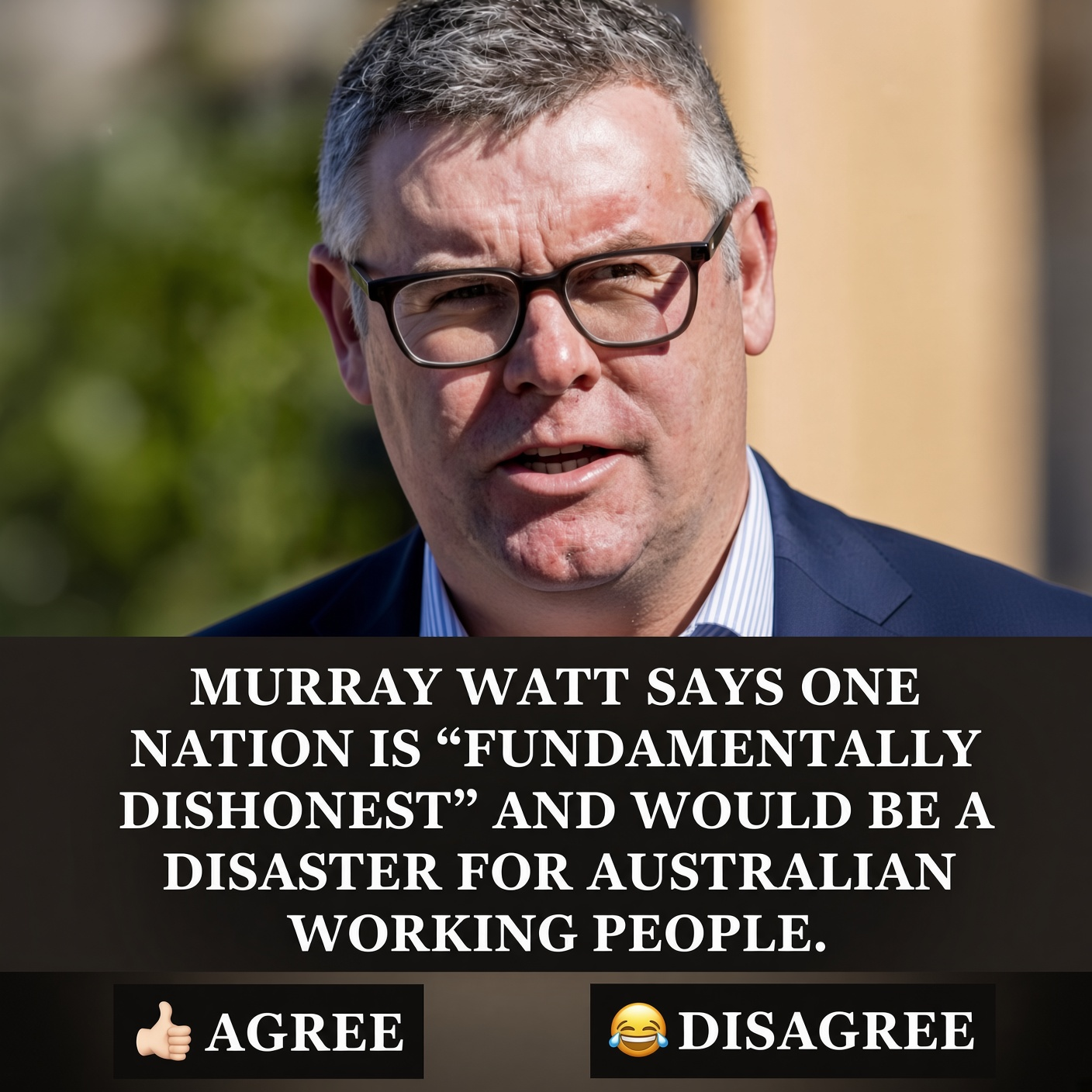
“I reckon what’s dishonest is telling battlers that you’re standing up for them, then coming in and voting against wage rises,” Watt said.
He extended the attack to housing, accusing One Nation of blaming migration for Australia’s housing problems while opposing measures Labor says would increase housing supply.
Watt then turned to healthcare, arguing there was a contradiction between One Nation presenting itself as a defender of ordinary Australians and opposing a Labor government introducing measures intended to expand healthcare support.
“That’s what One Nation are. They are fundamentally dishonest when it comes to standing up for Australian battlers,” Watt said.
It is an unusually direct attack, but the political calculation behind it is easy to understand.
One Nation’s growth has increasingly forced Labor to confront Hanson not simply as a conservative rival to the Liberal and National parties, but as a competitor for economically frustrated voters.
Many of those voters do not necessarily fit traditional definitions of the political right.
They include working Australians worried about housing affordability, wage growth, energy bills and the cost of groceries.
They include voters in outer suburbs and regional communities.
They include people who previously supported Labor but believe the party has become disconnected from their priorities.
And they include Australians who believe rapid population growth has intensified pressure on housing and infrastructure.
That makes the battle over the word “battler” politically significant.
For decades, Australian political parties have competed to present themselves as defenders of people who work hard, pay their bills and feel they are not getting ahead.
Hanson has increasingly built One Nation’s message around precisely that constituency.
She argues that governments have allowed migration to run too high, pushed energy policies that increase costs, wasted taxpayer money and prioritised political causes over the immediate economic interests of Australian families.
Labor’s response cannot simply be that Hanson is wrong on immigration or culturally divisive.
If voters are moving towards One Nation because they believe Hanson represents their economic interests, Labor needs to challenge that belief directly.
Watt’s intervention is designed to do exactly that.
His first line of attack is wages.
Labor has repeatedly sought to portray its industrial relations agenda as one of the clearest differences between itself and the conservative parties.
Since returning to government, it has introduced major workplace reforms covering areas including bargaining, casual employment, labour hire and worker protections.
Measures such as “same job, same pay” have been central to Labor’s argument that employers should not be able to use labour-hire arrangements simply to undercut wages agreed for permanent workforces.
One Nation has opposed parts of Labor’s workplace relations program and has frequently voted alongside the Coalition against government industrial relations legislation.
For Labor, those votes provide an opening.
If Hanson campaigns as the champion of working Australians, Watt argues, voters should examine whether One Nation’s parliamentary record advances the interests of those workers.
But the distinction between political characterisation and the underlying parliamentary record matters.
Voting against a Labor industrial relations bill is not automatically identical to voting against every wage rise.
Legislation can contain multiple provisions.
Opposition parties may argue they support higher wages while objecting to the mechanism chosen by the government.
They may argue that additional regulation raises costs for employers, reduces hiring or damages small businesses.
Labor may reject those arguments, but they form part of the substantive political dispute.
That is why Watt’s claim is best understood as Labor’s interpretation of One Nation’s voting record rather than a complete description of every vote.
The same caution applies to housing.
Housing has become one of the most important points of conflict between Hanson and the Albanese government.
One Nation has consistently linked Australia’s housing shortage to high migration and population growth.
The party argues that governments cannot bring large numbers of additional people into the country without adding to demand for homes, rentals, roads, hospitals and other infrastructure.
That argument has gained political traction because Australia’s housing supply has struggled to keep pace with demand.
Labor’s response is that migration is only one component of a much broader housing problem.
Australia also faces planning restrictions, construction industry capacity constraints, high building costs, shortages of skilled workers and long-standing failures to build enough homes in areas where people want to live.
The Albanese government has consequently pursued programs designed to increase housing supply and support new construction.
Watt’s criticism is that One Nation cannot credibly demand more housing while opposing government legislation intended to deliver it.
Again, One Nation would dispute the premise that every Labor housing program represents an effective solution.
A party can believe more homes should be built while opposing a particular funding model or government scheme.
The real question for voters is therefore more precise: what did One Nation oppose, why did it oppose it, and what alternative did it propose?
That is where parliamentary voting records become more useful than campaign slogans from either side.
Labor is entitled to highlight votes it believes contradict One Nation’s public positioning.
One Nation is entitled to explain why it cast those votes.
Readers should be wary of reducing complex legislation to a single description supplied by the government that introduced it or the opposition that rejected it.
The political significance, however, remains substantial.
Watt is trying to force Hanson onto terrain where One Nation’s rhetoric must be compared with legislative decisions.
His healthcare criticism follows the same pattern.
Labor has made Medicare and expanded access to healthcare central to its pitch to working and middle-income Australians.
For the government, health policy is also historically favourable political territory.
Watt therefore wants voters to see a contradiction between Hanson’s claim to represent Australians struggling to afford essential services and One Nation’s opposition to Labor government measures.
The attack becomes even more politically consequential when Watt links One Nation to the Liberals.
“They say they’ll do one thing, then they come down here and vote with the Liberals,” he said.
He then went further, arguing that One Nation and the Liberal Party ultimately depend on one another if either side of the conservative divide hopes to remove Labor from government.
That claim is clearly designed to weaken One Nation’s outsider status.
Hanson’s political strength comes partly from presenting her party as fundamentally different from both major parties.
If Labor can persuade voters that One Nation ultimately functions as another parliamentary ally of the Liberals, that distinction becomes harder for Hanson to maintain.
But the relationship between One Nation and the Coalition is considerably more complicated than simply describing the two as the same.
The two forces compete aggressively for many of the same voters.
One Nation has attacked Liberal politicians as weak, disconnected and unwilling to confront issues such as migration.
Liberal figures have attacked Hanson over her policies, judgement and One Nation’s preparedness for government.
At the same time, parliamentary politics can force parties that compete electorally to cooperate on individual pieces of legislation.
That is already visible in the current debate over migration and national security.
Senior Coalition figures have indicated they are prepared to examine and potentially work with One Nation on legislation intended to strengthen Australia’s ability to deal with terrorism-related cases.
Shadow figures have stressed that they would consider legislation on its merits rather than reject it merely because One Nation introduced it.
That does not amount to a formal Coalition-One Nation alliance.
It does demonstrate why Labor sees political value in presenting the parties as increasingly interconnected.
Watt’s larger objective is to define the next electoral contest before Hanson can define it herself.
One Nation wants the contest to be between ordinary Australians and a political establishment that has failed them.
Hanson’s preferred dividing line cuts across the traditional Labor-versus-Coalition structure.
On one side are Australians struggling with housing, bills, migration pressures and declining trust in institutions.
On the other, in One Nation’s telling, are major parties that created those problems and refuse to acknowledge them.
Labor wants a different dividing line.
It wants working voters to see a choice between a Labor government delivering workplace protections, Medicare and housing investment and a conservative parliamentary bloc consisting of Liberals, Nationals and One Nation.
Watt’s attack makes that strategy unusually explicit.
Whether it succeeds will depend on more than rhetoric.
Hanson’s rise has been driven partly by the perception that the traditional parties have failed to produce acceptable results.
A voter struggling to pay rent may care less about which party supported a housing bill than whether rents actually become more affordable.
A worker watching grocery and electricity bills rise may judge wage policy by real purchasing power rather than nominal wage increases.
A family waiting for medical treatment may care more about whether it can see a doctor affordably than about which party claims ownership of Medicare.
That creates a difficult challenge for Labor.
It can point to legislation and parliamentary votes.
Hanson can point to outcomes.
If voters remain dissatisfied with those outcomes, One Nation may still benefit even when Labor successfully demonstrates that the party opposed government measures intended to improve them.
One Nation faces the reverse problem.
Its outsider status becomes harder to sustain as its electoral support grows.
A minor party can criticise legislation relatively easily.
A party presenting itself as a potential government must explain what it would enact instead.
If Hanson says migration is worsening the housing shortage, voters can reasonably ask what migration level One Nation would set and how quickly housing pressures would respond.
If the party opposes Labor’s housing programs, voters can ask what construction and planning policies would replace them.
If it opposes workplace legislation, it can be asked how its alternative would increase workers’ real incomes.
If it says healthcare is failing, it can be asked how much additional money it would spend, where that money would come from and how it would address workforce shortages.
Those are governing questions rather than protest questions.
They are becoming unavoidable because One Nation is no longer politically marginal.
As its support rises, Hanson is attracting greater scrutiny not merely over what she opposes but what she would do with power.
That transition explains why Labor is increasingly interested in One Nation’s parliamentary record.
Past votes provide clues about how a party might govern.
They can expose contradictions.
They can also be selectively presented by opponents.
The responsible test is therefore to examine both the vote and the legislation behind it.
Watt has put three areas on the table: wages, housing and healthcare.
One Nation will increasingly be expected to answer on all three.
There is also a strategic risk for Labor in attacking Hanson too aggressively.
One Nation has long benefited from portraying criticism by established politicians as proof that the political establishment fears it.
Every attack can be repackaged as evidence that Hanson is threatening a system protecting its own interests.
If Labor simply calls One Nation dishonest without persuading voters on the substance, it may reinforce the outsider narrative it is trying to dismantle.
Watt’s stronger argument is therefore not the insult itself.
It is the invitation to examine the parliamentary record.
That is measurable.
It allows individual votes to be scrutinised.
It allows One Nation to provide its explanations.
And it allows voters to determine whether Hanson’s rhetoric matches her party’s decisions when legislation reaches the Senate.
The same standard should apply to Labor.
If the government claims a bill will raise wages, build homes or expand healthcare, it should be judged on whether the legislation actually delivers those outcomes.
A parliamentary majority does not make a policy successful.
Nor does opposition to a government bill automatically mean opposition to the objective in its title.
Political accountability works best when neither government branding nor opposition slogans are accepted at face value.
That makes the Watt-Hanson confrontation more substantive than another exchange of political insults.
It is a fight over who can credibly claim to represent Australians who feel economically squeezed.
For Hanson, that claim has become central to One Nation’s growth.
For Labor, allowing her to own it uncontested would be dangerous.
Watt is therefore trying to transform One Nation’s greatest political strength into a vulnerability.
Hanson says she stands with the battlers.
Labor’s answer is: check the votes.
One Nation’s answer will be that Australians should check the results produced by governments that have actually held power.
That argument — more than the accusation of dishonesty itself — is likely to become increasingly important as the battle for working-class and cost-of-living voters intensifies.