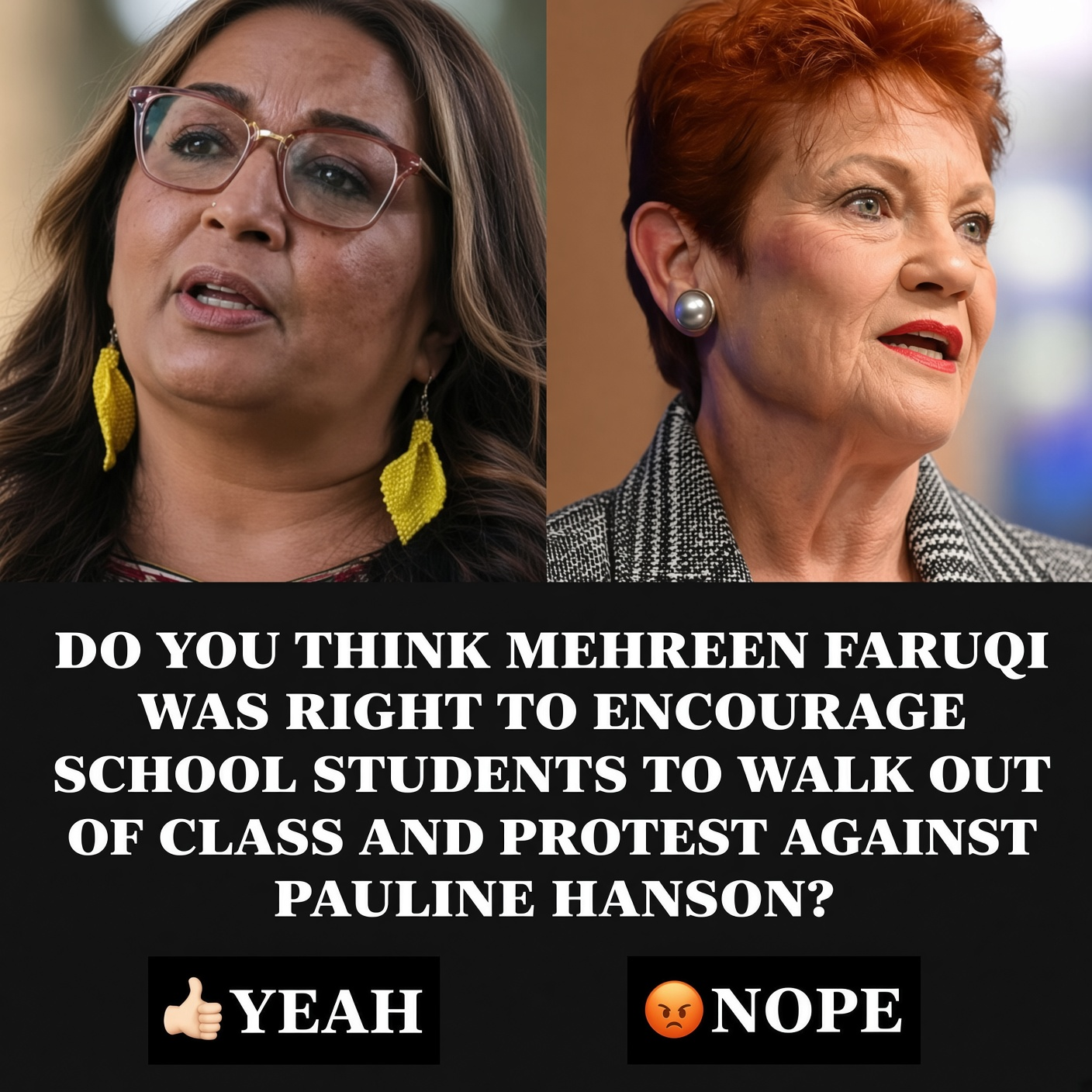
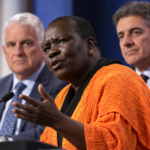
Greens Senator Mehreen Faruqi’s decision to openly encourage school students to leave class for a nationwide protest against Pauline Hanson has intensified a difficult political question: where should Australia draw the line between encouraging young people to participate in democracy and recruiting them into partisan political campaigns?
The controversy centres on a Greens-authorised video published ahead of Thursday’s nationwide “Students Say No to Hanson” demonstrations.
Faruqi, the Australian Greens’ deputy Senate leader, did not simply defend the right of young Australians to protest.
She actively encouraged participation.
In the video, Faruqi described One Nation as “racist, sexist, anti-worker and divisive” and urged young people concerned about what she called the rise of the far right to join thousands of other students demonstrating around Australia.
Then came the deliberately playful conclusion.
Faruqi portrayed herself as granting permission for a student to attend, telling them: “Of course” and “Have fun.”
Her accompanying social media post made the message equally clear, declaring that students were saying no to One Nation’s politics and announcing that the “permission slip” had been signed.
The video succeeded in attracting attention.
It also ensured that the demonstrations would become a debate not only about Hanson, but about the role elected politicians should play in encouraging school-age children into political action during class time.
A protest deliberately organised as a school walkout
Thursday’s demonstrations were not spontaneous gatherings that happened to attract school students.
They were organised in advance as a national political action.
The National Union of Students played a central role in coordinating rallies across Australia, while High School Anti-Capitalists and socialist activists were involved in mobilising secondary-school participants.
The purpose was explicit: students were being encouraged to leave classes and demonstrate against Hanson and One Nation.
Rallies took place across major Australian cities, including Sydney, Melbourne, Brisbane, Adelaide and Perth.
Thousands ultimately participated.
In Sydney, more than 1,000 protesters gathered in the CBD.
Hundreds attended in Melbourne, including students from more than 100 Victorian schools.
More than 2,000 students from dozens of schools and colleges were reported at Adelaide’s demonstration, while hundreds more gathered in Brisbane.
The organisers described the mobilisation as a youth response to Hanson’s growing political influence and what they called the “rise of the far right”.
Students carried anti-One Nation placards and chanted against Hanson, accusing her party of racism and attacking its positions on migration, multiculturalism and minority rights.
Some participants went considerably further, with profanity directed personally at Hanson appearing in chants at several demonstrations.
The demonstrations showed that opposition to One Nation has reached well into younger Australia.
But the organisation behind the rallies has become an important part of the story.
The activist toolkit raises harder questions
Reporting before the walkout revealed the circulation of a document titled The High School Anticapitalists’ Toolkit.
The material went beyond simply telling students where a rally would be held.
It provided practical advice for building political activist networks inside schools.
Students were encouraged to establish groups, use private online chats, distribute posters and leaflets and recruit classmates.
The toolkit also encouraged students to attend protests in school uniform because doing so would increase the visibility of school-student participation.
That detail is particularly relevant to the argument over whether minors were simply expressing individual political opinions or were also being deliberately mobilised as part of a wider ideological campaign.
The toolkit reportedly placed opposition to Hanson within a much broader anti-capitalist political program.
Its objective was not simply defeating One Nation at an election.
It sought to develop activist networks capable of continuing political organisation beyond a single demonstration.
There is nothing secret about that ideology.
High School Anti-Capitalists openly identifies itself as anti-capitalist, while Socialist Alternative is an openly revolutionary socialist organisation with a long presence in Australian university politics.
The existence of organised political recruitment among students is therefore not merely an allegation.
There is documented campaign material encouraging students to organise politically within their schools.
What that does not establish is that Australian schools or teachers themselves were running the campaign.
That distinction matters.
An outside political organisation attempting to recruit students is one thing.
A school institutionally promoting partisan political activism would be another.
Evidence of the first does not automatically prove the second.
Faruqi’s involvement changes the argument
The role of external activists would already have generated controversy.
Faruqi’s intervention adds another dimension because she is not a university organiser or grassroots campaigner.
She is a sitting federal senator and a senior figure in a political party competing directly with One Nation.
That creates an obvious partisan context.
Faruqi and Hanson are political opponents.
The Greens and One Nation occupy sharply opposing positions on migration, climate policy, multiculturalism, Palestine and numerous social issues.
The two senators also have their own significant personal and legal history.
Faruqi successfully pursued racial discrimination proceedings over Hanson’s 2022 social media post telling her to return to Pakistan.
Against that background, Faruqi encouraging students to leave school for an explicitly anti-Hanson political campaign cannot reasonably be described as politically neutral civic education.
It is political advocacy.
The question is whether that advocacy is appropriate.
Political participation or crossing a line?
There is a strong democratic argument in Faruqi’s favour.
Australians do not suddenly acquire political consciousness on their eighteenth birthday.
Teenagers are affected by government decisions long before they can vote.
Education policy affects them directly.
Housing affordability will shape their adult lives.
Climate and energy policy will have consequences for decades.
Migration will influence the Australia in which they live and work.
Young people are therefore entitled to develop political opinions and express them.
Australian history contains many examples of students participating in political movements.
But recognising that right does not settle the question of whether elected politicians should encourage minors to leave school for a partisan demonstration.
There is a difference between saying students have the right to protest and actively encouraging them to miss classes to protest your political opponents.
That distinction is at the centre of the controversy surrounding Faruqi.
Her video did not merely say students should be allowed to attend if they chose.
It encouraged them to participate and playfully presented the senator herself as granting permission.
Critics argue that this crossed a line from supporting youth political expression into actively mobilising schoolchildren for partisan politics.
Faruqi and the protest organisers would strongly reject that characterisation.
They argue that students themselves recognise a political threat and are exercising their democratic voice.
Jason Clare took a different position
Federal Education Minister Jason Clare demonstrated that supporting the right to protest does not necessarily mean supporting a school-hours walkout.
Clare acknowledged that Australia is a democracy and that people have every right to demonstrate.
But his message to high-school students was that they should remain in class while school was operating.
His position was effectively: protest if you wish, but do it outside school hours.
Victorian political and education authorities delivered a similar message.
Premier Ben Carroll urged students to stay in school.
Education Minister Gabrielle Williams said the government’s expectation was that students would be in classrooms.
The Victorian Department of Education said normal attendance requirements continued to apply.
Balwyn High School explicitly advised that absences to attend the rally were not sanctioned.
Those responses undermine suggestions that Thursday’s walkout amounted to an officially endorsed political excursion.
Students participated despite authorities telling them that ordinary attendance expectations remained in place.
The test should work in both political directions
One way of examining the Faruqi controversy is to reverse the politics.
Imagine a senior One Nation senator producing an authorised political video encouraging high-school students to leave class for demonstrations against the Greens.
Imagine conservative activists distributing manuals outside schools explaining how teenagers could establish political networks among classmates.
Imagine those manuals advising students to wear school uniforms to maximise media coverage.
And imagine the protest specifically targeting an elected Greens senator.
The involvement of adult political organisations would rightly attract scrutiny.
The same standard should apply here.
That does not mean young people should be prohibited from supporting the Greens, One Nation, Labor, the Coalition or any other political movement.
It means adults holding political power should expect questions when they encourage minors to leave compulsory education for partisan activity.
Political affiliation should not determine the standard.
Students are not automatically political props
There is another side to the argument that should not be ignored.
The fact that adults organised the demonstrations does not prove that participating students were incapable of forming their own opinions.
Independent reporting from Thursday’s rallies included interviews with teenagers who clearly articulated why they opposed Hanson.
Some discussed racism and migration.
Others spoke about LGBTQ+ rights and multiculturalism.
Some said One Nation’s rising electoral support was precisely why they believed demonstrating was urgent.
In Melbourne, one participant interviewed by reporters was just 13 and attended with the support of her father.
Political organisation and genuine personal conviction can exist at the same time.
A student can sincerely oppose Hanson while also being recruited by an activist group.
A student can sincerely support Hanson while being influenced by One Nation’s campaigning.
Adults are also influenced by parties, campaign advertising, unions, newspapers, social media and political organisations.
The presence of influence does not automatically eliminate individual agency.
That is why describing every student at Thursday’s demonstrations as a political “foot soldier” would go further than the evidence supports.
The stronger question is what happens inside schools
The most important education issue may ultimately be separate from the walkout itself.
Schools should help students understand competing political arguments without instructing them which political party deserves their support.
That means students criticising Hanson should be free to do so.
Students supporting Hanson should be equally free to express that position.
A classroom examining immigration should consider population growth, economic benefits, housing demand, infrastructure capacity and social cohesion.
A discussion of climate policy should examine emissions alongside energy prices, reliability and technology.
A discussion of capitalism should expose students to both its critics and defenders.
The objective should be political literacy rather than political conformity.
Claims that Australian schools themselves are indoctrinating students require evidence from those schools.
Were teachers distributing rally material?
Were students encouraged by staff to leave class?
Were external political activists given institutional access?
Were students expressing different political opinions treated unfairly?
Were school resources used to organise demonstrations?
Those are legitimate questions.
The existence of thousands of anti-Hanson teenagers does not answer them.
Hanson turns the protests back on her opponents
Hanson has responded to the demonstrations by arguing that schools should teach young Australians “how to think” rather than telling them “what to think”.
She has also attempted to redirect students’ anger towards the cost of living.
Instead of protesting One Nation, Hanson argues, young Australians should ask why wages are under pressure, housing has become unaffordable and everyday expenses have increased under governments actually holding power.
Her political opponents reject that framing.
Protest organisers accuse Hanson of scapegoating migrants and minorities for economic problems they say have deeper causes.
That disagreement is precisely the sort of political argument young Australians should be capable of examining critically.
Housing affordability is real.
Cost-of-living pressure is real.
Population growth is real.
Discrimination is real.
Economic inequality is real.
Political parties disagree profoundly over what causes those problems and how they should be addressed.
Students should be equipped to interrogate all of those claims.
They should be able to challenge Hanson.
They should also be able to challenge Faruqi.
The ‘permission slip’ will outlast the protest
Thursday’s demonstrations are over, but Faruqi’s video has left behind a much broader argument.
Thousands of young Australians demonstrated that they already have strong political opinions.
Established political organisations demonstrated that they are increasingly interested in mobilising those young people.
High School Anti-Capitalists demonstrated that some activists want to build lasting political networks inside schools.
Education authorities demonstrated that participation in political protest does not automatically override attendance expectations.
And Faruqi demonstrated that at least one senior federal politician is prepared to publicly encourage students participating in such a campaign.
None of that requires treating teenagers as incapable of thinking for themselves.
But respecting their political agency should not mean ignoring the power adults have over the political environments surrounding them.
The standard should be simple and politically neutral.
Young Australians should learn about politics.
They should argue about politics.
They should challenge politicians.
They should be free to become activists if they choose.
But schools should remain places where students learn how to assess competing ideas rather than institutions that decide which political conclusions are acceptable.
And elected politicians who encourage schoolchildren to leave class to campaign against their political opponents should expect their judgement to be scrutinised.
Faruqi wanted young Australians politically engaged.
Thursday showed that many of them already are.
The harder question is whether senior politicians should be signing the metaphorical permission slip telling them when to leave the classroom to prove it.