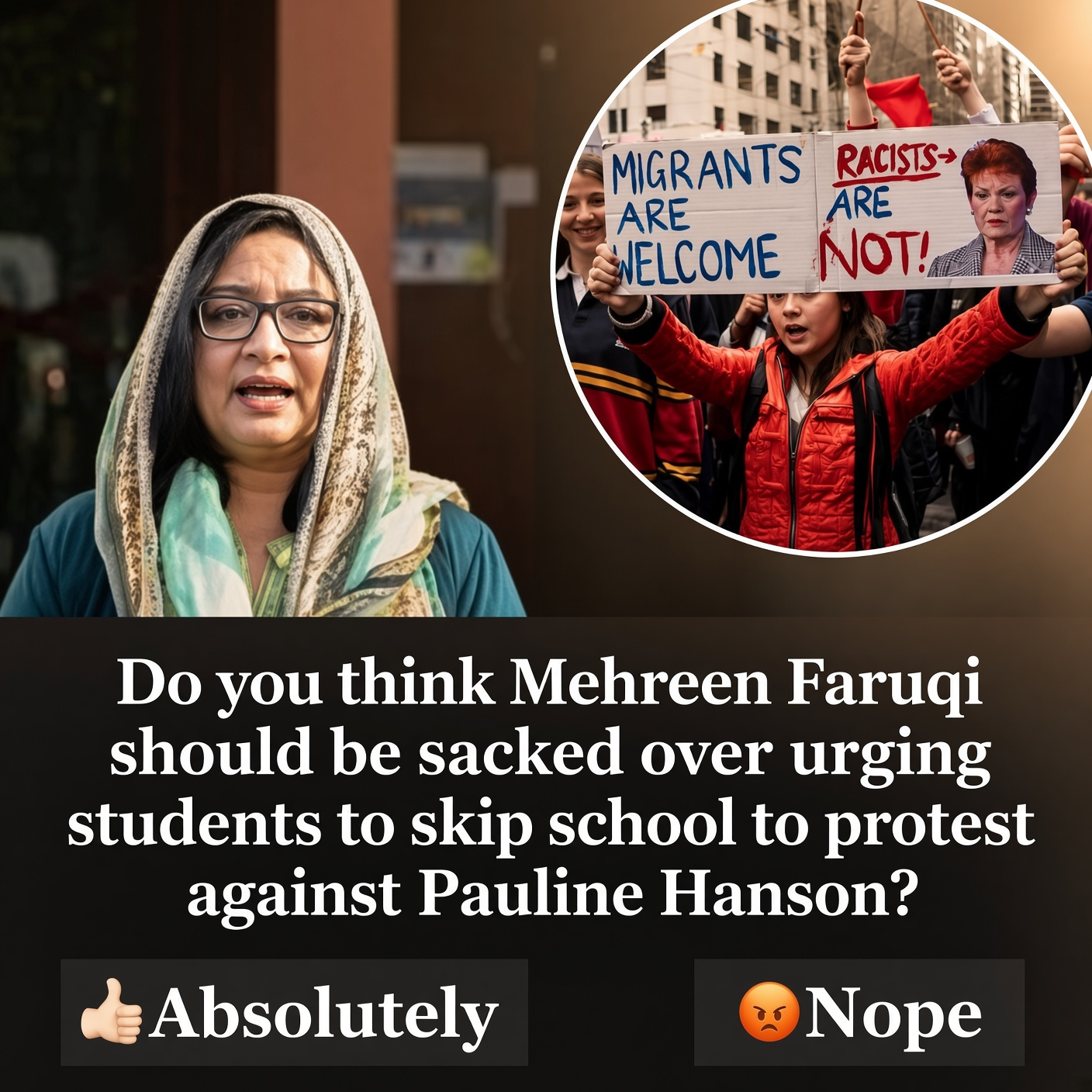
Greens Senator Mehreen Faruqi explicitly encouraged young Australians to join a school-hours walkout against Pauline Hanson and One Nation, telling students seeking her “permission” to attend the nationwide demonstrations: “Of course” — and “Have fun!”
The intervention came in a social media video published ahead of Thursday’s “Students Say No to Hanson” demonstrations, which ultimately brought thousands of high-school and university students onto streets across Australia.
Faruqi, the Greens’ deputy leader in the Senate, used the video to encourage young people concerned about One Nation’s growing political influence to participate.
She described the demonstrations as a response to what she called the “rise of the far right” and launched a sweeping attack on Hanson’s party.
“If you’re concerned that the far right is gaining ground, and that parties such as Pauline Hanson’s One Nation are seeking to undermine women’s rights, workers’ rights and environmental protections,” Faruqi said, before urging students considering Thursday’s action to get involved.
She characterised One Nation’s politics as “racist, sexist, anti-worker and divisive”.
Then came the line that has turned her involvement into a much larger argument about politicians encouraging children to leave school.
“And you want my permission? Of course. I hope you’ve made a big sign. Have fun!” Faruqi said.
The remarks were deliberately playful.
The political question they raised was considerably more serious.
Should a federal senator be encouraging school-age children to leave scheduled classes to participate in a demonstration against a rival political party?
For Faruqi and supporters of the protests, the answer is connected to democratic participation.
They argue young Australians have a legitimate interest in political decisions affecting their future and should be able to mobilise against policies they consider discriminatory.
For One Nation and other critics, the episode represents something very different: an adult politician actively encouraging children to skip school for partisan political activism.
The demonstrations themselves were not spontaneous.
They formed part of a nationally coordinated day of action against Hanson and One Nation.
The National Union of Students played a central role in organising the campaign, while High School Anti-Capitalists and activists associated with Socialist Alternative were involved in mobilising students in several locations.
Organisers promoted rallies in eight Australian cities and encouraged secondary-school as well as university students to participate.
The campaign had an explicitly ideological objective.
Organisers said they wanted to build a movement capable of challenging Hanson’s growing influence and what they described as far-right politics.
One organising statement said the purpose was to build an anti-Hanson movement capable of contesting the “far-right’s dominance”.
Thursday demonstrated that the organisers were capable of mobilising significant numbers.
Thousands participated nationally.
In Sydney, more than 1,000 protesters gathered in the CBD.
Melbourne saw hundreds of students from more than 100 Victorian schools participate in a rally beginning outside the State Library of Victoria.
In Adelaide, more than 2,000 students from approximately 40 high schools and colleges assembled outside Parliament House.
Around 500 students and supporters gathered in Brisbane’s King George Square.
Perth also attracted a large demonstration.
The rallies featured school uniforms, handmade and professionally prepared placards, political speeches and chants directed at Hanson and One Nation.
Some of the language was highly confrontational.
Protesters accused Hanson of racism, sexism and targeting migrants and minorities.
At some rallies, chants included profanity directed personally at the One Nation leader.
Faruqi’s intervention stood out because she is an elected federal politician rather than one of the activist organisers.
That distinction matters.
Political organisations routinely encourage supporters to attend demonstrations.
University students routinely leave lectures to protest.
Politicians routinely endorse rallies aligned with their beliefs.
But compulsory-school-age students occupy a different position.
They are minors.
Many cannot vote.
They are subject to school attendance requirements.
Schools and parents retain responsibilities for their education and welfare.
That is why Faruqi’s playful “permission” message immediately attracted scrutiny.
Federal Education Minister Jason Clare took a markedly different position.
Clare defended the general democratic right to protest but said high-school students should not be missing school to exercise it.
“If people want to protest on the weekend, then fill your boots, but I want you at school when school is on, learning,” he told reporters before the demonstrations.
That is a significant distinction within the government’s broader political response.
Clare did not tell students they were forbidden from opposing Hanson.
He did not challenge their right to protest.
He challenged the timing.
His position was that political activism does not automatically override the expectation that school students attend classes.
Victorian political leaders delivered a similar message.
Premier Ben Carroll urged students to remain in school, while Education Minister Gabrielle Williams emphasised that classrooms were where students were expected to be during school hours.
Victoria’s Department of Education said normal attendance expectations continued to apply.
At least one school, Balwyn High School, explicitly stated that absence for the anti-Hanson demonstration was not sanctioned.
Those facts complicate claims that Thursday’s protests represented officially approved political activity within the school system.
The evidence instead shows students participating despite political and educational authorities telling them they should remain in class.
That does not eliminate questions about the influence of teachers, activists or political organisations.
It does mean those questions require evidence rather than assumption.
The involvement of High School Anti-Capitalists has become particularly controversial.
The organisation was openly seeking to mobilise secondary-school students against Hanson.
Material associated with the group did considerably more than advertise a single demonstration.
A High School Anti-Capitalists organising toolkit circulated among students provided practical advice on political organising inside schools.
Reporting on the material described instructions for creating activist networks, distributing posters and leaflets and using private group chats.
Students were encouraged to wear school uniforms at protests because doing so would increase the visibility of their participation.
The material framed opposition to Hanson within a much broader anti-capitalist political project.
That provides genuine evidence of ideological organisations attempting to recruit and organise school students.
It does not, however, automatically prove that schools themselves were responsible.
There is an important difference between an external socialist organisation attempting to recruit students and a classroom teacher directing students towards socialist politics.
The former is documented.
The latter requires evidence from individual schools.
Were teachers distributing campaign materials?
Were classrooms used to promote the walkout?
Did staff encourage students to attend?
Were school communication systems used by organisers?
Were students with pro-One Nation views treated differently?
Those questions are legitimate.
Thursday’s crowd size does not answer them.
Nor does the participation of schoolchildren prove those children had no political agency of their own.
Independent reporting from the demonstrations found students capable of explaining why they attended.
Some objected to Hanson’s immigration policies.
Some spoke about racism.
Others raised concerns about LGBTQ+ rights.
Some explicitly said One Nation’s rapidly increasing electoral support had made political action more urgent.
In Melbourne, a 13-year-old participant told reporters why she opposed Hanson while attending with the support of her father.
In Brisbane, students argued that migrants and international students were being blamed unfairly for Australia’s housing and cost-of-living problems.
Those views may have been influenced by activists, parents, teachers, friends, social media or political organisations.
The same is true of political opinions held by adults.
Influence alone is not proof of indoctrination.
The more revealing question is whether young people are exposed to competing arguments.
A student being encouraged to oppose One Nation should understand what One Nation actually proposes.
A student supporting Hanson should understand the strongest arguments against her policies.
Immigration should be discussed with evidence about population growth, housing demand, wages, infrastructure and economic benefits.
Climate and energy policy should include costs, reliability, emissions and competing technological options.
Debates over multiculturalism should allow students to examine both its benefits and genuine questions around integration and social cohesion.
Political education should equip students to challenge Hanson.
It should also equip them to challenge Faruqi.
Hanson has responded to the protests by making precisely that argument.
She said Australian schools should teach young people “how to think, not what to think”.
Rather than protesting One Nation, Hanson said students should question why their parents’ wages were under pressure and why everyday living costs had increased.
She blamed the Labor-Greens political establishment for weakening the economic future young Australians will inherit.
“Whether you know it or not, One Nation and I are fighting for you,” Hanson told students.
Her opponents reject that argument.
They accuse One Nation of directing legitimate economic frustration towards migrants and minority communities rather than the deeper causes of housing unaffordability and economic inequality.
That disagreement is now becoming one of Australia’s most important generational political battles.
Young Australians have plenty to be politically angry about.
Home ownership has become increasingly difficult.
Rents are high.
Cost-of-living pressures remain substantial.
Students face uncertainty over education costs and employment.
Population growth, housing construction and infrastructure are subjects of intense national debate.
Young people also care strongly about climate change, discrimination and social issues.
Political movements are competing to tell them who caused those problems and who can fix them.
One Nation’s answer emphasises migration, government spending, energy policy and the failure of the major parties.
The activist left emphasises capitalism, inequality, discrimination and corporate power.
The Greens occupy much of that second political territory.
Faruqi’s intervention therefore did not occur outside partisan politics.
It was part of it.
That makes consistency especially important.
Imagine the political positions reversed.
Suppose a One Nation senator produced a video encouraging schoolchildren to leave class for a nationwide demonstration against the Greens.
Suppose conservative organisations distributed organising guides telling teenagers how to build political networks inside their schools.
Suppose students were encouraged to wear uniforms to maximise media impact.
Progressive politicians would be entitled to scrutinise that activity.
The same standard should apply when the politics are reversed.
Political participation is not inherently improper because young people are involved.
But adult politicians encouraging minors to leave school for partisan demonstrations should expect questions regardless of ideology.
There is also an important difference between a right to protest and a right to protest without consequences for missing school.
Students may believe a cause is important enough to justify an absence.
Parents may support that decision.
Schools can still record and manage the absence according to their normal policies.
That is essentially the position Victorian education authorities adopted.
It allows political expression without requiring schools themselves to endorse the political cause.
The alternative risks creating impossible questions about which political demonstrations qualify for special treatment.
Would a climate strike count?
An anti-Hanson rally?
A pro-Palestinian march?
A March for Australia demonstration?
An anti-abortion protest?
A pro-One Nation rally?
The cleanest standard is ideological neutrality.
School attendance rules should not depend on whether administrators approve of the cause.
The same principle should apply inside classrooms.
Teachers are entitled to personal political beliefs.
Students are entitled to theirs.
Education becomes problematic when authority is used to tell students which partisan conclusion they are expected to reach.
That is why accusations of indoctrination should be taken seriously.
It is also why they should require evidence.
External socialist organisations recruiting schoolchildren provide a legitimate subject for scrutiny.
Faruqi encouraging students to join the walkout is a documented political intervention.
Neither fact, by itself, proves systematic indoctrination by Australia’s teachers.
The rallies nevertheless revealed how deeply the political fight over Hanson has moved into younger Australia.
The original Hanson phenomenon in the late 1990s also triggered student walkouts.
Almost three decades later, another generation is marching against the same politician.
But the political environment is different.
One Nation is no longer merely an insurgent minor party struggling for relevance.
Its support has risen dramatically.
Hanson is openly discussing whether she could lead Australia.
Labor, the Coalition and the Greens are all responding to One Nation as a significant electoral force.
That explains the urgency of the activists organising against her.
It also explains why One Nation is attempting to turn the protests to its advantage.
Images of students leaving school to attack Hanson can work politically in two directions.
Organisers see young Australians rejecting One Nation.
Hanson’s supporters see left-wing organisations mobilising children against a politician challenging the establishment.
Faruqi’s “permission” video strengthens the second interpretation because it places a senior elected Greens politician directly inside the story.
That does not mean Faruqi secretly organised every student who attended.
It does mean she publicly encouraged them.
And that is enough for voters to judge the appropriateness of her intervention for themselves.
The national walkout has therefore created a question larger than Pauline Hanson.
How should Australian democracy involve people who are old enough to form political opinions but too young to vote?
Young people should not be told they have nothing to say until their eighteenth birthday.
Nor should they be treated as convenient campaign material for adults.
Schools should develop political literacy without becoming partisan institutions.
Politicians should be free to persuade young Australians while being transparent about what they are doing.
And attendance standards should be applied consistently.
Faruqi clearly wanted students at Thursday’s demonstrations.
Clare clearly wanted high-school students in their classrooms.
Hanson clearly believes the protests demonstrate a wider ideological problem in education.
The students themselves clearly had something to say.
All four facts can coexist.
The challenge now is separating legitimate youth political participation from adult partisan mobilisation — without pretending that teenagers have no political agency and without pretending that adults have no influence over them.
Faruqi’s “Have fun!” message has ensured that argument will not disappear with the end of Thursday’s marches.