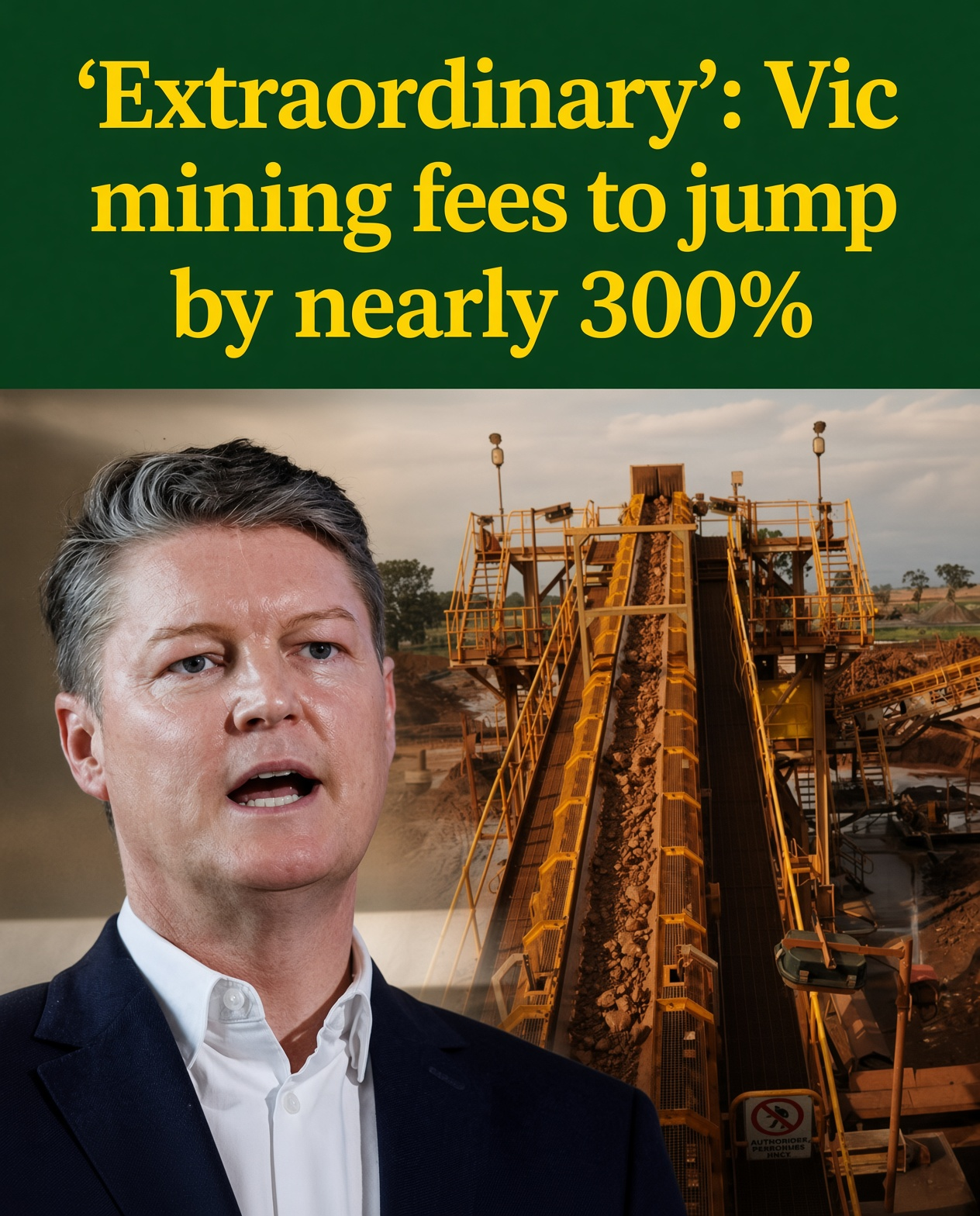
Victoria’s mining and quarrying industries are preparing for a major fight with the Carroll government after extraordinary regulatory fee increases of up to almost 300 per cent were confirmed, prompting warnings the additional costs could eventually flow through to housing and infrastructure projects.
The changes are set to dramatically increase the price of applying for mining and retention licences while imposing substantially higher charges across parts of the quarrying and extractive industries.
Some of the increases are due to take effect from January 1, 2027.
A mining licence application that currently costs $4,529.90 is set to rise to $17,983.30 — an increase of approximately 297 per cent.
Mining licence application fee almost quadruples
The mining licence increase is among the most dramatic changes confronting Victoria’s resources sector.
Moving from $4,529.90 to $17,983.30 means an applicant will pay more than $13,000 extra simply at the application stage.
Other parts of the licensing regime are also being increased.
Exploration licence application fees are set to rise by about 40 per cent, while retention licence applications will become close to four times as expensive.
For companies deciding where to spend exploration dollars, the industry argues those differences matter.
New rehabilitation fees can run above $140,000
The reforms do not stop at licence applications.
New regulatory fees are also being introduced for mine rehabilitation processes.
Industry reporting indicates some fees for lodging mine rehabilitation plans can exceed $140,000.
Rehabilitation is already a major financial obligation for Victorian resource operators.
The state’s regulatory system requires operators to ensure land is eventually returned to a safe, stable and sustainable condition.
Mining companies already have to provide rehabilitation bonds
Resources Victoria requires operators to provide financial guarantees against the cost of restoring mining, exploration and quarry sites.
These rehabilitation bonds generally reflect 100 per cent of the estimated rehabilitation cost.
If an operator fails to satisfactorily rehabilitate a site, the state can use the financial guarantee to carry out the work.
Calculations can include earthworks, revegetation, infrastructure removal, environmental monitoring, project management and contingencies.
Industry therefore argues the new regulatory charges arrive on top of significant existing environmental and financial obligations.
Minerals Council says Victoria risks losing investment
The Minerals Council of Australia has attacked the scale of the increases.
MCA Victoria executive director James Sorahan argues Victoria already presents a comparatively expensive environment for mineral exploration.
The organisation fears making licence applications and approvals substantially more expensive will make interstate and international projects more attractive.
Exploration capital is highly mobile.
A company considering whether to drill in Victoria, Western Australia, Queensland or overseas can redirect capital before a mine ever exists.
The industry’s biggest fear is what never gets discovered
That is an important feature of exploration economics.
An established mine can generate revenue against which regulatory costs can be absorbed.
An exploration company has no guarantee it will ever discover an economically viable deposit.
Most exploration programs do not become operating mines.
Companies therefore spend money years before knowing whether a project will generate revenue.
Industry groups argue higher upfront costs can kill marginal exploration programs before anybody knows what lies underground.
Victoria says it has $200bn in critical minerals potential
The dispute comes at an awkward time for the state government’s own resources ambitions.
Victorian Budget Estimates material says the government is delivering a Critical Minerals Roadmap intended to develop up to $200 billion worth of in-ground critical mineral resources.
The government has highlighted projects involving rare earths, mineral sands, antimony and gold as evidence of the sector’s potential.
That creates an obvious tension: Victoria wants more critical-minerals development while simultaneously making parts of the regulatory pathway considerably more expensive.
The government says taxpayers currently carry too much of the bill
The Carroll government’s defence is based on cost recovery.
According to the government, resource companies currently fund only about 36 per cent of the cost of regulating their industries.
The remainder is effectively carried by taxpayers.
The government argues businesses profiting from the extraction of Victorian resources should make a larger contribution towards the cost of overseeing those activities.
From that perspective, the increases are not simply a new revenue grab but a reallocation of regulatory costs towards the industries being regulated.
The 234% figure was already contemplated in regulatory analysis
The size of the proposed increases did not emerge without prior regulatory analysis.
A Victorian Regulatory Impact Statement examining earth resources fees considered several cost-recovery models.
One option was a proportional increase across existing fees sufficient to achieve full cost recovery.
The calculation found that would require a flat increase of approximately 234 per cent across fee categories, excluding the mine stability levy, alongside new charges.
The figure illustrates the size of the gap government believes exists between regulatory expenditure and industry contributions.
Industry groups were consulted
The Regulatory Impact Statement records consultation with major sector organisations during January 2025.
Participants included the Association of Mining and Exploration Companies, Minerals Council of Australia Victoria, Cement Concrete & Aggregates Australia and the Construction Material Processors Association.
Several alternative approaches were examined following those discussions.
They included quarterly payment options and different treatment of exploration fees intended to encourage investment.
Consultation, however, has plainly not produced industry acceptance of the final cost increases.
Quarries are being hit as well
The backlash extends beyond traditional mineral mining.
Victoria’s extractive industries — particularly quarries producing stone, sand and aggregates — are also confronting substantially higher charges.
Reporting on the changes indicates fees across many quarry and extractive-industry categories could rise by roughly 234 per cent.
The government is seeking to recover nearly $14 million annually in regulatory costs that it says are not presently being covered by the sector.
That is where the argument begins to move from mining policy into the cost of construction.
Quarry products end up in almost everything Victoria builds
Quarries are a basic part of the construction supply chain.
They provide crushed rock, stone, sand and other materials used in concrete, asphalt and civil construction.
Those materials go into houses.
They go into roads, railways, bridges and tunnels.
They are required for renewable-energy projects and electricity infrastructure.
Unlike a gold mine producing an internationally traded commodity, a quarry can feed directly into the cost base of local Victorian construction.
Construction industry warns costs will be passed on
Cement Concrete & Aggregates Australia has warned that substantially higher quarry charges will not simply disappear inside company balance sheets.
Chief executive Michael Kilgariff argues the increases could raise the cost of producing essential construction materials.
The organisation says that ultimately threatens housing affordability as well as the cost of infrastructure and energy developments.
Its warning is straightforward: make the inputs into construction more expensive and at least some of that additional cost can move down the supply chain.
That does not mean house prices will suddenly rise 234%
The numbers require careful interpretation.
A 234 per cent increase in a particular regulatory fee does not mean concrete prices will increase by 234 per cent.
Nor does a 297 per cent mining application increase translate into a comparable increase in the price of a new home.
Regulatory fees represent only one component of an operator’s total costs, while quarry materials themselves represent only part of the overall cost of construction.
The credible concern is incremental cost pressure — not a one-for-one transfer of the headline percentage into house prices.
Transport costs make local quarries especially important
Construction materials are heavy and relatively low-value compared with commodities such as gold.
That makes transport unusually important.
Moving aggregates long distances by truck can quickly become expensive.
If regulatory settings discourage new quarries close to Melbourne and regional growth corridors, construction companies may have to source materials from further away.
That can create a double cost: higher regulatory expenses at the quarry and higher transport expenses getting material to building sites.
The government itself says quarry supply supports housing
Victorian government documents demonstrate that policymakers understand the importance of quarry supply.
Budget Estimates material says 90 million tonnes of new quarry resources were approved in the nine months to March 2026.
That lifted the state’s approved stockpile to approximately 1.4 billion tonnes.
The government said that represented around 17 years of supply.
It explicitly linked those resources to supporting the Big Build and new housing developments.
That makes the fee fight politically uncomfortable
Victoria needs enormous quantities of construction material.
The state is simultaneously pursuing housing targets, major transport infrastructure and the construction of new electricity transmission and renewable-energy projects.
All require physical materials.
Industry groups therefore argue government cannot treat quarry regulation as an isolated revenue issue.
If the policy reduces investment or increases production costs, they say the consequences could reappear elsewhere in the government’s own building program.
CCAA wants the changes delayed
Cement Concrete & Aggregates Australia is pushing for the increases affecting the extractive sector to be deferred.
The organisation wants implementation held back until a new regulatory framework scheduled for July 2027.
Its argument is that imposing large fee increases shortly before broader regulatory changes creates unnecessary uncertainty and cost.
The industry would prefer government address fees as part of the wider reform rather than introduce the increases beforehand.
The Opposition has seized on the backlash
Victoria’s Coalition has attacked the government over the increases.
Shadow Resources Minister David Davis argues the policy sends the wrong signal to investors and businesses at a time when Victoria needs economic growth.
The Opposition has also connected quarry charges with the state’s housing affordability and infrastructure challenges.
For the Coalition, the fee increases provide another opportunity to portray the Carroll government as making it more expensive to do business in Victoria.
Mining competitiveness is becoming a bigger issue
Victoria is not Australia’s dominant mining jurisdiction.
Western Australia and Queensland have much larger mining sectors and powerful established resource economies.
That makes competitiveness particularly important for Victoria.
A company considering a speculative exploration program does not necessarily have to spend that money in Victoria.
Industry leaders argue every additional cost therefore has to be considered against what competing jurisdictions are charging.
Critical minerals make that competition more intense
The global race for critical minerals has intensified as governments seek secure supplies for batteries, defence technology, electronics and energy infrastructure.
Australia wants to capture more of the investment flowing into those supply chains.
Victoria has significant deposits and wants them developed.
But geological potential alone does not guarantee investment.
Companies also compare regulation, approval times, taxes, infrastructure, labour availability and political risk.
The state has a legitimate regulatory-cost problem
The industry criticism does not eliminate the government’s underlying problem.
Mining and quarrying require substantial public regulation.
Government agencies must assess applications, inspect operations, monitor environmental and safety compliance and oversee rehabilitation.
Those functions cost money.
If industry contributions cover only about 36 per cent of regulatory costs, taxpayers are funding much of the balance.
The government is entitled to ask why the general public should heavily subsidise regulation of commercial resource businesses.
But full cost recovery is not automatically economically optimal
There is another side to that calculation.
Governments frequently bear some regulatory or infrastructure costs because industries create wider economic benefits.
Mining and quarrying support employment, regional economies, construction, exports and tax revenue.
Exploration can also create future projects whose benefits are impossible to quantify when the first licence application is lodged.
The relevant policy question is therefore not simply who creates the regulatory cost, but what fee structure best serves Victoria’s broader economic interests.
Exploration deserves particular attention
That distinction is strongest at the exploration stage.
An explorer is not necessarily extracting or selling anything.
It may spend millions of dollars drilling and conducting geological work only to conclude a deposit cannot be developed economically.
Heavy upfront fees can therefore discourage the riskiest and earliest stage of the resources pipeline.
Without exploration, there are no new discoveries to become tomorrow’s mines.
Victoria previously considered protecting exploration fees
The government’s own Regulatory Impact Statement recognised this issue.
Following industry consultation, one option considered keeping exploration fees at existing levels specifically to encourage investment in Victoria’s resources sector.
That demonstrates the trade-off was understood during policy development.
The final package nevertheless includes significant increases affecting exploration.
The industry is now asking why investment attraction did not receive greater weight.
Mining is also paying royalties
Regulatory application fees are only one payment resource companies make to the state.
Victoria also charges royalties on mineral production.
Resources Victoria currently lists a royalty rate of 2.75 per cent of net market value for minerals other than gold.
Gold production above the relevant threshold is also subject to a 2.75 per cent royalty.
Licence holders additionally face annual rent and other compliance obligations.
The sector therefore argues the new fees must be viewed as part of the total government cost imposed on projects rather than in isolation.
Government regulation protects communities too
The public-interest case for strong regulation remains substantial.
Mines and quarries can create dust, noise, traffic and environmental risks.
Poorly rehabilitated sites can leave governments and communities with long-term liabilities.
Resources Victoria is responsible for monitoring compliance and can take enforcement action when operators breach approved work plans.
Those functions are essential regardless of whether regulation is funded principally by industry or taxpayers.
The fight is really about where the line should be drawn
Few participants are arguing Victoria should abandon mining regulation.
The disagreement is about cost allocation and economic consequences.
The government says companies accessing Victoria’s resources should pay a fairer share of the regulatory bill.
Industry says increases approaching 300 per cent cross the line from reasonable cost recovery into an investment deterrent.
Quarry operators add that consumers and taxpayers could ultimately pay anyway if higher costs flow into construction contracts.
Housing makes the argument particularly sensitive
The timing could hardly be more politically difficult.
Victoria is attempting to dramatically increase housing supply while affordability remains under pressure.
Governments repeatedly argue that more homes need to be built faster and more cheaply.
That requires land, labour, finance, approvals and enormous quantities of construction material.
Any government policy that potentially increases the cost of those materials will inevitably face scrutiny against its housing agenda.
Infrastructure taxpayers could also feel the effect
The same principle applies to publicly funded construction.
If quarry products become more expensive, contractors bidding for roads and other infrastructure can incorporate those costs into their prices.
The state could therefore recover additional regulatory revenue from the extractive sector while paying some of that money back indirectly through higher project costs.
Whether that effect will be material depends on how much of the fee increase is passed through.
No credible public evidence yet establishes a precise dollar impact on Victoria’s overall construction bill.
That distinction matters in a debate dominated by huge percentages
A 297 per cent increase makes a powerful headline.
So does 234 per cent.
But policymakers and voters need the underlying dollar amounts and economic effects as well as the percentage change.
The mining licence example is clear: an application rises from about $4,530 to almost $18,000.
The next question is whether that additional $13,000 meaningfully changes investment decisions for different types and sizes of operators.
Smaller operators may feel increases more acutely
Large multinational mining companies can absorb costs that are significant for junior explorers and smaller quarry businesses.
That means a uniform fee increase can have unequal effects across the sector.
A large established operation may regard a five-figure regulatory charge as minor.
A small exploration company repeatedly applying for licences while raising speculative capital may not.
Understanding that distributional impact will be crucial to judging whether the new regime damages competition or merely increases cost recovery.
The January deadline gives industry a political window
With major increases scheduled to begin from January 1, the resources sector has time to campaign against them.
Industry organisations are signalling they intend to use that window.
The objective will be to convince the Carroll government to modify, delay or reverse parts of the package before the higher charges bite.
That means the fee dispute is likely to become increasingly political rather than remaining a technical argument about regulatory accounting.
Victoria is trying to achieve two competing objectives
The state wants commercial resource operators to pay more of the cost of their own regulation.
At the same time, it wants new exploration, critical-minerals investment, quarry supply and cheaper construction.
Those goals are not necessarily incompatible.
But the fee settings have to be calibrated carefully if government wants to achieve all of them.
Charge too little and taxpayers subsidise industry regulation; charge too much and Victoria risks discouraging the investment it says it wants.
The industry’s construction warning now puts the government under pressure
The most politically dangerous part of the dispute may ultimately have little to do with gold or critical minerals.
It is the claim that higher quarry costs will eventually reach ordinary Victorians through houses, roads and infrastructure.
That claim cannot yet be translated into a reliable dollar increase for the price of a home.
But the economic mechanism behind it is plausible enough to demand scrutiny.
Quarry materials are unavoidable inputs into construction, and somebody ultimately pays the cost of producing them.
The real test will come after January
The Carroll government can point to a legitimate cost-recovery problem and argue commercial resource companies should contribute more towards the regulation they require.
The industry can point to fee increases approaching 300 per cent and ask whether Victoria is undermining its own ambitions for mining, critical minerals, housing and infrastructure.
Both arguments have substance.
What cannot be known yet is how strongly the new fees will change investment decisions, quarry prices and downstream construction costs.
If exploration capital leaves Victoria, projects are delayed or local construction materials become materially more expensive, the government will face pressure to revisit the regime.
If investment continues and the additional fees simply shift regulatory costs away from taxpayers without significant downstream effects, its cost-recovery argument will be strengthened.
With the resources sector now promising a fight, Victoria is about to find out which calculation is right.