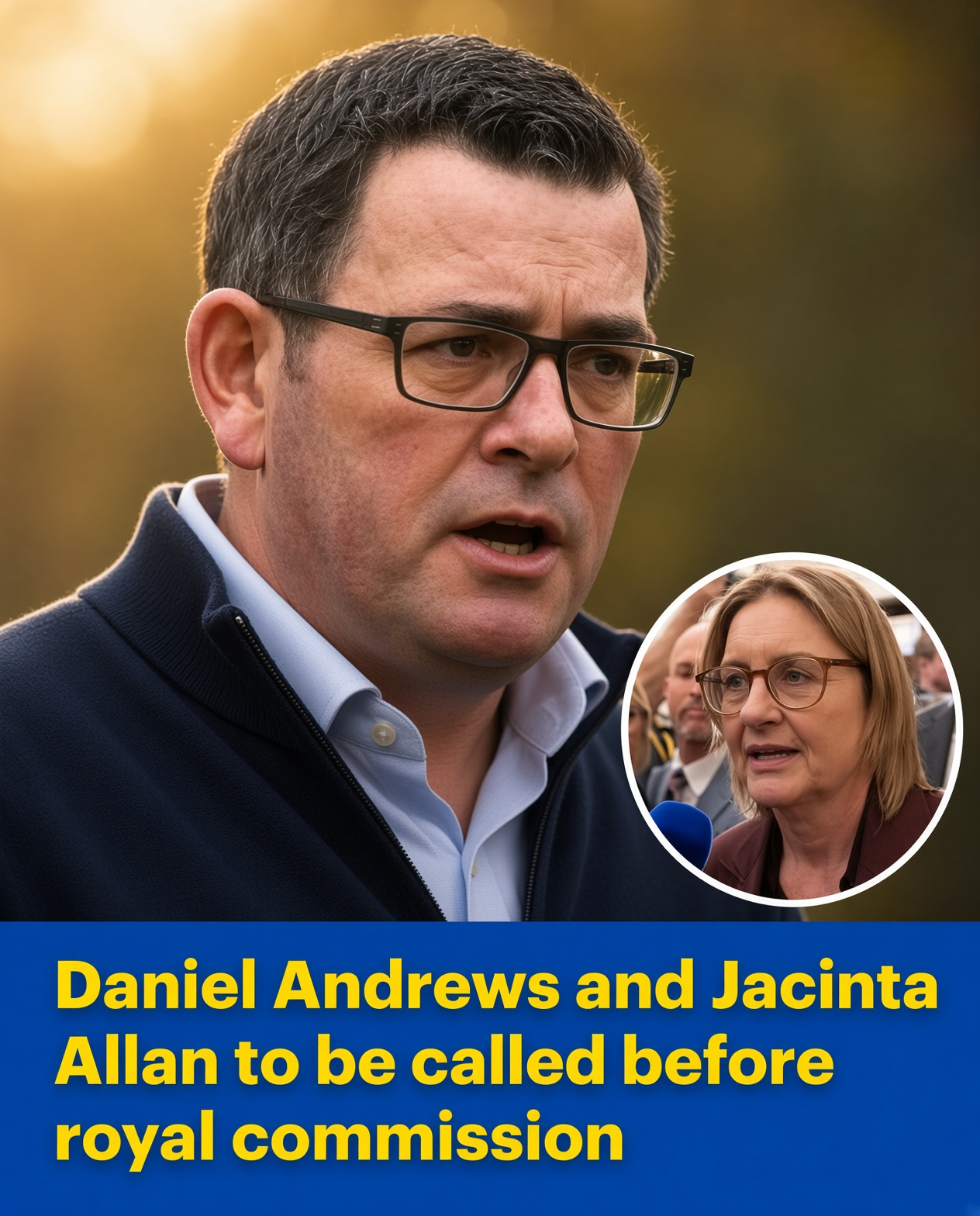
Former Victorian premiers Daniel Andrews and Jacinta Allan could be hauled before a sweeping $50 million royal commission into corruption, criminal infiltration and serious misconduct on Victoria’s major construction projects, with Premier Ben Carroll declaring that “nothing is off limits”.
Carroll has formally unveiled the scope and leadership of the Royal Commission into the Integrity of Major Public and Civil Infrastructure Construction Projects in Victoria, setting up what could become one of the most consequential inquiries into the state’s Big Build era.
Former South Australian chief justice Christopher Kourakis AC has been appointed Royal Commissioner and given extensive powers to follow evidence through unions, construction companies, contractors and the Victorian government itself.
Carroll’s message was unequivocal: no politician, official, union or company will receive automatic protection from scrutiny.
‘Nothing is off limits’
Announcing the terms of reference on Thursday, Carroll stressed the breadth of the investigation.
“The terms of reference are broad. They are expansive. Nothing is off limits,” the Premier said.
The inquiry follows years of allegations surrounding criminality and misconduct in Victoria’s construction industry, including on major taxpayer-funded infrastructure sites.
Carroll said Victorians deserved to understand how organised crime was able to find its way into building sites and whether failures within government or industry allowed it to happen.
“Who allowed it to happen? And how do we make sure it never happens again?” he said.
Daniel Andrews could be called
The breadth of the commission immediately raises questions about Daniel Andrews.
Andrews served as premier from 2014 until 2023, overseeing the enormous expansion of Victoria’s infrastructure program that became synonymous with the government’s Big Build.
Projects launched or advanced during the Andrews era involved billions of dollars of public expenditure and some of the state’s largest construction workforces.
If Commissioner Kourakis considers Andrews possesses relevant evidence about government decisions, oversight or construction-sector relationships, the former premier can be called.
Jacinta Allan could face even closer scrutiny
Jacinta Allan may be particularly relevant because her responsibilities extended well beyond her later period as premier.
Before succeeding Andrews, Allan spent years in senior transport and infrastructure portfolios.
She was closely associated with delivery of Victoria’s major infrastructure agenda and held responsibility for projects including the Metro Tunnel and other major transport works.
Her long tenure in infrastructure means the commission could potentially seek evidence about what ministers and agencies knew, what warnings were received and how contracts and worksites were overseen.
That does not mean Allan has been accused or found guilty of corruption. It means her former responsibilities could make her evidence relevant to the inquiry.
Neither former premier has yet been ordered to appear
There is an important distinction in the reporting surrounding Andrews and Allan.
The royal commission has the power to compel former premiers and ministers to give evidence.
Political opponents and commentators are already calling for senior former Labor figures to appear.
However, it is ultimately Commissioner Kourakis who will determine which witnesses are required.
As of the commission’s launch, it should therefore not be stated as established fact that Andrews or Allan have already been summonsed.
Kourakis gets a $50m budget
The government has allocated $50 million to the royal commission.
Kourakis will relocate to Melbourne for the inquiry and will determine when formal proceedings begin.
He must deliver his final report no later than August 20, 2027.
An interim report can be issued earlier if the commissioner considers one necessary.
The 12-month timetable gives the inquiry considerable scope but also places pressure on it to move quickly through potentially vast quantities of evidence.
Who is Christopher Kourakis?
Kourakis is a former Chief Justice of the Supreme Court of South Australia and brings decades of senior legal experience to the task.
Carroll described his choice of commissioner as deliberate.
“I chose somebody independent, rigorous and fearless,” the Premier said.
That independence will be critical because the commission may investigate decisions taken by governments led by Carroll’s own Labor Party.
The inquiry will ultimately have to follow evidence across political, commercial and industrial boundaries without regard to who is embarrassed by the result.
What exactly will the royal commission investigate?
The terms of reference extend well beyond allegations against a single union.
Kourakis can examine the extent to which corruption, criminal conduct or serious misconduct occurred on or in connection with major public and civil infrastructure projects in Victoria.
The investigation can examine conduct undertaken or instigated by the CFMEU.
But it can also investigate construction companies and consortia, subcontractors, labour-hire businesses, contractors, suppliers and other participants.
That makes this a construction-industry and government-integrity inquiry rather than simply a royal commission into the CFMEU.
The CFMEU will be under intense scrutiny
Allegations involving the Victorian construction division of the CFMEU are central to the circumstances that produced the royal commission.
Claims of organised crime infiltration, intimidation and misconduct on major construction sites have generated intense political pressure for a deeper inquiry.
The union’s construction division is under administration.
CFMEU administrator Michael Crosby has said the organisation will cooperate fully with the commission.
But the administrator has also argued scrutiny should extend across the industry rather than being confined to unions.
Construction companies are firmly within the frame
The terms of reference accommodate precisely that broader approach.
Head contractors and construction consortia can be investigated.
So can subcontracting arrangements, labour-hire practices and suppliers.
That matters because corruption in major construction cannot necessarily occur through one participant acting alone.
If evidence reveals companies knowingly accommodated, facilitated or benefited from improper practices, the commission has room to investigate those relationships.
Government agencies can also be examined
Perhaps the most politically dangerous component for Labor is the commission’s capacity to investigate the role of government.
The inquiry can examine whether oversight systems failed.
It can consider procurement and contracting practices and the administration of taxpayer-funded infrastructure projects.
It can ask whether authorities received warning signs and, if so, what happened next.
That moves the central question beyond “was there corruption?” to the much harder question: “how was it allowed to happen on public projects?”
Cabinet confidentiality will not be used as a shield
Carroll has also made an unusually significant commitment regarding government records.
The Premier says his government will waive Cabinet confidentiality where relevant to the royal commission.
That potentially opens material ordinarily protected by Cabinet secrecy to scrutiny.
Documents can provide evidence about what ministers were told, which options were considered and why particular decisions were made.
For an inquiry potentially examining years of infrastructure governance, access to documentary evidence could prove more important than political testimony alone.
The commission has coercive powers
A royal commission is fundamentally different from an ordinary parliamentary inquiry.
It possesses strong statutory powers to obtain evidence.
Witnesses can be compelled to appear.
Documents can be demanded.
Evidence can be taken under oath.
That means individuals cannot necessarily avoid scrutiny simply because they would prefer not to participate.
That is why ‘nobody is off limits’ matters
Carroll’s phrase is politically powerful, but the commission’s legal powers are what give it substance.
If Kourakis determines a former premier, minister, senior bureaucrat, union official or construction executive possesses relevant evidence, the inquiry has mechanisms to obtain it.
The same applies to documentary records.
The government has promised cooperation rather than relying on political conventions to block access.
The test will be whether that promise survives once the commission begins asking difficult questions.
The commission can follow the money
Another major issue will be the financial consequences of misconduct.
Victoria’s Big Build represents enormous public expenditure.
If corrupt or improper conduct inflated project costs, taxpayers may have paid more than necessary.
The commission can examine the financial impact of wrongdoing and whether money can potentially be recovered.
That gives the inquiry a practical purpose beyond identifying historical failures: it may establish whether taxpayers suffered quantifiable losses and whether any can be clawed back.
A Special Prosecutor will operate alongside the inquiry
The royal commission itself is not a criminal court.
It can uncover evidence, make findings and refer matters, but it does not convict people of criminal offences.
The Carroll government therefore plans to establish an Office of the Special Prosecutor.
A prosecutor will be selected once the office has been created.
The intention is to ensure potential criminal evidence uncovered by the commission has a clear pathway towards investigation and prosecution where appropriate.
IBAC is also set for stronger powers
The royal commission forms part of a broader integrity package.
Carroll has foreshadowed legislation expanding the powers of Victoria’s Independent Broad-based Anti-corruption Commission.
The objective is to improve the state’s capacity to investigate corruption and misuse of public funds beyond the life of the royal commission.
That distinction matters.
A royal commission is temporary; Victoria’s integrity institutions will still have to police the construction sector after Kourakis delivers his final report.
Why Jacinta Allan’s infrastructure history matters
Allan’s position is politically sensitive because she occupied infrastructure portfolios for years before becoming premier.
She was intimately associated with the Big Build program and its delivery architecture.
That does not establish personal responsibility for wrongdoing allegedly committed by construction-sector participants.
But a royal commission examining government oversight may naturally want to understand what responsible ministers knew and what assurances they received.
That is why calls for Allan to testify are likely to persist regardless of whether she is ultimately compelled to appear.
Andrews presided over the Big Build’s expansion
Andrews faces a different but equally obvious political connection.
The Big Build became one of the defining features of his premiership.
His government invested heavily in rail, road and other infrastructure and maintained a close relationship with the construction workforce required to deliver those projects.
If the commission investigates systemic governance or oversight failures across that era, decisions made under the Andrews government will inevitably form part of the historical record.
The question is how far Kourakis decides personal testimony from the former premier is necessary to understand that record.
Carroll has reversed the direction of his predecessors
The creation of the royal commission also represents a sharp political break with the approach taken before Carroll became premier.
Allan had resisted calls for a royal commission, arguing other mechanisms and investigations were already dealing with construction-sector misconduct.
Carroll changed course after taking the leadership.
Calling the inquiry was one of his first major acts as Premier.
He has framed the decision as a declaration that integrity under his government will not be optional.
The royal commission is being launched 100 days before the election
The timing guarantees political controversy.
Carroll unveiled the commissioner and terms of reference exactly 100 days before Victorians are due to vote on November 28.
The Opposition has argued Labor should have acted much earlier.
Critics contend the government is attempting to reset its integrity credentials shortly before voters pass judgment on it.
Carroll rejects the suggestion that the inquiry is an election manoeuvre and says Victorians simply deserve the truth.
Labor cannot control where the evidence leads
That is the inherent risk of creating an independent royal commission with broad terms.
A government can establish an inquiry.
It cannot safely predict everything that inquiry will discover.
If Kourakis follows evidence into decisions made by Labor ministers, agencies or political offices, the commission could become deeply uncomfortable for the government that created it.
That is particularly true because Carroll has promised there will be no artificial barriers around Cabinet documents or senior political witnesses.
The Opposition will push for Andrews and Allan to appear
Victoria’s Coalition is likely to maintain intense pressure for both former premiers to give evidence publicly.
From the Opposition’s perspective, an investigation of Big Build governance would be incomplete without questioning the political leaders who presided over it.
Labor will counter that witness selection belongs to the independent commissioner rather than politicians.
Legally, that distinction is important.
Kourakis — not Ben Carroll, the Opposition or the media — will decide who needs to be summonsed.
The inquiry will not be limited to political theatre
While testimony from former premiers would attract enormous attention, the commission’s deeper work is likely to involve contracts, emails, procurement records, company structures and financial transactions.
Construction projects involve complicated chains of contractors and subcontractors.
Labour can be supplied through multiple businesses.
Money can pass through layers of commercial relationships before reaching its ultimate destination.
Understanding whether corruption became systemic will require forensic examination far beyond headline political witnesses.
Taxpayers have the greatest stake
At the centre of the inquiry are projects funded with public money.
Victorians were promised major infrastructure in return for billions of dollars of expenditure and substantial state borrowing.
If organised crime or corruption extracted money from those projects, taxpayers ultimately bore the cost.
If government systems failed to detect it, taxpayers also have an interest in understanding why.
The commission’s fundamental task is therefore not to produce political scalps but to establish whether public infrastructure was compromised and how the system should be repaired.
Business could face consequences as serious as unions
The broad terms of reference mean corporate Australia should not assume the inquiry is principally somebody else’s problem.
Major builders, subcontractors, labour-hire operators and suppliers can all come under examination.
The commission can investigate how contracts were obtained, how labour was supplied and whether commercial participants enabled improper conduct.
That could create reputational, regulatory and potentially legal consequences extending well beyond Victoria’s union movement.
Carroll’s “nothing is off limits” promise applies to companies as much as politicians and union officials.
Legitimate union activity is not itself the target
The inquiry will also need to distinguish corruption and criminality from lawful industrial activity.
Construction unions have legitimate functions representing workers over pay, conditions and workplace safety.
The fact that the CFMEU will be scrutinised does not make ordinary union activity corrupt.
The issue is whether legitimate industrial structures were abused to facilitate criminal conduct, coercion, improper payments or other serious misconduct.
Maintaining that distinction will be essential if the commission is to produce findings that withstand legal and political scrutiny.
There may be consequences outside Victoria
The construction industry does not stop at state borders.
Large contractors operate nationally.
Union structures and labour-hire businesses can also span multiple jurisdictions.
The terms of reference allow the commission to follow relevant evidence where Victorian infrastructure intersects with broader practices.
Findings could therefore have implications for construction regulation and contracting elsewhere in Australia.
A year from now Victoria should have answers
Kourakis must deliver his final report by August 20, 2027.
By then, Victoria should have a far clearer picture of whether corruption and organised crime became embedded in major construction projects, how any failures occurred and who was responsible for preventing them.
The inquiry will also be expected to recommend reforms designed to stop the same problems recurring.
Those findings could reshape the way Victoria procures and supervises multibillion-dollar infrastructure for years.
The most uncomfortable question remains: who knew what?
Allegations of misconduct by individuals are serious enough.
But the politically explosive issue is whether warning signs existed within a system spending billions of taxpayer dollars and, if so, whether people with the authority to act failed to do so.
That question potentially reaches construction companies, unions, public servants, agencies and ministers.
It explains why the records and testimony of former governments may become crucial.
And it explains why Daniel Andrews and Jacinta Allan will remain central names in the public debate over the commission even before Kourakis decides whether either must enter the witness box.
Carroll has created an inquiry that could reach back through Labor’s Big Build era
The new Premier has attempted to draw a line under years of controversy by creating the most powerful form of public inquiry available to a state government.
But royal commissions do not necessarily draw neat political lines.
They follow evidence.
With Cabinet confidentiality being waived, coercive powers available and a Special Prosecutor planned to pursue potential offences, this inquiry has tools capable of reaching far beyond the original allegations against the CFMEU.
That includes the people who built Victoria’s infrastructure, the companies that profited from it, the agencies that supervised it and potentially the premiers and ministers who governed while it happened.
For Daniel Andrews and Jacinta Allan, the key question is no longer whether their years in power fall within the historical period being examined.
They plainly do.
The question now is whether Christopher Kourakis decides he needs to hear from them personally — and Carroll has made clear that if he does, nobody is off limits.