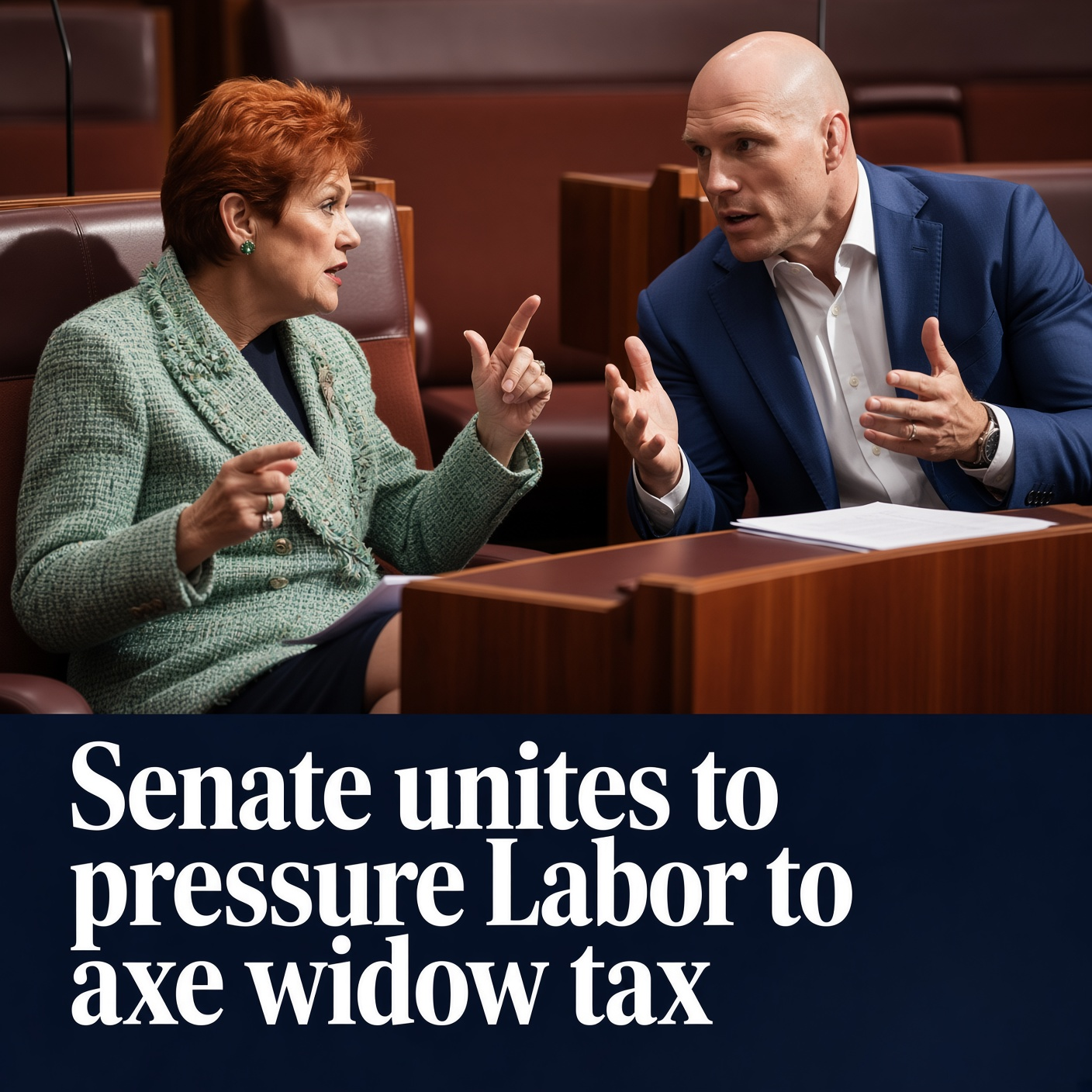
Labor is facing an unusually broad parliamentary alliance demanding an immediate fix to the so-called “widow tax”, with the Coalition, One Nation, Greens and influential crossbench senators joining forces to push their own legislation through the Senate.
The revolt brings together parties that rarely agree on major tax policy and increases pressure on the Albanese government to accelerate changes it has already promised to make.
Independent senators David Pocock and Jacqui Lambie are among those backing the push, alongside the Coalition, One Nation, the Greens and other crossbenchers.
The numbers potentially allow the legislation to clear the Senate without Labor.
But that would not abolish the disputed tax treatment by itself.
The bill would also have to pass the House of Representatives, where Labor holds a majority and can block legislation it does not support.
What is the ‘widow tax’?
Despite the politically potent nickname, Australia has not introduced a tax formally called the “widow tax”.
The dispute concerns an unintended consequence of Labor’s broader changes to negative gearing and capital gains tax.
The reforms limit negative gearing concessions for residential investment properties to new builds from July 1, 2027, while replacing the existing 50 per cent capital gains tax discount with a new system involving cost-base indexation and a 30 per cent minimum tax rate on capital gains accruing from that date.
Existing investment properties are intended to receive grandfathered treatment, protecting owners who bought before the new rules were announced.
The problem arises when jointly owned property changes ownership because one partner dies or a couple separates.
Under the legislation as passed, the transfer can cause the property to lose its grandfathered status, potentially leaving the surviving spouse or the person retaining the property after a relationship breakdown subject to the new tax arrangements.
That consequence became known politically as the “widow tax”.
Death or divorce could cost a property its grandfathered status
The practical concern can be illustrated with a couple who jointly own an investment property acquired before the government’s reforms.
While both remain owners, the property can continue under its grandfathered tax treatment.
If one spouse dies and ownership passes to the surviving spouse, however, that ownership change could cause the existing treatment to be lost.
A similar issue can arise when a relationship breaks down and one partner receives the other partner’s interest in the property as part of a settlement.
Opponents argue that means a tax reform supposedly directed at investment incentives can impose an additional financial consequence at precisely the moment a family is dealing with bereavement or divorce.
The government accepts that this outcome needs to be fixed.
Labor has already promised to change the law
The central dispute is therefore no longer about whether the problem exists.
It is about how quickly Parliament should repair it.
Labor announced on August 4 that it would amend the reforms so a person inheriting an investment property from their spouse would not lose the property’s existing access to negative gearing.
The government also opened consultation on additional carve-outs and technical changes involving newly constructed housing, affordable and disability accommodation and the new capital gains tax arrangements.
Treasurer Jim Chalmers has committed to fixing the unintended consequence.
But the government has chosen to conduct consultation and prepare its own amendments rather than immediately adopt the alternative legislation being pushed by its opponents.
That timetable has infuriated senators who argue there is no reason to wait when the government already accepts the policy outcome is wrong.
Pocock says the issue cannot wait
David Pocock has been one of the most prominent crossbench voices demanding faster action.
The ACT senator raised concerns about the issue during the original passage of the tax reforms and subsequently wrote to Chalmers and Finance Minister Katy Gallagher demanding “urgent legislative clarification”.
Pocock has argued that the uncertainty is already affecting Australians, even though the principal tax changes do not commence until July 2027.
He says family lawyers have reported lenders factoring the future reforms into lending assessments, potentially affecting settlements being negotiated now.
That is particularly concerning in divorce cases, where the ability of one partner to refinance a jointly owned property can determine whether they can retain the family’s investment asset.
Pocock therefore argues a promise to correct the problem later is insufficient.
He wants Parliament to legislate certainty now.
Coalition tried to force an immediate debate in the House
The Opposition has also attempted to use the issue against Labor in the House of Representatives.
Opposition Leader Angus Taylor moved on Tuesday to suspend standing orders so Parliament could immediately debate legislation addressing the “widow tax”.
He accused Labor of imposing an unfair burden on Australians dealing with the death of a partner or a traumatic separation.
The government used its House majority to defeat the attempt.
Taylor argued more than 40 days had passed since Chalmers promised a fix and accused Labor of unnecessarily delaying legislation by conducting another consultation process.
The government’s timetable could see its legislation dealt with during a later parliamentary sitting.
That is exactly what the Senate alliance is now attempting to disrupt.
Coalition, Greens and One Nation find common ground
The composition of the Senate coalition is politically striking.
The Coalition and One Nation have spent months attacking Labor’s broader tax reforms.
The Greens, by contrast, helped the government pass the reforms.
Yet the widow-tax issue has created enough common ground for those parties to support corrective action alongside independents and other crossbenchers.
That does not mean they agree on the merits of Labor’s overall negative gearing or capital gains tax agenda.
The agreement is considerably narrower.
They share the view that a person should not lose grandfathered tax treatment simply because their spouse dies or their relationship ends.
That narrow consensus is sufficient to put the government under significant pressure in the Senate.
Passing the Senate would be symbolic but not enough
The constitutional mechanics of the dispute are important.
Government legislation normally originates with ministers and, because Labor controls the House, the government has substantial control over which tax measures ultimately become law.
A bill supported by the non-Labor Senate can demonstrate that the government is isolated in the upper house.
It can force debate and increase political pressure.
But Senate passage alone cannot amend Australia’s tax laws.
The House must also agree to the bill.
With Labor holding a majority there, the government can prevent the opposition-backed measure from progressing and later introduce its own version of the fix.
The Senate manoeuvre is therefore as much about forcing Labor to accelerate its timetable as it is about legislating independently of the government.
The controversy came from much larger tax reforms
The widow-tax dispute is only one part of a substantial overhaul announced by Labor.
The Treasury Laws Amendment (Tax Reform No. 1) Bill 2026 made major changes to the taxation of property and capital gains.
Among other measures, it limits negative gearing on residential property investments to new builds from July 2027.
It also replaces the 50 per cent capital gains tax discount for individuals, trusts and partnerships with cost-base indexation and a 30 per cent minimum tax rate on relevant capital gains.
The reforms were among the most contentious elements of Labor’s tax package and attracted extensive criticism from property, business and tax groups during the legislative process.
The Parliamentary Library noted the controversy surrounding both the negative gearing and CGT components while the bills were before Parliament.
The grandfathering promise is at the heart of the argument
Grandfathering was designed to provide certainty to Australians who made investment decisions under the old tax system.
Rather than retrospectively applying the new negative gearing restrictions to every residential investment property, the government protected qualifying existing holdings.
That principle is why the death-and-divorce issue became so politically damaging.
A surviving spouse has not chosen to make a fresh investment simply because their partner died.
Likewise, a person receiving ownership of a jointly held property through a family-law settlement has not necessarily made the type of new investment decision the reforms were intended to discourage.
Treating those ownership changes as events capable of terminating grandfathered treatment therefore produced a result the government itself has now accepted should be corrected.
Critics say uncertainty is already causing problems
One of Labor’s arguments for taking time is that the relevant negative gearing changes do not begin until July 1, 2027.
In a purely tax-administration sense, that gives Parliament time to amend the rules before they begin operating.
Crossbench critics say that overlooks how financial decisions are made.
Banks, lawyers, accountants, investors and separating couples need to plan based on legislation already on the books.
Pocock has specifically pointed to reports from family lawyers that lenders are incorporating the future rules into loan assessments.
If a person going through a divorce needs finance to buy out their former partner’s share of a property, uncertainty about its future tax treatment can affect the bank’s assessment of that transaction.
That is why opponents argue the damage is not necessarily confined to tax bills issued after July 2027.
Labor wants a broader, technically robust fix
The government’s counterargument is that tax legislation is complex and correcting one unintended consequence can create others if amendments are rushed.
Labor’s consultation is considering more than bereavement.
The government has also been examining the treatment of relationship breakdowns and other circumstances in which property ownership changes without representing a conventional new investment.
Its August proposal specifically protects people inheriting investment property from a spouse, while consultation continues on other carve-outs.
From Labor’s perspective, the objective is to ensure the eventual legislation works across the tax system rather than rapidly passing an opposition bill that may require further repair.
Opponents counter that the core widow-and-divorce problem is already well understood and should be removed immediately.
This is not a superannuation death tax
The nickname also creates potential confusion with an entirely different area of Australian taxation.
Australia already has rules governing the taxation of superannuation death benefits paid to certain beneficiaries.
Those rules are unrelated to the current “widow tax” controversy.
The dispute before Parliament concerns the tax treatment of investment property under Labor’s new negative gearing and capital gains regime.
It is therefore inaccurate to describe the current Senate fight simply as an attempt to abolish an inheritance tax or an existing tax on superannuation death benefits.
The government has already faced pressure to amend its reforms
The latest confrontation is also part of a wider process of adjusting Labor’s tax package after objections from affected sectors.
The government has previously had to address concerns about the effect of its capital gains changes on start-ups and small businesses, while consultation continues over other elements of the tax overhaul.
That history has encouraged the Opposition to portray the widow issue not as an isolated drafting problem but as evidence the reforms were rushed.
Labor rejects the broader attack and maintains it can correct unintended consequences without abandoning the central tax changes.
The argument is now about speed, not whether widows should be protected
For all the partisan rhetoric surrounding the issue, the parliamentary disagreement has narrowed considerably.
The government has acknowledged the unintended consequence and promised to fix it.
The Coalition wants it fixed.
One Nation wants it fixed.
The Greens and key crossbenchers support action to prevent bereavement or relationship breakdown from stripping existing property owners of grandfathered treatment.
The remaining dispute is principally over timing and legislative mechanism.
Labor wants to complete consultation and introduce its own solution.
Its opponents want Parliament to act immediately.
Senate vote puts the political problem back on Labor
The cross-party alliance cannot force the government to accept its legislation while Labor controls the House.
It can, however, make delaying the promised fix increasingly uncomfortable.
If the alternative bill passes the Senate, Labor will face a straightforward political question: why not allow the House to pass a correction that almost every other parliamentary grouping supports?
The government can answer that its own legislation will be more comprehensive and technically sound.
But the longer that process takes, the easier it becomes for opponents to argue that Australians affected by death or separation are being left with avoidable uncertainty.
The “widow tax” was never the government’s stated policy objective.
Labor has already accepted that it needs to disappear.
Now an unusually united Senate is trying to ensure it disappears on Parliament’s timetable rather than the government’s.