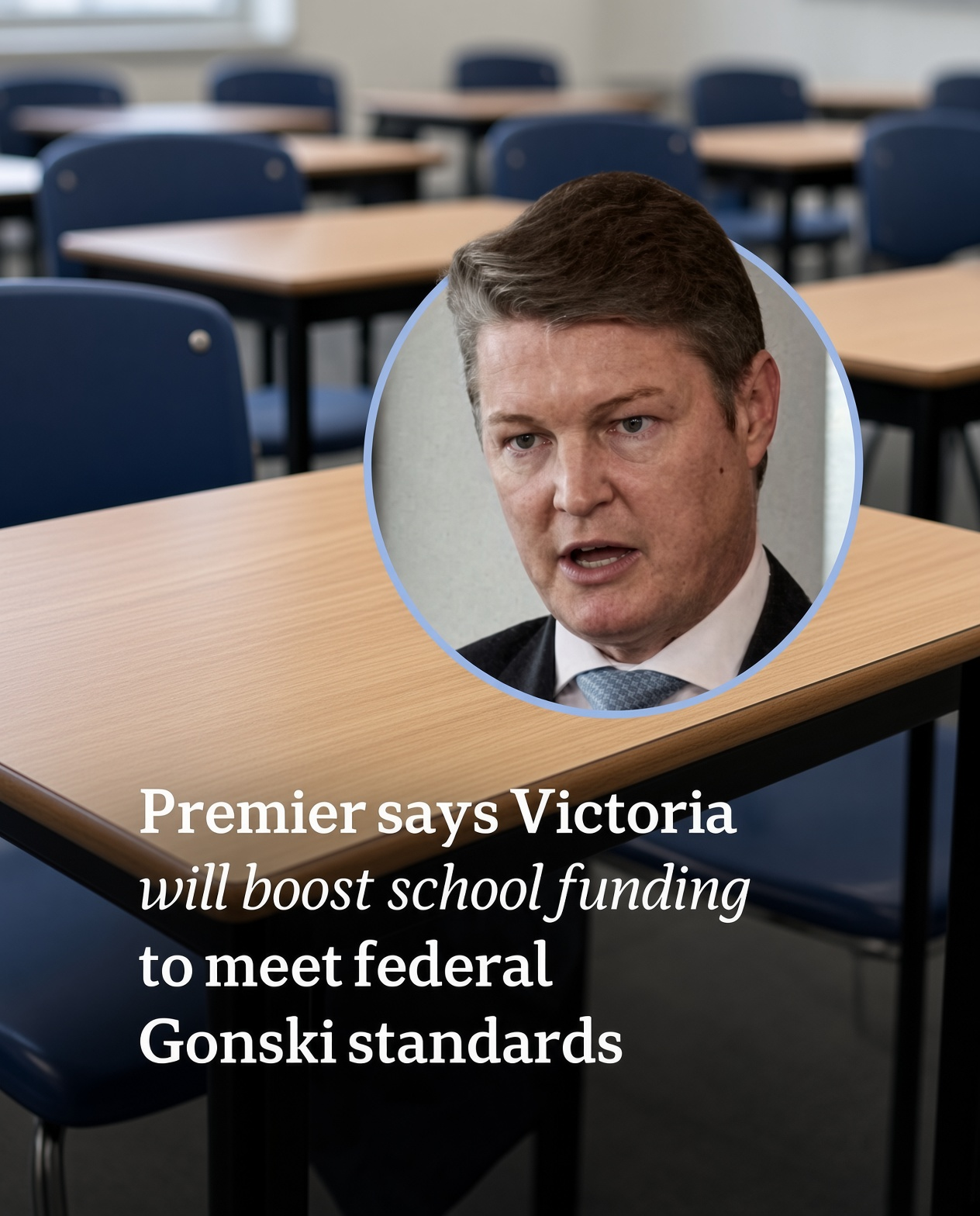
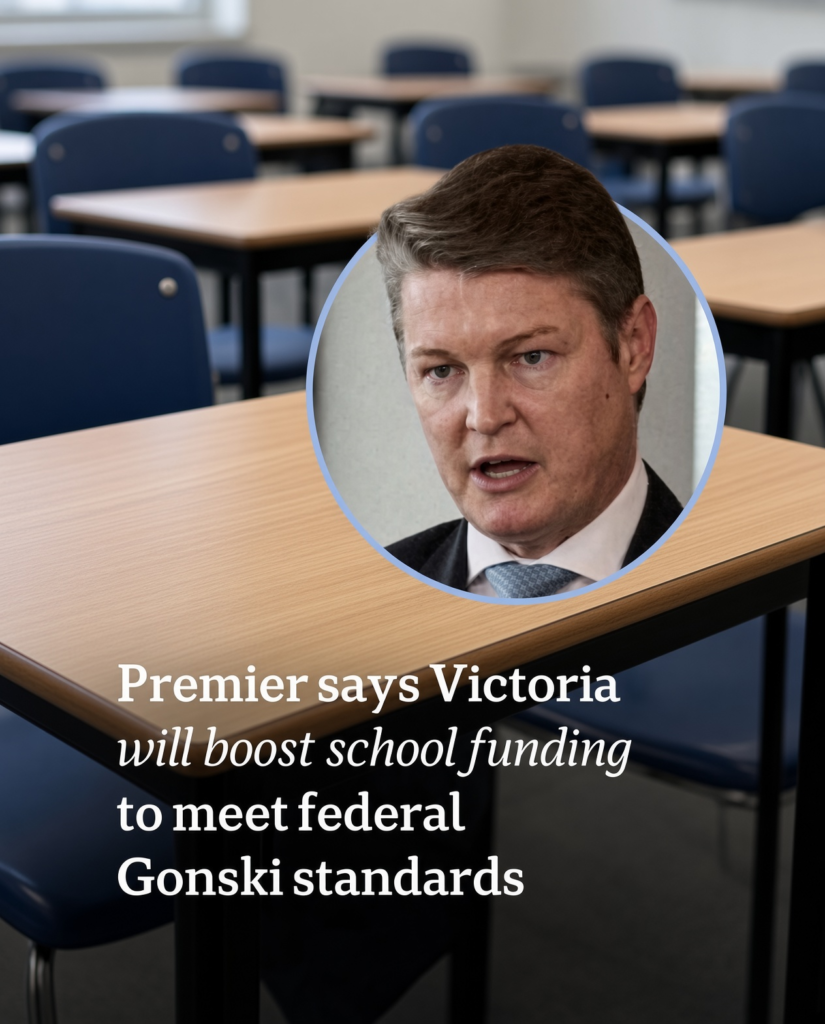
Victorian public schools are set for a major funding boost after new Premier Ben Carroll pledged to finally complete the state’s long-delayed school funding agreement with Canberra, potentially unlocking billions of dollars in additional Commonwealth support.
Carroll says his government intends to finalise a full funding agreement with the federal government before Victoria’s November election, putting the state’s public schools on a path towards receiving 100 per cent of the nationally agreed Schooling Resource Standard.
The commitment represents a significant intervention by the new Premier in one of the most contentious issues confronting Victoria’s education system.
Victoria is currently the national laggard in the transition to full public-school funding, with the state contributing about 70 per cent of the Schooling Resource Standard and the Commonwealth contributing 20 per cent under the present interim arrangements.
The federal government has offered to lift its contribution from 20 per cent to 25 per cent.
But for Victoria to secure the full benefit of that additional Commonwealth money, the state must meet its own obligation to fund at least 75 per cent of the standard.
Together, the two contributions would bring Victorian government schools to the benchmark of 100 per cent of the SRS.
Carroll told the ABC it was his intention to complete the agreement before voters go to the polls in November, saying he had recently discussed the issue with Prime Minister Anthony Albanese.
“I want to get this done,” Carroll said.
For public schools, the consequences could be substantial.
The Commonwealth has previously estimated its additional five percentage points would deliver about $2.5 billion in extra federal funding to Victorian public schools over a decade.
But the money comes as part of a broader funding partnership rather than a simple unconditional payment from Canberra.
Victoria must increase its own contribution and satisfy the terms of the Better and Fairer Schools Agreement, which links additional funding to reforms intended to improve student outcomes.
The dispute revolves around the Schooling Resource Standard, or SRS, the central funding benchmark that grew out of the landmark Gonski review.
The SRS is an estimate of how much public funding a school requires to meet the educational needs of its students.
Rather than allocating exactly the same amount for every child, the model begins with a base amount and adds additional funding according to student and school circumstances.
Those loadings recognise factors including socioeconomic disadvantage, disability, Aboriginal and Torres Strait Islander students, English-language needs, school size and geographic location.
The basic principle is that educating a child facing significant disadvantage may require more resources than educating a student without those additional needs.
The model traces its origins to the major review of Australian school funding led by businessman David Gonski and released in 2012.
That review concluded Australia needed a more consistent, needs-based system capable of reducing the relationship between a child’s background and their educational achievement.
The SRS subsequently became the benchmark around which Commonwealth and state funding arrangements were constructed.
More than a decade later, however, many Australian public schools were still operating below the benchmark.
The Albanese government responded through the Better and Fairer Schools Agreement, offering states and territories additional Commonwealth funding to put government schools on a path to 100 per cent of the SRS.
For most jurisdictions, Canberra agreed to increase its contribution from 20 per cent to 25 per cent by no later than 2034.
The states are expected to provide the remaining 75 per cent.
The Northern Territory has a different arrangement because of its substantially greater level of educational disadvantage, with the Commonwealth agreeing to lift its share there to 40 per cent.
By March 2025, the federal government had announced agreements with every state and territory putting public schools on a path towards full funding.
Victoria’s position proved more complicated.
The Allan government and Commonwealth announced an in-principle arrangement in January 2025 under which Canberra would provide the additional five percentage points.
At the time, Albanese, then-premier Jacinta Allan, federal Education Minister Jason Clare and Carroll — who was deputy premier and Victorian education minister — jointly described it as an historic agreement.
The Commonwealth estimated its additional contribution would provide around $2.5 billion to Victorian public schools over the following decade.
However, Victoria did not complete the long-term bilateral agreement required to establish the final funding trajectory.
Instead, the two governments signed an interim arrangement providing funding certainty through the end of 2026 while negotiations continued.
Under that stopgap deal, Victorian public schools remain funded at roughly 90 per cent of the benchmark, with the Commonwealth providing 20 per cent and the state nominally providing about 70 per cent.
That has left Victoria behind jurisdictions that have moved further towards full SRS funding.
The issue became increasingly politically damaging for the Allan government because of an earlier decision to delay the state’s own funding timetable.
Carroll has since acknowledged that decision was wrong.
Before becoming Premier, he had served as Victoria’s education minister and had pushed internally for the government to maintain its school funding commitments.
After taking the premiership, Carroll said he had argued strongly against delaying the funding timetable when the matter was considered inside government.
The delay has been estimated to have removed about $2.4 billion from the funding public schools would otherwise have received over the relevant period.
For Carroll, reversing course therefore carries both policy and political significance.
It allows him to distance his new administration from a controversial decision made under Allan while acting on an issue he had already opposed internally.
It also addresses one of the biggest grievances of Victorian teachers at a time when the government is embroiled in a bitter industrial dispute with the education workforce.
The Australian Education Union has been demanding significantly better pay, smaller classes, reduced workloads and greater investment in schools.
Teachers have staged industrial action as negotiations over a new enterprise agreement have dragged on.
The dispute has placed considerable pressure on Labor, traditionally a party with close political and industrial links to public-sector workers.
Carroll’s school funding commitment therefore arrives at an important moment.
On Monday, the Victorian government also put forward a revised pay package for teachers, principals and education support staff.
The proposal includes a $2,000 bonus and salary increases worth at least 28.3 per cent over four years, as well as changes intended to reduce some administrative and meeting burdens.
The union is considering the offer.
But the arguments over wages and SRS funding are not identical.
Teacher salaries represent one of the largest costs in the school system, but additional needs-based funding can also support classroom assistance, student wellbeing, specialist programs, intervention for children falling behind and other resources.
Carroll has previously argued that reaching full funding would allow schools to employ more teachers and support staff and provide more individual assistance to students.
For disadvantaged schools, the SRS matters particularly because the model is designed to direct extra funding towards students requiring greater educational support.
The full-funding agreement would also come with reform obligations.
The federal government’s Better and Fairer Schools framework does not simply transfer more money to the states.
Jurisdictions receiving additional Commonwealth funding are expected to implement measures aimed at improving educational outcomes, including evidence-based teaching, targeted student support and greater transparency about school performance.
The original 2025 Victoria-Commonwealth announcement identified priorities including more individualised support for students, evidence-based teaching practices and additional mental-health assistance.
Victoria has also committed to reforms aimed at strengthening mathematics and numeracy teaching.
One of the more complicated elements of the negotiations concerns what governments are permitted to count as school funding.
Critics of previous agreements have argued that headline percentages can exaggerate how much money actually reaches schools because governments have been allowed to count certain indirect expenditures towards their SRS contribution.
Victoria has faced particular scrutiny over those accounting arrangements.
The January 2025 agreement included a commitment to change how the state treated a four percentage point allowance for indirect costs.
The previous framework allowed Victoria to count expenses such as capital depreciation towards its funding share.
Under the new arrangements, that provision is intended to be replaced by recurrent spending on eligible expenses as the system transitions towards full funding.
Federal Education Minister Jason Clare has previously said Victoria must reach and maintain at least 75 per cent of the SRS while reducing the amount of indirect expenditure counted towards that share by 2034.
Education advocates have nevertheless continued to question whether accounting exemptions leave schools receiving less usable funding than headline government figures suggest.
Save Our Schools, an advocacy group campaigning for increased public-school funding, has argued that deductions and offsets have produced a substantial gap between Victoria’s nominal funding contribution and the amount it regards as genuine SRS expenditure.
That debate means the details of the bilateral agreement Carroll ultimately signs will matter almost as much as the announcement that a deal has been reached.
A commitment to “100 per cent” funding can sound straightforward.
In practice, the path involves Commonwealth and state contributions, transition dates, permitted expenditure categories and reform obligations that determine how much additional money reaches classrooms and when.
There is also the question of timing.
The national framework allows full funding to be reached by 2034 at the latest.
Carroll’s immediate promise is to complete the agreement before November’s state election, not necessarily to increase Victoria’s contribution from 70 to 75 per cent overnight.
The bilateral agreement would establish the pathway and timetable for reaching the benchmark.
That distinction is important for schools waiting for additional resources.
Signing the deal would unlock the Commonwealth’s higher contribution over the agreed transition period, but the full 100 per cent SRS level would be phased in rather than arriving as a single immediate cash injection.
The political impact could arrive considerably sooner.
Carroll has been attempting to reset Victorian Labor after replacing Allan as Premier, with education emerging as one of the areas where he can demonstrate a tangible change in direction.
His personal connection to the portfolio makes the issue particularly significant.
Before taking the top job, Carroll spent years as education minister and repeatedly advocated for the Commonwealth to increase its contribution to public schools.
In 2024, he publicly pushed the Albanese government to lift Canberra’s share to 25 per cent, arguing the then-proposed federal increase was insufficient.
The Commonwealth eventually agreed to precisely that 25 per cent contribution.
Victoria’s own funding decisions then became the obstacle to completing the arrangement.
Carroll now has responsibility for resolving the problem from the Premier’s office.
For the federal government, completing the Victorian deal would also remove an awkward unfinished element of its national school-funding agenda.
Canberra has repeatedly promoted the Better and Fairer Schools Agreement as the mechanism that will finally put every Australian public school on a path towards full SRS funding.
Without Victoria’s final bilateral agreement, the country’s second-largest state school system remained an important exception in practice.
A completed deal would allow both Labor governments to argue they had delivered on one of the central recommendations associated with the Gonski era: needs-based public funding sufficient to meet the nationally defined resource benchmark.
But the history of Australian school funding ensures political arguments will continue even after an agreement is signed.
The original Gonski review was commissioned more than 15 years ago, and generations of students have passed through the education system while governments negotiated over responsibility for meeting the benchmark.
Teacher unions and public-school advocates have repeatedly argued that delayed funding represents resources denied to students now, particularly in communities facing disadvantage.
Governments have countered that moving billions of dollars through the education system requires sustainable budget planning and reforms capable of demonstrating improved outcomes.
Victoria’s financial position adds another layer of difficulty.
The state is carrying substantial debt and faces competing demands for expenditure across hospitals, transport infrastructure, housing and other public services.
Committing another five percentage points of the SRS to public schools therefore requires meaningful additional state expenditure at a time of considerable budget pressure.
But failing to do so also carries a cost.
Because the Commonwealth’s extra contribution is tied to Victoria meeting the agreed funding conditions, leaving the state contribution below the required level risks delaying federal money that would otherwise flow into Victorian schools.
That is the financial opportunity Carroll now says he intends to capture.
It also explains why the issue is likely to feature heavily in the November election campaign.
Labor can present the agreement as a major investment in public education and evidence that the new Premier is prepared to reverse unpopular decisions inherited from the previous administration.
Teachers and education advocates, however, will be watching the timetable and accounting details closely rather than judging the policy solely on the headline commitment.
The Coalition will also have an opportunity to scrutinise how Labor intends to pay for the state’s increased contribution amid Victoria’s broader fiscal pressures.
For parents and students, the debate ultimately comes down to what additional resources become available inside schools.
Full SRS funding is designed to mean more than an accounting benchmark.
Its purpose is to give schools the staffing and support necessary to respond to the actual needs of their students, with additional assistance directed towards disadvantage rather than distributed uniformly.
After years of arguments over who should pay, Victoria is now closer to settling that question.
Carroll has put a clear political deadline on himself: he wants the agreement completed before the state election.
If he delivers it, Victoria would finally have a defined path from its current funding arrangements towards a combined 75 per cent state and 25 per cent Commonwealth contribution to the Schooling Resource Standard.
That would unlock the additional federal funding Canberra has had on the table and bring Victorian public schools into the national full-funding framework.
For a Premier seeking to establish his government quickly, it would also give Carroll a significant early achievement in the portfolio that helped define his political career.
The harder test will come afterwards: ensuring the promised funding actually reaches schools on schedule and produces the classroom improvements the Gonski reforms were intended to deliver.