Pauline Hanson is taking One Nation into some of Melbourne’s most unlikely political territory as the party attempts to turn its national resurgence into something far more consequential: influence over who governs Victoria.
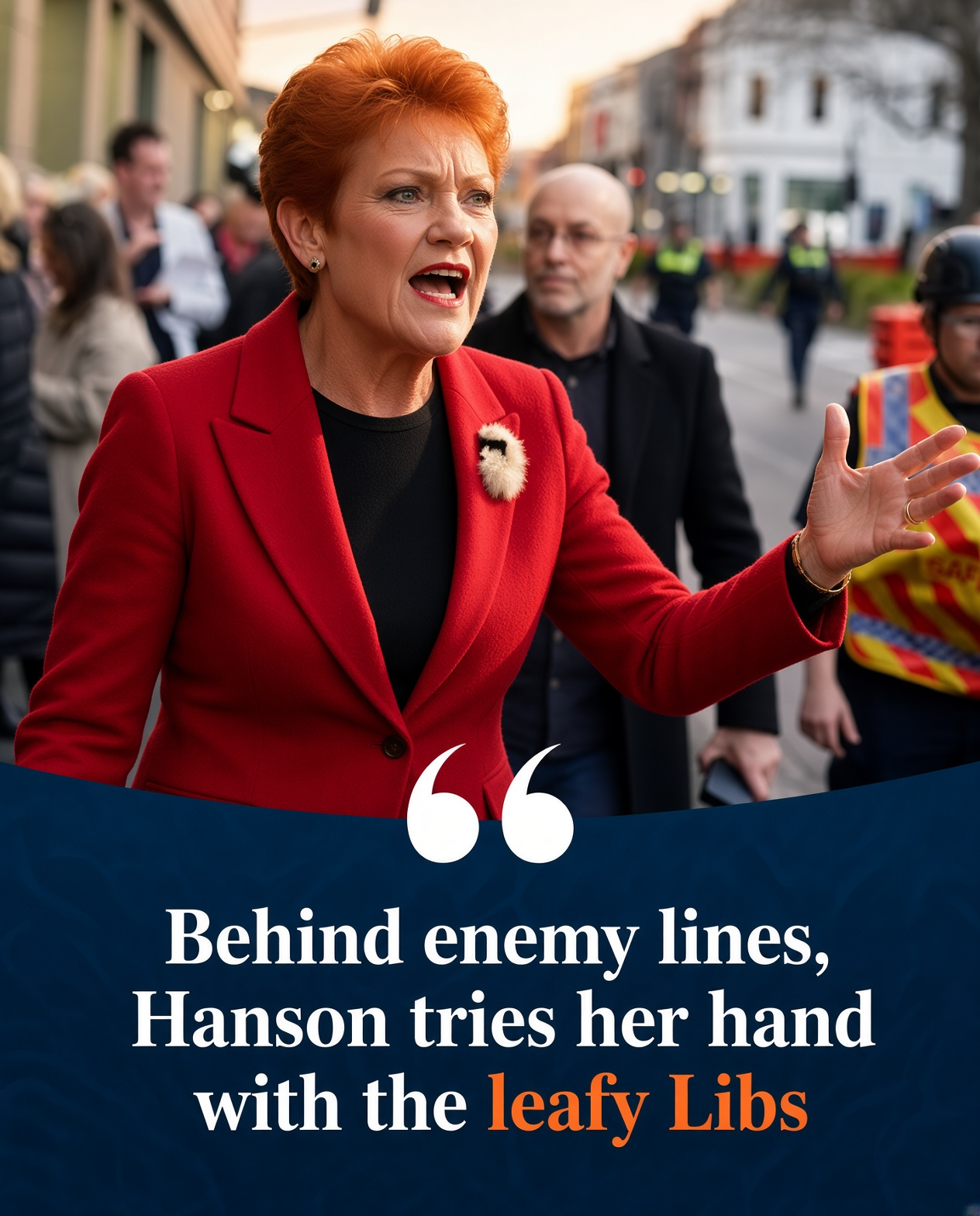
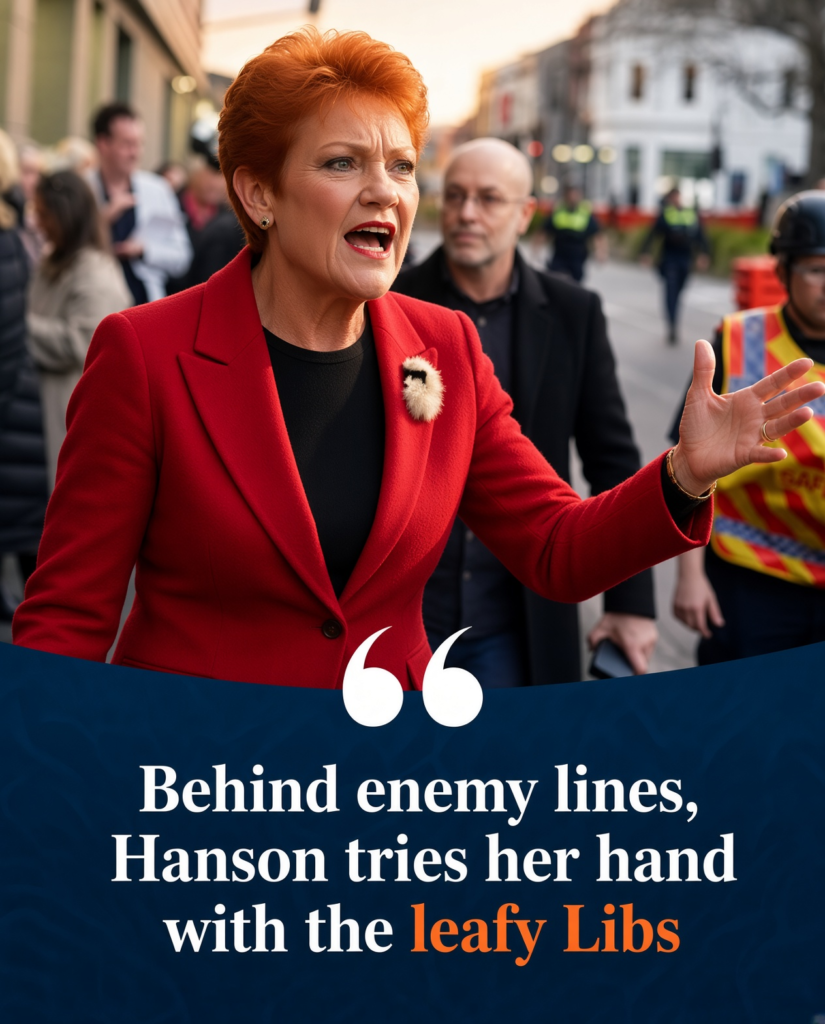
Hanson ventured into Melbourne’s affluent inner-east last week, bringing her political roadshow to Hawthorn — territory more readily associated with wealthy Liberal voters, teal independents and progressive professionals than One Nation.
It was an unusual setting for a party whose strongest historical appeal has tended to come from regional Australia, outer suburbs and communities dissatisfied with both major parties.
But that was precisely the point.
One Nation is no longer content to campaign only where Hanson already has an obvious constituency.
It wants Liberal voters too.
And as Victoria approaches its November 28 election, Hanson has an opportunity to exploit a political landscape in which Labor is struggling after more than a decade in government, the Coalition is attempting to demonstrate it is ready to govern, and large numbers of voters have shown a willingness to abandon the traditional major parties.
One Nation’s support appears to have softened from some of the extraordinary polling highs recorded earlier this year.
That does not necessarily make Hanson less important.
In a sufficiently fragmented election, it could make her party pivotal.
One Nation does not need to win government in Victoria to influence who does.
It can take primary votes from Liberal and Labor candidates, alter preference contests in marginal electorates and potentially secure Legislative Assembly or Legislative Council representation capable of shaping the next parliament.
If neither Labor nor the Coalition wins the 45 lower-house seats required for a majority, the composition of the crossbench could determine whether Premier Ben Carroll or Liberal leader Jess Wilson is ultimately able to form government.
That possibility explains why Hanson’s Victorian campaign is receiving scrutiny far beyond what One Nation’s historical performance in the state might suggest.
Victoria has traditionally been difficult territory for the party.
One Nation performed far better in Queensland and parts of regional Australia during its original rise in the late 1990s.
Electoral analyst Antony Green’s examination of the 1998 federal election illustrates the difference.
One Nation recorded only 3.7 per cent in Victoria that year, compared with substantially stronger results in some other states.
Its support was also markedly weaker in inner-metropolitan electorates than in provincial and rural seats.
Hawthorn therefore represents almost the opposite of the traditional One Nation stereotype.
The suburb sits within Melbourne’s prosperous eastern belt, close to some of the most expensive residential areas in Australia.
The broader region has long been central to the Victorian Liberal Party’s identity.
But the politics of Melbourne’s wealthy inner-east have changed.
Traditional Liberal voters have become more willing to support independents and minor parties, while disputes over climate policy, taxation, social issues and the direction of the Liberal Party have fractured once-reliable voting blocs.
One Nation is now testing whether some of that discontent can move in its direction rather than towards centrist independents.
The party promoted an August 3 Hawthorn event featuring Hanson and its Victorian Legislative Council candidates as part of the launch of its state campaign.
The choice of location amounted to a statement of intent.
Hanson is attempting to demonstrate that One Nation’s appeal can extend into territory once regarded as safely Liberal.
It is part of a broader Victorian expansion.
One Nation has installed Warren Pickering as its state leader and lower-house candidate for Pakenham while announcing an initial group of eight upper-house candidates.
The party has signalled an ambition to contest seats widely across Victoria.
Hanson has framed the campaign around familiar One Nation themes including migration, crime, cost of living, government spending and opposition to progressive social policy.
But Victoria presents a different challenge from a federal election.
State governments do not control migration levels, meaning Hanson’s most powerful national campaign issue cannot simply be translated into a Victorian government policy.
One Nation must instead persuade voters that its broader arguments about population growth, housing, infrastructure and government priorities remain relevant to state politics.
It must also develop credible positions on hospitals, schools, policing, roads, public transport, debt and the other services directly controlled from Spring Street.
Pickering will be central to that effort.
He is contesting Pakenham, an outer-suburban electorate on Melbourne’s south-eastern fringe where rapid population growth and infrastructure pressures give One Nation a more obvious political opening than Hawthorn.
The seat is also exactly the kind of electorate likely to matter in a close election.
But the larger strategic threat One Nation poses to the major parties is not confined to the seats it might actually win.
Preferences could be decisive.
Victoria uses preferential voting in Legislative Assembly elections.
A candidate therefore does not need to lead on first preferences to win a seat.
If nobody receives an absolute majority of first-preference votes, lower-ranked candidates are eliminated and their ballots redistributed according to voters’ subsequent preferences until one of the remaining candidates has a majority.
That system makes a large One Nation primary vote potentially important even where its candidate finishes third.
Imagine a traditional Labor-Liberal marginal seat in which One Nation attracts a substantial bloc of voters who previously supported the Coalition.
The Liberal candidate could fall behind Labor on first preferences but recover if enough One Nation voters direct subsequent preferences back to the Coalition.
Alternatively, fragmented preference flows could produce unexpected contests in which One Nation itself survives into the final count.
That uncertainty is one reason conventional two-party-preferred polling becomes less informative as support for minor parties rises.
Australia’s electoral system was built to produce a final majority between candidates at the electorate level, but it does not guarantee the final two candidates will always be Labor and Liberal.
Victoria in 2026 increasingly resembles a genuine multi-party contest.
Earlier polling illustrated how disruptive that could become.
Leaked seat modelling reported by the Australian Financial Review in July produced a scenario in which Labor could fall to approximately 25 Legislative Assembly seats, the Coalition win around 28 and One Nation secure as many as 19.
Such modelling should not be read as a prediction of the November result.
Seat projections based on statewide polling become particularly uncertain when a minor party has limited historical state-election data, candidate quality varies enormously and preference flows are difficult to forecast.
But the modelling demonstrated the scale of disruption theoretically possible if One Nation converted its polling support efficiently into individual electorates.
A parliament resembling that scenario would leave no major party close to the 45 seats required for majority government.
Negotiations with crossbench MPs would then become unavoidable.
That possibility has transformed the strategic calculations facing both major parties.
For Labor, One Nation potentially draws support from working-class and outer-suburban voters who once formed part of the party’s traditional electoral coalition.
Migration, housing affordability, crime and cost-of-living pressures can resonate strongly in communities experiencing rapid population growth and stretched public infrastructure.
For the Liberals, the threat is different and potentially more immediate.
One Nation competes directly for conservative voters.
A voter frustrated with Labor but unconvinced by the Liberal opposition now has another prominent option on the right.
That makes Hanson both a potential source of preferences and a competitor capable of preventing Liberal candidates from reaching the final count.
It also explains the symbolism of campaigning in Melbourne’s Liberal heartland.
Hanson is effectively telling conservative voters they no longer have to regard the Liberal Party as their automatic political home.
That challenge is particularly uncomfortable for Wilson.
The opposition leader needs to consolidate voters dissatisfied with Labor if the Coalition is to return to government after four consecutive election defeats.
Every anti-Labor voter who chooses One Nation rather than the Liberals makes that task more complicated.
At the same time, Wilson cannot afford to alienate One Nation voters whose preferences may ultimately be required to defeat Labor candidates.
That creates a familiar strategic dilemma for centre-right parties confronting a populist competitor.
Move too far towards One Nation and the Liberals risk losing moderate voters.
Attack Hanson too aggressively and they risk antagonising voters whose preferences could decide marginal seats.
Ignore her and One Nation may continue eating into the conservative primary vote.
The problem is magnified in affluent inner-Melbourne electorates, where the Liberals face pressure from the opposite political direction as well.
Independent candidates have already demonstrated an ability to win traditional Liberal voters concerned about climate policy, political integrity and social issues.
The Liberal Party can therefore find itself squeezed simultaneously by centrist challengers on one side and One Nation on the other.
That is the political terrain Hanson is exploring in Hawthorn.
Whether significant numbers of “leafy Liberal” voters will actually switch to One Nation remains uncertain.
Historical voting patterns suggest affluent inner-metropolitan electorates are considerably harder territory for Hanson than regional or outer-suburban communities.
But One Nation does not necessarily need a breakthrough victory there for the strategy to matter.
Even a modest reduction in the Liberal primary vote can change a close contest.
The same principle applies across the state.
One Nation’s importance in November will depend not only on its statewide percentage but on where that vote is concentrated.
Ten per cent spread evenly across Victoria may produce very different results from 20 or 25 per cent concentrated in a smaller number of outer-suburban and regional electorates.
Candidate selection matters too.
Minor parties frequently perform strongly in opinion polls before elections but struggle to reproduce those numbers uniformly when voters encounter unfamiliar local candidates.
Campaign organisation, volunteers, preference negotiations and the ability to staff polling booths can all affect the final result.
One Nation is attempting to build that organisational infrastructure in Victoria now.
The launch of its first candidate group was therefore about more than publicity for Hanson.
It represented an effort to turn a national political brand into a functioning state-election machine.
That transition has already brought scrutiny.
Pickering has faced questions about previous statements that appeared to differ from federal One Nation positions, including his comments on deporting visa overstayers.
The party’s media strategy has also become controversial after journalists from the ABC, The Guardian and The Age were barred from a Melbourne press conference announcing candidates.
Hanson accused those organisations of biased coverage and said the restrictions were temporary.
Critics accused her of avoiding scrutiny precisely when One Nation was asking Victorians to take its candidates seriously as potential parliamentarians.
The confrontation illustrates the transition the party is attempting to make.
A protest party can campaign largely through its leader and broad messages.
A party capable of determining government faces much more detailed examination of its candidates, costings, internal discipline and state-specific policies.
That scrutiny will intensify if One Nation continues polling at levels that put multiple seats within reach.
Hanson also faces another complication: the party’s support is volatile.
Different Victorian polls this year have produced strikingly different results.
A Roy Morgan poll conducted in April had One Nation at 24.5 per cent in Victoria.
Resolve polling across March and April put the party at 21 per cent, while Freshwater polling in March recorded 20 per cent.
Earlier Roy Morgan polling in February had One Nation as high as 26.5 per cent.
The variation is a warning against treating any individual result as a settled measure of the party’s support.
Polling methodology, undecided voters and the difficulty of measuring a rapidly changing three-party contest can produce substantial differences.
Recent reporting suggests One Nation has softened from some of its earlier peaks.
But the relevant question is not simply whether Hanson is rising or falling by several percentage points.
It is whether One Nation remains large enough to disrupt the Labor-Coalition contest.
On current evidence, it does.
The political environment has also changed significantly since many of the earlier polls were conducted.
Jacinta Allan is no longer premier.
Ben Carroll has taken over Labor’s leadership and is attempting to reset a government damaged by concerns over debt, infrastructure spending, crime, cost of living and fatigue after years in office.
Carroll has moved quickly on education funding and other issues in an effort to establish a different political identity.
That creates another uncertainty for Hanson.
One Nation’s strongest polling developed while Allan was premier and voter dissatisfaction with her government was exceptionally high.
If Carroll succeeds in recovering disaffected Labor voters, some of the conditions that produced One Nation’s surge could weaken.
The Liberals face the same uncertainty from the opposite direction.
Wilson has a substantial advantage over Carroll in recent preferred-premier polling, but converting dissatisfaction with Labor into a majority Coalition government remains a much harder task.
Latest Victorian reporting points to a large bloc of voters who remain unconvinced by either major party.
Cost of living, crime, housing, healthcare and economic management remain central concerns.
Those issues do not fit neatly into a traditional left-right contest.
That gives minor parties opportunities.
It also makes the election unusually difficult to model.
One Nation’s strongest weapon is dissatisfaction.
Voters do not need to agree with every Hanson policy to use a One Nation first preference as a rejection of Labor and the Coalition.
But protest voting becomes more complicated when a minor party has a realistic chance of winning seats.
Voters who once treated One Nation as a way to send the major parties a message may increasingly have to consider what its candidates would actually do in parliament.
That is particularly important in a potential hung parliament.
If One Nation wins lower-house seats and neither major party reaches 45, individual One Nation MPs could face decisions about confidence and supply — the votes determining whether a government can survive and fund its operations.
Hanson would then have influence extending far beyond the percentage of Victorians who gave her party their first preference.
The upper house provides another avenue to power.
Victoria’s Legislative Council is elected using proportional representation across eight regions.
Minor parties can therefore win representation with a substantially smaller share of the vote than is generally required to capture a lower-house electorate.
One Nation’s eight announced upper-house candidates demonstrate the importance it places on that chamber.
A strong result could give the party votes needed by whichever government emerges to pass contested legislation.
Even if Hanson’s candidates fail to determine who becomes premier, they could help determine what that premier is able to legislate.
That is why focusing only on whether One Nation’s headline polling has risen or fallen can miss the larger story.
The party’s Victorian campaign has already changed the strategic environment.
Labor must defend outer-suburban and working-class voters against a challenger attacking it over migration, housing and cost of living.
The Liberals must simultaneously defeat Labor while preventing Hanson from fragmenting the conservative vote.
And both parties must prepare for the possibility that neither will control parliament alone.
Hanson’s trip into Hawthorn captures that disruption neatly.
It is not natural One Nation territory.
That is what makes it politically interesting.
Twenty-eight years ago, One Nation’s Victorian vote was tiny compared with its support in Queensland and regional Australia.
Today Hanson can hold an event in Melbourne’s affluent east while both major parties watch closely for signs that even their traditional voters are prepared to move.
The experiment may fail.
Some of the voters attracted to One Nation during its polling surge may return to the Liberals or Labor as election day approaches.
Others may choose independents or smaller parties.
The difficulty of translating statewide polling into individual lower-house victories could leave One Nation with far fewer seats than its headline support initially suggests.
But the major parties cannot plan on that outcome.
With just over three months until Victorians vote, the election remains too fragmented and too volatile to assume the contest will eventually revert to a conventional Labor-versus-Coalition race.
Hanson does not have to conquer Melbourne’s leafy Liberal suburbs to change the result.
She only needs to take enough votes in enough electorates to alter who survives the preference count — and enough seats, if the parliament is hung, to make both major parties pay attention afterwards.