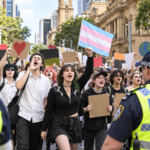
A nationwide student walkout against Pauline Hanson has ignited a bitter political argument before it has even begun, with critics telling teenagers to stay in class while organisers urge young Australians to take to the streets against One Nation.
High school and university students are preparing to walk out on Thursday, August 13, as part of a coordinated national day of action promoted under the banner “Students Say No to Hanson”.
Rallies are planned across major Australian cities including Brisbane, Melbourne, Sydney, Canberra, Adelaide and Perth, as well as Wollongong and Newcastle.
The High School Anti-Capitalists group is among those organising and promoting the protests, while the National Union of Students has also backed the campaign.
Organisers are calling on students to leave school and university classes to demonstrate against Hanson and One Nation’s growing political influence.
But the campaign has triggered an increasingly combative response from conservative politicians and commentators, who question both the decision to miss classes and the extent to which school-aged children understand the political arguments they are being encouraged to join.
The latest flashpoint came from a promotional video directed at Queensland students.
“Students in Queensland are going to walk out on this Thursday to fight against Pauline Hanson,” an organiser said in the clip.
“If you hate Pauline Hanson, you have to be there to learn how to fight her and her racism.”
The wording of the appeal quickly became ammunition for critics.
A right-wing commentator operating under the name GoWokeGoBroke seized on the phrase “walk out on this Thursday”, arguing the grammatical mistake undermined the message being delivered.
“Kids who can’t form simple sentences need to stay in school and not go to Pauline Hanson protests,” the commentator wrote.
“This is exactly why they need to stay in school and not go to Pauline Hanson protests.”
The commentator then offered a grammar lesson, suggesting the speaker should have said students would “walk out this Thursday” or “walk out on Thursday”.
The exchange was mocking, but it reflected a much larger dispute that has developed around the protests.
Should school students leave class to participate in political activism — and who is influencing them to do it?
Liberal senator Alex Antic has already entered that argument, accusing adults of politicising children for left-wing political causes.
Antic said students should be at school rather than abandoning lessons to protest against a political party and questioned whether young participants fully understood the issues involved.
“Why are kids protesting things that they don’t really — I think — have a proper grasp of?” Antic said.
He also questioned why adults were encouraging students to participate.
“Kids need to be in schools,” he said.
That argument has become one of the principal lines of criticism directed at the August 13 action.
Supporters see young people participating in democratic debate about racism, migration, gender and Australian politics.
Critics see politically active adults and organisations encouraging children to leave school for a partisan demonstration against a party they may not yet be old enough to vote against.
The organisers reject the suggestion that young Australians should remain politically passive until adulthood.
Promotional material for the walkout portrays Hanson and One Nation as representing what activists describe as racist, sexist, anti-worker and far-right politics.
Those descriptions are the organisers’ political characterisations of Hanson and her party rather than neutral descriptions of One Nation’s policies.
The activists have also criticised Labor and the Coalition, and some of the groups involved take explicitly anti-capitalist positions extending well beyond opposition to Hanson.
The High School Anti-Capitalists have encouraged students to organise within their schools through social media, posters, group chats and networks of friends.
They have framed the August 13 rallies as a national mobilisation rather than a conventional political meeting.
Students are being encouraged to leave their classes and converge on central locations in their cities.
In Melbourne, the rally is scheduled for 2pm outside the State Library of Victoria.
Students from a range of public and private schools are expected to participate, including teenagers from schools such as Methodist Ladies’ College, Mount Alexander College, Footscray High School, Northcote High School and others.
Melbourne organiser Jules Arpula has said organisers expect thousands of students nationally.
“We’re walking out of high schools and universities across the country to protest Hanson’s far-right, sexist, racist, anti-worker politics,” she said.
Again, those labels reflect the protesters’ assessment of Hanson rather than an uncontested description.
The Melbourne protest has support from student political organisations including groups associated with Socialist Alternative.
Similar political networks are involved elsewhere.
In Adelaide, Socialist Alternative branches at university campuses are among groups supporting the demonstration, alongside student anti-capitalist organisers.
The National Union of Students is also supporting the national action.
That organisational involvement has fuelled accusations from opponents that the walkout is not simply a spontaneous rebellion by teenagers.
But the existence of adult or university political organisations supporting a protest does not, by itself, establish that participating high school students have been coerced or “brainwashed”.
There is currently no clear evidence that teachers are directing students to attend the rallies.
Indeed, some teachers discussing the controversy publicly have pushed back against claims that schools are responsible for students developing anti-Hanson views, saying young people are capable of forming strong political opinions independently.
The distinction matters because two separate arguments have increasingly become conflated.
One is whether students should be allowed or encouraged to leave school during class time for political demonstrations.
The other is whether their political views are genuinely their own.
A person can oppose students missing lessons without concluding that teenagers are incapable of political thought.
Equally, supporting young people’s right to hold political opinions does not automatically mean schools should treat attendance at a demonstration as equivalent to classroom attendance.
Education authorities are navigating precisely that distinction.
In Victoria, the Department of Education has said ordinary attendance expectations remain in place and schools will deal with absences accordingly.
That means the political purpose of the protest does not automatically exempt students from the usual consequences of missing school.
In South Australia, Education Minister Lucy Hood has said parents should determine whether their children participate, while making clear her view that school is generally where students belong during the week.
The debate has particular resonance because Australia has a long history of young people participating in political movements.
School strikes over climate change demonstrated that teenagers can mobilise nationally around an issue even before most are eligible to vote.
The current organisers are also deliberately invoking an earlier generation of student opposition to Hanson.
When Hanson and One Nation first rose to prominence in the late 1990s, students were among those who demonstrated against the party.
Today’s activists see parallels between that period and One Nation’s renewed political momentum.
Hanson returned to federal Parliament as a senator in 2016 and has since rebuilt One Nation into a significant force on the Australian right.
The party has recently enjoyed substantially stronger national polling and is attempting to expand its representation at both federal and state level.
Migration has become one of the biggest drivers of its current campaign.
Hanson argues Australia’s immigration intake should be reduced dramatically, linking high population growth to housing shortages, infrastructure pressure and cost-of-living problems.
One Nation is also campaigning heavily on national identity, crime, energy policy and opposition to what it regards as progressive ideology in public institutions.
Those positions have brought Hanson into increasingly direct conflict with left-wing activists.
The August 13 protests come only weeks after demonstrators targeted a One Nation event in Melbourne, where Hanson was announcing candidates for Victoria’s November state election.
That event generated a substantial police presence and heated confrontations outside the venue.
It also became the centre of a separate controversy when Hanson barred journalists from the ABC, The Age and The Guardian from attending her press conference.
The current student protests therefore form part of a much wider escalation surrounding One Nation’s growing political profile.
The stronger the party becomes, the more organised its opponents are becoming.
And the younger age of some of those opponents has opened an entirely new political front.
Conservative critics have questioned whether children should be exposed to overtly ideological campaigns.
Former Liberal senator Cory Bernardi has also attacked the protests, arguing the participating activists are hostile to alternative points of view.
Antic’s criticism focuses heavily on the adults surrounding the movement.
His concern is not merely that students will lose classroom time but that political activists may be using young people as vehicles for ideological campaigns.
Organisers would turn that argument around.
They contend that policies debated by adults can have direct consequences for young Australians and that teenagers therefore have a legitimate interest in political participation even before they can vote.
Questions of migration, climate change, housing and education will shape the country in which today’s school students become adults.
Young Australians also have rights to political expression and peaceful assembly, although those rights exist alongside school attendance requirements and parental responsibilities.
The real argument is consequently not whether teenagers are permitted to have political opinions.
It is how those opinions should interact with compulsory education and the influence of organised political groups.
There is also a strategic question for the anti-Hanson campaign itself.
One Nation has historically benefited from confrontations with political opponents who Hanson portrays as intolerant of her supporters.
A protest explicitly built around “hating” Hanson risks allowing the senator to shift attention away from scrutiny of her policies and towards the behaviour of her opponents.
That possibility has appeared even in public discussion among people unsympathetic to One Nation, with some questioning whether a general anti-Hanson demonstration could ultimately increase her profile.
The organisers clearly disagree.
They believe allowing Hanson’s political influence to grow without visible resistance would be the greater mistake.
That disagreement reflects a familiar dilemma in protest politics.
Demonstrations can bring attention to an issue and show that opposition exists.
They can also generate publicity for the person or organisation being protested against.
When the protesters are school students, the optics become even more complicated.
A large turnout would allow organisers to argue a new generation of Australians rejects Hanson’s politics.
But images of students leaving school may allow One Nation and its allies to argue that political activism is being prioritised over education.
The grammar controversy surrounding the Queensland video is an almost perfect miniature of that battle.
The organiser intended to recruit students to an anti-Hanson demonstration.
The response did not initially engage with Hanson’s policies at all.
Instead, a critic used the student’s wording to make the case that the teenager should spend Thursday learning rather than protesting.
For opponents of the walkout, that punchline encapsulates their objection.
For supporters, focusing on an awkward phrase from a young speaker rather than the political concerns motivating students is simply another way of dismissing their voices.
Neither argument answers the most important question facing schools and families before Thursday.
Parents will have to decide whether they support their children taking part.
Schools will have to manage students who leave during teaching hours.
Organisers will have to demonstrate that their campaign represents genuine student engagement rather than merely reproducing slogans from established activist organisations.
And critics will have to decide whether challenging the politics of the protests requires questioning the political capacity of young people themselves.
Those tensions mean Thursday’s walkout will be judged on more than crowd numbers.
Attention will be paid to who actually attends, how the demonstrations are conducted, what students say when asked why they are there and whether the rallies remain peaceful.
The events will also test the organisers’ claim that opposition to Hanson is sufficiently strong among young Australians to produce a genuinely nationwide mobilisation.
What is already clear is that the protests have succeeded in generating a national argument before students have left a single classroom.
The organisers want the discussion to be about Pauline Hanson and One Nation.
Their opponents want it to be about education, political influence and whether teenagers should be encouraged to skip school for activism.
On Thursday, those two arguments will collide in the streets.