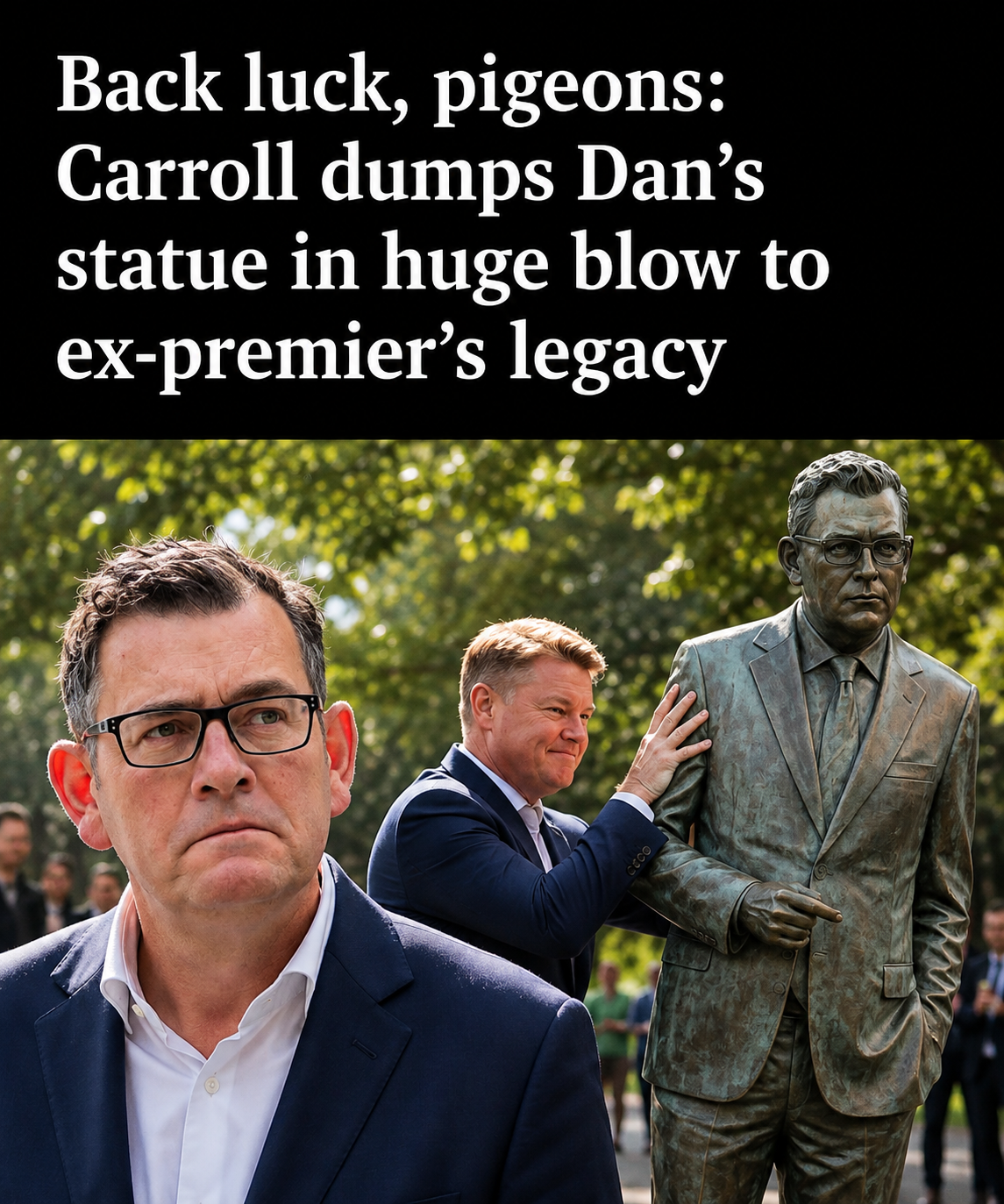
Victorian Premier Ben Carroll has scrapped the controversial $134,000 taxpayer-funded statue of Daniel Andrews and abolished the decades-old policy that automatically awarded long-serving premiers a bronze monument, declaring that gratitude for political service does not require taxpayers to fund a statue.
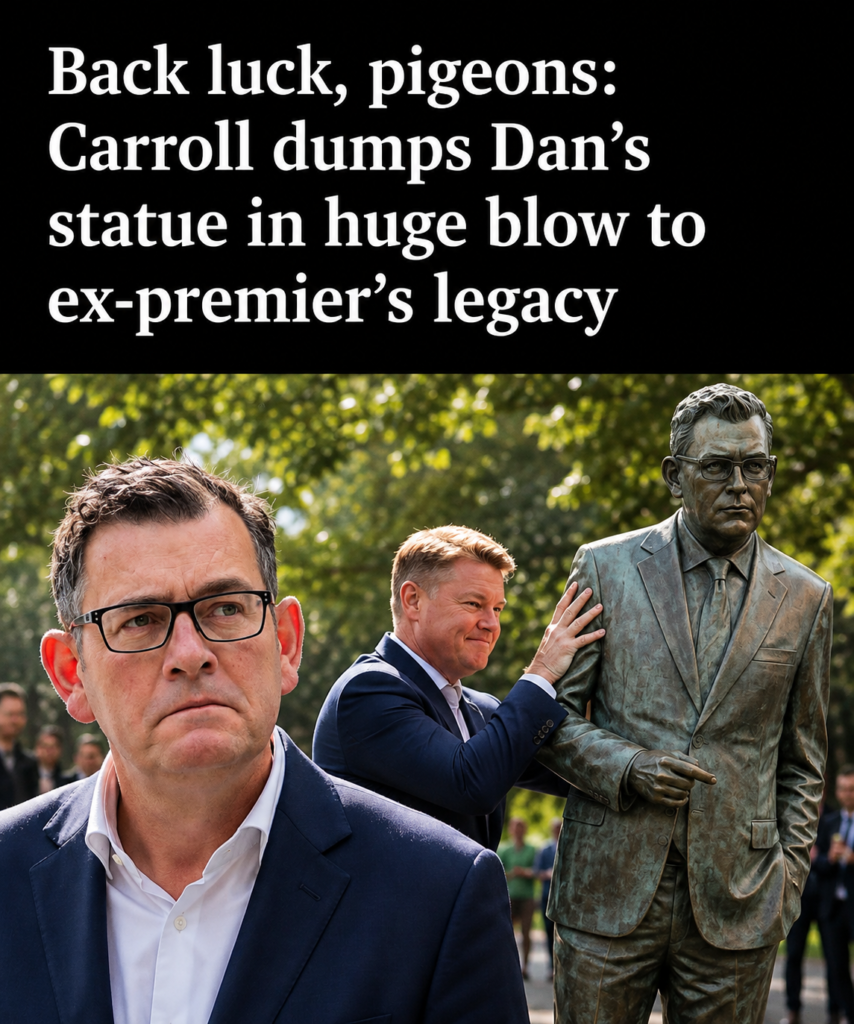
The decision, announced on Saturday, ends months of controversy surrounding plans to immortalise Andrews at Melbourne’s Treasury Place after his nine years as premier qualified him for an honour created by former Liberal premier Jeff Kennett in 1999.
Carroll has directed that work specifically commemorating Andrews cease and confirmed the automatic 3,000-day statue policy will be abolished.
“I respect your money,” Carroll said. “That means being careful and deliberate about how government spends it.”
“We are grateful to former Premiers for their service. But gratitude does not require a taxpayer-funded statue.”
There is, however, an important qualification to the cancellation: the existing $134,304 contract will not simply be torn up.
The government says cancelling the contract outright could impose unnecessary additional costs on taxpayers. Instead, an independent bipartisan panel will recommend another subject and location for the commissioned artwork.
Andrews will therefore lose the bronze monument that had been planned in his honour, while the money already committed to the sculpture contract will be redirected rather than recovered in full.
A $134,304 monument that became a political headache
The Andrews statue was formally confirmed by the Victorian government in May.
Meridian Sculpture, the firm responsible for the four existing statues of long-serving Victorian premiers at Treasury Place, had been selected through a procurement process to produce the new work.
The total cost was $134,304.
Work was already under way when the project became the subject of an increasingly bitter political argument over whether Andrews deserved a publicly funded monument and whether Victoria should be spending six figures on political statues while facing severe fiscal pressures.
The government initially defended the project on the straightforward basis that Andrews had qualified under an existing policy.
“Under a policy introduced by the Kennett government, Victorian premiers who serve more than 3,000 days in office are recognised with a statue along Treasury Place in honour of their service to the state,” a government spokesperson said when the project was confirmed.
Andrews comfortably exceeded that threshold.
He served as Victoria’s premier from December 2014 until September 2023, a period of 3,219 days, making him Victoria’s longest-serving Labor premier.
He won three consecutive state elections and dominated Victorian politics for almost a decade.
But his tenure also left one of the most polarising political legacies in modern Victorian history, particularly because of the state’s prolonged COVID-19 restrictions, failures associated with the hotel quarantine program and continuing arguments over infrastructure spending and state debt.
The statue therefore became much more than a question about an old commemorative rule.
It became another political argument about how Victoria should judge the Andrews era.
Public opposition put the project under pressure
Opposition to the statue increased after its cost became public.
A Freshwater Strategy poll published this month found 74 per cent of Victorians surveyed wanted Carroll to scrap the Andrews statue, compared with 15 per cent who supported proceeding with it.
Significantly, opposition extended beyond Coalition voters.
The poll found 54 per cent of Labor voters surveyed also wanted the statue abandoned.
Polling is not the same as a statewide vote and cannot establish that every Victorian opposed the project, but the result intensified pressure on a government already attempting to demonstrate greater discipline over public spending.
Opposition Leader Jess Wilson had promised that a Coalition government would cancel the statue if Labor refused to do so before the November state election.
Former premier Jeff Kennett — despite being the man whose government created the 3,000-day policy — also opposed an Andrews statue.
Carroll initially described the monument as “not a priority” after becoming premier.
Saturday’s announcement goes substantially further.
He has not merely stopped the Andrews monument. He has abolished the automatic rule that produced it.
The rule began under Jeff Kennett in 1999
Victoria’s political statue tradition dates to the final year of the Kennett government.
In 1999, the government commissioned bronze statues commemorating Victorian premiers who had served more than 3,000 days in office.
Four former premiers are currently represented at Treasury Place.
They are Country Party premier Sir Albert Dunstan, Liberal premiers Sir Henry Bolte and Sir Rupert Hamer, and Labor premier John Cain junior.
All four qualified through lengthy service rather than through an assessment of whether subsequent governments approved of their political records.
That objective threshold was one of the principal arguments advanced by supporters of the Andrews statue.
Andrews had passed 3,000 days. Under the existing policy, they argued, he should be treated the same way as earlier premiers regardless of whether voters or political opponents liked his record.
Labor MP Sheena Watt made that case in parliament, arguing that the standard established by Kennett had been consistently based on length of service rather than retrospective political popularity.
But the policy was never entirely comprehensive.
Sir James McCulloch served more than 3,000 days as premier across four separate terms during the 19th century but does not have a corresponding bronze statue among the four at Treasury Place.
There have also been calls for Victoria’s first female premier, Joan Kirner, to be commemorated despite serving fewer than 3,000 days.
Those anomalies helped raise a broader question: whether length of service alone remained a sensible way of determining who should receive permanent taxpayer-funded commemoration.
Carroll has now answered that question in the negative.
Andrews himself never appeared enthusiastic about the honour
The former premier has yet to publicly respond to Carroll’s decision.
But Andrews had previously shown little enthusiasm for the milestone that triggered the statue.
When he reached 3,000 days as premier in 2023, he pointed out that the threshold had been created by Kennett and dismissed the suggestion that the date held any special significance for him.
“There’s no magic to that day,” Andrews said at the time.
His public position was that reaching the milestone would simply mean another day doing the job rather than an occasion to celebrate a future bronze likeness.
That has not stopped the statue from becoming a proxy battle over his legacy since he left office.
Andrews supporters point to three election victories, major transport infrastructure programs, social reforms and his leadership through the pandemic.
His critics focus on Victoria’s COVID lockdowns, the disastrous hotel quarantine outbreak, growing debt, cost overruns and concerns about governance during the enormous Big Build infrastructure program.
The statue threatened to turn those competing assessments into a permanent argument over a bronze monument outside the offices of government.
Carroll has now removed that particular flashpoint.
The $134,000 will not simply return to taxpayers
The government’s handling of the existing contract is one of the most important details in Saturday’s announcement.
Work on an Andrews statue is stopping, but the contract itself is not being cancelled.
Carroll says this avoids unnecessary costs to taxpayers.
Instead, the new independent panel will recommend an alternative subject and location for the commissioned work.
The practical effect is that Victoria may still receive a sculpture under the contract — it simply will not be a statue automatically honouring Andrews because he passed 3,000 days in office.
That distinction also limits claims about the immediate financial saving.
The government has cancelled the Andrews commemoration, not recovered the entire $134,304 already committed to the commissioned project.
The ultimate use of that expenditure will depend on what the panel recommends.
The panel will have a broader role than choosing the subject of one artwork.
It will review how Victoria commemorates former senior public officials through statues, state funerals and memorial services, with the government seeking clearer and more consistent standards around when taxpayer-funded honours are appropriate.
Carroll said state funerals remained important but argued their significance depended partly on their rarity.
The review will examine their appropriate frequency, scale, arrangements and cost.
Carroll is trying to establish a different governing style
The statue decision also fits into a much wider political repositioning by Victoria’s new premier.
Carroll was sworn in as Victoria’s 50th premier on July 28 after replacing Jacinta Allan as Labor leader.
He inherited a government facing an election on November 28, heavy debt, persistent criticism over infrastructure costs and the political legacy of both Andrews and Allan.
Since taking office, Carroll has repeatedly attempted to frame his leadership around restraint, accountability and what he describes as common-sense government.
On Friday, his government announced a target to reduce expenditure on consultants and external advisers by $70 million.
Ministers were also instructed to cease new spending on several categories of non-essential internal expenditure, including government-branded apparel and merchandise for staff and bronze plaques bearing politicians’ names.
Carroll has also established a royal commission into alleged misconduct and corruption surrounding Victoria’s Big Build infrastructure program, with the inquiry able to examine decisions and conduct extending across previous governments.
Those decisions have an obvious political dimension.
Carroll has only months to persuade voters that a Labor government that has held power since 2014 can substantially change direction without changing parties.
Scrapping a statue of the Labor premier who dominated most of that period gives him a highly visible way to demonstrate distance from his predecessors.
The election makes the symbolism impossible to ignore
The timing makes the decision particularly significant.
Victorians vote on November 28.
The Coalition had already turned the Andrews statue into a campaign issue, using its $134,000 price tag as an example of what it says are Labor’s misplaced spending priorities.
By scrapping the monument now, Carroll removes an easy opposition target.
But the decision cannot erase the broader argument over Labor’s record.
The opposition will continue campaigning on debt, taxes, major-project spending and accountability, while Labor will argue that Carroll’s changes demonstrate a government willing to acknowledge problems and reform itself.
There is also a political risk for Carroll.
Andrews remains an enormously significant figure within Victorian Labor, and repudiating one of the formal honours attached to his tenure could irritate supporters who believe the former premier earned recognition by winning three elections and serving longer than any previous Labor premier.
Carroll has carefully avoided framing the decision as a judgment on Andrews personally.
His official announcement did not name him, referring instead to the statue of “Victoria’s 48th Premier”.
The government’s argument is that the problem lies with automatic taxpayer-funded statues, not with the service of one former leader.
That distinction allows Carroll to abolish the Andrews monument while maintaining respect for his predecessor.
An automatic political honour comes to an end
Whatever the electoral calculation, Saturday’s announcement marks the end of a Victorian tradition that survived for more than a quarter of a century.
Simply serving 3,000 days as premier will no longer guarantee a bronze likeness at taxpayer expense.
Future commemorations will instead be considered through a new process informed by the independent bipartisan review.
For Andrews, that means a distinction he technically qualified for will never be installed as originally planned.
For Carroll, it provides another opportunity to reinforce his central message as he tries to define a premiership that began only weeks ago: public spending, even on political traditions inherited from previous governments, must be capable of being justified to contemporary voters.
The decision will not resolve the debate over Daniel Andrews’ legacy.
Supporters and opponents are unlikely to agree any time soon on how Victoria should remember a premier who won three elections, transformed the state’s infrastructure agenda and governed through an extraordinary pandemic, but also left office amid intense arguments over debt, government accountability and the consequences of some of the country’s longest COVID restrictions.
What Carroll has decided is that taxpayers will no longer settle that argument automatically in bronze.
Daniel Andrews will not get the Treasury Place statue promised under the old 3,000-day rule, and no future Victorian premier will be guaranteed one merely by staying in office long enough — bringing the Kennett-era policy to an end as Carroll attempts to put fiscal restraint and a break with the past at the centre of his government before November’s election.