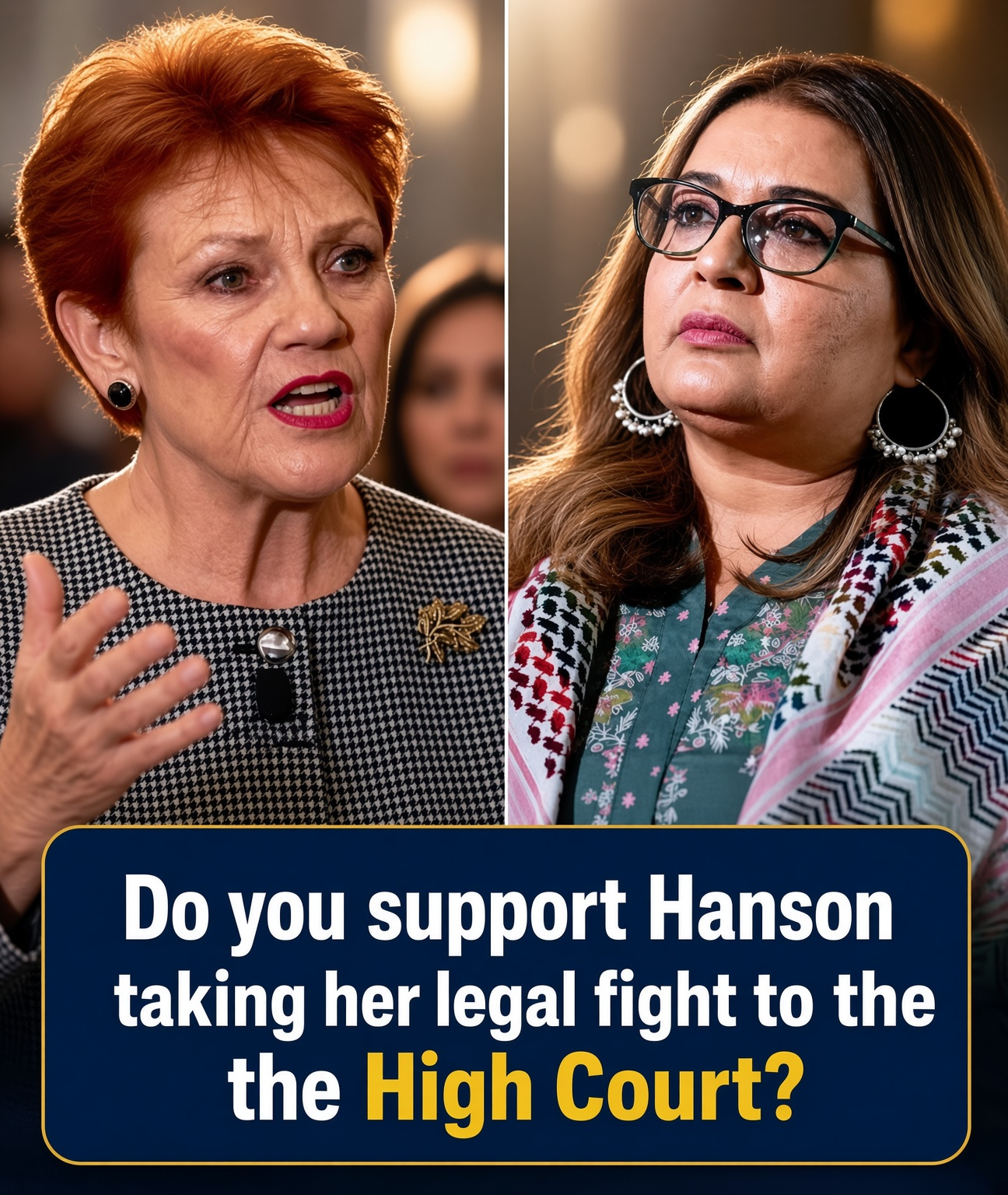
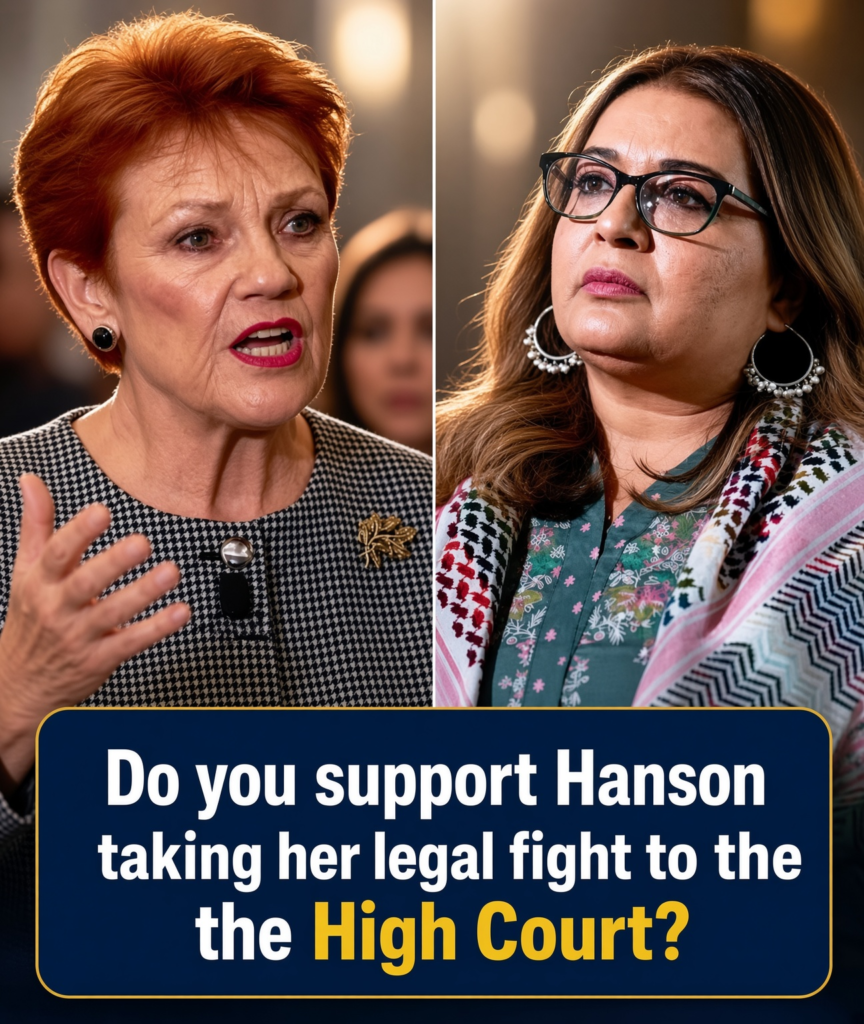
Pauline Hanson’s attempt to take her racial discrimination battle to the High Court has reopened one of Australia’s most misunderstood constitutional debates: exactly how much free speech does the Constitution actually protect?
The answer is more complicated than either side of the political argument often suggests.
Australia does not have an American-style constitutional right to free speech.
Instead, the High Court has recognised an implied freedom of communication about government and political matters because such communication is necessary for the system of representative and responsible government established by the Constitution.
That distinction could become central to Hanson’s attempt to overturn the finding that her 2022 social-media attack on Greens senator Mehreen Faruqi breached section 18C of the Racial Discrimination Act.
Australia does not have a constitutional right to say anything
This is the starting point for understanding the dispute.
The Australian Constitution contains no broad provision equivalent to the First Amendment of the United States Constitution.
There is no general constitutional guarantee allowing an individual to say whatever they want without legal consequences.
What Australian constitutional law recognises is narrower: an implied freedom of political communication.
And even that is not a personal right
The distinction is legally significant.
The implied freedom operates primarily as a restriction on government power.
It asks whether legislation impermissibly burdens communication necessary for Australia’s constitutionally prescribed system of representative and responsible government.
It is not simply a personal defence that can automatically be invoked whenever somebody describes their speech as political.
‘Political speech’ is nevertheless protected in an important sense
Australia’s system depends upon electors being able to discuss governments, politicians, elections and public policy.
That is why laws burdening political communication can face constitutional scrutiny.
The principle has been developed through a substantial body of High Court jurisprudence, with Lange v Australian Broadcasting Corporation becoming one of its defining authorities.
Lange remains central nearly 30 years later
The 1997 Lange decision reformulated the constitutional doctrine and linked the implied freedom directly to the text and structure of Australia’s system of representative government.
The doctrine has subsequently been developed and refined through later High Court cases.
But the basic principle remains: Australian law cannot impose an unjustifiable burden upon the political communication necessary for the constitutional system to function.
That does not mean every political insult is constitutionally immune
This is where Hanson’s case becomes difficult.
A communication can occur during a political argument without automatically receiving absolute constitutional protection.
Parliament can enact laws that burden political communication where those laws serve a legitimate constitutionally compatible purpose and the restriction is appropriately justified.
That principle has been central to the courts’ consideration of section 18C.
The dispute began after Queen Elizabeth II died
Hanson’s legal battle arose from an exchange on Twitter, now X, following the death of Queen Elizabeth II in September 2022.
Faruqi posted that she could not mourn the leader of what she described as a racist empire built on colonised peoples.
Hanson responded angrily.
She told Faruqi that after migrating to Australia she had taken advantage of the country, obtained citizenship, acquired property and secured a parliamentary career.
She then told her to pack her bags and “piss off back to Pakistan”.
Faruqi took Hanson to the Federal Court
The Greens senator brought proceedings under section 18C of the Racial Discrimination Act.
Section 18C makes certain public conduct unlawful where it is reasonably likely, in all the circumstances, to offend, insult, humiliate or intimidate another person or group and the conduct is done because of race, colour or national or ethnic origin.
Section 18D contains exemptions covering certain artistic, academic, scientific and public-interest communications where its requirements are satisfied.
Justice Angus Stewart ruled against Hanson
In November 2024, Justice Angus Stewart found that Hanson’s tweet breached section 18C.
The court found it was reasonably likely to offend, insult, humiliate and intimidate Faruqi and relevant groups of people, including people of colour from migrant backgrounds.
Hanson also failed to establish the section 18D defence.
The court considered the political context
One important nuance is frequently lost in commentary surrounding the case.
The court did not simply conclude that the Constitution has nothing to say about Hanson’s political speech.
Justice Stewart expressly considered her argument that section 18C, read with section 18D, infringed the implied freedom of political communication.
Hanson’s tweet concerned a matter of public interest
The primary judgment accepted that Hanson was commenting in a context involving a matter of public interest — namely Faruqi’s comments about Queen Elizabeth II and the monarchy.
It also accepted that Hanson’s response reflected beliefs she had expressed publicly for years.
But those findings were not enough to make the tweet lawful. >
The court saw an ad hominem attack rather than substantive argument
Justice Stewart concluded that Hanson’s message did not genuinely respond to the substance of Faruqi’s criticism of the monarchy and colonialism.
Instead, he characterised it as essentially an angry personal attack directed at Faruqi.
That distinction is critical to understanding why simply describing the tweet as “political speech” did not resolve the case in Hanson’s favour.
Section 18C does burden political communication
There is another important point that complicates claims from both camps.
The Federal Court accepted that Part IIA of the Racial Discrimination Act can burden the implied freedom of political communication.
That proposition itself is hardly surprising.
A law restricting particular public communications can affect political discussion.
But a burden does not automatically make a law unconstitutional
This is the crucial constitutional distinction.
If every burden on political communication were invalid, Australia could have virtually no laws regulating speech connected with politics.
Instead, courts consider the purpose of the law and whether the restriction can constitutionally be justified.
Justice Stewart found the burden imposed by Part IIA was slight and its purpose — combating racial hatred and discrimination — was compatible with representative and responsible government.
Hanson appealed
The One Nation leader challenged the decision before the Full Court of the Federal Court.
Her appeal attacked multiple elements of the primary judgment, including the application of section 18C and the constitutional analysis.
The appeal was decided on July 27, 2026.
Three judges unanimously rejected her case
Justices Melissa Perry, Geoffrey Kennett and Elizabeth Bennett dismissed Hanson’s appeal.
All seven grounds failed.
The Full Court left intact the finding that Hanson’s post was unlawful under the Racial Discrimination Act.
The court upheld the constitutional validity of the law
Hanson argued that section 18C imposed an impermissible restriction upon political communication.
The Full Court rejected that constitutional challenge.
It also upheld the conclusion that Hanson had not established the relevant section 18D protection for her tweet.
But Hanson is not finished
The One Nation leader has announced that she will seek to take the dispute to Australia’s highest court.
She says the case has implications far beyond her exchange with Faruqi and argues Australians are increasingly afraid to discuss contentious subjects including immigration, race, religion and Indigenous policy.
Her argument is that political debate requires considerably greater latitude than section 18C currently permits.
The High Court does not automatically hear an appeal
This distinction matters when describing the current status of the case.
A litigant cannot simply demand another appeal because they lost in the Full Federal Court.
Hanson must obtain special leave from the High Court.
The High Court grants special leave selectively, considering factors including whether a case raises a question of public importance or requires resolution of conflicting legal principles.
So Hanson has not yet won the right to argue the full appeal
Until special leave is granted, the Full Federal Court judgment remains the operative result.
That means Hanson’s tweet remains judicially determined to have contravened section 18C.
Her constitutional arguments have also, to this point, failed.
Her High Court challenge could nevertheless be significant
If special leave is granted, the case could provide the High Court with an opportunity to address section 18C at the highest judicial level.
That would potentially have consequences extending well beyond Hanson and Faruqi.
The case could clarify the relationship between Australia’s racial discrimination laws and the constitutional freedom of political communication.
Hanson is attacking section 18C from more than one direction
The emerging High Court case is not confined to a simple argument that Hanson’s tweet was political.
Her challenge also raises questions about the constitutional legislative foundation for section 18C.
That includes the relationship between the provision and Australia’s obligations under the International Convention on the Elimination of All Forms of Racial Discrimination.
The treaty argument could become important
Hanson’s side argues that the international convention deals with substantially more serious conduct involving racial hatred, discrimination and incitement than speech that merely “offends” or “insults”.
That argument questions whether section 18C goes further than the international obligations relied upon to support it.
If the High Court hears the case, that issue could form an important part of the constitutional challenge.
Professor Anne Twomey wants the High Court to examine it
Constitutional law expert Professor Anne Twomey has argued that the issues deserve consideration by the High Court.
She has questioned whether the constitutional analysis surrounding section 18C has received sufficient examination and pointed to the difference between the language of the racial discrimination convention and the broader language used in section 18C.
That does not mean Twomey predicts Hanson will win
This distinction is essential.
Saying a constitutional question deserves High Court consideration is not the same as saying the challenged law is unconstitutional.
Twomey has expressly acknowledged that the High Court could ultimately reach the same result and uphold the legislation.
The significance lies in having Australia’s highest court authoritatively resolve the questions raised.
The free-speech argument is therefore much narrower than it sounds
Claims that the Constitution simply “protects free speech” are too broad.
Claims that political communication receives no constitutional protection are equally misleading.
The Constitution protects the operation of Australia’s democratic system by limiting government interference with political communication.
The difficult legal question is determining when legislation crosses that constitutional line.
Privilege is a different form of protection
The raw commentary also refers to speech made “under privilege”.
That introduces a separate legal concept.
Members of Parliament receive powerful protections for statements made as part of parliamentary proceedings.
Those protections exist so elected representatives can debate public affairs without ordinary legal liability inhibiting parliamentary discussion.
But Hanson’s controversial tweet was posted publicly on social media, not delivered as part of parliamentary proceedings.
That means parliamentary privilege was not the shield
Hanson could not simply rely on her status as a senator to make an external social-media post immune from ordinary law.
The substantive legal battles instead concerned section 18C, section 18D and the Constitution’s implied freedom of political communication.
Those questions are analytically separate from parliamentary privilege.
Faruqi’s position is fundamentally different
Faruqi argues that the case demonstrates why racial vilification laws are necessary.
Following the Full Federal Court decision, she described the judgment as a victory for people who have been told to “go back” to where they came from and argued that hate speech should not be equated with free speech.
For Faruqi, section 18C protects Australians from serious racial marginalisation rather than improperly suppressing democratic debate.
Hanson says exactly the opposite
Hanson argues the breadth of section 18C chills legitimate discussion.
Her case is that Australians should be permitted to argue forcefully about political subjects even when their language is offensive to others.
She has framed the High Court move as a wider fight over the boundaries of democratic speech rather than simply an attempt to escape liability for one tweet.
That is the constitutional collision
Both propositions have democratic significance.
Australia has an interest in protecting robust political communication.
It also has an interest in preventing racial discrimination.
The constitutional question is not whether one of those interests exists and the other does not.
It is whether Parliament’s chosen mechanism for pursuing the second places an impermissible burden upon the first.
Lange does not automatically answer Hanson’s case
Invoking Lange identifies the constitutional doctrine.
It does not dictate the outcome.
The courts still have to examine the particular law, its purpose, the burden it imposes and whether that burden is constitutionally justified.
That is why Hanson’s implied-freedom argument has so far failed despite the obvious political setting of her exchange with Faruqi.
Nor does being offensive automatically remove constitutional protection
The reverse simplification should also be avoided.
The implied freedom is not limited to polite, popular or agreeable political opinions.
Political debate can be harsh and offensive.
The constitutional analysis instead depends upon the nature of the communication, the operation of the law restricting it and the justification for that restriction.
The High Court could finally give section 18C its biggest constitutional test
For decades, section 18C has generated political arguments over racism and freedom of expression.
Governments have considered changing it.
Politicians and commentators have repeatedly fought over the words “offend” and “insult”.
Hanson’s case now has the potential — if special leave is granted — to move that debate from Parliament and the media into Australia’s highest court.
The result could matter to far more people than two senators
A High Court judgment could clarify how far Parliament may go in regulating racially offensive political communication.
It could reaffirm the existing approach.
It could alter the interpretation or constitutional position of parts of section 18C.
Or Hanson may fail before the substantive appeal is ever heard if special leave is refused.
Those possibilities remain open.
What is already clear is what Australian free speech is not
Australia does not have an unlimited constitutional right to free speech.
Being a politician does not make everything said outside Parliament privileged.
Calling a statement political does not automatically place it beyond legislation.
And the existence of a burden on political communication does not automatically make the law imposing that burden unconstitutional.
But neither is political communication constitutionally irrelevant
The implied freedom exists precisely because Australians must be able to exchange information, criticism and opinions about government and political affairs.
That principle is embedded in the constitutional architecture of representative government and remains one of the most important limits upon government regulation of political expression.
Hanson’s challenge therefore presents a more difficult question than whether her tweet was offensive. The courts have already found that it was unlawful under section 18C. The potential High Court question is whether the law that produced that result sits within the limits imposed by Australia’s Constitution.
Nearly three decades after Lange, Pauline Hanson’s legal fight could give the High Court an opportunity to draw that line again — this time in one of Australia’s longest-running battles over race, political speech and section 18C.