For more than two decades, Casey’s life moved through a punishing cycle of addiction, prison and homelessness.
Today, the 48-year-old has a home of his own in Sydney and spends his working life helping about 60 men confronting many of the same problems that once consumed him.
His transformation did not come quickly, and Casey does not tell his story as though homelessness was a lifestyle he chose.
Instead, he describes a chain of childhood trauma, family violence, addiction and housing instability that began long before he ended up on the streets.
“I didn’t have the best start at life and I started using drugs at 20 years old,” Casey told news.com.au.
He grew up in a violent household with a father who struggled with addiction.
Drug use eventually became part of Casey’s own life, followed by years in which addiction, incarceration and unstable housing repeatedly fed into one another.
It took more than 20 years before something finally changed.
At 42, Casey reached the point where he no longer recognised the person he had become.
“At 42 years old I finally had enough. I didn’t like the person I’d become,” he said.
“Out of desperation I went to a rehab.”
Six years later, Casey’s life looks dramatically different: he has his own place in Sydney and works at a foster house and shelter supporting about 60 men who are dealing with the very challenges he once faced himself.
His story is one of recovery, but it also cuts against one of the most persistent assumptions surrounding homelessness — that people simply choose to live on the streets and could leave if they really wanted to.
Casey wants Australians to understand that his own path into homelessness was far more complicated.
For him, childhood trauma came first.
Addiction followed.
Housing instability, incarceration and homelessness then became part of a cycle that was extraordinarily difficult to escape.
His experience is personal, and it should not be treated as a template for every Australian experiencing homelessness.
There is no single pathway into homelessness.
People lose secure housing after family violence, relationship breakdown, financial hardship, mental health difficulties, illness, leaving custody or care, and through an increasingly unforgiving housing market.
Some people experience several of those pressures at once.
That complexity is important because the public image of homelessness often bears little resemblance to the way homelessness is actually measured in Australia.
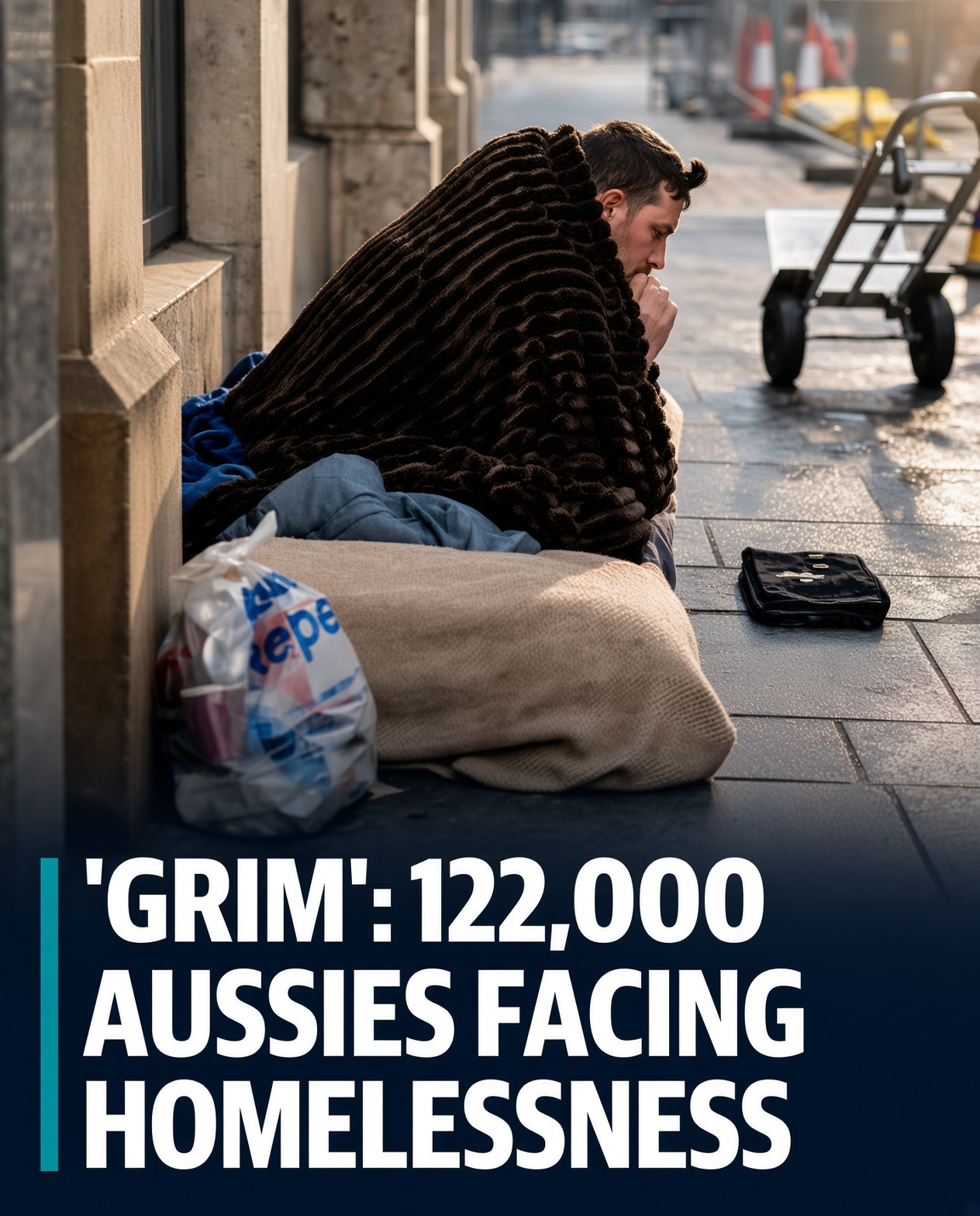
A person sleeping on a footpath is experiencing homelessness.
But so can someone sleeping temporarily on another family’s couch because they have nowhere else to go.
A woman and her children living in crisis accommodation after fleeing violence can be homeless.
So can people living in severely overcrowded dwellings or certain boarding-house and temporary accommodation situations.
The latest complete national Census estimate remains confronting.
The Australian Bureau of Statistics estimated that 122,494 people were experiencing homelessness on Census night in August 2021.
That was 6,067 more people than in 2016, an increase of 5.2 per cent.
But the number needs an important qualification when it is used in 2026.
It is not a live count of how many Australians are homeless today.
It is an estimate from the 2021 Census, and the ABS notes that the circumstances surrounding that Census were unusual because parts of Australia were operating under COVID-19 restrictions.
Governments had also provided temporary accommodation to some people sleeping rough or experiencing crisis during the pandemic.
The Census figures nevertheless demonstrate just how broad Australia’s homelessness problem already was.
Only a relatively small share of people counted as homeless were sleeping outdoors.
Of the 122,494 people estimated to be experiencing homelessness in 2021, 7,636 were living in improvised dwellings, tents or sleeping out.
That represents about 6 per cent of the total.
The largest group was almost invisible by comparison.
About 47,895 people — 39.1 per cent of everyone classified as homeless — were living in severely crowded dwellings.
Another 24,291 were in supported accommodation for people experiencing homelessness.
More than 22,000 were living in boarding houses, while about 16,600 were temporarily staying with other households.
Those numbers matter because they challenge the idea that homelessness can be understood simply by counting people visible on city streets.
Much of Australia’s homelessness is hidden inside houses, temporary rooms, crisis facilities and the homes of friends or relatives.
It can therefore be easy for someone with secure housing to underestimate the scale of the problem.
Casey’s experience represents another difficult part of that picture: persistent homelessness combined with addiction and contact with the criminal justice system.
Escaping that cycle can require much more than finding an available rental property.
A person recovering from addiction may need treatment and ongoing support.
Someone leaving prison can emerge without stable accommodation, employment or a strong support network.
Someone who has spent years homeless may need help rebuilding routines, relationships and the practical foundations of an independent life.
Casey’s turning point began with rehabilitation.
What makes his story particularly striking is where that decision eventually led.
He is now helping other men from a position of lived experience.
When someone at the shelter talks about addiction, Casey does not have to imagine what losing control of a life can feel like.
When a man is trying to rebuild after years of instability, Casey knows that recovery may not happen in a straight line.
And when someone believes their past has permanently determined their future, Casey can point to his own life as evidence that change remains possible even after decades.
That does not make recovery simple.
Nor does one successful story resolve the structural pressures pushing Australians towards homelessness.
More recent national service data shows how heavily the homelessness system continues to be used.
The Australian Institute of Health and Welfare reported that almost 289,000 people received assistance from specialist homelessness services during 2024–25.
That figure is different from the Census homelessness estimate and the two should not be confused.
The Census attempts to estimate how many people are experiencing homelessness at a particular point in time.
The AIHW figure counts clients who received assistance from specialist homelessness agencies over an entire financial year and includes people who were homeless as well as people at risk of becoming homeless.
Even with that distinction, the service data illustrates the extraordinary demand.
Almost 289,000 clients means homelessness agencies were dealing with a population larger than many Australian cities over the course of a single year.
And not every request could be met.
According to AIHW, the need for short-term or emergency accommodation went unmet for about 31 per cent of specialist homelessness service clients who needed that form of assistance.
That shortage has immediate consequences.
Emergency accommodation is often the bridge between a crisis and a safer, more stable housing arrangement.
When it is unavailable, people can be forced to remain in unsafe circumstances, rely on friends and family, sleep in cars or find other temporary options.
Family and domestic violence remains one of the biggest drivers bringing people into the specialist homelessness system.
AIHW found people who had experienced family and domestic violence were the largest client group in 2024–25, accounting for more than 40 per cent of all specialist homelessness services clients.
That is another reason simplistic descriptions of homelessness as a choice can be so damaging.
For someone fleeing violence, leaving a home can be the action that makes them safer.
The homelessness occurs because there is nowhere secure to go next.
Young Australians are another major part of the national picture.
The 2021 Census found 28,204 people experiencing homelessness were aged between 12 and 24, representing 23 per cent of the total homeless population.
The highest homelessness rate of any age group was among people aged 19 to 24, at 91 people per 10,000.
Older Australians are not immune either.
There were 19,378 people aged 55 and over experiencing homelessness in the 2021 Census, representing almost one in six of all people counted.
The statistics reveal something Casey’s story makes personal: homelessness can intersect with almost every stage of life, and the circumstances that push someone out of secure housing can begin years before the moment they are visibly homeless.
For Casey, those circumstances began in childhood.
He describes growing up with violence and addiction around him before starting to use drugs himself at 20.
By the time he reached his early 40s, the consequences had accumulated across more than two decades.
His decision to enter rehabilitation at 42 was therefore not simply a matter of deciding to stop sleeping rough.
It meant attempting to break a much larger pattern.
Today, his work supporting other men gives that recovery a second dimension.
He has not only moved out of homelessness himself; he now works inside the system trying to help others move towards stability.
That lived experience can carry particular value in homelessness and recovery services.
People who have spent years being judged, moved on or misunderstood can be reluctant to trust institutions.
Speaking with someone who has faced similar experiences can make support feel less abstract.
It can also challenge fatalism.
A person who has been homeless for years may believe that permanent housing, meaningful work and recovery belong to a different kind of person.
Casey’s life says otherwise.
Yet his message during Homelessness Week is not simply that people need to try harder.
It is that Australians should look more carefully at how people become homeless in the first place.
The national data supports the need for that broader view.
Homelessness encompasses far more than rough sleeping.
Demand for services extends far beyond the number counted on any single night.
Domestic violence is a major driver.
Emergency accommodation is not always available when people need it.
And for some people, homelessness is intertwined with trauma, addiction, imprisonment and years of instability.
Casey spent more than 20 years caught inside such a cycle.
At 42, he reached the point where he wanted something different and sought rehabilitation.
At 48, he has a home, a job and an unusual ability to look another struggling man in the eye and understand where he may have been.
For the roughly 60 men Casey now helps support, that may be one of the most useful things he can offer.
He knows how far away a normal life can feel when someone is living in crisis.
He also knows that feeling is not necessarily the end of the story.