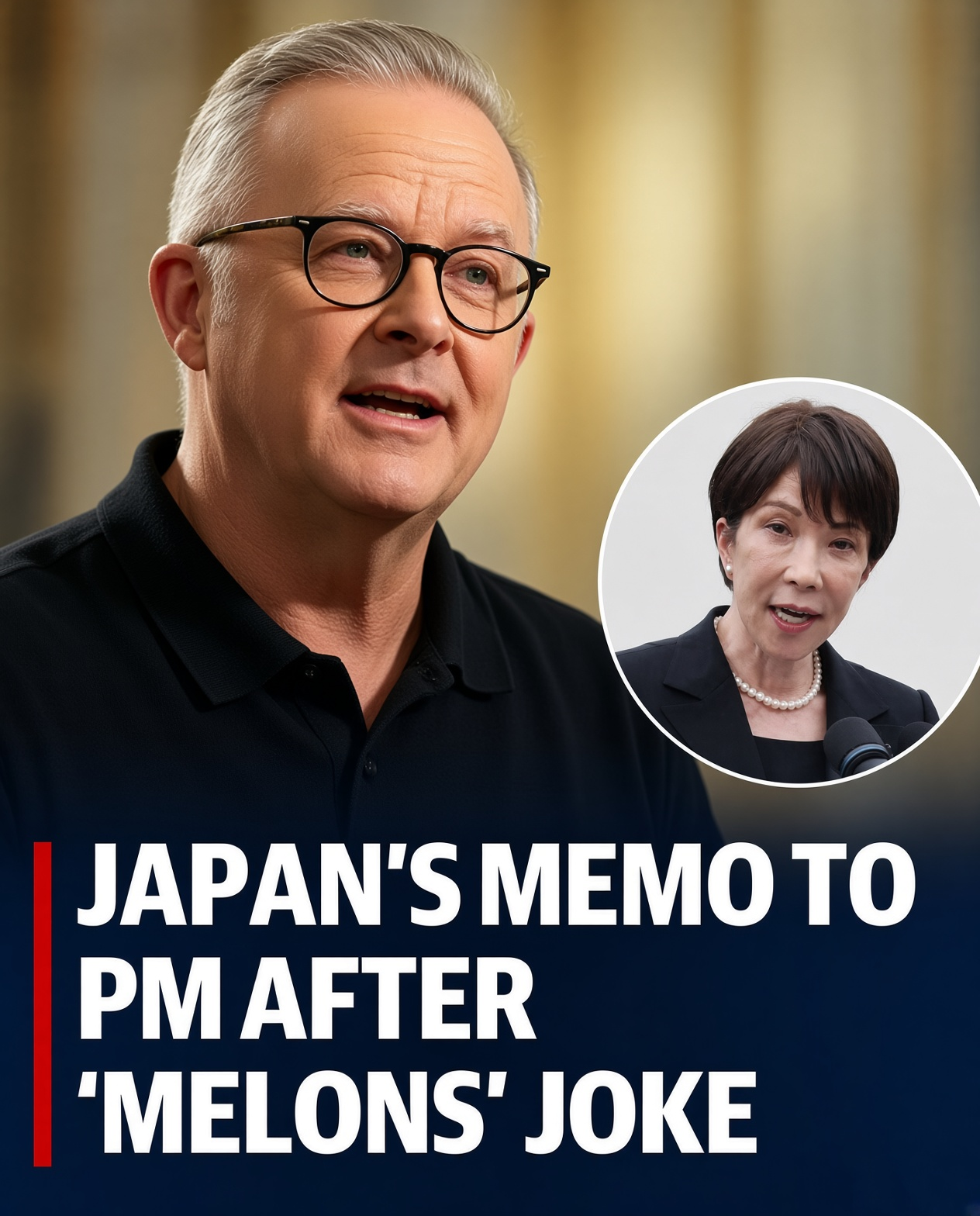
Japan has formally raised Anthony Albanese’s controversial podcast appearance involving Prime Minister Sanae Takaichi and her gift of Japanese melons, as both governments move to prevent the embarrassing episode from damaging one of Australia’s most important strategic relationships.
Official correspondence from Japan addressed the controversy after Albanese came under sustained criticism over an exchange in which he discussed Takaichi bringing him melons during her visit to Australia.
But rather than escalating the matter into a formal diplomatic protest, Japan has indicated that it regards much of the controversy as having been sensationalised by the media.
Japanese officials have also indicated there was no intention to lodge a formal complaint.
The Albanese government seized on that assessment as evidence that suggestions of a serious diplomatic rupture had been overstated.
The intervention leaves Canberra in an unusual position: Japan has formally addressed an episode involving its Prime Minister, while simultaneously signalling that it does not want the controversy allowed to damage the broader Australia-Japan relationship.
That distinction is important.
Official diplomatic correspondence means the matter has moved beyond ordinary Australian political commentary.
It does not, however, mean Japan has issued a formal diplomatic protest against Australia.
The Japanese position reported on Monday is substantially more restrained.
Tokyo’s apparent priority is to prevent the episode becoming larger than the original remarks.
Albanese has maintained that he was not making a sexual joke about Takaichi’s anatomy.
His office has rejected that interpretation.
Critics remain unconvinced, pointing to the wider exchange during the podcast and the gestures and comments accompanying the discussion.
The controversy originated in Albanese’s appearance with comedian Nikki Osborne.
During the conversation, the Prime Minister recalled receiving melons from Takaichi.
The exchange then took a direction critics interpreted as sexual innuendo.
Osborne made a reference to former Baywatch star Pamela Anderson, while Albanese’s gestures during the conversation subsequently became a focus of criticism.
Albanese insists the interpretation being placed on his contribution is wrong.
What is not disputed is that Takaichi really did present him with a prized Japanese melon.
The Japanese Ministry of Foreign Affairs recorded the gift in its official account of Takaichi’s May visit to Canberra.
Before a summit dinner hosted by Albanese on May 4, Takaichi presented the Australian Prime Minister with a Shizuoka-grown Crown Melon.
The gift had a specific diplomatic and trade purpose.
Japan wanted to promote further exports of Japanese agricultural, forestry, fishery and food products to Australia.
Australia had only recently lifted restrictions on imports of Japanese melons.
The Japanese Foreign Ministry noted that Shizuoka Crown Melons are cultivated using a “One Tree, One Fruit” method in which only one fruit is allowed to mature on each plant.
In other words, the melons were not an incidental detail of the leaders’ meeting.
They were part of Japan’s trade diplomacy.
That context is central to understanding why some Japanese observers reacted so strongly to the later podcast exchange.
A carefully selected premium agricultural gift intended to celebrate new market access became the subject of an Australian entertainment podcast months later.
Former Japanese ambassador to Australia Shingo Yamagami has been among the strongest critics.
Yamagami argued that whatever Albanese intended, joking at the expense of the Japanese Prime Minister risked being remembered negatively by Japanese people who place great value on the relationship with Australia.
He urged Albanese to focus on the significance of the bilateral partnership rather than allowing it to become associated with crude humour.
The current Japanese government has taken a noticeably less confrontational approach.
Its correspondence has reportedly characterised the media reaction as sensationalised and indicated it did not regard Albanese as acting with malicious intent.
That gives the Australian government an important diplomatic defence.
Labor ministers can argue that some of the strongest criticism in Canberra goes significantly beyond Tokyo’s own assessment.
But the existence of official correspondence also makes it difficult to dismiss the episode entirely as a manufactured domestic controversy.
Japan considered the issue significant enough to address through official channels.
The Opposition has continued to apply pressure.
Coalition foreign affairs spokesman Ted O’Brien met Japanese ambassador Kazuhiro Suzuki on Monday and expressed what he described as his “deep regret” over the comments.
O’Brien declined to reveal the details of the private diplomatic discussion.
He nevertheless made his view of Albanese’s conduct clear.
“The prime minister’s words were inappropriate and a national embarrassment,” O’Brien said.
He stressed that Australia’s “deep and enduring” relationship with Japan was one of the country’s most important international partnerships.
The Coalition has called on Albanese to apologise personally to Takaichi.
That call has also been supported by other political figures who believe the Prime Minister should end the controversy regardless of what he intended.
Labor has resisted that pressure.
Senior government ministers have argued Albanese’s remarks have been misinterpreted and pointed to Japan’s own restrained response.
The disagreement therefore increasingly revolves around two separate questions.
The first is what Albanese intended.
The second is what standard should apply to an Australian prime minister even if no offence was intended.
Those questions do not necessarily produce the same answer.
A remark can be unintended as a sexual insult while still being considered inappropriate in retrospect.
Likewise, Japan can decide that an episode does not warrant a formal complaint without endorsing everything said during the podcast.
Diplomatic governments routinely attempt to prevent minor controversies from overwhelming larger strategic interests.
Australia and Japan have particularly powerful reasons to do so.
The bilateral relationship now extends far beyond trade.
The two countries cooperate closely on defence, regional security, energy, critical minerals, cyber security and economic resilience.
Both are close allies of the United States.
Both have a strong interest in stability in the Indo-Pacific.
And both governments have spent years deliberately deepening strategic cooperation.
Only three months ago, Takaichi travelled to Canberra for her first official visit to Australia as Japanese Prime Minister.
She and Albanese held formal talks on May 4 and signed a Joint Declaration on Economic Security Cooperation.
The two leaders also agreed to establish a new Australia-Japan Strategic Cyber Partnership.
Defence and security cooperation was strengthened further.
DFAT says Albanese and Takaichi recognised during the visit that Australia and Japan were more strategically aligned than ever before.
That description demonstrates the scale of the relationship against which the current controversy has to be measured.
The two countries are not going to abandon major defence, trade and security cooperation over a podcast joke.
Nor does Japan’s decision against a formal complaint suggest a bilateral crisis.
But diplomatic relationships are built not only through treaties and defence contracts.
Personal relationships between leaders matter.
Symbolism matters.
Respect matters.
That is particularly true when political leaders are representing their countries rather than themselves.
A prime minister speaking on an entertainment podcast remains the Prime Minister of Australia.
The office does not disappear because the setting is informal.
That is the argument being made by Albanese’s critics.
His supporters counter that political leaders should be allowed to participate in informal media without every joke being interpreted as an official diplomatic statement.
The debate is complicated further by the context of the podcast itself.
The same appearance generated separate controversy over Albanese’s participation in a discussion involving Kylie Minogue and other Australian female celebrities.
That episode prompted criticism over whether the tone was appropriate for a serving prime minister.
The accumulation of controversies has made it harder for Labor to isolate the Takaichi exchange as a single misunderstood comment.
Opponents instead portray it as part of a broader lapse in judgment.
The government rejects that characterisation.
Japan’s measured response provides Labor with its strongest evidence that claims of serious diplomatic damage have been exaggerated.
Tokyo has not announced retaliation.
It has not summoned Australian representatives for a formal protest.
It has not suggested that strategic cooperation is under review.
It has not lodged the complaint some critics predicted.
Instead, Japanese correspondence has reportedly attempted to take heat out of the dispute.
That does not erase the embarrassment.
It does significantly change the diplomatic assessment.
The episode is better described as an awkward diplomatic controversy than a breakdown in Australia-Japan relations.
There is another reason both governments have an interest in putting it behind them.
2026 marks the 50th anniversary of the Basic Treaty of Friendship and Cooperation between Australia and Japan.
The treaty was signed in Tokyo on June 16, 1976 by Australian prime minister Malcolm Fraser and Japanese prime minister Miki Takeo.
It formally recognised friendship, shared interests and interdependence between the two countries and became an important foundation for the relationship that followed.
Half a century later, the partnership is considerably deeper.
Japan remains one of Australia’s most important economic partners.
Japanese investment has played a major role in Australia’s resources and energy industries.
Australia remains a major supplier of energy, minerals and food to Japan.
Security cooperation has expanded dramatically as the strategic environment in the Indo-Pacific has become more challenging.
Australia has also approved the acquisition of its first three general-purpose frigates from Japan, with the first scheduled for delivery in 2029.
The governments are building cooperation in critical technologies and economic security.
Those interests dwarf the substance of a controversial podcast exchange.
But that is precisely why the incident has attracted such attention.
Critics argue the importance of Japan should have made Albanese more careful, not less.
The melon itself symbolised the increasingly close economic relationship.
Japanese agricultural exporters had gained new access to the Australian market.
Takaichi used her visit to promote that opportunity personally.
For opponents of Albanese, turning the gift into comedy therefore showed poor diplomatic judgment.
For the government, that interpretation attributes an intention that Albanese denies having.
Tokyo’s position now offers a way for both sides to move forward.
Japan can acknowledge that the controversy occurred without demanding an apology or escalating it.
Australia can point to Japan’s assessment that media coverage exaggerated the matter.
Neither government has to allow the episode to interfere with defence, economic or strategic cooperation.
Domestic politics is another matter.
The Coalition has no reason to let the issue disappear while Albanese continues to face questions about his judgment.
O’Brien’s decision to meet the Japanese ambassador ensures the Opposition can demonstrate that it has treated the matter as a foreign-policy concern rather than merely an opportunity for partisan attack.
At the same time, opposition politicians need to avoid creating the very diplomatic crisis they accuse Albanese of risking.
If Tokyo is deliberately trying to lower the temperature, Australian politicians continuing to describe the episode as a major rupture could find themselves overstating Japan’s own position.
That is why the precise language surrounding the diplomatic correspondence matters.
Japan “raising” an issue is not synonymous with Japan “complaining”.
A diplomatic communication can clarify a government’s position without constituting a protest.
And a government saying media coverage has sensationalised an incident is materially different from saying it was offended and demanding corrective action.
Based on the information now available, Japan appears to have chosen the former path.
The episode nevertheless demonstrates how quickly informal political communication can cross international borders.
A comment made for an Australian podcast can be clipped, translated and circulated internationally within hours.
Gestures can travel without their surrounding conversation.
Humour can lose context entirely when moved between cultures.
And a joke involving another country’s leader can become a foreign-policy story whether the person making it intended that outcome or not.
That environment imposes a different standard on heads of government from entertainers.
A comedian can deliberately provoke.
A prime minister has to consider how the same material may be understood in another capital.
Albanese’s position remains that the sexual interpretation of his “melons” remarks is incorrect.
Japan’s current government appears prepared to accept that there was no malicious intention and move on.
Former ambassador Yamagami and Albanese’s Australian critics remain much less forgiving.
Whether Albanese ultimately offers a direct apology to Takaichi is now largely a political decision rather than a requirement imposed by Tokyo.
Japan has provided him with room to end the controversy without one.
But the unusual fact remains that an Australian Prime Minister’s appearance on a comedy podcast generated enough concern for Japan to address it in official correspondence.
For a relationship Canberra describes as one of its most important, that alone makes the episode considerably more than an ordinary bad joke.