Pauline Hanson is preparing to put One Nation candidates on ballot papers across almost the entire Victorian lower house as the party attempts to turn its national surge into a serious challenge at the November state election.
One Nation says it has now identified candidates for between 74 and 76 of Victoria’s 88 Legislative Assembly districts — potentially giving voters a One Nation option in more than 80 per cent of lower-house seats.
The scale of the operation represents a major expansion of the party’s Victorian ambitions.
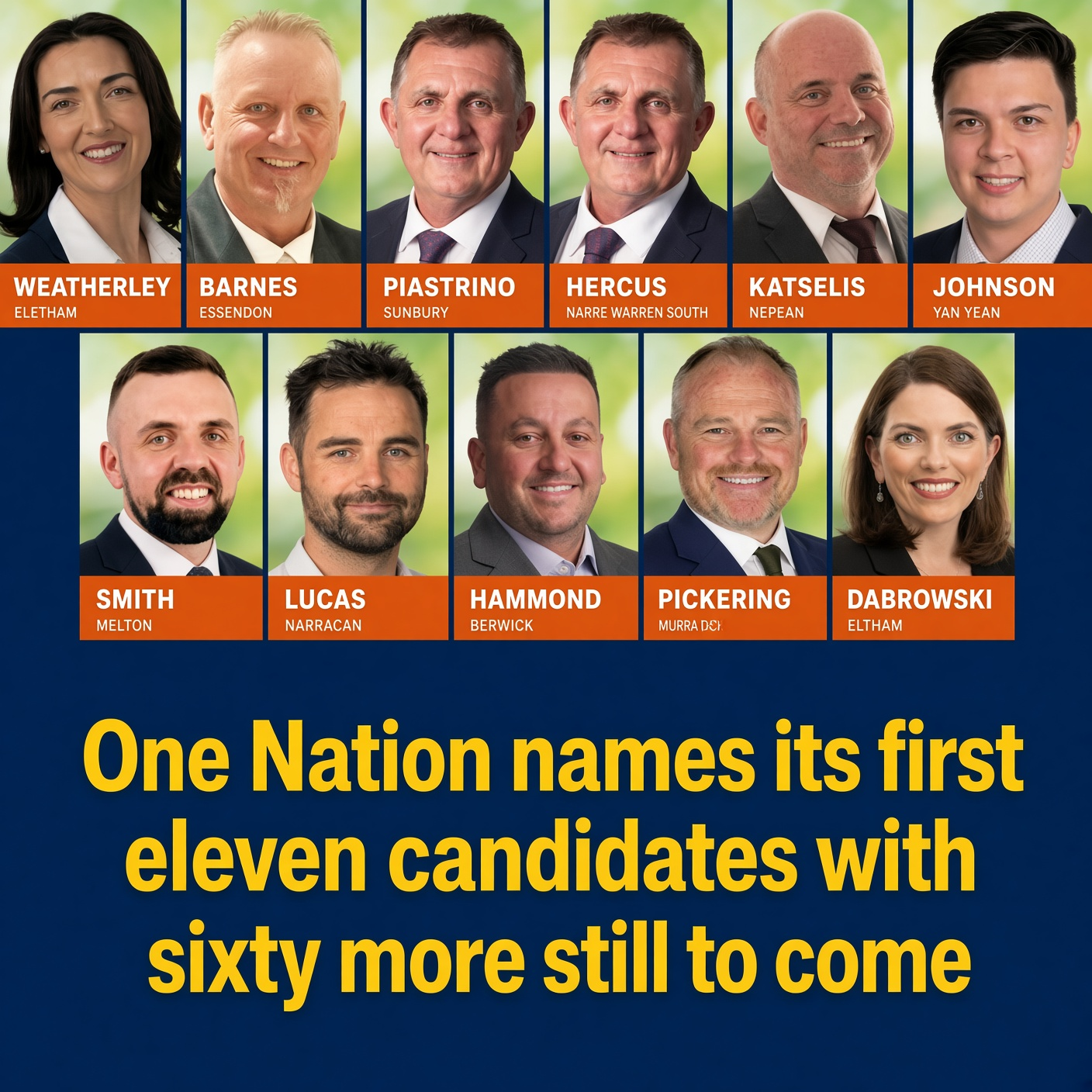
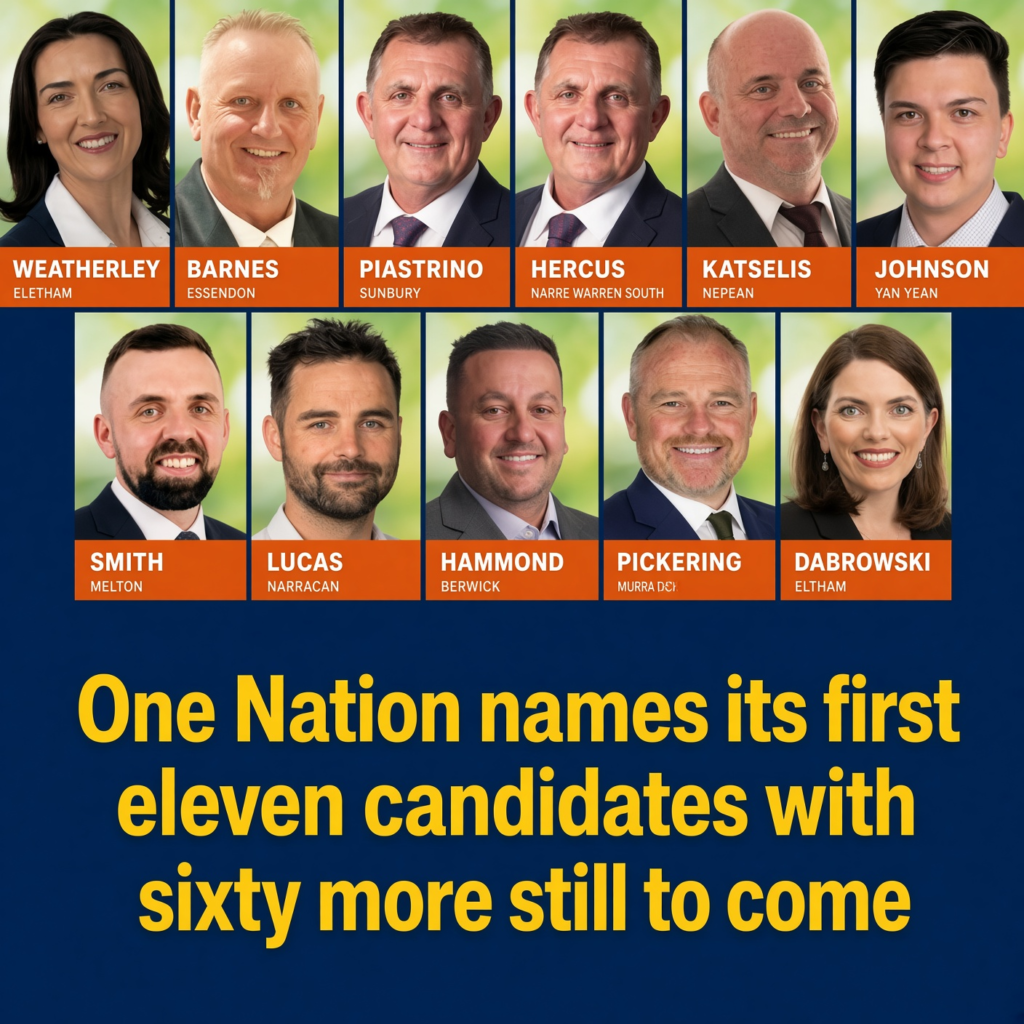
Eleven lower-house candidates have already been publicly unveiled, including former AFL premiership player John Barnes, two regional councillors, previous federal candidates and a candidate returning after achieving a record One Nation primary vote at a Victorian by-election.
Dozens more names are still to come.
Hanson’s strategy does not depend on winning anything close to 76 seats.
Instead, contesting almost the entire state allows One Nation to test how far its rising support can travel, accumulate primary votes across Victoria, influence preference contests and potentially turn previously conventional Labor-versus-Coalition electorates into three-way races.
With Victorians voting on November 28, the party is rapidly building the organisational infrastructure required to find out whether its recent momentum can survive a full state election campaign.
One Nation says it has candidates for up to 76 seats
Hanson revealed earlier this month that the party’s Victorian recruitment drive had produced candidates for approximately 74 to 76 lower-house districts.
That figure is significant because Victoria has only 88 Legislative Assembly seats.
If One Nation ultimately nominates 76 candidates, it would contest about 86 per cent of the lower house.
Even the lower figure of 74 would mean candidates in roughly 84 per cent of districts.
The party does not yet have to lodge those nominations with electoral authorities.
Formal nominations do not open until November.
But politically, the recruitment exercise means Hanson is attempting something much larger than a campaign concentrated on a handful of regional protest seats.
One Nation wants a statewide presence.
Eleven candidates have now been publicly unveiled
The first major group of lower-house candidates provides an indication of the type of people One Nation is recruiting.
They include councillors, former federal candidates, small-business figures and candidates who have already contested elections under the party’s banner.
The highest-profile recruit is John Barnes.
Barnes will contest Essendon.
The former Essendon and Geelong footballer played more than 200 AFL games and was part of Essendon’s 2000 premiership team.
He has subsequently remained a familiar figure in Melbourne and was elected to Moonee Valley City Council in 2024.
Now he is moving from local government into state politics.
John Barnes gives Hanson a recognisable Melbourne candidate
Barnes is not being sent into an easy electorate.
Essendon is a strongly Labor-held seat.
The margin is approximately 12.5 per cent.
That makes an outright One Nation victory a difficult proposition.
But Barnes gives the party something it has often lacked in Victorian metropolitan campaigns: an immediately recognisable candidate with an existing community profile.
His football career gives him name recognition extending far beyond traditional One Nation supporters.
Barnes has also spoken publicly about the serious health problems he experienced after football, including epilepsy and neurological damage.
He subsequently worked as a garbage collector before entering local government.
That unconventional background fits naturally with One Nation’s preference for candidates able to present themselves as outsiders to the professional political class.
Regional councillors are also joining the ticket
In Murray Plains, One Nation has selected Gannawarra Shire Mayor Garner Smith.
Smith gives the party a sitting local-government figure in a regional electorate where issues surrounding agriculture, energy infrastructure and regional services are likely to feature heavily.
Baw Baw Shire councillor Ben Lucas will contest Narracan.
That again gives One Nation a candidate with existing elected experience rather than someone entering public life for the first time.
Recruiting councillors provides practical advantages.
They have already campaigned.
They have existing community networks.
They understand local issues.
And they begin with at least some public recognition.
Darren Hercus will return in Nepean
One Nation is also returning to territory where it has already demonstrated electoral potential.
Darren Hercus will contest Nepean.
Hercus previously produced a record One Nation primary vote in the electorate during a by-election.
That gives the party actual electoral data on which to build rather than relying purely on statewide polling.
Returning candidates can also retain campaign infrastructure, volunteer networks and voter recognition from previous contests.
For a smaller party attempting to expand rapidly, those assets matter.
Former federal candidates are being recycled into the state campaign
Several people who previously stood federally for One Nation are now being deployed into Victorian state districts.
Trevor Hammond will contest Narre Warren South.
Jeremy Johnson is running in Yan Yean.
Mathew Katselis will contest Melton.
Those candidates already understand One Nation’s campaign operation and have experience appearing on a ballot under the party banner.
The strategy also allows the organisation to preserve political talent accumulated during federal campaigns rather than beginning candidate recruitment from zero at every election.
One Nation is targeting both Melbourne and regional Victoria
The geography of the announced candidates is revealing.
The party is not restricting itself to rural districts.
It is fielding candidates in Melbourne’s established suburbs, outer-growth corridors and regional communities.
Jessie Weatherly, an AI consultant, will contest Eltham.
Elita Dabrowski, a naturopath, will stand in Sunbury.
Hairdresser Michael Piastrino has been selected for Berwick.
The result is a candidate map stretching from traditional metropolitan Labor territory to fast-growing outer suburbs and rural districts.
That breadth is important to understanding Hanson’s strategy.
This is not merely an attempt to find one winnable Victorian seat.
It is an attempt to establish One Nation as a regular electoral presence across the state.
Not all of these seats are realistically winnable
The party’s own campaign should not be mistaken for evidence that One Nation is on course to win dozens of Victorian lower-house seats.
Several of the announced candidates are entering electorates with substantial major-party margins.
Essendon is an obvious example.
A party can field 76 candidates without being competitive in 76 districts.
Indeed, widespread candidacy serves purposes beyond winning individual seats.
It lifts statewide vote totals.
It allows the party to identify previously hidden pockets of support.
It builds local branches.
It creates a larger volunteer network.
And it gives voters dissatisfied with the major parties another box to mark.
Preferences make primary votes important even without victory
Victoria’s Legislative Assembly uses preferential voting.
Voters number candidates in order of preference.
If no candidate receives an absolute majority of first preferences, candidates are progressively excluded and their votes redistributed according to voters’ subsequent preferences.
That means a One Nation candidate does not need to win an electorate to affect its outcome.
Imagine a close Labor-Liberal contest in which One Nation attracts 10 or 15 per cent of first preferences.
Those votes can become extremely important when the One Nation candidate is eliminated.
Where those voters place Labor and the Coalition on their ballots can help determine the eventual winner.
That gives a growing minor party leverage beyond the seats it can capture outright.
But voters control preferences, not the party
There is an important qualification.
Political parties distribute how-to-vote cards recommending preference orders.
Those recommendations can influence voters.
They do not transfer votes automatically.
Victorians ultimately decide their own preference order.
For One Nation, that means the behaviour of its voters could become just as politically important as formal preference recommendations.
If Hanson attracts substantial numbers of former Coalition voters, those preferences may behave differently from votes coming from previously disengaged or Labor-supporting voters.
The pattern will vary between electorates.
Victoria votes on November 28
The timetable is now fixed.
The Victorian state election will be held on Saturday, November 28, 2026.
All 88 Legislative Assembly seats will be contested.
The state’s 40 Legislative Council positions will also be decided across eight upper-house regions.
Almost 4.7 million Victorians are expected to vote, according to the Victorian Electoral Commission.
Voting is compulsory for enrolled Australian citizens aged 18 and over.
The parliamentary term expires and election writs are issued on November 3.
Candidate nominations open the following morning.
One Nation’s 74–76 candidates are not yet official VEC nominees
This distinction matters when describing the party’s current position.
Hanson says One Nation has secured or identified candidates for up to 76 seats.
But the Victorian Electoral Commission cannot yet list those people as formally nominated election candidates.
Nominations open at 9am on November 4.
They close at noon on November 9.
Registered political parties then lodge their endorsed nominations through the VEC process.
Until that happens, One Nation’s 74–76 figure represents its internal candidate recruitment and endorsement position rather than the final certified ballot.
Some candidates can still withdraw or be replaced before nominations close.
Hanson’s confidence follows a breakthrough year for One Nation
The Victorian expansion is occurring after one of the most significant periods in One Nation’s history.
In May, David Farley won the federal Farrer by-election in NSW.
It was an extraordinary result.
Farrer had been held by the Coalition since the electorate was created in 1949.
Former Liberal leader Sussan Ley had represented it for a quarter of a century.
At the 2025 federal election, One Nation received less than seven per cent of the primary vote there.
One year later, Farley surged to about 40 per cent.
After preferences, he won comfortably.
Farrer changed perceptions about what One Nation could win
The result mattered beyond one NSW electorate.
For years, One Nation had been primarily associated with Senate representation rather than winning single-member lower-house electorates.
Farrer demonstrated that the party could consolidate a protest vote strongly enough to win under preferential voting.
It also demonstrated how rapidly a supposedly safe major-party seat could become competitive when voter loyalties fractured.
Farley described the result in simple terms.
“People just want change,” he said after his victory.
Hanson’s message was more combative.
“We’re coming after those other seats,” she told supporters.
Victoria is now one of the places where that promise is being tested.
The Victorian Coalition faces its own One Nation problem
Hanson’s statewide expansion is not only a threat to Labor.
It creates strategic problems for Opposition Leader Jess Wilson and the Liberal-National Coalition as well.
One Nation competes directly for voters on the political right, particularly those concerned about immigration, energy policy, crime and distrust of established institutions.
Every voter shifting from Liberal or National to One Nation reduces the Coalition’s primary vote.
Preferences may eventually return some of those votes.
But there is no guarantee they all will.
And in electorates where the Coalition needs to overtake Labor before preferences can decide the contest, losing first preferences to Hanson can be dangerous.
Energy policy is one obvious battlefield
One Nation has aggressively opposed net-zero policies and major renewable-energy infrastructure.
That position has particular resonance in parts of regional Victoria affected by transmission-line proposals.
The Victorian Coalition has itself hardened its stance.
Wilson recently confirmed that a Coalition government would scrap the proposed VNI West transmission project rather than merely pause and review it.
The decision provides a clearer distinction between the Coalition and Labor.
It also reduces political territory available to One Nation on an issue where Hanson has been attacking both major parties.
That illustrates the broader effect a rising minor party can have before winning a single seat.
Major parties begin adjusting their own positions in response.
Labor is confronting a different political environment under Ben Carroll
The Victorian campaign is also unfolding under a new premier.
Ben Carroll replaced Jacinta Allan as Labor leader and premier in July.
He has attempted to establish what he calls a “new direction”, including changes to cabinet, a royal commission into the construction industry and a major review of government spending.
Carroll has also announced plans to cut $2 billion from the Suburban Rail Loop while proceeding with the railway.
Labor’s challenge is to convince voters that the leadership change represents a genuine reset after more than a decade in government.
One Nation’s strategy is to offer dissatisfied voters an alternative outlet for protest.
But Hanson is not simply targeting Labor
Raw political messaging sometimes describes One Nation’s Victorian campaign as an effort to break Labor’s grip on the state.
Electorally, the picture is more complicated.
A One Nation surge could damage Labor in some districts.
It could damage the Coalition in others.
And in some seats it could reshape preference flows without coming close to winning.
That is why a statewide One Nation campaign creates uncertainty for both major blocs.
The party does not need every new supporter to have previously voted Labor.
It needs dissatisfied voters from multiple directions.
GetUp is already preparing to fight One Nation directly
One measure of how seriously the party’s Victorian expansion is being taken came this week from progressive activist organisation GetUp.
GetUp is launching a targeted campaign against One Nation across five Labor-held seats in Melbourne’s south-east.
The electorates are Frankston, Cranbourne, Carrum, Narre Warren North and Narre Warren South.
The campaign will use paid organisers and volunteers for door-knocking, train-station campaigning and digital outreach.
Its strategy is notable because it is not simply designed to promote Labor.
GetUp says it intends to engage directly with voters considering One Nation and challenge the party’s positions on issues including wages, health care and childcare.
The progressive group learnt a painful lesson in Farrer
GetUp was involved in efforts to counter One Nation during the Farrer by-election.
Those efforts failed to stop Farley’s breakthrough.
The organisation now intends to modify its approach.
Rather than relying heavily on advertising, its Victorian operation will emphasise local conversations and grassroots campaigning.
That decision itself says something about the political environment.
One Nation is no longer being treated merely as a fringe presence whose voters can be ignored until preferences are counted.
Opponents are beginning to organise specifically around stopping its growth.
The five seats tell us where activists see vulnerability
Frankston, Cranbourne, Carrum, Narre Warren North and Narre Warren South sit largely in Melbourne’s south-east and outer suburban belt.
These are precisely the types of electorates where cost-of-living pressures, housing, infrastructure, population growth and perceptions of government services can become potent political issues.
One Nation’s ability to make gains in metropolitan areas will be crucial.
Historically, the party’s strongest support has often come from regional and outer-suburban communities.
If it can significantly broaden that base across Melbourne, the Victorian election becomes much less predictable.
Running candidates almost everywhere provides valuable information
There is another strategic advantage to Hanson’s 74–76-seat approach that may not pay off immediately.
It creates an electoral map of One Nation’s support.
If the party contests only ten carefully selected seats, it learns very little about its potential elsewhere.
If it contests 76, it can identify districts where support unexpectedly reaches 10, 15 or 20 per cent.
Those areas can then become targets for future elections.
Local branches can be strengthened.
Candidates can return.
Volunteers can be recruited.
Donor networks can be developed.
In that sense, November is not merely an election.
It is an enormous statewide test of One Nation’s political market.
Candidate quality will become increasingly important
The obvious risk in rapid expansion is vetting.
Finding 74 to 76 suitable candidates is a substantially different organisational challenge from selecting a handful of high-profile contenders.
Every candidate brings a personal history.
Old social-media posts can surface.
Past business dealings can attract scrutiny.
Previous political statements can become campaign controversies.
The larger the candidate pool, the greater the probability that at least one candidate becomes a distraction.
That problem is not unique to One Nation.
Major parties face it at every election.
But large organisations possess established vetting operations and extensive local branches.
For a rapidly expanding minor party, building comparable systems is a major test of political maturity.
Winning votes and building a government are different challenges
Recent commentary about One Nation’s surge has increasingly focused on this distinction.
Hanson possesses enormous personal recognition and has maintained a remarkably consistent political identity over three decades.
That authenticity is a major electoral asset among voters who distrust conventional politicians.
But turning a protest movement into a durable governing organisation requires more.
It requires candidate depth.
Policy expertise.
Local organisation.
Parliamentary discipline.
Fundraising.
And credible successors capable of sustaining the party beyond its founder.
The Victorian campaign will test several of those qualities simultaneously.
The lower house is only half of the Victorian contest
Much attention is naturally falling on the 88 Legislative Assembly seats because that chamber determines who forms government.
But Victoria will also elect its 40-member Legislative Council on November 28.
The upper house is divided into eight regions, each electing five MPs.
Minor parties traditionally have better opportunities in proportional upper-house contests than in single-member Assembly districts.
For One Nation, therefore, the election is not simply about whether Barnes or another high-profile candidate can capture a lower-house seat.
A strong statewide vote can potentially translate into parliamentary representation through the Legislative Council as well.
That makes broad candidate coverage even more strategically useful.
There are still more than 60 names to come
The most immediate question is who fills the rest of One Nation’s proposed ticket.
If the party ultimately reaches Hanson’s stated 74–76 target, the eleven candidates already announced represent only a fraction of its lower-house field.
More than 60 prospective candidates could therefore emerge before formal nominations close.
Where Hanson deploys the strongest recruits will reveal much about the party’s internal assessment of Victoria’s electoral map.
A celebrity or sitting councillor placed in a marginal electorate suggests genuine ambition.
An unknown candidate in a safe seat may indicate that the objective is primarily statewide coverage.
The distinction will become clearer as the full ticket emerges.
The official test comes in November
Until nominations close, the 74–76 figure remains a statement of One Nation’s preparedness rather than a final ballot count.
The decisive dates are November 4 to November 9.
That is when political parties formally lodge their endorsed candidates with the Victorian Electoral Commission.
Early voting then begins on November 18.
Ten days later, almost 4.7 million Victorians will be entitled to decide the state’s political future.
Only then will the scale of One Nation’s expansion become measurable in votes.
Hanson is attempting to transform a surge into infrastructure
That may ultimately be the most important element of the Victorian campaign.
Opinion polls can rise and fall quickly.
Protest votes can disappear.
A charismatic leader can attract attention without leaving behind a durable organisation.
Candidates are different.
Finding dozens of them means establishing relationships in local communities.
Putting them on ballots produces data.
Campaigning recruits volunteers.
Votes create public funding, visibility and political credibility.
And competitive results can produce candidates prepared to try again.
One Nation’s challenge is therefore no longer simply whether Pauline Hanson can attract dissatisfied voters.
It is whether her party can build the machinery required to convert those voters into lasting political power.
Victoria will provide the biggest test yet
Hanson’s party enters the campaign with momentum it has rarely possessed before.
Farrer demonstrated that a supposedly safe major-party seat can fall.
The Victorian Coalition is adjusting policies on issues where One Nation is competing aggressively.
Progressive campaigners are organising specifically to stop Hanson’s candidates.
And One Nation itself is preparing to appear on potentially 74 to 76 of Victoria’s 88 lower-house ballots.
That does not mean a wave of One Nation MPs is inevitable.
Many of the seats being contested remain difficult.
Some candidates will struggle for visibility.
Preferential voting can produce outcomes very different from statewide primary-vote polling.
And candidate recruitment on this scale brings substantial organisational risks.
But the breadth of the campaign changes the equation for Victoria’s established parties.
Labor can no longer assume every dissatisfied voter will move directly to the Coalition.
The Coalition cannot assume every voter abandoning Labor will move directly to it.
And neither can assume One Nation will remain confined to a small number of regional electorates.
On November 28, Hanson intends to give voters across most of Victoria another choice.
The election will reveal whether that enormous candidate expansion produces little more than extra boxes on ballot papers — or marks the beginning of a much larger reshaping of Victorian politics.