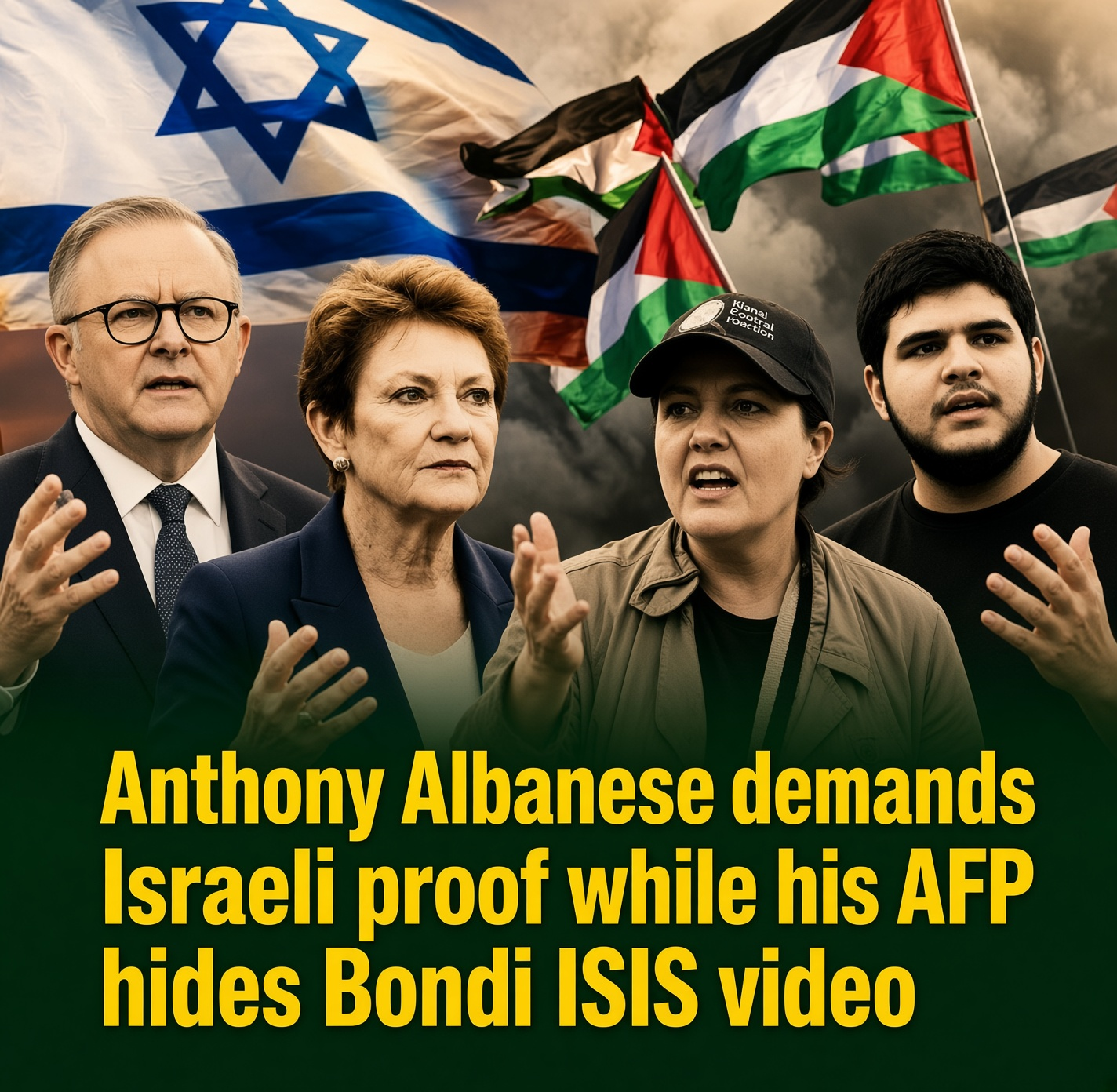
Pauline Hanson has escalated her battle to obtain a video allegedly recorded by the perpetrators of the Bondi Beach terrorist attack, opening a new political argument over why Australians cannot see evidence from the country’s deadliest recent terror atrocity while the Albanese government demands greater transparency from Israel.
The One Nation leader has taken the Australian Federal Police’s refusal to release the footage to the Office of the Australian Information Commissioner.
The video is alleged to show Naveed Akram and his father Sajid Akram sitting with firearms in front of Islamic State imagery before the December 14, 2025 attack.
Descriptions of the recording have already emerged through court and police material.
But the footage itself remains out of public view.
Hanson wants that changed.
The AFP says releasing it could spread violent-extremist material, prejudice continuing investigative work and create public-safety and national-security risks.
The dispute has acquired an additional political dimension because Prime Minister Anthony Albanese and Foreign Minister Penny Wong are simultaneously demanding greater transparency and accountability from Israel over its investigation into the killing of Australian aid worker Zomi Frankcom.
For Hanson, the contrast is obvious.
For the government and AFP, the two cases involve fundamentally different legal and security considerations.
Now the Information Commissioner may be asked to determine whether the AFP has struck the right balance.
One Nation has formally challenged the AFP refusal
The latest move takes Hanson’s campaign beyond speeches and political demands.
One Nation initially sought the Bondi recording through Australia’s Freedom of Information system.
The AFP rejected that request.
Hanson has now sought external review by the Information Commissioner, challenging the federal police decision and arguing there is an overriding public interest in disclosure.
That review process matters because the decision is no longer simply being argued between Hanson and the AFP.
The Information Commissioner has statutory powers to review FOI decisions made by Commonwealth agencies.
The commissioner can affirm, vary or set aside a reviewable decision.
What is allegedly on the video?
The existence of a recording linked to the alleged Bondi perpetrators is not merely a One Nation assertion.
Its contents have been described in material that became public after the attack.
The recording allegedly shows Naveed and Sajid Akram seated in front of an Islamic State flag or imagery.
Firearms and ammunition are visible.
The men allegedly discuss motivations connected with their planned violence.
Naveed is also described in reports of the material as appearing to recite from the Qur’an.
The footage was allegedly recorded approximately two months before the Bondi attack.
Those descriptions have become central to Hanson’s argument.
If Australians can already read substantial details about the recording, she asks, why can they not see an appropriately redacted version or receive an official transcript?
The Bondi attack killed 15 people
The context could scarcely be more serious.
On December 14, 2025, a father and son carried out a terrorist attack at Bondi Beach targeting a Jewish gathering.
Fifteen victims were killed.
Many more were injured.
Official parliamentary proceedings have subsequently described the attackers as leaving an Islamic State flag on their vehicle before beginning their assault.
The attack profoundly changed Australia’s political debate about antisemitism, Islamist extremism, intelligence, firearms and social cohesion.
It also triggered a Royal Commission and extensive scrutiny of what authorities knew about Naveed Akram before the massacre.
ASIO had previously investigated Naveed Akram
That history adds considerably to public interest in the case.
ASIO Director-General Mike Burgess has confirmed that his agency investigated Naveed Akram in 2019.
Following the Bondi attack, Burgess ordered an internal review of ASIO’s decision-making.
That review was conducted by someone from outside ASIO who was given access to the agency’s records.
ASIO ultimately stood by its original assessment.
Burgess told Senate Estimates that the agency continued to believe the Akrams did not adhere to or intend to engage in violent extremism at the time of the 2019 investigation.
He also warned against allowing hindsight to transform assumptions and allegations into established facts.
The later video therefore raises an obvious question of chronology
A finding that somebody did not intend to engage in violent extremism in 2019 does not establish what that person believed years later.
Nor does later radicalisation necessarily prove an earlier intelligence assessment was wrong when it was made.
Understanding when and how the alleged attackers’ ideology developed is consequently one of the crucial questions surrounding Bondi.
A video allegedly recorded two months before the massacre could form an important part of that chronology.
That does not automatically mean the public has a legal right to see it while investigations continue.
It does explain the intense public interest in its contents.
The AFP says release carries real risks
The federal police have not simply said the public should not know what happened.
Their FOI refusal relies on specific concerns.
According to reporting on the decision, those include the potential dissemination of violent-extremist material.
The AFP has also cited risks to continuing investigative activity and public safety.
National-security considerations form part of its position as well.
Authorities internationally routinely face similar dilemmas when dealing with terrorist propaganda.
Material produced by extremists can have evidentiary value while simultaneously functioning as propaganda capable of inspiring sympathisers.
Police therefore have legitimate reasons to consider whether unrestricted publication could cause harm.
Hanson says those reasons do not justify total secrecy
One Nation’s answer is that disclosure need not be all or nothing.
Hanson has argued that Australians should be given either the footage or sufficient information from it to understand what the alleged attackers said and believed.
A redacted transcript is one possible compromise she has raised.
That could potentially provide information about the statements without distributing extremist imagery itself.
The party argues Australians should not have to wait years for inquiries and legal proceedings before understanding evidence already held by authorities about the motivations behind a mass-casualty terrorist attack.
Hanson accuses Labor of hiding the truth
Her political allegation goes considerably further than the established facts.
Hanson says Labor has not been upfront with Australians about Bondi.
She has also alleged that political sensitivities surrounding Muslim communities and electorates in western Sydney are influencing the government’s approach.
That is a serious accusation.
At present, it remains an accusation.
No publicly available evidence establishes that Albanese or another Labor minister instructed the AFP to refuse the FOI request because of electoral considerations.
Nor is there public evidence demonstrating that the AFP decision was made to avoid offending a particular community.
The AFP is not simply Anthony Albanese’s personal police force
This distinction matters when describing the controversy.
The Australian Federal Police is a Commonwealth law-enforcement agency.
The Albanese government is politically accountable for Commonwealth administration and the legislative framework under which federal agencies operate.
But an AFP decision under the Freedom of Information Act should not automatically be described as a personal decision by the Prime Minister.
The available evidence establishes that the AFP refused disclosure.
It does not establish that Albanese personally ordered the footage withheld.
That makes a headline claiming the Prime Minister himself “blocked” the video stronger than the evidence currently supports.
But the timing creates an unavoidable political comparison
Only days before Hanson’s escalation became public, the Albanese government was demanding substantially more transparency from another government.
This dispute concerns Australian aid worker Zomi Frankcom.
Frankcom and six World Central Kitchen colleagues were killed by Israeli strikes in Gaza on April 1, 2024.
The aid convoy had coordinated its movements with Israeli authorities.
The vehicles were marked as belonging to World Central Kitchen.
The deaths triggered international condemnation and an Israeli military investigation.
More than two years later, the handling of that investigation remains a source of major diplomatic friction between Canberra and Israel.
Israel decided against a criminal investigation
The latest controversy erupted when Israeli authorities concluded there was insufficient basis for criminal proceedings against soldiers involved in the strike.
The Israeli military has maintained that the convoy was mistakenly believed to contain Hamas operatives.
Its investigation identified operational failures.
Officers were removed or reprimanded.
But the military prosecution ultimately did not proceed with a criminal investigation.
That conclusion infuriated Frankcom’s family and the Australian government.
Albanese called the outcome an ‘outrage’
The Prime Minister responded unusually strongly.
Albanese rejected the idea that the matter could simply be considered closed and criticised Israel’s handling of the case.
The government has demanded accountability and a fuller explanation.
Foreign Minister Penny Wong has also made clear that Australia is dissatisfied with the level of information and accountability provided.
Australia’s ambassador has been directed to continue raising the matter.
Canberra’s position is that an Australian citizen was killed while performing humanitarian work and that Israel has not adequately answered the questions surrounding her death.
Frankcom’s family wants the evidence released
The family has gone further.
It has called for an independent investigation and greater disclosure of the evidence surrounding the attack.
That includes demands concerning audio and other material capable of showing what Israeli personnel knew and said before the convoy was struck.
The family described the latest Israeli decision as an insult.
World Central Kitchen has also challenged Israel’s account.
Australia is considering what further avenues may remain available to seek accountability.
That is where Hanson’s double-standard argument begins
Her argument can be stated without accepting every accusation she makes.
The Australian government says transparency is necessary to understand how an Australian aid worker was killed overseas.
Hanson says Australians deserve comparable transparency when trying to understand how 15 people were murdered in a terrorist attack at home.
In one case, Canberra is asking a foreign government to disclose more information.
In the other, a Commonwealth agency is resisting an FOI application for potentially important evidence.
That contrast is politically potent.
Whether it is legally a double standard is more complicated.
The two cases are not legally equivalent
The Bondi recording is evidence connected to a domestic terrorist investigation.
AFP says publication could interfere with investigative and security interests.
The Frankcom dispute concerns Australia’s diplomatic demands of a foreign state after that state’s military process concluded without criminal proceedings.
Different laws apply.
Different institutions control the evidence.
Different national-security considerations may arise.
And the procedural stages of the two matters are different.
Those distinctions do not eliminate the political question about transparency.
They do mean that simply placing the cases side by side does not establish government hypocrisy as a matter of fact.
There is also a question of extremist propaganda
One of the strongest arguments against publishing terrorist recordings is the risk that publicity achieves precisely what their creators intended.
Islamic State has historically depended heavily on propaganda.
Videos, photographs and manifestos can be repackaged online, stripped of journalistic context and circulated among extremist networks.
Publishing raw footage could therefore create consequences extending far beyond Australian public accountability.
This is not an abstract concern.
Counter-terrorism agencies routinely attempt to limit the amplification of violent-extremist propaganda.
But that does not settle the case for a transcript
The existence of propaganda risks strengthens the argument against unrestricted publication of the original video.
It does not necessarily answer Hanson’s alternative request.
A carefully prepared official transcript could remove imagery, propaganda symbols and other material deemed operationally sensitive while still allowing Australians to understand what was said.
Redactions could protect investigative information.
Authorities could potentially provide contextual explanation alongside it.
Whether that is legally or operationally possible is ultimately a matter for the review process and relevant agencies.
But it demonstrates why the debate cannot be reduced to a binary choice between releasing everything and revealing nothing.
The Royal Commission will eventually examine the broader failures
The Bondi attack is already subject to much deeper scrutiny.
The Royal Commission provides a formal mechanism for examining the circumstances surrounding the atrocity and the performance of Australia’s institutions.
ASIO has repeatedly emphasised the importance of allowing that process to establish facts rather than relying on speculation.
The commission can investigate questions about radicalisation, intelligence assessments, information sharing, firearms and government responses.
It may ultimately provide much of the information Hanson says Australians deserve.
The political dispute is about whether the public should have to wait.
Transparency and operational secrecy inevitably collide after terrorism
Democratic governments face a difficult balance after mass-casualty attacks.
Excessive secrecy damages public trust.
When governments tell citizens only that authorities are handling the matter, unanswered questions can rapidly become conspiracy theories.
Selective disclosure can create suspicions that politically inconvenient information is being withheld.
But excessive disclosure can compromise investigations, reveal intelligence methods, prejudice prosecutions and amplify extremist propaganda.
Both risks are real.
The purpose of FOI review mechanisms is partly to test whether government agencies have found the correct balance.
The Information Commissioner now provides an independent test
That is why Hanson’s decision to seek review is significant.
She does not have to persuade the AFP voluntarily to reverse itself.
The Freedom of Information system allows external scrutiny of agency decisions.
The Information Commissioner can examine the relevant material and the exemptions relied upon by the AFP.
Importantly, the commissioner can consider evidence that cannot simply be published in the media.
The eventual decision can therefore test the AFP’s secrecy claims without requiring journalists or politicians to guess what operational risks exist.
For Labor, the politics are more difficult than the legal distinction
The government can correctly point out that an AFP FOI decision is not the same thing as Albanese personally suppressing evidence.
It can point to national-security exemptions.
It can point to the continuing investigation.
And it can argue that terrorist propaganda should not be unnecessarily circulated.
But none of those explanations entirely neutralises the political problem.
The government has itself made transparency and accountability the language of its criticism of Israel.
That creates an obvious standard against which its domestic institutions will also be judged.
If Australians are told that another democracy should disclose evidence surrounding the death of an Australian citizen, some will inevitably ask why Australian authorities cannot provide more information surrounding the deaths of 15 people at Bondi.
Hanson is exploiting that contradiction aggressively
One Nation has increasingly made the Bondi attack central to its arguments about national security, immigration, radical Islam and government transparency.
Hanson has accused Labor of refusing to confront the ideological dimensions of the massacre.
She has pushed legislative changes dealing with Australians linked to overseas terrorist organisations.
She has demanded greater disclosure surrounding the Akrams.
And she is now using the Frankcom dispute to argue that Labor applies one standard to Israel and another to itself.
That is political advocacy.
But the underlying FOI dispute is real.
There is no evidence yet of an electoral cover-up
Hanson’s most serious allegation should therefore remain clearly attributed to her.
She argues Labor does not want to offend voters in western Sydney.
No evidence presently available establishes that as the reason the AFP refused the video.
The AFP has publicly identifiable law-enforcement and security grounds available to it.
Unless documents, testimony or the Information Commissioner’s review establish political interference, claiming an electoral cover-up as fact would go beyond the evidence.
That does not prevent Hanson from making the allegation.
It does mean reporting should distinguish her accusation from what has actually been established.
The video itself could eventually settle part of the argument
One reason this dispute has become so politically powerful is that Australians are being asked to debate material most of them cannot examine.
Descriptions of the recording exist.
Its alleged connection to Islamic State ideology has been widely reported.
The broader Islamic State dimension of the Bondi attack is already established in official public discussion.
Yet the original footage remains controlled by authorities.
If an appropriately redacted version or transcript is eventually released, Australians will be able to evaluate its significance more directly.
If it remains withheld, the government and AFP will continue facing demands to explain why.
The question is ultimately how much Australians are entitled to know
There is no serious dispute that some counter-terrorism evidence must remain secret.
There is equally no serious democratic argument that governments should be exempt from scrutiny merely by invoking national security.
The hard cases sit between those extremes.
The Bondi recording is now one of them.
Fifteen people were killed.
The attack was connected to Islamic State-inspired extremism.
Authorities possess a recording allegedly shedding light on the perpetrators’ motivations before the massacre.
The AFP says releasing it creates unacceptable risks.
Hanson says Australians deserve to see it, or at minimum receive a redacted transcript.
And the same federal government whose police agency is resisting disclosure is currently demanding more transparency from Israel over the death of an Australian overseas.
That does not, by itself, prove hypocrisy.
But it creates a transparency test that cannot simply be dismissed as political theatre.
The Information Commissioner now has an opportunity to examine whether the AFP’s reasons for secrecy outweigh the extraordinary public interest surrounding Australia’s Bondi terror attack.
Until that review is resolved, Hanson will continue asking the question at the heart of her campaign: if Canberra believes transparency is essential when demanding answers abroad, how much transparency should Australians expect from their own institutions at home?