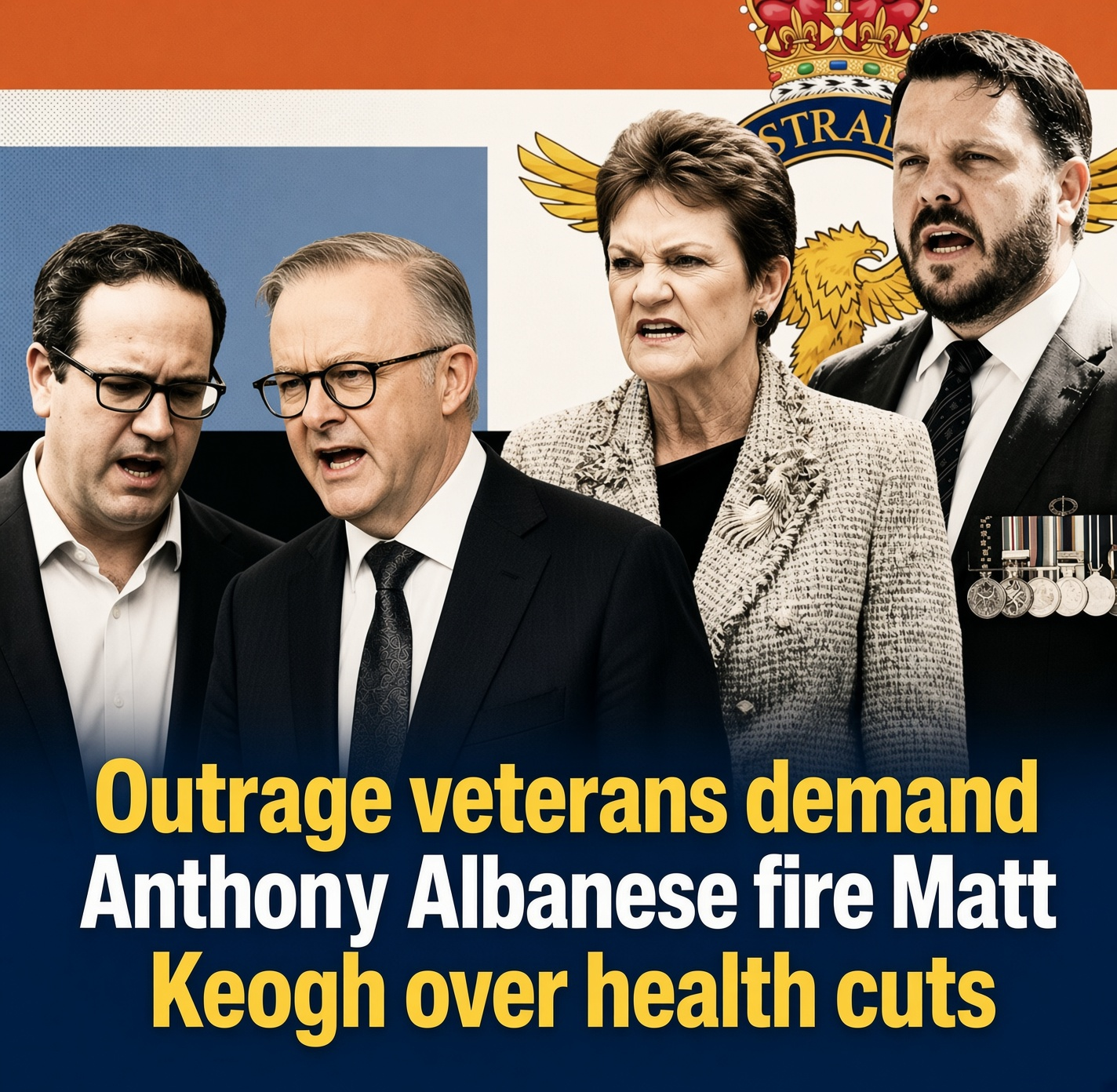
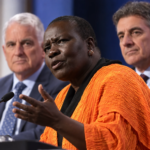
Veterans are demanding Anthony Albanese sack Veterans’ Affairs Minister Matt Keogh as a furious backlash over Labor’s new $5,000 allied-health threshold engulfs Canberra, with the minister forced to admit he “got it wrong” after initially failing to meet former Defence personnel who travelled to Parliament House to confront him.
The controversy has escalated from a dispute over health funding into a damaging test of the government’s relationship with Australia’s veteran community.
Veterans who met Keogh have accused him of treating them with contempt, alleging he refused handshakes, sat with his arms crossed and rolled his eyes during an emotional discussion that included veteran suicide.
Keogh disputes allegations about his conduct, but has acknowledged that his initial handling of the veterans’ request for a meeting was wrong.
Prime Minister Anthony Albanese is standing by his minister — but calls for Keogh’s dismissal are growing rather than disappearing.
What Labor is actually changing
At the centre of the dispute is a major overhaul of allied-health arrangements for veterans from July 1, 2027.
The Department of Veterans’ Affairs says a new $5,000 annual threshold will apply to allied-health services used by Veteran Card holders.
That includes services such as physiotherapy, psychology, occupational therapy, exercise physiology and other forms of ongoing treatment that can be crucial for veterans living with complex service-related injuries.
But describing the policy simply as a hard $5,000 ceiling on all treatment is incomplete.
DVA officially describes the figure as a threshold at which the clinical effectiveness of further allied-health treatment will be reviewed.
Veterans can potentially receive treatment above $5,000
The government’s policy contains a mechanism allowing DVA to fund services beyond the $5,000 annual amount where there is a valid clinical need.
That distinction has become central to Labor’s defence.
The government says veterans will not simply reach $5,000 and automatically have necessary treatment switched off.
Instead, cases requiring additional expenditure are intended to undergo further clinical consideration.
Critics argue that distinction does not resolve their central concern: vulnerable veterans may face another bureaucratic hurdle between themselves and medically necessary care.
The reforms are expected to save more than $779 million
The financial scale of the measure explains much of the suspicion surrounding it.
RSL Australia says the government has confirmed the allied-health reforms will deliver savings of more than $779 million over five years.
That is a substantial reduction in projected expenditure.
Importantly, the $779 million figure covers five years — not four years as some political commentary surrounding the controversy has claimed.
The size of those savings has prompted veterans’ advocates to question whether the policy is principally a clinical reform or a Budget-saving exercise.
RSL Australia says the Budget ‘gives with one hand while taking with the other’
RSL Australia has offered a more nuanced response than either side of the increasingly heated political debate.
It welcomed new investment in veterans’ healthcare and acknowledged positive elements of the government’s reforms.
But it also raised serious concerns about the savings associated with the new allied-health arrangements.
Its assessment was pointed.
Veterans and their families, the organisation said, would reasonably question a Budget that “gives with one hand while taking with the other”.
Labor is also increasing allied-health fees
The $779 million saving is not the only component of the package.
The government is substantially increasing the fees paid to allied-health providers.
DVA describes the increase as the largest in more than 20 years.
That matters because veterans have faced difficulties finding providers willing to accept DVA patients when government reimbursement rates lag commercial fees.
Labor argues increasing those fees will make it easier for veterans to find professionals prepared to treat them.
The 12-session treatment cycle is also being abolished
Another significant change has received less attention amid the controversy.
The existing Treatment Cycle generally requires another referral after 12 sessions or 12 months, whichever comes first.
From July 2027, that arrangement will be removed.
Veterans will therefore be able to receive more than 12 allied-health sessions without automatically requiring another referral solely because the existing treatment cycle has expired.
The government argues this will reduce bureaucracy for many veterans even as the $5,000 review threshold creates additional scrutiny for higher-cost cases.
Why veterans are still furious
For veterans with complicated physical and psychological injuries, $5,000 can be consumed quickly.
Regular psychology, physiotherapy, occupational therapy and other treatments can continue for years after military service.
Some veterans require several allied-health disciplines simultaneously.
Their advocates fear the threshold could particularly affect people whose injuries are the most serious and whose treatment requirements are therefore the most expensive.
The veterans who need the greatest amount of care are precisely the people most likely to trigger the new review process.
Julie-Ann Finney has become one of the strongest critics
Among those leading the campaign is veteran-suicide advocate Julie-Ann Finney.
Finney lost her son, Royal Australian Navy sailor David Finney, to suicide in 2019 and became a prominent campaigner for the Royal Commission into Defence and Veteran Suicide.
She was part of the delegation that travelled to Canberra to challenge the government over the allied-health changes.
Finney has now argued Keogh’s position as Veterans’ Affairs Minister is untenable.
Her involvement gives the confrontation particular political weight because the Albanese government has repeatedly committed itself to implementing reforms following the landmark royal commission.
The meeting became a political disaster
The veterans arrived at Parliament House seeking a meeting with Keogh.
Initially, they were told the minister would not be available.
That decision triggered anger and political pressure, particularly given the significance of the issues the delegation had travelled to discuss.
A meeting was eventually organised for approximately 5.30pm.
Rather than calming the controversy, what happened inside that meeting made it considerably worse.
Veterans accuse Keogh of refusing handshakes
Members of the delegation subsequently gave highly critical accounts of the minister’s behaviour.
They alleged Keogh entered the meeting and refused to shake their hands.
They said he sat with his arms crossed.
They also accused him of rolling his eyes while deeply serious issues, including suicide among former Defence personnel, were being discussed.
Those are allegations from participants in the meeting, and Keogh has disputed claims that he behaved disrespectfully.
The competing accounts have nevertheless intensified questions about whether trust between the minister and sections of the veteran community has broken down.
Keogh admits he ‘got it wrong’
One part of the controversy is not disputed.
Keogh subsequently acknowledged that he should have met the veterans earlier.
He told Parliament he had made the wrong call in initially declining the meeting.
“I got it wrong,” the minister conceded.
The apology addressed his failure to meet the delegation earlier but did not amount to an abandonment of the allied-health reforms.
The government is standing by the policy
Keogh continues to defend the rationale behind the changes.
The government argues there is evidence of excessive or clinically ineffective service delivery in parts of the allied-health system.
It says the reforms are designed to make sure taxpayers fund clinically effective treatment while simultaneously increasing provider fees and improving access.
Keogh has also emphasised that veterans with genuine clinical requirements above the threshold will have a pathway to continued support.
Labor therefore rejects the characterisation that every veteran will simply have their healthcare cut off once they spend $5,000.
Veterans fear another DVA approval process
For critics, however, the existence of an exemption process is part of the problem.
Veterans and their families have repeatedly complained about complex interactions with DVA, delays in approvals and the psychological burden of repeatedly demonstrating the legitimacy of service-related conditions.
The Royal Commission into Defence and Veteran Suicide documented profound problems in the systems surrounding serving and former ADF personnel.
Against that background, adding another point at which treatment may require review is politically and emotionally sensitive.
The concern is not merely whether an exemption exists on paper, but how quickly and reliably it works when a veteran actually needs treatment.
Jacqui Lambie enters the fight
The controversy escalated further on Thursday when independent Tasmanian Senator Jacqui Lambie delivered an emotional Senate intervention against the policy.
Lambie is a former Australian Army corporal and has made veterans’ affairs a central part of her political career.
She used her own experience with serious health problems to illustrate what she believes is wrong with the $5,000 threshold.
Her message to the government was unequivocal: “Drop the bloody cap.”
Lambie reveals her own $7,000 surgery
Lambie disclosed that she recently underwent surgery costing about $7,000 for vaginal and bladder prolapse.
She linked her condition to her military service and the physical demands placed on women in the Defence Force.
Her example immediately highlighted the problem critics see in the $5,000 figure.
A single significant medical episode can exceed that amount.
For a veteran requiring multiple allied-health services over an entire year, opponents argue the threshold could be reached even more quickly.
Female veterans raise a particular concern
Lambie’s intervention also broadened the controversy beyond the immediate political confrontation with Keogh.
She highlighted health problems affecting female veterans, including pelvic injuries and the consequences of carrying military equipment designed around different physical assumptions.
She accused the system of failing to properly recognise and respond to those conditions.
Her argument is that apparently neutral spending thresholds can have very different consequences for veterans with complex or poorly understood service-related injuries.
Phillip Thompson has moved against the minister
Coalition MP and former soldier Phillip Thompson has become another leading critic of the policy.
Thompson moved a formal censure motion against Keogh in the House of Representatives over the $5,000 arrangement.
He has cited veterans suffering from severe physical trauma and post-traumatic stress disorder while arguing that the government is imposing an unacceptable administrative barrier on treatment.
A petition opposing the measure has attracted thousands of signatures.
Thompson has joined demands for Albanese to remove Keogh from the veterans portfolio.
Labor says only a small proportion will be affected
The government’s defence rests partly on the distribution of current allied-health expenditure.
Keogh argues the majority of veterans do not currently exceed the proposed annual threshold.
From Labor’s perspective, that means most Veteran Card holders will benefit from higher provider fees and the removal of the Treatment Cycle without ever encountering the $5,000 review process.
Critics respond that the relatively small group exceeding the threshold may include precisely the veterans with the most complex and serious conditions.
That is why percentages alone do not settle the argument.
Is it a cap or a threshold?
The language has become politically important.
Critics consistently call the policy a $5,000 “cap”.
DVA’s official description is a $5,000 “annual threshold for review of clinical effectiveness”.
The difference is substantive.
A hard cap would mean funding necessarily ends at $5,000.
Under the government’s published design, treatment above $5,000 can continue where additional services are judged clinically necessary.
But veterans’ groups argue that an approval mechanism can still operate as a practical barrier if it causes delays, uncertainty or interruption to established treatment.
The $779 million saving makes scepticism inevitable
If the change were purely about clinical administration, its enormous Budget impact would attract less attention.
But the government expects the broader allied-health reforms to reduce expenditure by more than $779 million over five years.
That inevitably raises a question.
If services will remain available whenever they are clinically necessary, where exactly will three-quarters of a billion dollars in savings come from?
Labor’s answer is that the system currently includes over-servicing and treatment that does not deliver sufficient clinical benefit.
Veterans’ advocates want much stronger assurances that necessary treatment will not be caught in the attempt to remove unnecessary spending.
There is a genuine problem with provider fees
The government also has a legitimate problem it is attempting to address.
Veterans have reported difficulty finding allied-health providers prepared to treat them under DVA arrangements.
One reason has been reimbursement rates that providers regard as inadequate compared with ordinary private fees.
Increasing those payments can improve access by making veteran patients financially viable for more practices.
The reform therefore contains a real investment in access alongside the projected Budget savings.
The argument is over who pays for that investment
This is where RSL Australia’s criticism becomes particularly relevant.
Higher provider fees cost government more.
The new threshold and associated utilisation controls save government money.
The net package is therefore not simply a healthcare expansion.
It restructures where veterans’ health dollars are spent while reducing projected expenditure overall.
Veterans want confidence that those savings will come from genuine waste rather than treatment required by people living with the consequences of their service.
The Royal Commission changed the standard expected of government
The political environment surrounding veterans’ policy is also radically different following the Royal Commission into Defence and Veteran Suicide.
The commission exposed systemic failures across Defence, veterans’ support and the transition from military to civilian life.
It documented the devastating consequences that can follow when former personnel become trapped in bureaucratic systems or struggle to obtain appropriate support.
Any new policy that appears to put another administrative hurdle between veterans and healthcare will therefore face intense scrutiny.
That makes Keogh’s meeting particularly damaging
A Veterans’ Affairs Minister needs an unusually high level of trust with the people his department serves.
Even if Keogh disputes the veterans’ description of his body language, the fact that participants emerged from the meeting feeling insulted is politically serious.
The minister’s initial failure to meet them compounded the problem.
His subsequent admission that he got that decision wrong was necessary.
Whether it is enough to repair the relationship is another question entirely.
Albanese is refusing to sack him
Despite the mounting pressure, the Prime Minister has backed Keogh.
Albanese confirmed on Thursday that the minister retains his confidence.
Labor MPs have defended the broader policy while acknowledging problems in how the changes were communicated and how the veterans’ delegation was handled.
For now, Keogh remains Veterans’ Affairs Minister.
That makes Albanese increasingly responsible for the political consequences if the controversy continues to escalate.
The Prime Minister is being asked to meet the veterans himself
Veterans involved in the campaign have sought direct engagement with Albanese.
The request raises the stakes beyond Keogh’s ministerial performance.
If the Prime Minister meets them, he will face direct pressure to abandon or substantially modify the threshold.
If he refuses, critics will accuse the government of repeating the same mistake that Keogh has already admitted making.
The issue is therefore moving steadily towards the Prime Minister’s desk.
The government still has time to change the design
The new arrangements are not scheduled to begin until July 1, 2027.
Consultation and implementation work therefore remain underway.
That leaves room for Labor to alter how the threshold operates, strengthen automatic exemptions or create clearer protections for veterans with complex and chronic conditions.
Reports suggest potential safeguards for groups including veterans with complex PTSD are among the issues being considered.
The final practical impact will depend heavily on those implementation details.
A poorly designed review could cause real harm
Continuity matters enormously in allied healthcare.
A veteran who has established a productive relationship with a psychologist or physiotherapist may deteriorate if treatment is unexpectedly interrupted.
Someone with chronic musculoskeletal injuries may require regular treatment simply to remain mobile and independent.
For those patients, even temporary uncertainty over funding can matter.
The government’s challenge is to ensure the $5,000 threshold never becomes a cliff edge in practice, regardless of what it is called administratively.
But unlimited spending also deserves scrutiny
The opposing argument cannot simply be dismissed.
Governments have an obligation to ensure taxpayer-funded healthcare is clinically effective.
More treatment is not automatically better treatment.
Where providers deliver unnecessary sessions or services without measurable benefit, public money can be wasted while patients receive little value.
A system designed around veterans’ welfare should be capable of identifying genuine over-servicing without treating every review as an attack on veterans.
The policy therefore depends on trust
That is precisely what makes the current political crisis so damaging.
A clinical-review system can work only if veterans trust the institution conducting the review.
They must believe decisions will be made quickly, competently and primarily around their health needs rather than Treasury savings targets.
The $779 million Budget saving makes that trust harder to establish.
The bitter meeting with Keogh makes it harder still.
The government’s immediate problem is therefore not only the policy architecture. It is credibility.
Keogh now has two fights on his hands
The first is to persuade veterans that necessary treatment will continue beyond $5,000.
The second is to persuade them that he remains the right minister to deliver that assurance.
Those questions have become inseparable after the Parliament House confrontation.
Julie-Ann Finney says his position is untenable.
Phillip Thompson wants him removed.
Jacqui Lambie wants the threshold abandoned.
Albanese, for now, is backing both his minister and the government’s reform.
The next move belongs to Labor
The government has more than ten months before the new allied-health arrangements are scheduled to begin.
That gives it time to prove that veterans with complex needs will not lose necessary care.
It can publish clearer exemption rules.
It can establish rapid approval mechanisms.
It can explain precisely where the $779 million in savings will come from.
And it can demonstrate that the lessons of the Royal Commission into Defence and Veteran Suicide are reflected in the way DVA treats vulnerable former personnel.
What Labor cannot afford is for veterans to believe the Budget saving matters more than their treatment.
The controversy is no longer just about $5,000
The threshold triggered the fight.
The meeting transformed it.
Keogh’s admission that he got his initial response wrong prevented the controversy from becoming a simple dispute over whether the veterans were entitled to his time.
But it has not resolved the much larger issue.
Veterans want to know whether the government can remove more than $779 million from projected allied-health spending without making the men and women with the most serious service-related conditions pay the price.
Labor says it can.
Its critics say the risk is unacceptable.
And as Albanese continues to stand behind Matt Keogh, responsibility for proving the policy will protect vulnerable veterans increasingly rests with the Prime Minister himself.