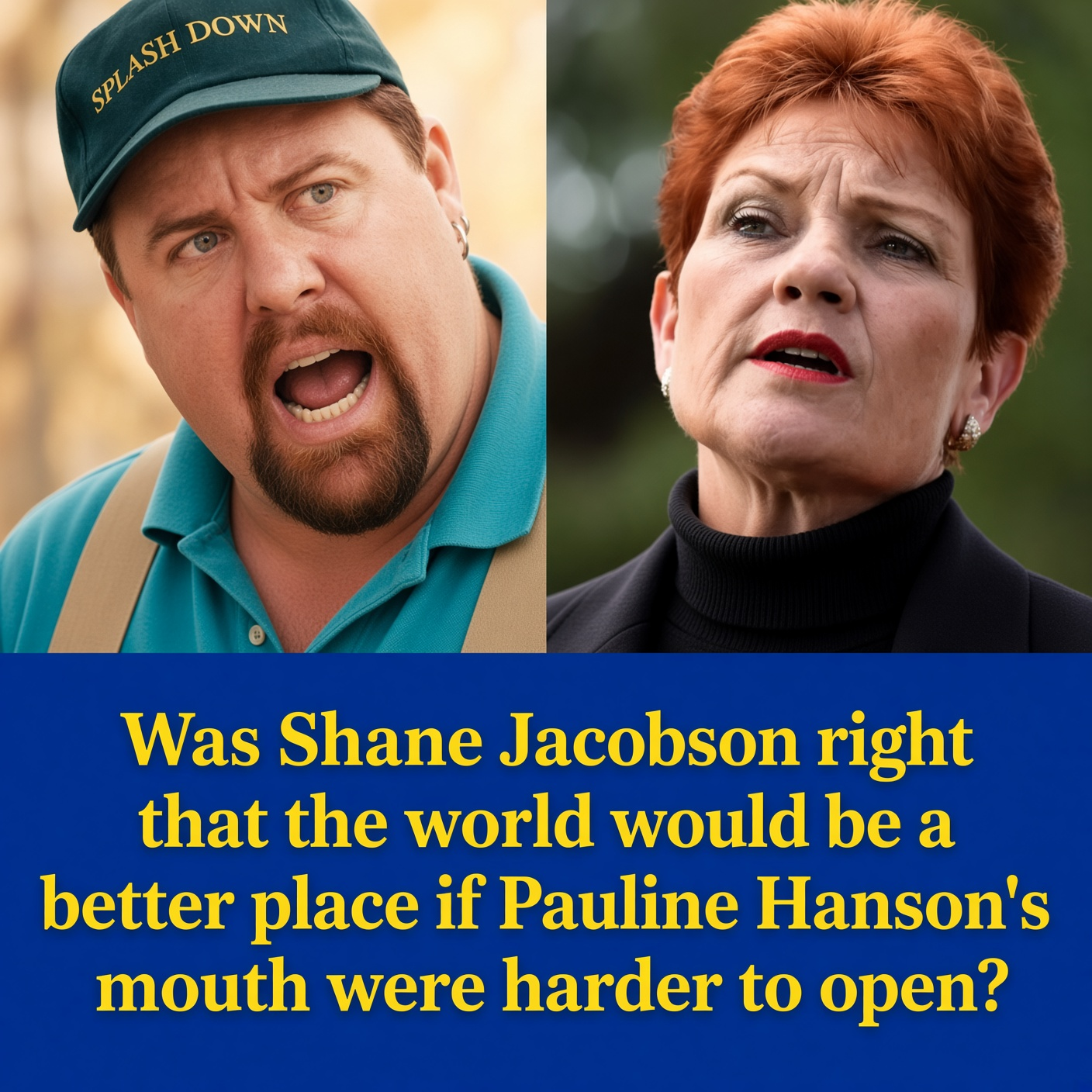
Shane Jacobson turned a stubborn Logies envelope into one of the night’s most politically charged jokes, telling a packed room that the world would be a better place if Pauline Hanson’s mouth were just as difficult to open.
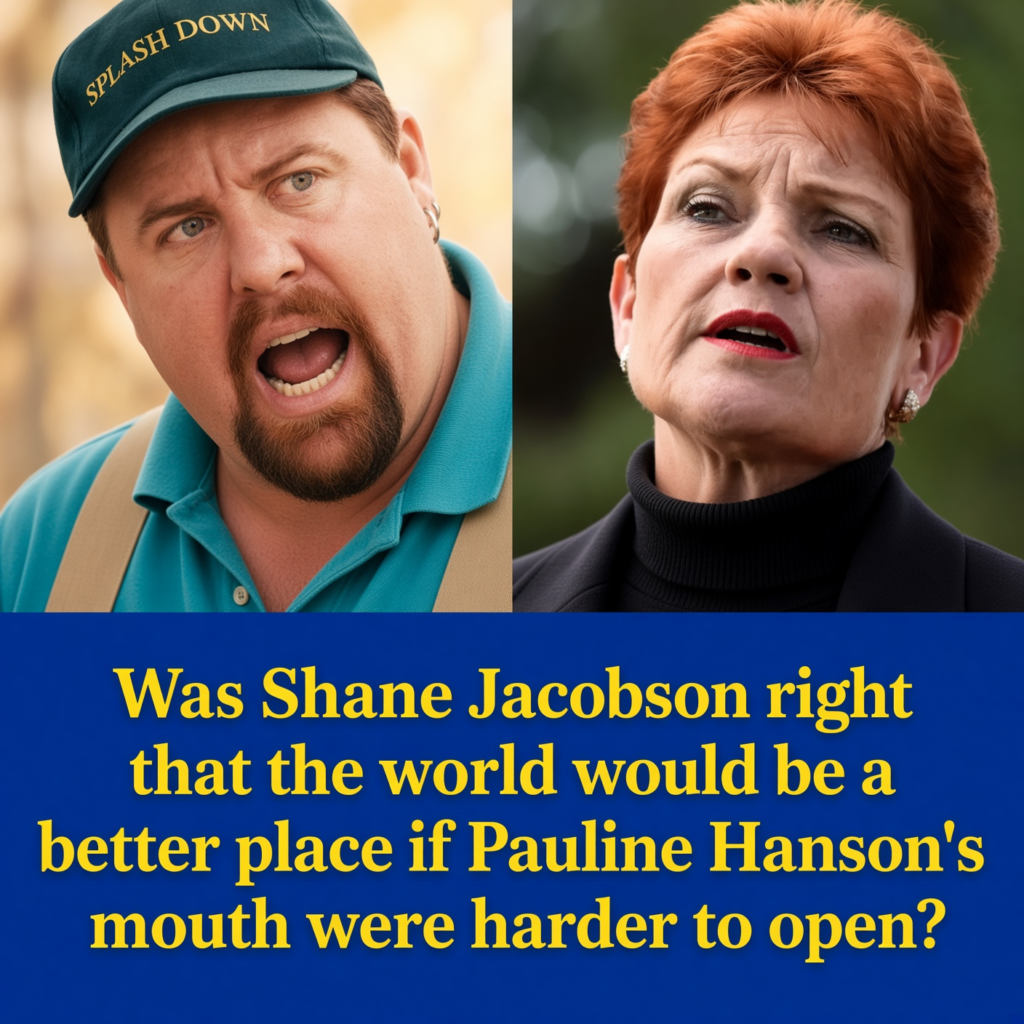
The Australian actor and comedian was on stage with Sophie Monk at the 2026 TV Week Logie Awards when he struggled to open the envelope containing the winner’s name.
Rather than quietly fight with the packaging, Jacobson turned the moment into a punchline.
“My God! If Pauline Hanson’s mouth was this hard to open, wouldn’t the world be a better place?” he joked.
The line drew laughter inside the room.
Outside it, the reaction was considerably more divided.
Jacobson’s joke came from an awkward envelope
Jacobson and Monk had taken to the stage to present two awards when their segment quickly became a comedy routine.
Jacobson joked that the pair had been given two awards to present because of “budget cuts”.
He also turned his attention to Monk’s striking outfit, joking that she appeared to be “missing half” of it.
Then came the envelope.
As Jacobson struggled to prise it open, Hanson suddenly became the target.
The joke was brief, unmistakably political and delivered to a television-industry audience that immediately understood the reference.
Hanson wasn’t in the room
The One Nation leader was not part of the Logies ceremony.
She was not presenting an award, nominated for one or involved in Australian television’s biggest awards night.
That became part of the criticism afterwards.
Detractors questioned why an entertainment awards ceremony needed to turn an absent federal politician into a punchline.
Supporters of the gag saw nothing extraordinary about it.
Politicians have been targets of Australian comedy for generations, and Hanson has spent decades occupying a highly prominent and polarising position in national politics.
The reaction quickly split along familiar lines
The joke attracted both praise and condemnation after footage circulated beyond the Logies audience.
Some viewers celebrated Jacobson for taking a shot at a politician whose views they strongly oppose.
Others accused the Logies of revealing a political double standard by mocking Hanson to an approving room.
Her supporters argued that the line was less a clever political joke than an expression of hostility towards someone with whom the entertainment industry disagrees.
The dispute rapidly became bigger than whether one joke was funny.
It became another argument about the politics of Australia’s cultural institutions.
Rita Panahi called it the low point of the night
Herald Sun columnist Rita Panahi was among the strongest critics.
She argued the Logies had become overly political and described Jacobson’s Hanson line as the low point of the ceremony.
Panahi also criticised jokes delivered earlier in the evening at the expense of Karl Stefanovic and Dave Hughes.
Her broader complaint was that Australian television’s night of nights had become comfortable making jokes that appealed to the political instincts of the people in the room.
To critics like Panahi, the laughter was as revealing as the punchline itself.
But political satire is hardly new to the Logies
There is another side to the argument.
The Logies have never been conducted as a politically neutral parliamentary proceeding.
They are an entertainment show.
Presenters and hosts are expected to make jokes about celebrities, television personalities, current affairs and occasionally politicians.
Australian comedy has a particularly long tradition of ridiculing political leaders from across the spectrum.
On that view, treating Hanson as somehow off-limits would itself be unusual.
Robert Irwin had already set a political tone
Jacobson’s Hanson gag also did not occur in isolation.
Host Robert Irwin had earlier included political references in his opening monologue.
One involved absent television presenter Karl Stefanovic.
Irwin joked that Stefanovic had not RSVP’d, before saying a seat had nevertheless been saved for him “to the right” — and then “the far right”.
Dave Hughes was another target after his increasingly outspoken interventions in Victorian politics.
By the time Jacobson mentioned Hanson, political satire had already become part of the night’s comedy.
Kate Langbroek also attacked the Logies jokes
The political jabs generated criticism from elsewhere in Australian media.
Kate Langbroek subsequently attacked Irwin’s jokes about Stefanovic and Hughes, arguing that they were unnecessary and questioning why the audience had responded so enthusiastically.
Her criticism was notable because it was not principally a defence of Hanson or One Nation.
Instead, it raised a broader question about the culture of the room.
When almost everybody in an audience appears to share the joke’s political assumptions, satire can start looking less like challenging power and more like entertaining people who already agree.
That is the argument now surrounding Jacobson
A comedian making fun of a politician is not normally remarkable.
But the identity of the politician, the audience and the political climate changed how the joke was received.
Hanson is currently at the centre of a renewed national political debate as One Nation records substantially stronger polling than it achieved at the 2025 federal election.
Her policies on immigration, multiculturalism, superannuation, tobacco excise and other issues have generated intense coverage.
She is therefore not merely a historical political figure being recycled for an easy gag.
She leads a party actively competing for a substantially larger share of Australia’s electorate.
Does popularity make a politician less legitimate to mock?
No.
Political popularity has never created immunity from satire.
Prime ministers, opposition leaders and minor-party politicians can all legitimately be mocked.
But political relevance does change the context.
If millions of Australians support a politician, jokes suggesting the country would be better if that politician could not speak may predictably be heard by those voters as contempt for more than one individual.
That does not make the joke illegitimate. It does help explain the backlash.
There is also an important distinction between ridicule and censorship
Jacobson’s line was a joke.
He did not announce a policy proposal to prevent Hanson speaking.
Nor does an awards-show punchline deprive a senator of her political platform.
Hanson remains free to give interviews, address Parliament, campaign, publish statements and argue for One Nation’s policies.
Interpreting the line literally as a demand to silence an elected senator would therefore go further than the available evidence supports.
But the joke clearly worked by invoking the idea that hearing less from Hanson would improve the world.
That is why it generated a political response.
Comedy depends on permission to offend
There is a broader principle at stake for people defending Jacobson.
Comedy becomes extraordinarily narrow if every joke about a politician must first satisfy that politician’s supporters.
Satirists routinely exaggerate, insult and ridicule public figures.
Politicians voluntarily operate in an environment where their words, appearance, policies and mistakes can become material.
A society that protects Hanson’s right to make controversial political arguments must also protect Jacobson’s right to make a joke about Hanson.
Neither side is entitled to immunity from criticism.
But audiences are equally free to call a joke bad
Freedom to make a joke does not create an obligation to laugh.
Viewers are entitled to find Jacobson’s line sharp, harmless, predictable, mean-spirited or simply unfunny.
They are also entitled to question whether an entertainment industry that frequently speaks about diversity of perspectives actually reflects much political diversity within its own major events.
That criticism is not censorship either.
It is part of the same freedom that allows the joke in the first place.
The Logies audience became part of the story
If Jacobson had made the remark in a comedy club, the moment might have disappeared within hours.
The Logies are different.
The ceremony presents itself as a celebration of Australian television and brings together many of the industry’s most recognisable figures.
That means audience reactions inevitably carry symbolism.
The laughter was interpreted by some Hanson supporters not merely as approval of one comedian’s line, but as evidence of how sections of Australian media regard the One Nation leader.
Whether that interpretation is fair or not, it explains why a few seconds of envelope trouble travelled far beyond an awards ceremony.
Hanson has built a political career around establishment hostility
There is another irony in the controversy.
Being attacked by prominent media and entertainment figures is not necessarily politically damaging for Hanson.
It can reinforce one of One Nation’s most effective messages.
Hanson frequently presents herself as an outsider confronting institutions she argues are disconnected from ordinary Australians.
Her party has increasingly criticised national media organisations and metropolitan cultural institutions.
A room full of television celebrities laughing at a joke about shutting Hanson’s mouth can therefore be incorporated almost perfectly into One Nation’s existing political narrative.
The joke may have pleased Hanson’s opponents — and helped Hanson
This is the political paradox of the moment.
People who strongly dislike Hanson may have found Jacobson’s joke satisfying.
But political jokes do not operate only on the people who agree with them.
Hanson’s supporters can watch exactly the same clip and conclude that Australia’s media establishment despises their political choices.
Undecided voters may see an entertainment industry unnecessarily inserting itself into politics.
In that sense, a joke designed at Hanson’s expense can simultaneously reinforce the anti-establishment brand that has sustained her career.
Australian television has always mixed entertainment and politics
None of this began in 2026.
Australian television has a long tradition of political comedy, satire and irreverence.
Politicians have appeared on entertainment programs, been impersonated by comedians and been subjected to jokes at public events for decades.
That tradition is part of a healthy democracy.
The difficult question is not whether politics belongs in comedy, but whether comedy remains willing to aim unpredictably rather than only at culturally safe targets.
The best political comedy creates discomfort everywhere
Great satire rarely functions as a party campaign advertisement.
It attacks hypocrisy, vanity, incompetence and absurdity wherever they appear.
Sometimes that means ridiculing Hanson.
Sometimes it means ridiculing Anthony Albanese, Labor, the Greens, the Coalition, broadcasters, celebrities or the entertainment industry itself.
A political joke becomes more interesting when the audience cannot confidently predict who will be spared.
That is the standard critics of the 2026 Logies are really challenging the industry to meet.
Jacobson’s line was legal, legitimate — and open to criticism
There is no contradiction in holding all three propositions simultaneously.
Jacobson was entitled to make the joke.
Hanson is entitled to continue expressing political views many Australians strongly dislike.
And viewers are entitled to criticise an awards ceremony if they believe its humour reflects a narrow political culture.
Free expression protects the comedian, the politician and the audience responding to both.
So would the world really be better if Hanson’s mouth were harder to open?
That is not a factual question an awards ceremony can answer.
Australians who oppose Hanson will have one response.
Australians who vote for One Nation will have another.
The democratic answer is considerably less dramatic than Jacobson’s punchline: Hanson gets to speak, her opponents get to challenge her, comedians get to mock her and voters ultimately decide how much political influence she receives.
The more revealing question from the Logies may therefore not be whether Shane Jacobson was “right”. It is why one throwaway joke about an envelope became such a powerful cultural dividing line.
The answer lies in an Australia where entertainment, media and politics are increasingly interpreted through the same partisan lens.
Jacobson got his envelope open.
The argument he opened with it may prove much harder to close.