Labor has launched a fierce defence of Australia’s compulsory superannuation system as One Nation pushes to make it easier for workers struggling with mortgages, housing and the cost of living to access their retirement savings early.
The rapidly escalating political battle centres on a simple but consequential argument from Pauline Hanson: superannuation belongs to the worker, and Australians experiencing serious financial pressure should have greater control over when they can use it.
“It is their money,” the One Nation leader said while outlining her position on Sunday.
Hanson said many Australians were struggling to meet mortgage repayments and other household expenses while simultaneously holding retirement savings they generally cannot access.
“A lot of Australians are doing it tough now and struggling to pay off their mortgages,” Hanson said.
She called for Australia’s preservation rules to be “lightened up a bit”, opening the possibility of substantially broader early access to super.
One Nation MP Barnaby Joyce has now expanded the argument further, suggesting Australians unable to afford food or secure housing should potentially qualify for access under financial-hardship provisions.
“You already have people who can access their super. In hardships, you can,” Joyce told Seven’s Sunrise on Monday.
He argued that being unable to feed yourself because of the cost of living, or being without a home and forced to live in a car, could reasonably be regarded as hardship.
Labor’s response has been emphatic.
Treasurer Jim Chalmers has accused One Nation of threatening one of the central pillars of Australia’s retirement-income system, arguing that easier withdrawals would leave workers with smaller balances and potentially greater dependence on taxpayers in retirement.
“One Nation wants to destroy the compulsory superannuation system just like the Liberals do,” Chalmers said as the dispute erupted.
Labor is attempting to turn the issue into a fundamental political choice about whether superannuation should remain preserved primarily for retirement or become a more flexible source of money during a worker’s lifetime.
But the argument is more complicated than either side’s political slogans suggest.
Australians can already access superannuation before retirement under specified circumstances.
The Australian Taxation Office lists several pathways for early access, including severe financial hardship and compassionate grounds, as well as circumstances involving terminal medical conditions and incapacity.
Severe financial hardship applications are made directly to a person’s super fund and are subject to eligibility requirements.
Compassionate release can cover particular expenses where legislative conditions are satisfied.
These include certain medical treatment and medical transport expenses, palliative care and, in qualifying circumstances, payments needed to prevent foreclosure or forced sale of a person’s principal home.
So the dispute is not really about creating early access from nothing.
It is about dramatically widening the circumstances in which Australians can use it.
One Nation’s argument is that the current thresholds are too restrictive for an era in which Australians can have substantial super balances while struggling to pay immediate household bills.
Labor’s argument is that those restrictions are exactly what make compulsory superannuation work.
The money is difficult to access because it is intended to remain invested for decades.
That allows investment earnings to compound and gives workers a substantially larger pool of assets when they retire.
Opening the system too widely would undermine that central purpose, Labor argues.
The billion-dollar question
The political debate comes as Australians are already withdrawing substantial amounts from super before retirement under existing rules.
News Corp reporting says around 50,000 Australians accessed their super early during the 2023–24 financial year, representing roughly 0.5 per cent of Australians.
That provides both sides with ammunition.
For One Nation, it demonstrates that early access is already an accepted feature of the system and raises the question of why eligibility should not be broadened when households are confronting extreme cost pressures.
For Labor and the superannuation industry, the relatively small proportion of Australians using early release demonstrates that the system is deliberately designed to make withdrawals exceptional rather than routine.
Changing that balance could have enormous long-term consequences.
The Australian superannuation system holds trillions of dollars on behalf of workers.
Those assets are invested across Australian and international shares, property, infrastructure, bonds, private markets and other investments.
Its scale rests partly on the expectation that most members will leave their savings invested until they reach an eligible condition of release.
Every early withdrawal therefore has two effects.
The obvious one is that the member’s balance immediately falls.
The less visible one is that the withdrawn money stops earning investment returns.
For a younger worker, that second effect can accumulate for decades.
Hanson clarifies what she wants
The controversy initially intensified after some reporting characterised Hanson’s remarks as opening the door to ending compulsory superannuation altogether.
Hanson has since pushed back against that interpretation.
She said she was not calling for an end to compulsory super but wanted Australians to have easier access to their savings when they genuinely needed the money for a home, medical expenses or other significant costs.
That clarification is important because abolishing compulsory superannuation and expanding early access are fundamentally different policies.
Ending compulsory super would alter whether employers must make Superannuation Guarantee contributions in the first place.
Expanding early access would retain those contributions but change when workers could withdraw some of the accumulated money.
The detailed One Nation proposal remains under development.
There is not yet a complete published framework setting out precisely which expenses would qualify, how much a member could access, how frequently withdrawals could occur or whether some withdrawals would eventually need to be repaid.
Those details could determine whether the proposal becomes a limited expansion of hardship provisions or a fundamental restructuring of the purpose of superannuation.
Housing sits at the centre of the fight
Housing is where the argument becomes particularly potent.
One Nation already supports allowing superannuation funds to invest some of a member’s retirement savings in that person’s home.
The party’s published housing material describes super as one component of a broader affordability program, alongside policies intended to reduce construction costs and housing demand.
The attraction is obvious.
For many Australians, owning a home outright is one of the strongest predictors of financial security in retirement.
A person retiring with a modest super balance but a fully paid-off house can face very different living costs from someone with a larger retirement account who remains exposed to private rents.
Supporters of greater super flexibility therefore argue that treating retirement savings and home ownership as completely separate objectives makes little sense.
Money used to acquire a home has not necessarily disappeared into consumption.
It has been converted into another asset.
Labor’s objection is that giving buyers additional purchasing power does not create additional houses.
If large numbers of Australians suddenly gain access to their super balances while housing supply remains constrained, buyers may simply have more money with which to bid against one another.
Labor MP Julian Hill escalated that argument on Monday, describing super-for-housing as extraordinarily bad policy and warning it could push house prices higher while simultaneously weakening retirement balances.
That is one of the most important economic questions surrounding the proposal.
If super access increases purchasing power faster than housing supply increases, part of the benefit intended for first-home buyers could ultimately be captured by existing property owners through higher sale prices.
One Nation argues housing policy must therefore address supply and demand as well as finance.
Barnaby Joyce widens the battlefield
Joyce’s intervention makes the dispute considerably broader than housing.
He is questioning how Australia defines hardship itself.
If someone cannot afford basic food, why should retirement savings remain untouchable?
If a person is sleeping in a car while holding tens of thousands of dollars in superannuation, should government rules prevent them from using some of it to secure accommodation?
Those scenarios give the One Nation argument considerable emotional force.
But they also reveal the difficulty of designing the policy.
Once general cost-of-living pressure becomes an eligible reason for withdrawal, policymakers must decide where hardship begins.
Is it homelessness?
Mortgage arrears?
Rental stress?
Difficulty paying electricity bills?
Food insecurity?
Personal debt?
A temporary loss of employment?
The broader the definition becomes, the closer superannuation moves towards functioning as an emergency savings account rather than a preserved retirement asset.
That is precisely the transformation Labor wants to prevent.
Plibersek joins Labor’s defence
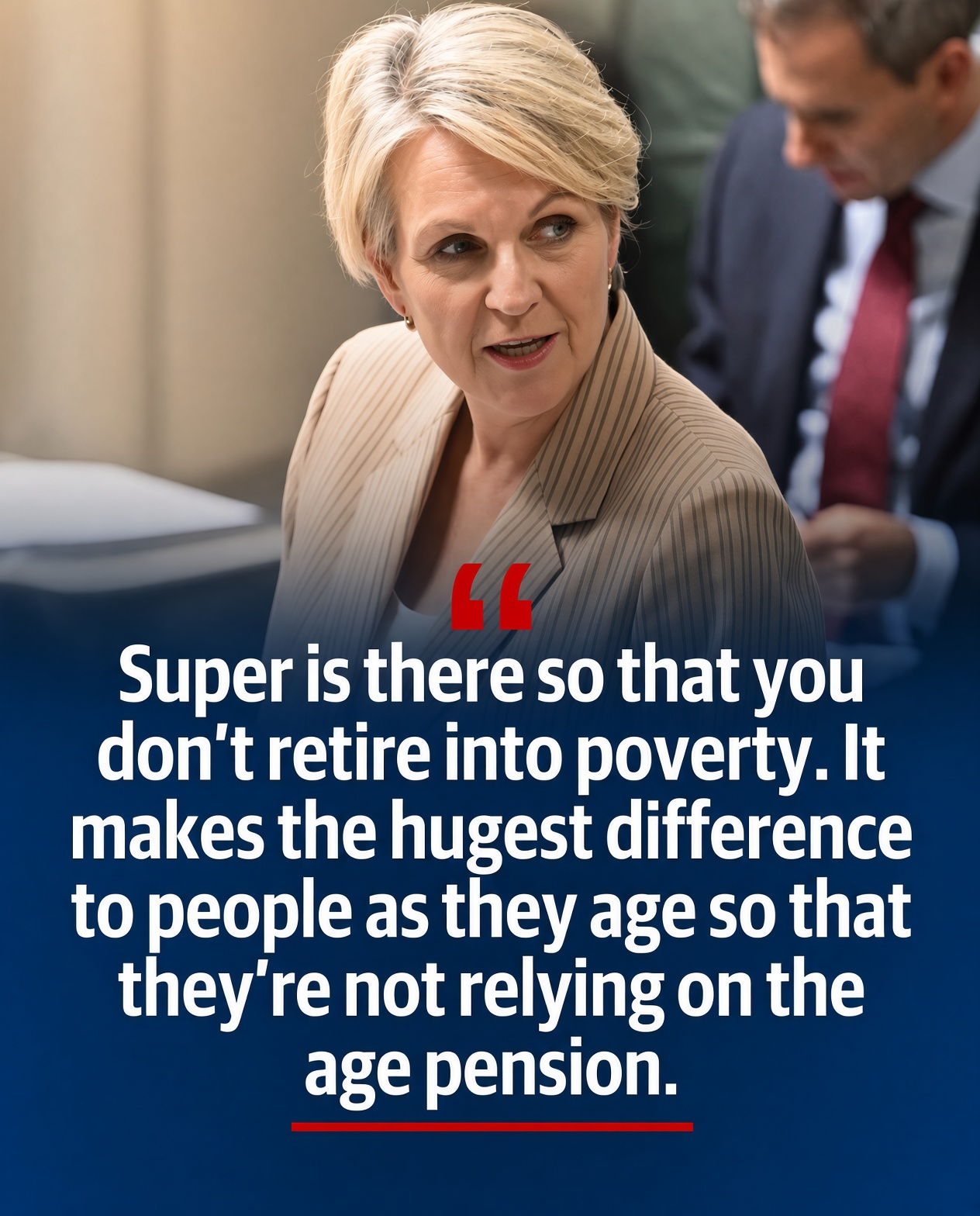
Labor frontbencher Tanya Plibersek has also rejected the push for substantially easier access, clashing with Joyce over whether giving people greater control today would ultimately leave them financially worse off.
The government’s position is that compulsory super exists partly because retirement planning involves decisions whose consequences may not become visible for decades.
A withdrawal that provides immediate relief at 35 can mean less financial independence at 70.
Joyce’s counterargument is about ownership and immediate necessity: there is little comfort in being told money is being protected for your retirement if you cannot afford basic needs today.
That difference captures the philosophical divide at the heart of the debate.
Labor emphasises preservation.
One Nation emphasises ownership.
Labor asks what happens to a person’s retirement balance decades from now.
One Nation asks what happens to that person if they cannot pay the mortgage next month.
The COVID precedent
Australia has already conducted a massive real-world experiment in broader early access.
During the COVID-19 pandemic, the Morrison government temporarily allowed eligible Australians experiencing financial hardship to withdraw up to $10,000 in 2019–20 and another $10,000 in 2020–21.
The program released billions of dollars from the superannuation system.
Supporters saw it as proof that retirement savings can provide a crucial financial safety net during an extraordinary crisis.
Critics argued it demonstrated the long-term cost of using super to solve short-term financial problems.
Superannuation industry groups have invoked that experience in responding to Hanson’s proposal, warning that money removed early loses years or decades of potential investment growth.
The COVID precedent also demonstrates why the current debate cannot be reduced to whether workers technically own their super.
They do.
The policy question is whether ownership should automatically confer unrestricted access before retirement.
Australia’s compulsory system has historically answered no.
The Coalition is being pulled into the argument
Labor is deliberately trying to link One Nation’s position with long-running Coalition debates about superannuation.
The Coalition took a policy to the 2022 election allowing eligible first-home buyers to withdraw up to 40 per cent of their super balance, capped at $50,000, for a home purchase.
More recently, senior Coalition figures have continued questioning whether the current super system gives Australians enough control over their money.
Deputy Liberal leader Jane Hume has emphasised the importance of home ownership to retirement security, while Opposition Leader Angus Taylor has argued for greater individual control over superannuation investment.
Liberal Senator Andrew Bragg has gone further, publicly criticising compulsory super and calling for major reform.
That gives Chalmers an obvious political strategy.
Rather than presenting the fight as Labor versus Hanson alone, he is portraying it as Labor defending compulsory super against a broader right-of-centre movement seeking to weaken preservation rules.
Recent polling showing One Nation’s increased political strength makes that attack more significant than it might have been several years ago.
Superannuation could consequently become another policy area in which competition between the Coalition and One Nation pulls the political debate away from Labor’s preferred position.
What One Nation still needs to answer
Hanson’s core message is easy to understand.
“It’s their money.”
The harder work begins after that sentence.
If One Nation wants substantially broader early access, it will need to decide how much can be withdrawn and under what circumstances.
It will need to address whether younger workers should face different limits from people approaching retirement.
It will need to determine whether money used for a home remains economically connected to the super fund or becomes an outright withdrawal.
It will need safeguards against people exhausting their balances.
And it will need to explain what happens decades later if Australians who accessed substantial amounts early arrive at retirement with insufficient savings.
Labor faces difficult questions of its own.
Defending the theoretical value of a retirement balance is politically challenging when voters are struggling with immediate housing and living costs.
A worker under serious mortgage pressure may reasonably ask why a system designed for their future financial security cannot provide more assistance when their present financial security is collapsing.
Existing hardship and compassionate provisions answer that question to some extent.
Hanson and Joyce argue they do not answer it adequately.
A much bigger argument than a withdrawal rule
The emerging fight ultimately concerns what compulsory superannuation is supposed to be.
Under Labor’s model, it is principally deferred income protected for retirement.
Under the more flexible model being explored by One Nation, it would remain retirement savings but could also become a financial resource available at major points of need during a person’s working life.
Neither model eliminates trade-offs.
Strict preservation protects future balances but limits options for households facing financial pressure today.
Broader access provides immediate freedom but exposes retirement savings to depletion.
Using super for housing can help an individual buyer assemble more capital, but potentially adds demand to a constrained property market.
Using it for ordinary living expenses can rescue a household in genuine distress, but unlike buying a home, the money may leave no corresponding asset behind.
Those distinctions are likely to become increasingly important as One Nation develops its final policy.
For now, Hanson has clarified one point after the initial political storm.
She says she is not campaigning to simply abolish compulsory superannuation.
She wants Australians to have substantially greater access to the money already accumulated in their names.
Chalmers and Labor believe that could begin dismantling the protections that make compulsory super work.
Joyce argues the current protections make little sense when Australians cannot afford food or somewhere to live.
That leaves voters with a question likely to feature prominently in the next federal campaign.
Should superannuation primarily protect Australians from poverty in retirement — or should Australians be trusted to use more of their own retirement money when they are struggling long before they get there?