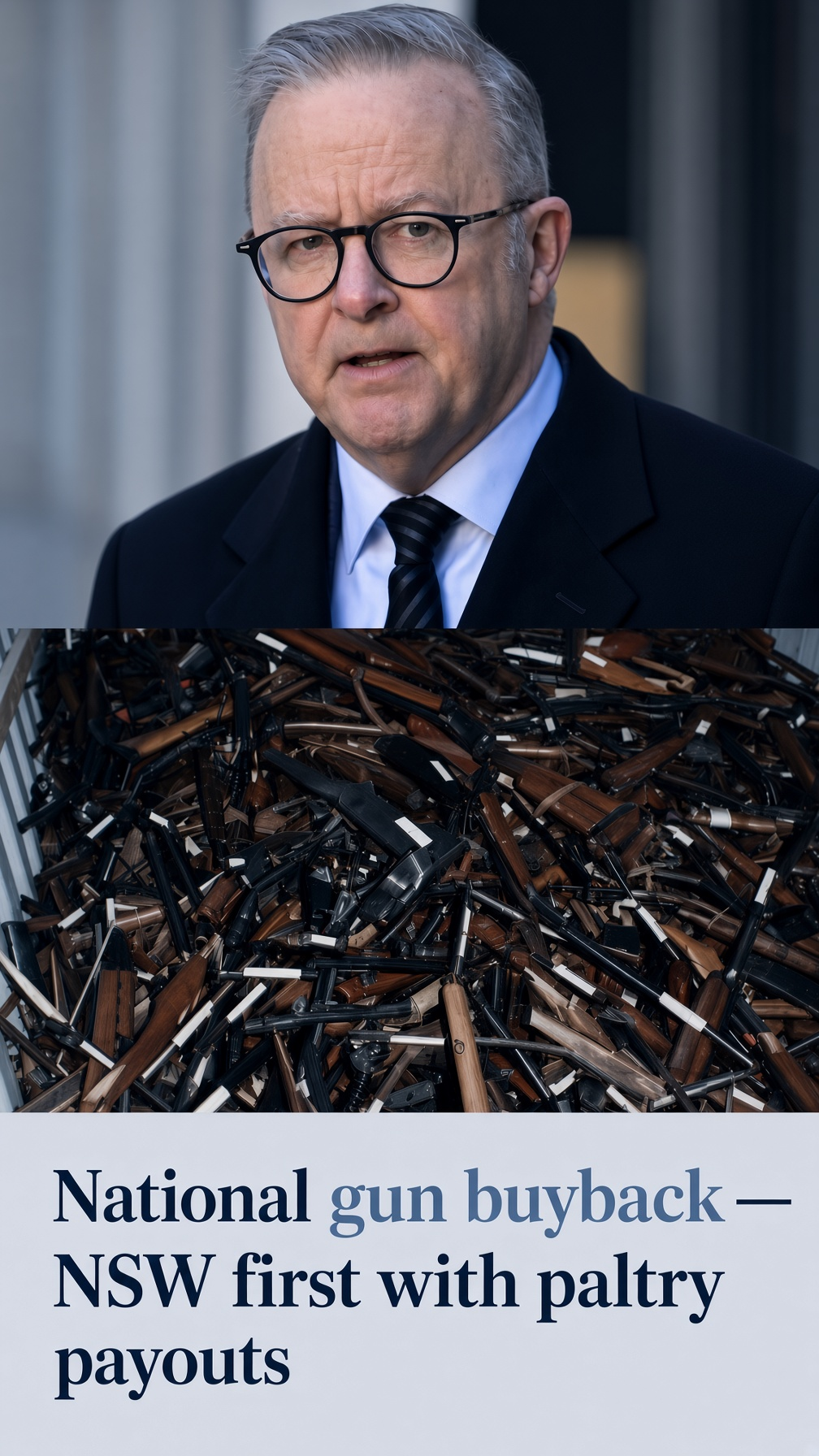
Australia’s largest firearms buyback since the historic gun reforms that followed the Port Arthur massacre will begin in New South Wales on November 2, but Anthony Albanese’s promised national scheme is starting with only one state formally signed up and growing anger over how much lawful firearm owners and dealers will be paid.
The Albanese and Minns governments have struck an agreement to jointly fund the NSW component of the National Gun Buyback Scheme, making the state the first jurisdiction to formally join the Commonwealth program.
The buyback was announced following the deadly Bondi Beach terrorist attack in December 2025 and forms part of a much broader tightening of Australia’s firearms laws.
But eight months after Canberra announced its national ambition, NSW remains out in front while several other jurisdictions remain opposed or unconvinced.
Buyback begins on November 2
The first phase of the NSW scheme will begin on November 2, 2026.
The Commonwealth and NSW governments will share the cost of purchasing eligible firearms, while the Commonwealth will cover the cost of destroying surrendered weapons.
Prime Minister Anthony Albanese says the agreement is the first step towards delivering the national program announced by his government in December.
NSW could ultimately remove as many as 274,000 registered firearms through the scheme.
That represents roughly one-quarter of the state’s legal firearm stock.
Albanese still wants the rest of Australia on board
The Prime Minister has made clear he does not regard the NSW agreement as the end of the process.
He says the Commonwealth will continue working with state and territory governments to expand participation.
The political difficulty is that several jurisdictions have questioned the proposal or rejected joining it under the model offered by Canberra.
The result is an awkward starting point for a program designed and promoted as a “National Gun Buyback Scheme”.
The plan followed the Bondi terrorist attack
The Commonwealth announced the scheme days after the December 2025 terrorist attack at a Jewish Hanukkah event at Bondi Beach.
Fifteen victims were killed.
The attack prompted an immediate national debate about firearms, extremism, intelligence failures and the ability of authorities to identify potentially dangerous individuals.
The federal government subsequently announced what it described as the largest gun buyback since the Howard government’s response to the 1996 Port Arthur massacre.
Albanese argued that reducing the number of firearms in the community had to form part of Australia’s response.
NSW dramatically tightened its gun laws
The Minns government moved rapidly after the attack.
Legislation passed in December introduced what the government described as the toughest firearms laws in Australia.
Among the most significant changes was a general limit of four firearms per individual licence holder.
Primary producers can hold up to 10 under the relevant exemptions.
Other changes affected particular firearm types, magazine capacities and licensing arrangements.
The buyback provides a mechanism for owners affected by those restrictions to surrender firearms that they can no longer lawfully retain.
How much will gun owners receive?
The government has now published the compensation schedule for the first phase.
An air rifle attracts a payment of $450.
A rimfire rifle is valued at $600.
A single-barrel shotgun attracts $650.
A double-barrel shotgun attracts $850.
Some other eligible firearms will receive payments of up to $1,000 during Phase 1.
Those figures have become one of the most contentious elements of the scheme.
Critics say the prices are far below market value
Firearm owners, dealers and political opponents argue that a fixed government schedule cannot adequately reflect the enormous variation in the condition, age, manufacturer and market value of individual firearms.
A firearm classified within one broad category may be worth considerably more than another firearm technically falling into the same category.
That has prompted accusations that lawful owners could be forced to surrender valuable private property for substantially less than they paid for it.
The government describes the payments as compensation; critics describe some of the offers as inadequate or “low-ball”.
Higher-value firearms will be dealt with later
The first phase is not intended to cover every firearm at the same maximum payment.
A second phase is planned for 2027.
It will deal with higher-value firearms and is expected to provide compensation reaching as high as $10,000 in eligible cases.
Further details will be required before affected owners can determine exactly how individual high-value firearms will be assessed.
That distinction is important because claims that the entire buyback caps compensation at $1,000 are incorrect.
Dealers say they face a much larger financial hit
Firearms businesses have their own concerns.
The changes affect not only privately owned firearms but commercial inventories and the future value of businesses operating within the lawful shooting industry.
The NSW government is providing financial assistance for eligible dealers, including grants of up to $25,000.
But some businesses say that amount bears little relationship to their potential losses.
A dealer holding substantial stock can have considerably more than $25,000 tied up in firearms and associated business activity affected by regulatory changes.
One Dubbo dealer calls the grant a ‘slap in the face’
The dealer assistance has already attracted fierce criticism in regional NSW.
A Dubbo firearms dealer described the $25,000 grant as a “slap in the face”, arguing businesses face consequences extending far beyond the compensation available to individual firearm owners.
Dealers also need to consider unsold stock, changes in customer demand and the longer-term effect of tighter ownership limits.
For regional firearm businesses, the dispute is therefore as much about commercial viability as the value assigned to individual guns.
Regional MPs are pushing back
The buyback is emerging as a significant political issue outside Sydney.
Regional MPs and representatives of shooting communities argue licensed firearm owners are being required to carry the consequences of a terrorist attack despite having committed no offence.
They say Australia should focus resources on illegal firearms, organised crime, extremist networks and intelligence failures rather than imposing additional costs on people already complying with strict licensing requirements.
That argument is likely to become increasingly prominent as the November start date approaches.
The government says fewer guns means less risk
The Albanese and Minns governments take a fundamentally different view.
Their argument is that the overall number and concentration of firearms matters to public safety regardless of whether most individual owners are law-abiding.
Firearms can be stolen.
Licence holders’ circumstances can change.
Weapons can move from lawful possession into illegal markets.
And authorities can fail to identify a dangerous person before an attack occurs.
From that perspective, reducing the pool of firearms itself reduces potential risk.
NSW expects an enormous number of guns to be surrendered
The scale of the program demonstrates how consequential the new ownership caps could be.
More than 1.1 million registered firearms are held in NSW.
Government estimates suggest up to 274,000 could ultimately be surrendered.
Approximately 50,000 licensed owners could be affected.
If those estimates are realised, the NSW scheme alone would become one of the largest firearm-reduction exercises Australia has undertaken in decades.
The Port Arthur comparison carries enormous political weight
Both governments have repeatedly invoked Australia’s post-Port Arthur reforms when explaining the new program.
After 35 people were murdered at Port Arthur in Tasmania in 1996, the Howard government reached agreement with states and territories on the National Firearms Agreement.
The associated buyback removed hundreds of thousands of newly prohibited firearms from private ownership.
The reforms became one of the defining acts of John Howard’s prime ministership.
For gun-control advocates, the lesson is that governments should again respond decisively after a mass-casualty attack.
But critics say 2026 is not 1996
Opponents reject a straightforward comparison between the two periods.
The Port Arthur reforms targeted categories of firearms that governments had collectively decided should no longer be generally available.
Today’s debate involves new ownership caps and a broader effort to reduce firearm numbers following a terrorist attack.
Critics argue the policy response should concentrate on the characteristics of the Bondi attackers and the failures that allowed the threat to develop.
They say reducing firearms held by compliant sporting shooters, hunters and farmers does not directly address Islamist terrorism or illegal gun crime.
The Bondi guns were legally obtained
The government’s counterargument is strengthened by a crucial feature of the Bondi attack.
The powerful firearms used in the terrorist assault had been legally obtained.
That fact challenges the proposition that focusing exclusively on black-market firearms would address every serious threat.
A firearm can be legally acquired and registered before circumstances emerge that make its owner a public-safety risk.
The Bondi attack therefore sits at the centre of the government’s case for tighter licensing, ownership and intelligence arrangements.
The debate is also about intelligence
Even strong gun-control advocates acknowledge firearm regulation cannot substitute for effective intelligence and policing.
The Bondi attack triggered questions about extremism, information sharing and whether authorities had sufficient tools to identify dangerous individuals.
Former Labor minister Mike Kelly is among those who have stressed the importance of better integration of intelligence and government data.
A gun buyback can reduce access to weapons, but it cannot by itself identify an extremist planning violence.
Queensland has resisted the Commonwealth plan
The difficulty facing Albanese became clear early in the year when Queensland rejected participation.
Asked in January how a national program could succeed without a state with one of Australia’s largest firearm populations, Albanese said Queensland would need to justify its position.
He invoked the bipartisan national cooperation achieved during the Howard-era reforms.
That level of nationwide political consensus has so far proved much harder to reproduce.
Other states have their own objections
Queensland is not alone.
Victoria, South Australia and the Northern Territory have been among jurisdictions resisting or questioning the Commonwealth approach.
Some argue existing state laws are adequate.
Others have questioned who should pay.
South Australia has indicated that participation would require greater Commonwealth funding.
Western Australia, meanwhile, has already pursued its own firearms reforms and buyback arrangements.
Australia therefore has a patchwork of different positions rather than the uniform national response the Commonwealth initially sought.
Funding is one reason 1996 keeps coming up
The Howard-era program was backed by Commonwealth funding.
The current NSW arrangement shares costs between the state and federal governments.
That difference has become politically significant.
States asked to implement major firearm reductions must consider compensation, administration, policing and destruction costs.
Those expenses can become substantial when hundreds of thousands of firearms are involved.
For reluctant premiers, the debate is therefore not only philosophical. It is also fiscal.
The final cost could approach extraordinary levels
No simple national final bill can yet be stated because participation remains unsettled and the number and value of surrendered firearms are unknown.
In NSW alone, however, hundreds of millions of dollars could ultimately be involved.
The combination of compensation, administration, dealer assistance, registry upgrades and enforcement makes the policy a substantial taxpayer commitment.
Opponents have questioned whether the same money would produce greater safety benefits if directed towards policing, intelligence, border enforcement or regional services.
The government says the comparison is false because Australia can strengthen those capabilities while also reducing firearm numbers.
One Nation is turning the issue into an election fight
The backlash is now moving directly into electoral politics.
One Nation is preparing to campaign against the buyback at the NSW election.
Candidate Stuart Bonds has attacked the policy and argued the government acted before the relevant royal commission had completed all of its work.
He says One Nation would focus instead on terrorism and organised crime.
The party believes anger among licensed firearm owners, particularly in regional NSW, can be converted into votes.
The NSW opposition is also distancing itself
The Liberal opposition has criticised the cost and effectiveness of the policy.
Nationals representatives have also strongly opposed aspects of the reforms.
The political pressure is particularly acute in rural electorates where firearms are more commonly used for pest control, farming and recreational shooting.
For those communities, a gun is often viewed very differently from the way firearms are perceived in inner-city political debate.
That cultural divide will make the buyback a difficult issue to contain within conventional law-and-order politics.
Primary producers receive different treatment
The NSW legislation recognises some of those practical differences.
While the general ownership cap is four firearms, qualifying primary producers can hold up to 10.
The reforms also contain specific treatment for certain firearm categories where agricultural use is established.
That reflects the reality that firearms remain working tools on many Australian farms.
Nevertheless, farming organisations and rural shooters argue the new restrictions still impose unnecessary burdens on people with legitimate occupational needs.
Licensed owners say they are already heavily regulated
Obtaining and keeping a firearm in NSW already requires licensing, registration, genuine reasons for ownership and compliance with storage rules.
Acquiring another firearm generally requires a Permit to Acquire.
Licences and individual firearms are recorded through the state’s regulatory system.
New reforms have also reduced standard firearm licence terms from five years to a maximum of two years from July 2026.
Opponents of the buyback therefore reject any suggestion that ordinary Australian firearm ownership was lightly regulated before the Bondi attack.
Government says the laws needed to change anyway
Minns has defended the reforms as a necessary response to an extraordinary attack.
His government argues firearm regulation must evolve when weaknesses become apparent.
The NSW government has also committed $42.8 million over 10 years to the state’s firearms registry, including staffing and technology improvements.
That investment shows the post-Bondi response extends beyond simply purchasing guns.
The broader objective is to change how firearms are owned, licensed, tracked and regulated across the state.
A national firearms register is another part of the picture
Australia is also moving towards improved national firearms information systems.
Better tracking has been a longstanding recommendation because firearms regulation is primarily administered by states and territories.
Differences between systems can complicate law-enforcement visibility across jurisdictions.
A stronger national register is intended to make it easier for authorities to understand who possesses firearms and where those weapons are located.
For policing, that information may ultimately prove as important as the number of guns surrendered through the buyback.
Compensation will determine much of the public response
The principle of a buyback is only one part of the political battle.
How governments compensate people who lawfully acquired property under the previous rules could determine whether implementation is orderly or bitterly contested.
An owner who voluntarily decides to sell a firearm is in a different position from someone who must surrender it because legislation has changed.
That is why arguments about fair market value carry more weight than an ordinary disagreement over government spending.
For affected owners, compensation is a question of property rights as well as gun policy.
Government schedules have one obvious advantage
Fixed compensation rates make a mass program administratively manageable.
Individually valuing hundreds of thousands of firearms would require enormous resources and could generate endless disputes over condition, modifications and collectible value.
A standard schedule provides certainty and speed.
The trade-off is precision.
Any standardised price will inevitably overvalue some surrendered firearms and undervalue others.
Phase 2 will be the harder valuation test
Higher-value firearms present a much greater challenge.
Some sporting, competition or collectible firearms can be worth many thousands of dollars.
The government’s promise of payments reaching $10,000 in Phase 2 recognises that reality.
But affected owners will want to know how value will be established and what happens where market value exceeds the maximum available compensation.
Until those details are finalised, criticism of the scheme’s fairness is unlikely to disappear.
The November launch will be only the beginning
The first NSW phase does not settle the national argument.
It begins it.
Albanese still needs to persuade reluctant jurisdictions that participation is worthwhile.
Minns needs to demonstrate the NSW scheme can operate at enormous scale.
Firearm owners will judge whether compensation is fair.
Dealers will calculate the financial damage to their businesses.
Police and security agencies will eventually need to demonstrate whether the broader reforms improve public safety.
And voters will decide whether the policy represents decisive leadership after terrorism or an expensive response aimed disproportionately at people who were already obeying the law.
The Port Arthur legacy guarantees the stakes will remain high
Gun policy occupies an unusual place in Australian political history.
The reforms introduced after Port Arthur became internationally recognised and remain strongly associated with Australia’s approach to firearm regulation.
Invoking that legacy gives Albanese’s new scheme enormous symbolic weight.
It also invites comparison with a period when every jurisdiction ultimately came together behind major national reforms.
Thirty years later, that unity has not yet been recreated.
For now, Australia’s new “national” gun buyback begins in one state.
On November 2, NSW will start purchasing firearms from affected owners while Canberra continues trying to persuade the rest of the country to follow.
Whether that becomes the beginning of another genuinely national firearms settlement — or remains a largely NSW-driven response accompanied by fierce disputes over compensation, cost and effectiveness — will determine whether Albanese’s promised post-Bondi reforms ever match the national reach of the Port Arthur era.