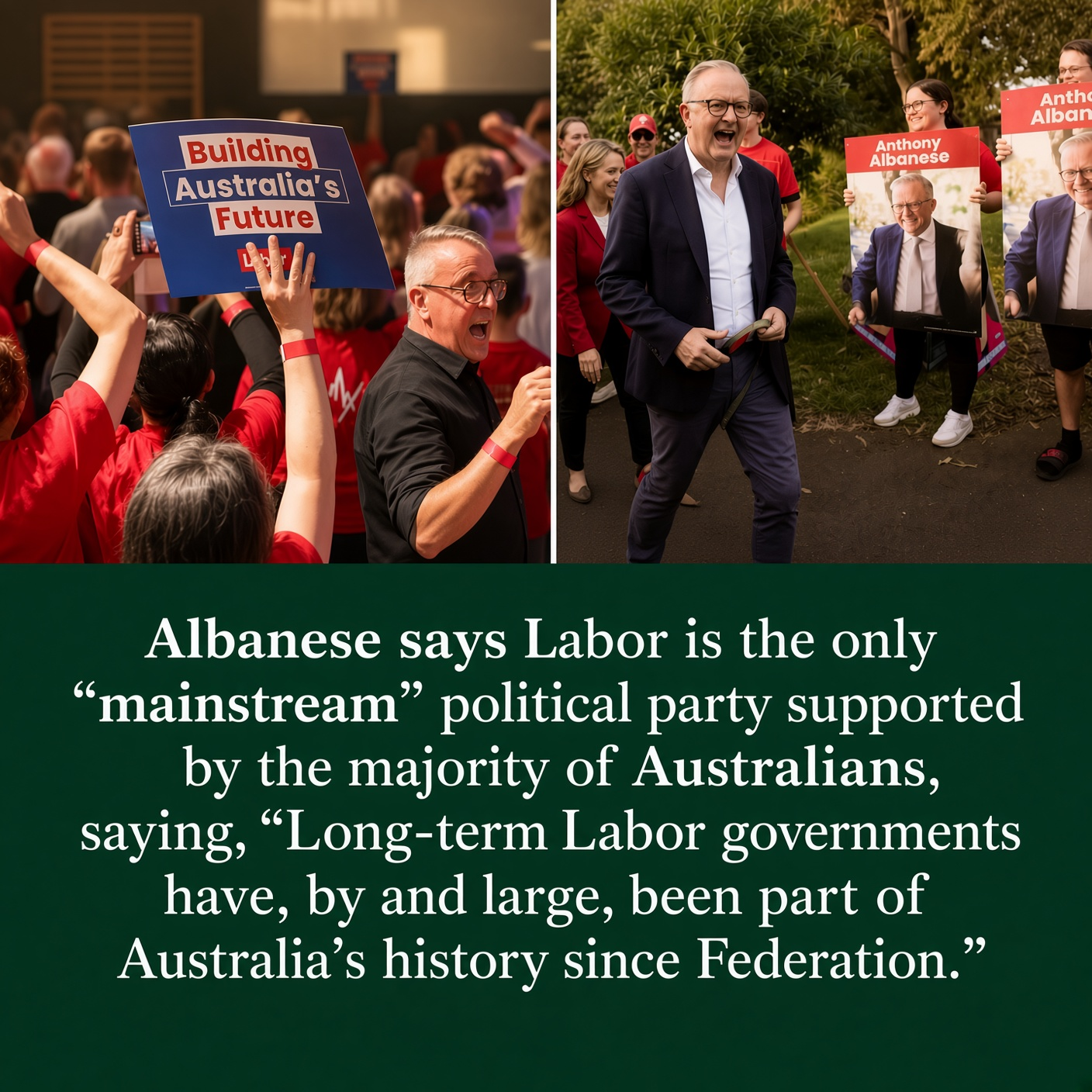
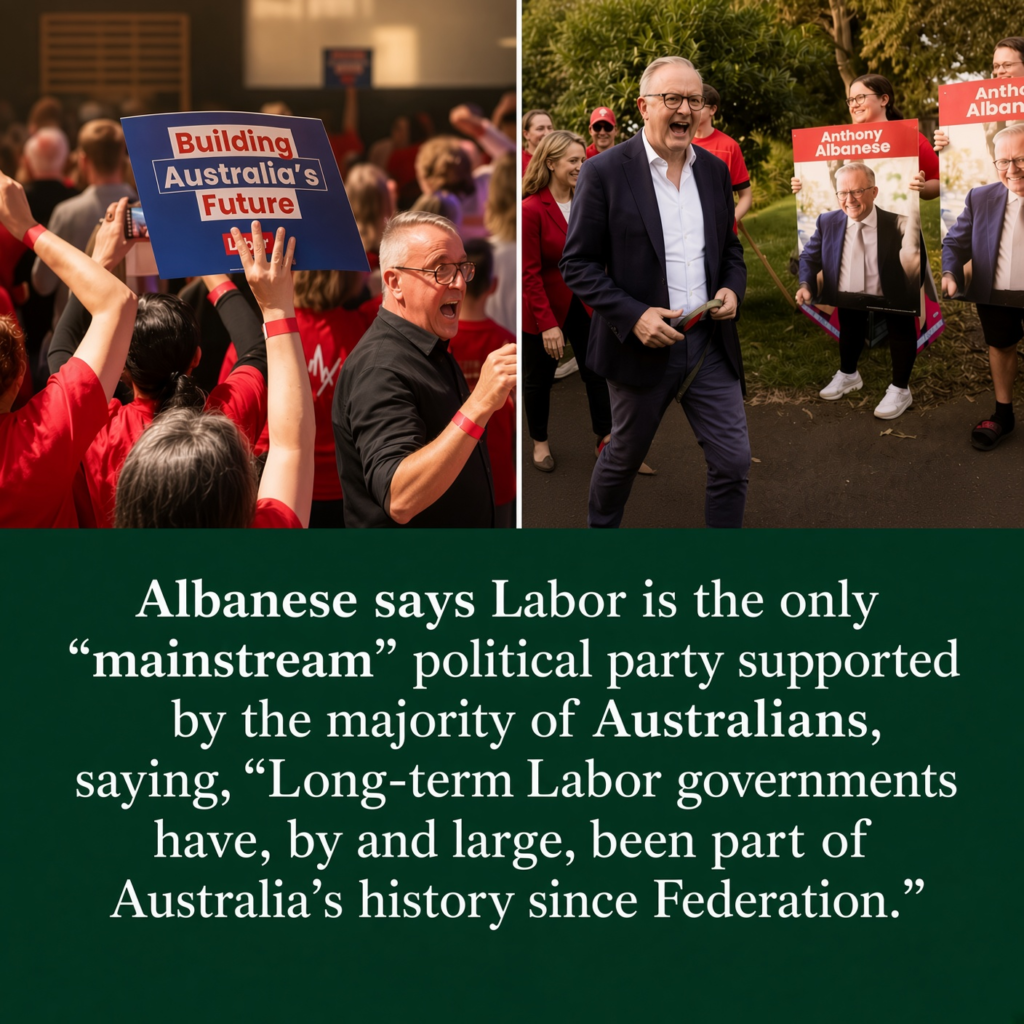
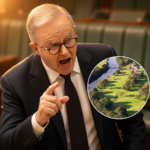
Anthony Albanese has declared Labor the “natural party of government” and Australia’s only mainstream political party with a clear sense of what it stands for, making an ambitious claim about Labor’s place in Australian politics as voters increasingly abandon the traditional two-party contest.
The Prime Minister made the remarks during an August 14 interview with News24, arguing that Labor represents the interests of a majority of Australians and should aspire to remain in office for the long term.
But Albanese’s comments contained an important historical qualification.
Far from claiming Labor has traditionally dominated federal government, Albanese acknowledged that long-term Labor governments have generally been the exception since Federation — and said he wants to change that.
Albanese: Labor is the ‘natural party of government’
Asked about Labor’s record in office and his own place among Labor prime ministers, Albanese rejected the idea that longevity was primarily a personal achievement.
Instead, he turned the discussion towards the party’s longer-term political ambitions.
“I’ve said that I want to see Labor in government for the long term,” Albanese said.
He then delivered the line that immediately attracted political attention.
“I see Labor as the natural party of government.”
Albanese said Labor represented the interests of a majority of Australians and argued it had become the country’s clearest mainstream political force.
‘The only mainstream political party now’
The Prime Minister went further than simply arguing Labor deserved another term.
He said the party occupied a position its opponents currently did not.
“I think it’s very clear that we’re the only mainstream political party now,” Albanese said.
He pointed to Labor’s objectives, values and direction for Australia as evidence.
It was a striking claim at a time when Australia’s political system is becoming more fragmented, not less.
His historical argument was actually about Labor’s weakness
One important detail in Albanese’s answer can easily be lost.
The Prime Minister did not say long-term Labor governments had generally characterised Australian political history.
He said the opposite.
“Long-term Labor governments haven’t by and large been part of Australia’s history since Federation,” Albanese said.
That distinction substantially changes the meaning of his argument.
Albanese was not claiming Labor had always been Australia’s natural governing party. He was outlining an ambition to make it one.
Hawke and Keating are the modern benchmark
Albanese pointed to Bob Hawke and Paul Keating as the outstanding modern exception.
Together, the Hawke and Keating Labor governments held office from 1983 until 1996 — approximately 13 years.
That period transformed Australia’s economy through financial deregulation, tariff reform, changes to taxation and industrial relations, and the expansion of compulsory superannuation.
It also demonstrated that Labor could sustain government across multiple electoral cycles.
For Albanese, Hawke and Keating provide the clearest model of the long-term Labor government he wants to build.
Whitlam lasted less than three years
The comparison with Gough Whitlam was deliberate.
Whitlam returned Labor to government in December 1972 after 23 years in opposition.
His government introduced sweeping reforms but ended dramatically with his dismissal in November 1975.
That meant one of the most consequential Labor governments in Australian history lasted less than three years.
Albanese’s point was that political significance and governing longevity have not always gone together for Labor.
Rudd and Gillard managed only two terms
Labor’s next period in federal office after the Hawke-Keating era began with Kevin Rudd’s 2007 election victory.
It continued through Julia Gillard’s prime ministership, Rudd’s return to the leadership and Labor’s defeat in 2013.
The period produced major reforms including the National Disability Insurance Scheme and responses to the Global Financial Crisis.
But leadership instability became a defining political weakness.
Albanese explicitly contrasted those two terms with his ambition to establish a much longer Labor era.
He does not want merely to ‘occupy the space’
The Prime Minister framed longevity as valuable only if accompanied by substantial government action.
He said he did not view his own time in office simply as a personal milestone.
“I’m not here to occupy the space,” Albanese said.
His argument was that governments should use political longevity to implement reforms that endure beyond individual electoral cycles.
The ambition is therefore not merely to keep Labor in office, but to establish it as the default governing institution of contemporary Australian politics.
That is an enormous political claim
The phrase “natural party of government” has a particular significance in Westminster political systems.
It implies more than winning an election.
It describes a party capable of building a sufficiently broad electoral coalition that voters come to regard it as the normal holder of executive power, with opposition governments becoming interruptions rather than the alternative half of a balanced political contest.
Albanese is effectively arguing Labor can occupy that position in modern Australia.
Australian history presents an obvious challenge
At the federal level, the Liberal Party and its predecessors have enjoyed some of Australia’s longest periods in office.
Robert Menzies dominated the post-war political era, while John Howard governed from 1996 until 2007.
The Liberal Party itself says it has governed federally for 48 years since its formation in 1944.
Coalition governments also held office from 2013 until Albanese defeated Scott Morrison in 2022.
Historically, therefore, describing Labor as Australia’s natural governing party is an aspiration rather than an uncontested description of the past.
Albanese believes the political landscape has changed
His case depends less on history than on the condition of Labor’s opponents today.
The traditional Coalition has struggled since its heavy defeat at the 2025 federal election.
At the same time, Pauline Hanson’s One Nation has emerged as a much larger national political force.
The result is an increasingly fragmented contest in which Labor faces opponents across several different parts of the political spectrum rather than a single dominant alternative government.
Albanese appears to believe that fragmentation gives Labor an opportunity to establish itself as the broad centre of Australian politics.
But Labor does not have majority primary support
There is an important distinction between Albanese saying Labor represents the interests of a majority of Australians and saying a majority of Australians currently vote Labor.
They are not the same proposition.
Recent opinion polling has generally placed Labor well below 50 per cent on the primary vote.
One recent Resolve Political Monitor reported Labor at 28 per cent, One Nation at 26 per cent and the Coalition at 23 per cent.
The Australian electorate is therefore divided among several political forces, even where Labor remains the largest individual party in particular polls.
One Nation makes the ‘mainstream’ claim more complicated
The rise of One Nation is particularly important to Albanese’s argument.
Pauline Hanson’s party can no longer easily be treated as a small protest movement operating at the edge of federal politics.
Recent polling has repeatedly placed it at or near the major parties, while its expanding parliamentary ambitions are forcing both Labor and the Coalition to reconsider electoral strategy.
Corporate Australia has even begun examining how it would engage with One Nation if the party gains substantially greater parliamentary influence.
That makes the definition of “mainstream” itself part of the political contest.
Can a party polling around a quarter of voters be outside the mainstream?
That question will become increasingly difficult if One Nation sustains its current level of support.
A party’s ideology can sit outside the traditional political centre while its electoral support becomes undeniably significant.
Labor can argue that One Nation’s policies do not represent mainstream Australian values.
One Nation can respond that millions of voters are demonstrating otherwise.
The battle is therefore no longer simply about vote numbers. It is about who gets to define the political centre.
The Coalition faces a different problem
For decades, the Coalition was Labor’s obvious alternative government.
That assumption has weakened as its primary vote has fallen and One Nation has competed aggressively for conservative voters.
The Coalition must now differentiate itself from both Labor and Hanson while convincing voters it remains capable of governing nationally.
Questions about preferences, cooperation or any future parliamentary arrangement with One Nation add another complication.
Albanese’s “only mainstream political party” argument is designed to exploit precisely that uncertainty.
Labor wants to own the broad political centre
The strategic objective behind Albanese’s language is relatively clear.
Labor wants voters to see it as the stable governing choice between an unsettled Coalition and a rapidly growing populist challenger.
That requires Labor to appeal simultaneously to traditional working-class voters, professionals, suburban families, younger Australians and culturally diverse communities.
Those groups do not necessarily agree on immigration, tax, housing, climate or social policy.
Becoming the “natural party of government” means holding that complicated coalition together election after election.
Immigration may be the hardest test
Few issues expose those internal tensions more clearly than immigration.
One Nation has made migration central to its political resurgence.
The Coalition has also moved towards lower migration settings.
Labor must respond to concerns about housing, infrastructure and population growth without alienating voters who regard multiculturalism and immigration as fundamental parts of modern Australia.
How Albanese navigates that argument could determine whether his broad electoral coalition holds or fractures.
Housing is another vulnerability
Housing affordability is particularly dangerous for a government claiming to represent the majority.
Younger Australians face high barriers to home ownership, while established homeowners have substantial wealth tied to property values.
Policies that improve affordability by lowering prices can benefit prospective buyers while alarming existing owners.
Tax reform creates similar conflicts.
A natural governing party must somehow reconcile groups whose economic interests can point in opposite directions.
Cost of living remains the immediate test
Whatever Labor says about long-term political realignment, governments are ultimately judged on everyday conditions.
Households care about mortgage repayments, rent, groceries, electricity, wages and employment.
Recent polling shows economic pressure continues to weigh on the government.
Albanese’s personal standing has also weakened from earlier periods of his prime ministership.
No historical theory about Labor’s place in Australian politics can insulate the government from voter dissatisfaction with living standards.
Albanese is also invoking Bob Hawke’s governing style
The Prime Minister has recently identified Hawke as the Labor leader whose governing approach most closely resembles the model he admires.
He has praised collective cabinet government, internal party discipline and structures designed to resolve disputes before they become public crises.
That stands in obvious contrast to the leadership warfare that damaged the Rudd-Gillard years.
For Albanese, long-term government depends not only on winning elections but on convincing voters that Labor can govern itself.
Internal stability has political value
Australian voters experienced extraordinary leadership instability during the 2010s.
Labor removed Rudd for Gillard and later restored Rudd.
The Liberals subsequently replaced Tony Abbott with Malcolm Turnbull and Turnbull with Scott Morrison.
The repeated leadership changes created widespread public frustration with Canberra.
Albanese has made stability part of his political brand.
A party seeking to become the country’s default governing force cannot repeatedly descend into leadership warfare.
Labor also has strong state-level precedent
While long periods of federal Labor government have been relatively uncommon, state politics provides more favourable examples for Albanese’s argument.
Labor has enjoyed extended periods of government in several states and territories.
Queensland, Victoria and other jurisdictions have all experienced lengthy Labor eras.
Those governments demonstrated how a party can construct electoral coalitions durable enough to survive repeated elections.
Albanese’s challenge is to reproduce that kind of institutional dominance federally, where the Coalition historically proved much more successful at sustaining long periods in office.
Being the ‘natural party’ can create its own danger
There is also a risk in the language itself.
Governments that begin to view themselves as the natural holders of power can appear entitled.
Australian voters have repeatedly demonstrated a willingness to remove governments they believe have become complacent, disconnected or arrogant.
The phrase can therefore work both ways.
To Labor supporters it expresses confidence and political ambition; to opponents it can sound like a party claiming a special entitlement to govern.
No Australian party has a permanent right to power
The Westminster system ultimately rests on the opposite principle.
Governments remain in office only while they retain parliamentary confidence and electoral support.
Political coalitions change.
Economic conditions change.
Generational priorities change.
Parties that once appeared dominant can decline surprisingly quickly.
There is no constitutional or electoral category called the natural party of government. Voters decide who governs at every election.
Albanese is making a strategic argument, not a constitutional one
Seen in that context, his statement is best understood as a declaration of Labor’s ambition.
He wants the party to become broad enough that Australians instinctively regard it as competent, stable and representative of ordinary national interests.
That would leave opponents fighting to prove why Labor should temporarily be removed rather than Labor continually having to prove it belongs in government.
Achieving that position would fundamentally reshape Australia’s traditional two-party political system.
One Nation’s rise could help — or destroy — that strategy
A divided conservative vote could benefit Labor enormously.
If the Coalition and One Nation compete for the same voters, Labor may be able to win seats with relatively modest primary support after preferences.
But One Nation also threatens Labor directly in working-class, outer-suburban and regional communities.
Those are voters Labor historically regarded as central to its own political identity.
The same force weakening the Coalition could therefore also undermine Labor’s claim to represent Australia’s broad majority.
The next federal election will test Albanese’s theory
Labor’s challenge over the coming years is not merely to remain ahead of its opponents in individual opinion polls.
It must demonstrate that the coalition which returned it to government can survive economic pressure, political controversy and the transformation of Australia’s party system.
The Coalition will attempt to rebuild itself as the conventional alternative government.
One Nation will argue that neither major party adequately represents voters demanding more fundamental change.
Albanese, meanwhile, is making the largest claim of all: that Labor can become the enduring centre around which Australian politics revolves.
History says that will not be easy
The Prime Minister himself effectively conceded that point.
Whitlam lasted less than three years.
Rudd and Gillard governed for two terms.
Hawke and Keating’s 13-year government remains the exceptional modern Labor benchmark.
Coalition governments, by contrast, have occupied some of the longest stretches of federal power since Federation.
Albanese is therefore not describing an established Australian tradition. He is announcing that he wants to overturn one.
‘Natural’ still has to be earned
Calling Labor the natural party of government is politically powerful language.
Making it true would require something much harder.
Labor would need to maintain economic credibility, improve living standards, address housing pressures, manage immigration, hold its increasingly diverse electoral coalition together and prevent internal divisions from consuming the government.
It would also need to survive a political environment in which voters have more credible alternatives than they have had for decades.
And ultimately, no prime minister gets to decide which party Australians regard as their natural government.
That decision belongs to voters.
Albanese has made his ambition explicit. The elections ahead will determine whether Australians share it.