Australians have spent years being told the country’s chronic housing shortage would prevent a serious property crash.
Across the Tasman, New Zealand offers an uncomfortable reminder that beliefs about ever-rising house prices can change remarkably quickly.
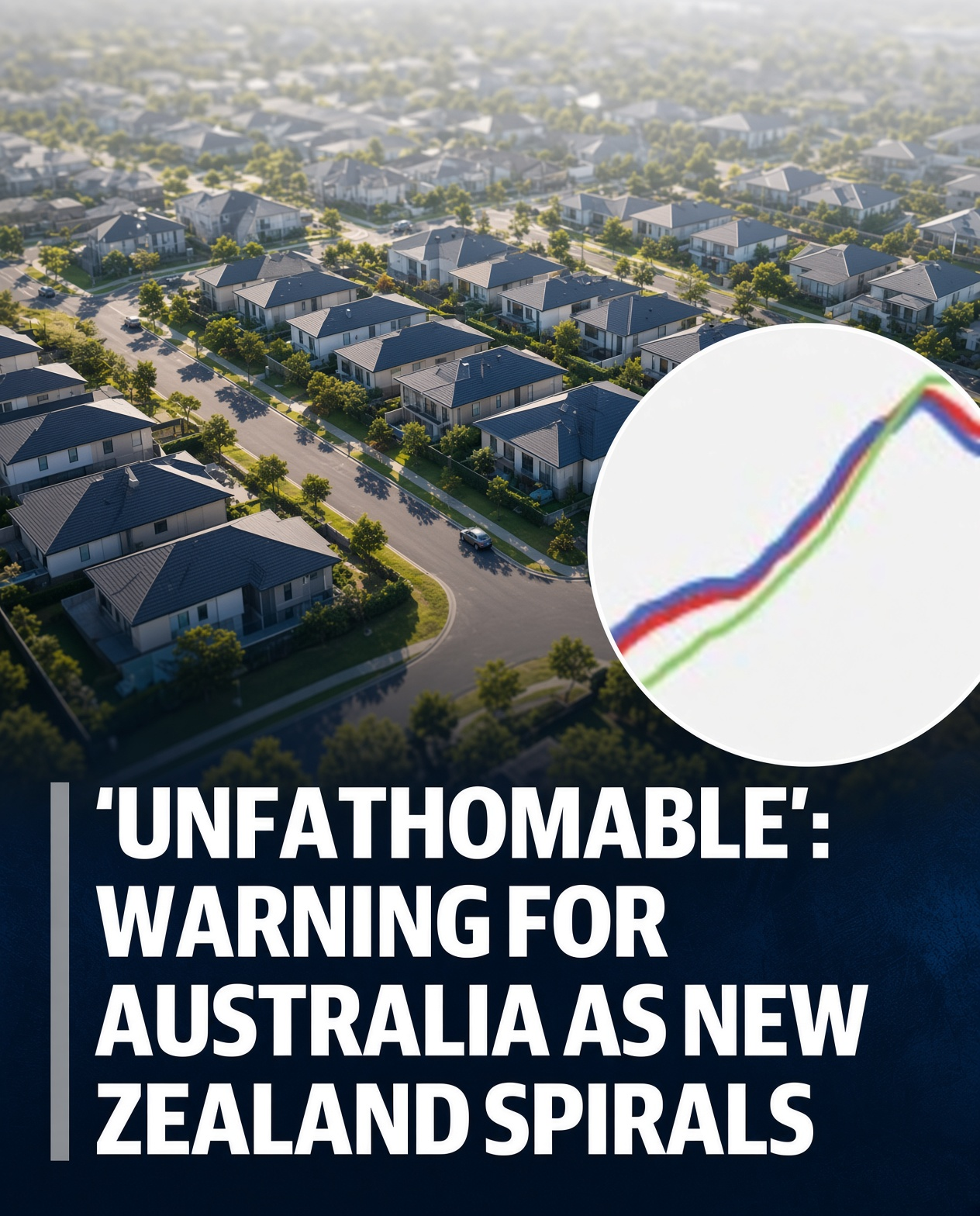
New Zealand has endured its most severe housing downturn in decades, with inflation-adjusted property prices falling about 27 per cent over roughly four and a half years.
Australia is nowhere near that scale of decline.
But after years of extraordinary growth, its own market has finally begun moving in the opposite direction.
National Australian home prices have fallen about 1.8 per cent from their March 2026 peak, while Sydney and Melbourne are both down roughly 3 per cent over the year.
And some economists who once saw limited scope for a serious correction are becoming considerably more pessimistic.
ANZ now forecasts a 10.6 per cent peak-to-trough fall across Australia’s capital-city housing market, including declines of 14.5 per cent in Sydney and 12.8 per cent in Melbourne — numbers that would fundamentally challenge the assumption that Australia’s property shortage makes substantial price falls virtually impossible.
The comparison with New Zealand is not perfect.
Australia has different population dynamics, different housing shortages and its own policy settings.
But the New Zealand experience demonstrates something important.
Housing can remain structurally undersupplied while prices fall.
Population growth can support property demand without making prices immune to higher interest rates.
And once buyer psychology changes, a market built around expectations of capital gains can behave very differently.
A year ago, the suggestion that Australia might follow New Zealand down was widely dismissed.
Australian property values were at record highs.
Government assistance was supporting entry into the market.
Demand remained intense.
Listings were constrained.
Housing construction was struggling to keep pace with population growth.
The idea of a major national correction appeared difficult to reconcile with the fundamental shortage of homes.
Then the environment changed.
Inflation accelerated again.
The Reserve Bank returned to monetary tightening.
The cash rate rose three times during 2026 and currently stands at 4.35 per cent.
The federal government also announced changes affecting tax concessions for residential property investment.
Buyer sentiment deteriorated.
Borrowing capacity came under renewed pressure.
And the country’s two largest housing markets began recording meaningful declines.
The result is a debate that would have sounded considerably more alarmist only 12 months ago.
Could Australia experience a genuine housing correction rather than another brief pause before prices resume climbing?
New Zealand shows why the answer can no longer simply be dismissed.
What happened across the Tasman
New Zealand entered its downturn after an extraordinary pandemic-era property boom.
Cheap money, strong housing demand and expectations of continuing gains drove values sharply higher.
The resulting affordability problem became extreme.
At its peak in 2021, New Zealand’s house-price-to-income ratio was around 8.3.
That meant housing values had become dramatically detached from what ordinary household incomes could comfortably support.
Then monetary conditions reversed.
Interest rates rose.
Credit became more expensive.
Migration dynamics changed.
The amount buyers could borrow fell.
The property boom became a prolonged correction.
Inflation-adjusted house prices eventually dropped about 27 per cent over approximately four and a half years.
That does not mean every New Zealand property lost 27 per cent of its nominal value.
The figure refers to the decline in real, or inflation-adjusted, house prices and should not be confused with the movement in a particular suburb’s median sale price.
The distinction matters.
But it does not make the correction insignificant.
The fall has substantially improved the relationship between property values and household incomes.
New Zealand’s price-to-income ratio has fallen from roughly 8.3 at its 2021 peak to around 5.9.
That is still expensive by historical standards.
It is nevertheless a major affordability adjustment.
And it happened without the permanent disappearance of housing demand.
New Zealanders still need somewhere to live.
The country did not suddenly acquire an unlimited supply of homes.
Instead, the amount purchasers could pay changed.
That is the lesson with the greatest relevance for Australia.
Australia is even more expensive relative to incomes
Australia’s house-price-to-income ratio remains around 8.9 — substantially higher than New Zealand’s current level.
That does not automatically mean Australian prices must fall until the two countries match.
Housing markets do not have a universal price-to-income ratio towards which they mechanically return.
Interest rates, taxes, incomes, population growth, credit availability, construction costs, land constraints and investor behaviour all influence sustainable valuations.
But an exceptionally high price-to-income ratio makes affordability heavily dependent on the availability and cost of credit.
That becomes a problem when interest rates rise.
Someone purchasing a home does not simply pay the advertised property price.
They have to service the mortgage attached to it.
When mortgage rates increase, the same household income supports a smaller loan.
Buyers can therefore become less capable of paying yesterday’s prices even if they still desperately want a home.
This is one reason housing shortages cannot guarantee rising values.
A shortage can create enormous demand.
But demand in a property market has to be backed by purchasing power.
A household that wants a $1.5 million Sydney home but can only obtain finance for $1.2 million cannot bid $1.5 million.
If enough buyers encounter the same constraint, prices adjust.
ANZ dramatically changes its forecast
One of the clearest indications that Australia’s outlook has changed came from ANZ’s latest property forecasts.
The bank’s economists now expect capital-city prices to fall 4.3 per cent during 2026 and another 3.4 per cent in 2027.
Measured from market peak to eventual trough, ANZ expects a decline of approximately 10.6 per cent.
The projected correction is considerably larger in Sydney and Melbourne.
ANZ forecasts Sydney prices could ultimately fall 14.5 per cent from peak to trough.
Melbourne is projected to decline 12.8 per cent.
Adelaide’s expected peak-to-trough decline is about 9.8 per cent, Brisbane’s 7.9 per cent and Perth’s 5.2 per cent.
Those are forecasts, not guaranteed outcomes.
Property predictions can change rapidly as interest rates, inflation and government policy change.
But the direction of the revisions is significant.
ANZ says prices have been declining more quickly than it previously anticipated.
Sydney and Melbourne auction clearance rates below 50 per cent provide another sign of weakening conditions.
When clearance rates remain low, properties can take longer to sell and vendors face greater pressure to negotiate.
That begins shifting bargaining power from sellers towards buyers.
It also changes psychology.
During a boom, buyers worry that delaying a purchase for six months will make the property more expensive.
During a downturn, the same buyer can begin wondering whether waiting six months will make it cheaper.
That seemingly small change can have enormous consequences.
Fear of missing out disappears.
Buyers become selective.
Properties pass in at auction.
Vendors have to meet the market.
Investors reconsider whether expected capital gains justify the cost of holding a property.
Fewer transactions can then reinforce the downturn.
The New Zealand market is no longer in freefall
There is an important qualification to the New Zealand comparison.
Describing what has happened there as a housing crash does not mean prices are still collapsing at the same pace today.
The latest Real Estate Institute of New Zealand figures show a market that has become considerably steadier.
REINZ reported a national median sale price of NZ$770,000 in June 2026.
That was 0.7 per cent higher than a year earlier.
Its House Price Index, which adjusts for differences in the properties being sold, remained 0.8 per cent lower year-on-year.
Inventory was 7.3 per cent higher than in June 2025, while national sales volumes were down 2.9 per cent.
REINZ described conditions as relatively steady but cautious, with substantial differences between regions.
That makes New Zealand useful as a case study of a completed or mature correction rather than evidence of a market currently plunging without a floor.
Its warning for Australia is what happened between the peak and today’s more stable conditions.
It is also what happened to expectations.
Property owners who had become accustomed to seeing housing as a one-way investment discovered that substantial real declines could persist for years.
Why Australia could be different
There are strong reasons not to assume Australia will simply reproduce New Zealand’s experience.
The most important is population.
Australia has experienced strong population growth, supported heavily by net overseas migration.
Every additional household needs somewhere to live.
When construction does not keep pace, that creates pressure on both rents and property demand.
Australia also faces severe constraints on housing supply.
Building costs have risen.
Construction companies have failed.
Planning and infrastructure constraints can delay new development.
Governments have repeatedly struggled to meet housing construction ambitions.
Those supply problems provide an important floor beneath property demand.
ANZ itself expects housing shortages and construction constraints to limit the depth and duration of the correction.
This is why a New Zealand-style 27 per cent real-price decline should not be treated as Australia’s central forecast.
It is a risk scenario and historical comparison.
It is not an inevitability.
But population growth cannot override mortgage mathematics
The strongest argument against an Australian crash is often expressed simply: there are too many people and not enough homes.
That argument is powerful, but incomplete.
Population growth supports underlying housing demand.
It does not determine how much a bank will lend each household.
That is where interest rates become decisive.
The Reserve Bank’s cash rate currently stands at 4.35 per cent.
The RBA increased rates three times during 2026 after inflation pressures strengthened again.
Those increases flow through to mortgage rates and borrowing assessments.
Existing homeowners pay more to service variable-rate debt.
Potential buyers qualify for smaller mortgages.
Investors face higher holding costs.
Developers encounter more expensive finance.
At some point, those financial constraints can overpower even strong underlying demand.
There may be 20 potential buyers interested in a house.
But if none can finance the vendor’s asking price, the existence of 20 interested buyers does not prevent the price from falling.
Falling prices can feed back into the economy
A significant property correction would not be confined to homeowners checking valuations on real-estate apps.
Housing is deeply connected to Australian household spending.
When property prices rise, homeowners can feel wealthier and become more comfortable spending.
When prices fall, the process can work in reverse.
Economists call this the wealth effect.
There is also a turnover effect.
A property transaction generates spending beyond the house itself.
Buyers hire removalists.
They purchase furniture and appliances.
They renovate.
They pay tradespeople.
When fewer homes change hands, some of that spending disappears.
That is one reason the current housing downturn may actually reduce pressure on the Reserve Bank to raise rates further.
Former RBA officials and economists have noted that weaker property conditions are evidence restrictive monetary policy is affecting the economy.
If households spend less as housing wealth falls, demand cools.
That can help reduce inflation.
The irony is that falling house prices can therefore be painful for owners while simultaneously improving the prospects that mortgage rates eventually stabilise.
The greatest risk is for recent buyers
Not every homeowner experiences a 10 per cent property decline in the same way.
Someone who purchased a Sydney house 20 years ago may still be sitting on enormous capital gains after a double-digit correction.
A buyer who entered the market near the 2026 peak with a small deposit is in a very different position.
If a home purchased for $1 million with a $950,000 mortgage falls substantially in value, the owner’s equity can disappear quickly.
That does not automatically force a sale.
As long as the borrower can continue meeting repayments, a paper decline in the property’s value does not necessarily create an immediate financial crisis.
But it reduces flexibility.
Refinancing can become harder.
Selling may crystallise a loss.
A borrower who needs to move because of divorce, unemployment or another life event may discover the property is worth less than expected.
That is where a prolonged downturn becomes more dangerous than an ordinary market fluctuation.
First-home buyers see the other side
For Australians locked out of home ownership, falling prices can be good news.
A 10 per cent fall in the value of a $1 million property removes $100,000 from the purchase price.
That can reduce the deposit required and the amount of debt a household must ultimately repay.
But again, interest rates complicate the calculation.
A cheaper home financed at a substantially higher mortgage rate is not necessarily more affordable on a monthly basis.
That is why Australia’s housing affordability crisis cannot be solved simply by hoping prices collapse.
Affordability depends on the relationship between prices, incomes and financing costs.
New Zealand’s adjustment has been significant because property values fell substantially relative to incomes.
Australia would need some combination of slower price growth, stronger income growth, greater housing supply and sustainable financing costs to achieve the same kind of rebalancing without a destructive crash.
The belief that property always rises is being tested
Perhaps the most important similarity between Australia and pre-correction New Zealand is psychological.
For years, property ownership in both countries became closely associated with wealth creation.
Short downturns happened.
Individual cities underperformed.
But the long-term national story appeared remarkably resilient.
That history encouraged investors to treat temporary price weakness as a buying opportunity.
It encouraged homeowners to assume losses would quickly reverse.
And it encouraged borrowers to stretch because future capital gains seemed likely to repair today’s affordability problem.
New Zealand challenged that assumption.
A multi-year decline changes the calculation.
If buyers begin believing prices could be lower next year, purchasing immediately becomes less urgent.
If investors no longer assume strong capital gains, rental yields and holding costs become more important.
If homeowners cannot rely on rapidly growing equity, borrowing against property becomes less attractive.
A housing market can therefore change before population or supply fundamentals change significantly.
Expectations themselves matter.
A warning, not a prediction
Australia has not entered a New Zealand-scale property crash.
National values are down only about 1.8 per cent from their March peak.
Even ANZ’s dramatically weaker forecast envisages a peak-to-trough capital-city decline of about 10.6 per cent — far short of New Zealand’s roughly 27 per cent inflation-adjusted fall.
Australia also retains powerful structural support from population growth and insufficient housing construction.
Those differences cannot be ignored.
But neither can the direction of travel.
Sydney and Melbourne are falling.
Auction conditions have weakened.
Interest rates have risen three times this year.
Major-bank forecasts have become substantially more bearish.
And the idea that Australia’s housing shortage makes a meaningful correction impossible is being tested in real time.
New Zealand’s experience does not prove what comes next.
It proves what can happen when expensive housing meets higher borrowing costs and changing expectations.
A year ago, Australians could look across the Tasman and regard that experience as something fundamentally different from their own.
That distinction is becoming harder to make.
The question is no longer whether Australian house prices can fall.
They already are.
The question is how far the correction runs before affordability, interest rates and housing demand find a new balance — and whether Australia’s long-held faith in permanently rising property values survives the journey.