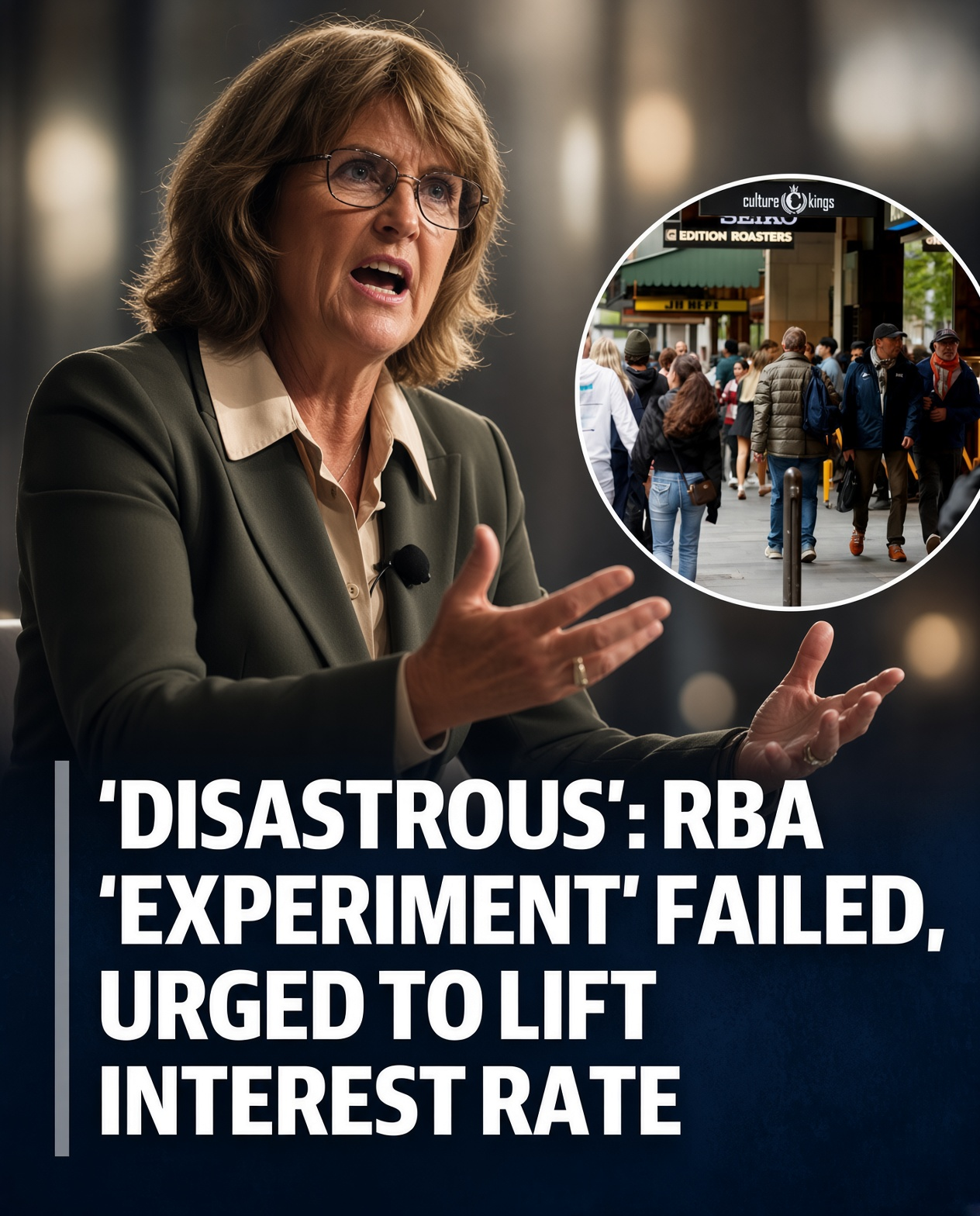
Australian mortgage holders could need to brace for interest rates substantially higher than today’s 4.35 per cent cash rate, according to a leading economist who says the Reserve Bank has been “too kind” and allowed inflation to become far harder to defeat.
EQ Economics managing director Warren Hogan has delivered one of the most aggressive calls ahead of Tuesday’s Reserve Bank decision, arguing Australia needs the equivalent of at least four additional quarter-point rate increases.
Hogan believes the appropriate cash rate is at least 5.6 per cent — dramatically higher than the current 4.35 per cent — and says the RBA made a fundamental mistake by failing to crush inflation when it had the opportunity.
“They’ve been too kind,” Hogan said.
He argued the bank should have pushed rates to at least 5 per cent during the previous tightening cycle rather than stopping at 4.35 per cent.
“The reality is the interest rate is not out by one or two rate hikes, it is out by at least four,” Hogan said.
“That is why they need to raise rates this week.”
If Hogan is right, the three rate increases Australians have already endured this year would not mark the end of the pain but merely the beginning of another substantial tightening phase.
His assessment is considerably more hawkish than the prevailing expectation ahead of Tuesday’s decision.
The Reserve Bank is widely expected to leave the cash rate unchanged at 4.35 per cent.
Markets have reduced expectations of an immediate increase following softer-than-expected inflation data, while Australia’s weakening housing market and signs of cooling economic activity have strengthened the argument for a pause.
That makes Hogan an important dissenting voice rather than a representative of the economic consensus.
His argument is that Australia risks paying a much larger price later if policymakers again mistake temporary improvements in inflation for evidence that the problem has been solved.
At the centre of the debate is an uncomfortable number.
Underlying inflation remains above the Reserve Bank’s 2–3 per cent target.
Australia’s latest quarterly figures showed headline inflation easing to about 3.8 per cent in June, while trimmed mean inflation — the measure watched closely by the RBA because it removes some unusually large price movements — was around 3.6 per cent.
Those results were softer than feared.
But they were not inside the target band.
Hogan believes policymakers are focusing too heavily on incremental improvements rather than the underlying inflationary pressure still embedded in the economy.
His criticism reaches back several years.
Australia entered the post-pandemic inflation surge with interest rates extraordinarily low.
The RBA then embarked on a rapid tightening cycle as inflation accelerated.
By late 2023, the cash rate had reached 4.35 per cent.
The bank subsequently held it there throughout 2024.
Hogan argues that was the crucial mistake.
Rather than stopping at 4.35 per cent, he believes the RBA should have continued towards 5 per cent or higher while the economy was better positioned to absorb the impact.
Doing so, in his view, would have hit demand harder and prevented inflationary psychology becoming entrenched.
The RBA took a different view.
Its board repeatedly argued monetary policy was already restrictive and that the full effect of previous increases took time to flow through households and businesses.
Interest rates operate with long and uncertain lags.
A mortgage borrower may feel an increase almost immediately.
A business might not change an investment decision for months.
Wage negotiations can take longer again.
That makes central banking inherently difficult.
If the RBA waits until inflation has completely disappeared before stopping rate increases, it risks tightening far too much and pushing the economy into recession.
If it stops too early, inflation can regain momentum and force the bank to start again.
Hogan believes Australia has experienced the second problem.
He describes the country’s relatively low-rate strategy as an “economic experiment”.
His argument is that Australia attempted to bring inflation down while maintaining interest rates below levels seen in some comparable developed economies.
That approach was designed partly to preserve employment and avoid unnecessarily crushing household demand.
But Hogan says it has failed.
Inflation remained too persistent, forcing the RBA to reverse course and increase rates three times during 2026.
The cash rate rose from 3.60 per cent in February to 4.35 per cent by May.
The Reserve Bank then paused in June, leaving the rate unchanged at its current level.
The board said inflation had picked up materially but decided it needed more information before tightening again.
Minutes of that meeting show policymakers unanimously agreed to keep the cash rate at 4.35 per cent.
Importantly, however, they did not declare victory over inflation.
The board explicitly said it would remain attentive to incoming data and the evolving balance of risks.
It also stated that it remained prepared to increase the cash rate if necessary.
That leaves open the possibility of another hike even if Hogan’s proposed move towards 5.6 per cent remains far beyond mainstream expectations.
The disagreement ultimately comes down to how much economic pain policymakers should accept today to reduce the risk of greater pain tomorrow.
Hogan fears Australia could repeat one of the defining economic mistakes of the 1970s.
During that era, policymakers repeatedly struggled to suppress inflation decisively.
Price pressures became embedded.
Workers demanded higher wages to compensate for rising living costs.
Businesses increased prices to cover higher wage and input costs.
Those increases fed back into expectations of still more inflation.
Eventually much more aggressive monetary tightening was required.
Hogan’s warning is essentially that a central bank can be too cautious as well as too aggressive.
Keeping rates lower protects borrowers in the short term.
But if that allows inflation to persist, every household continues paying through higher prices.
The eventual rate increases required to restore price stability can also become more severe.
For mortgage holders, however, the prospect of a cash rate around 5.6 per cent is daunting.
Australians are already among the most interest-rate-sensitive borrowers in the developed world because of the structure of the mortgage market.
Many borrowers are on variable rates or relatively short fixed-rate periods.
Changes in the RBA cash rate can therefore flow through to household repayments much faster than in countries where 20- or 30-year fixed mortgages are common.
A series of four conventional 25-basis-point increases would add another full percentage point to the cash rate.
If lenders passed those increases through in full, a household with a large variable mortgage could face hundreds of dollars more in monthly repayments.
And Hogan’s preferred 5.6 per cent level would imply slightly more tightening again from the current 4.35 per cent.
The effect would vary substantially according to loan size, remaining term and the interest rate charged by an individual lender.
But the direction would be unmistakable.
Household cash flow would tighten further.
That prospect comes as mortgage stress is already rising.
New analysis released ahead of the RBA meeting points to an 18 per cent increase in national mortgage default risk over three months.
The Finance Brokers Association of Australia has urged the Reserve Bank not to increase rates again, warning that some borrowers have reached a financial tipping point after years of higher repayments and escalating living expenses.
That produces a stark disagreement between two economic perspectives.
Mortgage industry representatives argue the RBA needs to recognise the real-world damage already being inflicted on households.
Hogan argues that showing borrowers more mercy now could ultimately produce greater economic damage.
Both sides are looking at the same basic problem from different directions.
For the FBAA, mortgage distress is evidence that monetary policy is already sufficiently restrictive.
For Hogan, persistent inflation is evidence that it is not restrictive enough.
The Reserve Bank has to decide which risk is greater.
It also has to consider Australia’s labour market.
Higher rates work partly by reducing demand.
Businesses respond by slowing investment and hiring.
Consumers spend less.
Economic growth weakens.
Eventually that reduces the ability of businesses to keep increasing prices.
But if rates are pushed too high, the process can move beyond an orderly slowdown.
Businesses can fail.
Unemployment can rise sharply.
House prices can fall rapidly.
Mortgage defaults can increase.
The economy can enter recession.
Hogan acknowledges the risk but argues delaying necessary tightening can make that eventual downturn worse.
He has warned that Australia could face a financial crisis if inflation is allowed to remain uncontrolled and the RBA later has to slam on the brakes.
His argument also extends beyond Martin Place.
Hogan has been critical of government spending, saying monetary and fiscal policy have been working against one another.
The Reserve Bank can increase interest rates to reduce demand.
But federal and state governments can simultaneously add demand through spending.
If public expenditure grows rapidly while the central bank is trying to cool the economy, interest rates may need to do more of the work.
That issue has become increasingly political.
Critics of the Albanese government argue high public spending has made the RBA’s inflation fight unnecessarily difficult.
Treasurer Jim Chalmers rejects the characterisation that Labor has simply been fuelling inflation.
The government points to savings, spending reprioritisations and reforms designed to improve the structural position of the budget.
The question for monetary policy is not simply whether government expenditure is high in an abstract sense.
It is whether total demand across households, businesses and government is running beyond the economy’s capacity to supply goods and services without generating excessive inflation.
That capacity problem has been particularly difficult since the pandemic.
Australia experienced major disruptions to supply chains.
Labour shortages appeared across industries.
Migration and population growth rebounded sharply.
Housing construction struggled to keep pace.
Energy costs rose.
Global commodity shocks added further volatility.
Not all of those pressures can be fixed by increasing mortgage repayments.
Interest rates cannot build houses.
They cannot produce more electricity.
They cannot directly solve supply-chain shortages.
But the RBA has one principal tool for managing inflation: the price of money.
If supply cannot increase quickly enough, the bank can attempt to reduce demand until it better matches available capacity.
That is why households often bear such a visible share of the adjustment.
Mortgage borrowers reduce spending rapidly when repayments rise.
The effectiveness of that mechanism is also one reason Hogan believes rates should have been higher earlier.
In his assessment, the bank tried to achieve a soft landing with insufficient monetary restraint.
The inflation problem survived.
The RBA then had to reverse previous easing and return the cash rate to 4.35 per cent.
Whether that proves the experiment “failed” is more contentious.
The latest inflation numbers have softened.
Headline inflation at about 3.8 per cent remains too high but is moving in the right direction.
Trimmed mean inflation at around 3.6 per cent is also below some earlier RBA projections.
Australia’s housing market is weakening, providing another sign that tighter financial conditions are restraining activity.
Those developments explain why the prevailing expectation is for the board to hold rather than follow Hogan’s advice immediately.
Some forecasters now believe the next RBA move could ultimately be a cut, although not until well into 2027.
That is almost the mirror image of Hogan’s forecast.
If inflation continues falling and unemployment rises, the case for additional increases weakens substantially.
If household consumption slows sharply, monetary policy may already have done enough.
If the housing downturn accelerates, further increases could become dangerous.
But if inflation stalls above target while spending and wages remain strong, Hogan’s warning will look considerably more prescient.
The Reserve Bank therefore faces a classic policy dilemma.
It does not know today’s neutral interest rate with precision.
It cannot know exactly how much restraint is already travelling through the economy.
And it receives most economic data with a delay.
Today’s decision is being made using information describing an economy that is already changing.
That uncertainty is one reason central banks tend to move incrementally rather than making enormous rate changes in a single meeting.
It is also why the phrase “four more rate hikes” needs qualification.
Hogan is not saying the RBA has announced four increases.
He is not reporting a market consensus that four increases are inevitable.
He is arguing that monetary policy is at least one percentage point too loose and that a cash rate around 5.6 per cent would be more appropriate.
That is a forecast and policy prescription from one economist.
It is nevertheless an unusually consequential one.
If the mainstream view is right, Australians may be near the top of this rate cycle.
A hold today could be followed by a lengthy period of stability and eventually reductions as inflation returns towards target.
If Hogan is right, the current 4.35 per cent rate is not the peak at all.
It is significantly below where the RBA needs to go.
For households deciding whether to refinance, purchase a property or take on additional debt, the difference between those scenarios is enormous.
It is equally important for businesses making investment decisions.
A company assessing a project at today’s borrowing costs may reach a completely different conclusion if the cash rate approaches 5.5 or 6 per cent.
Property markets would also face another significant test.
Australian house prices are already falling in important markets.