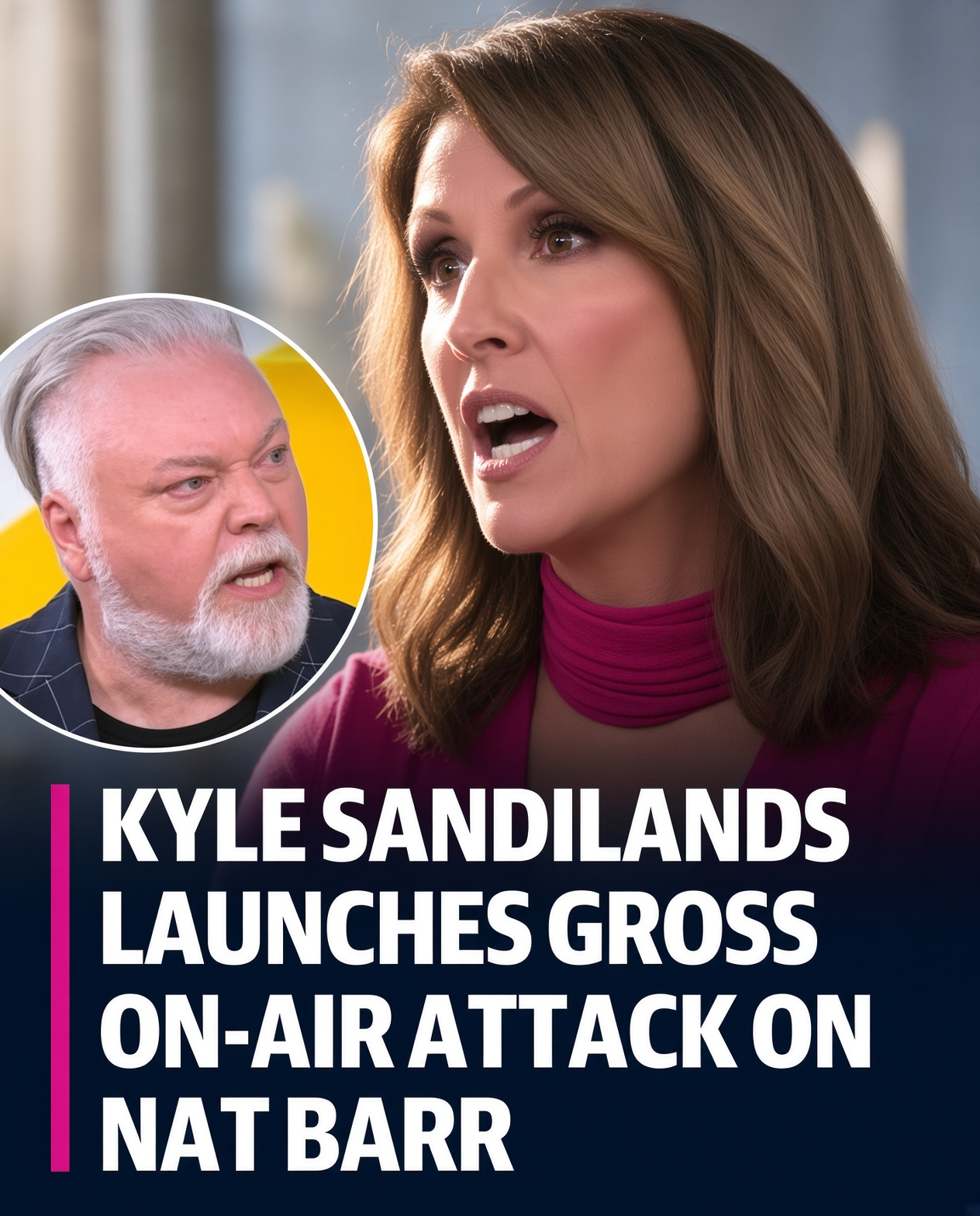
Kyle Sandilands has launched a deeply personal attack on Sunrise host Natalie Barr, days after their tense television interview left the controversial broadcaster furious over questions about his treatment of women and his long history of offensive on-air remarks.
Sandilands revisited the encounter during the latest edition of his newly launched subscription program, Kyle Sandilands Live, accusing Barr of adopting a confrontational approach when she interviewed him last week.
Rather than limiting his response to criticism of her questions, however, Sandilands turned his attention to Barr personally, making crude remarks about the veteran presenter’s appearance.
The outburst came after Barr challenged Sandilands about whether he regretted some of the controversies that have followed him throughout his broadcasting career.
She also asked whether he would be comfortable allowing his young son to listen to his program.
That question appears to have particularly irritated Sandilands.
Days later, he was still angry enough about the Sunrise exchange to revisit it on his own program — and turn a dispute about journalism into an attack on the journalist herself.
Sandilands complained that Barr had been unnecessarily confrontational and suggested he had been invited onto Sunrise only to be subjected to hostile questioning.
He then began mocking her physical appearance.
At one point, Sandilands claimed he was deliberately restraining himself because of his “respect for women”.
The assertion sat awkwardly alongside the personal nature of the comments he was making about Barr.
The dispute began with Sandilands’ appearance on Sunrise last week, his first major television interview since the dramatic collapse of his long-running radio partnership with Jackie “O” Henderson and his subsequent departure from ARN.
Barr used the interview to question Sandilands not only about his career upheaval but about the conduct that had made him one of Australian broadcasting’s most polarising personalities.
She raised controversial comments he had made about women and people with disability and asked whether, looking back, he had regrets.
Sandilands largely defended his record.
He argued that some remarks had been jokes that were subsequently interpreted differently from the way he intended them.
The exchange became particularly pointed when Barr brought the discussion closer to home.
She asked Sandilands whether he would allow his son Otto to listen to his broadcasts.
For a broadcaster who has spent decades defending provocative material as entertainment for adults, the question placed his public persona alongside the standards he might apply as a parent.
Sandilands did not accept the premise that there was a contradiction.
But his reaction days later made clear the question had stayed with him.
The feud comes at a particularly important moment in his career.
Sandilands is attempting to establish himself outside the conventional commercial-radio system that made him one of Australia’s highest-paid media personalities.
His new program is a subscription-based venture rather than a traditional free-to-air breakfast show.
He has explicitly pitched the new format around fewer restraints.
When revealing plans for the venture in June, Sandilands said listeners would hear more from an ensemble cast, there would be no advertising and, crucially, “no censorship”.
That promise has become central to the identity of his comeback.
For supporters, it offers the Sandilands they believe corporate media had increasingly tried to restrain.
For critics, it raises the question of whether removing commercial and editorial guardrails will encourage exactly the type of personal attack he has now directed at Barr.
The subscription model changes the commercial equation.
Traditional breakfast radio depends heavily on advertisers.
When a presenter generates a major controversy, companies can withdraw advertising and impose immediate financial pressure on the broadcaster and station.
Sandilands has experienced that pressure before.
His career has included repeated controversies that prompted complaints, regulatory scrutiny and advertiser backlash.
A direct-to-consumer subscription program reduces that dependence.
Listeners pay for access to Sandilands himself.
That means the qualities some advertisers may regard as a liability can potentially become part of the product being sold to subscribers.
The new show costs $99 for an annual subscription.
Sandilands has spoken ambitiously about attracting a large paying audience and has promoted increasingly valuable giveaways tied to subscriber milestones.
If he were to reach 100,000 subscribers at the advertised annual price, gross subscription revenue would approach $10 million before expenses and other costs.
The model gives Sandilands an opportunity to test whether his personal audience is strong enough to support a major media business without the distribution power of commercial radio.
His launch this week demonstrated both the possibilities and risks.
The debut of Kyle Sandilands Live attracted substantial media attention but was plagued by technical problems.
Listeners encountered audio issues including an echo that persisted through parts of the broadcast.
Sandilands became visibly and audibly frustrated with his production team as the problems continued.
Other segments also went awry.
A planned attempt to telephone Prime Minister Anthony Albanese instead reached former prime minister Scott Morrison.
Audio difficulties affected other interviews.
Despite the chaotic launch, Sandilands succeeded in doing one thing immediately: getting people talking about his new show.
His attack on Barr ensures that attention continues.
It also revives the central question that has followed Sandilands through much of his career.
Where does deliberately provocative entertainment end and unacceptable personal conduct begin?
Sandilands has built his professional identity by refusing the conventions expected of most mainstream broadcasters.
His programs have long relied on confrontation, sexual discussion, celebrity gossip, arguments and remarks designed to shock.
For many listeners, that unpredictability was the attraction.
For others, it repeatedly crossed into cruelty.
The distinction became particularly consequential this year because the end of The Kyle and Jackie O Show followed a very public confrontation with Henderson.
On February 20, Sandilands criticised his longtime co-host during a live broadcast, accusing her of being distracted by astrology and saying it had made her difficult to work with.
The exchange became increasingly personal.
Henderson was visibly and audibly upset.
The dispute ultimately became part of a much larger breakdown between Sandilands and ARN.
Sandilands was suspended and his contract was later terminated.
The broadcaster challenged that outcome before eventually reaching a multimillion-dollar settlement with his former employer.
Sandilands later acknowledged that he wished he had handled the argument with Henderson differently.
He said he had apologised to her privately on the same evening as the confrontation.
“I said things I wish I had said differently,” he said in a statement issued in March.
He described the destruction of their professional partnership as devastating.
But the Barr episode demonstrates that Sandilands’ instinct to answer criticism with aggressive personal commentary remains very much part of his broadcasting style.
That matters because his Sunrise appearance presented an obvious opportunity to make a different case for himself.
Sandilands could argue that decades of controversial broadcasting should be viewed in the context of entertainment.
He could acknowledge mistakes while maintaining that critics sometimes strip jokes of context.
He could distinguish the persona heard behind a microphone from the father, husband and businessman he is away from it.
Those were among the themes available to him during a high-profile comeback interview.
Barr’s questions tested them.
Her job was not simply to provide Sandilands with a promotional platform for his new venture.
The end of one of Australia’s biggest radio shows had followed an on-air conflict involving Sandilands’ treatment of his female co-host.
Questions about his past conduct were therefore directly relevant to his return.
Sandilands plainly disagreed with the manner in which Barr pursued them.
That disagreement itself is unremarkable.
Interview subjects frequently believe journalists have been unfair.
They can challenge the premise of questions, criticise an interview afterwards or provide evidence that they believe was ignored.
What distinguishes Sandilands’ response is that he moved from criticising Barr’s journalism to insulting Barr herself.
That shift is likely to fuel rather than extinguish the criticism he was already confronting.
It also comes against the backdrop of a broadcasting career in which comments about women have repeatedly become controversies.
That history was part of the reason Barr was asking the questions in the first place.
Sandilands’ defenders may see the latest response differently.
His appeal has always depended partly on the belief that he says publicly what others would only say privately.
A restrained corporate response to an interview he believed was hostile would arguably be inconsistent with the persona his paying subscribers expect.
His new platform is specifically being sold as an uncensored alternative to mainstream radio.
That creates an unusual incentive.
For most broadcasters, controversy is something management eventually has to contain.
For Sandilands as an independent subscription personality, controversy can generate publicity for the very product he is trying to sell.
The danger is that outrage alone does not necessarily create a sustainable audience.
The first broadcast’s technical problems demonstrated that independence also means responsibility for delivering the product.
Listeners paying $99 a year may enjoy provocative commentary but still expect professional audio, reliable interviews and a program capable of functioning technically.
Sandilands no longer has the enormous infrastructure of a national commercial radio network behind him.
That gives him greater control.
It also removes a convenient institution to blame when things go wrong.
The same applies editorially.
“No censorship” means Sandilands has far greater freedom to decide what goes to air.
It also means the consequences of those decisions attach more directly to him.
The attack on Barr provides an early demonstration of what that new environment may look like.
There is another irony in the dispute.
Sandilands has spent much of his career interviewing celebrities, politicians and ordinary people with a confrontational style of his own.
His success was built partly on asking questions conventional presenters might avoid.
He has often celebrated discomfort as good broadcasting.
Barr’s Sunrise interview subjected him to a version of that same principle.
She asked about his history.
She asked whether he regretted it.
And she asked whether the content he had spent years defending was something he would want his own child hearing.
Sandilands was entitled to reject those questions or their premise.
His decision to answer days later by targeting Barr personally will now become part of the same public record he was being asked to explain.
That may be the defining contradiction of his comeback.
Sandilands wants to prove that conventional media institutions no longer control him.
His subscription model gives him a realistic opportunity to do exactly that.
But independence from bosses, advertisers and network standards does not mean independence from public reaction.
Every controversial remark can still be recorded, shared and scrutinised outside his paywall.
And every attack can become another question in the next interview.
For Barr, the immediate dispute began with questions she asked on Sunrise.
For Sandilands, it clearly did not end when the interview did.
Nearly a week later, he was still talking about it — and his attempt to settle the score has ensured everybody else will be talking about it too.