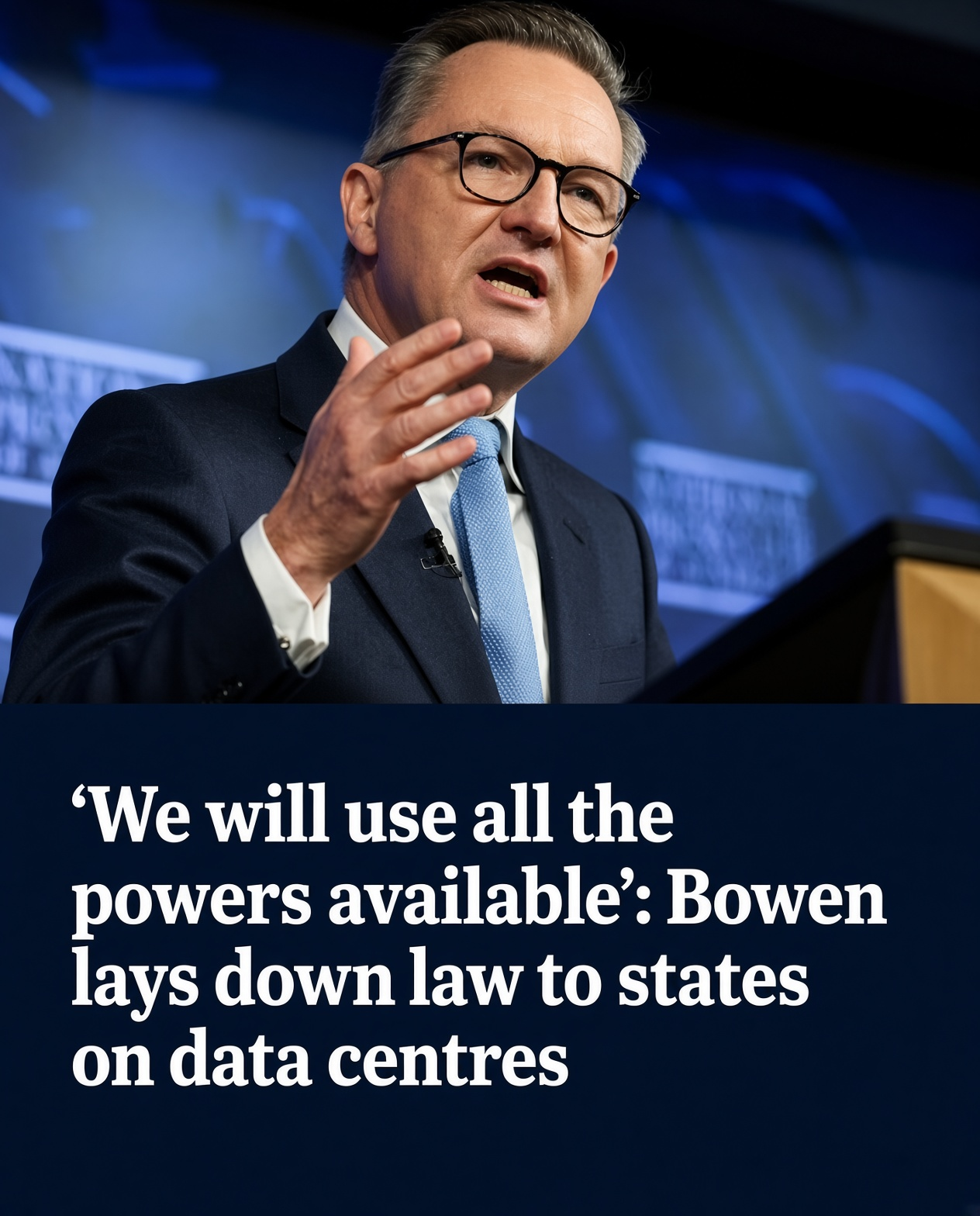
Climate Change and Energy Minister Chris Bowen has warned the Commonwealth will use its federal powers to stop states pursuing energy-hungry data centres on terms that undermine national renewable energy and electricity reliability plans.
Bowen has insisted Australia can embrace the artificial intelligence and data centre investment boom while continuing to cut emissions, but says new facilities cannot simply arrive on the grid, consume enormous amounts of electricity and leave households and other businesses to carry the cost.
The federal government wants large new data centres to effectively bring new power supply with them, primarily by underwriting additional renewable generation while arranging reliable firming capacity to keep their operations running around the clock.
Operators would also be expected to pay their full share of the electricity network infrastructure required to connect them.
The approach has put Canberra on a collision course with the Queensland and Northern Territory governments, which have pushed back against federal efforts to impose renewable energy conditions on projects they hope will attract billions of dollars in investment.
Bowen used a National Press Club address in Canberra to make clear he would not allow disagreement from individual states to derail the national policy.
“AI and climate change are the defining issues of our age,” he said.
His argument is that Australia does not have to choose between them.
The government believes the extraordinary growth in computing demand can be turned into an accelerator for new renewable investment — but only if the companies creating the demand are required to help pay for the additional energy system needed to serve them.
Under the proposed national approach, large data centres would be required to obtain renewable energy certificates demonstrating that their electricity use is fully offset by renewable generation that might otherwise not have been built.
The requirement is designed to be flexible rather than forcing every facility to operate directly from an adjacent solar or wind farm at every moment of the day.
Bowen has acknowledged that data centres require continuous, highly reliable electricity.
His position is that renewable generation should provide the principal additional energy associated with the projects, backed by appropriate firming arrangements.
That firming could include batteries and other dispatchable capacity, with gas potentially playing a supporting role rather than becoming the primary source of electricity for a new data centre.
“The requirements are renewable energy and then sensible firming arrangements,” Bowen said during questions following his National Press Club speech.
The distinction is crucial to understanding the federal policy.
Canberra is not proposing that every server inside an Australian data centre must physically consume renewable electricity during every second of operation.
Electricity flows through an interconnected grid and cannot generally be traced from an individual wind turbine or solar farm to a particular computer rack.
Instead, the policy is intended to ensure the additional demand created by major new facilities is matched by investment in additional renewable supply.
In practical terms, a developer could underwrite a new renewable project through a long-term power purchase agreement, develop generation itself or use other approved mechanisms to demonstrate it had supported sufficient additional clean energy.
Renewable energy certificates would then provide evidence that the facility had offset its electricity consumption under the national framework.
The government says that approach is necessary because the scale of the coming data centre boom could fundamentally reshape Australia’s electricity system.
Artificial intelligence requires vast amounts of computing power.
Training sophisticated AI models consumes substantial electricity, but the growth in demand does not end when a model has been trained.
Everyday use of generative AI products requires servers to process enormous numbers of requests, while cloud computing, streaming, digital commerce and other online services continue to increase the amount of data infrastructure required.
Data centres also need cooling systems, network equipment and other infrastructure operating continuously.
Unlike many industrial customers, the largest facilities can require a substantial and relatively constant electricity load.
That creates both an opportunity and a problem for Australia.
The opportunity is economic.
Australia has abundant land, strong renewable energy resources, established capital markets, political stability and proximity to rapidly expanding Asian digital economies.
Governments see the possibility of attracting tens of billions of dollars in data centre investment as AI becomes a foundational technology across the global economy.
The problem is electricity.
New data centres can consume amounts of power comparable with major industrial operations, and several large developments concentrated in the same region can require significant new generation, transmission and distribution infrastructure.
If that infrastructure is not built quickly enough, additional demand can increase pressure on an electricity system already undergoing the transition away from ageing coal-fired generation.
There is also a politically explosive question over who pays.
If network businesses are required to spend billions of dollars strengthening connections and expanding infrastructure for new data centres, governments do not want those costs simply distributed across ordinary electricity customers.
That is why the Albanese government has adopted what is effectively a “causer pays” approach.
Its expectations for data centre and AI infrastructure operators, first outlined in March, include underwriting additional renewable power, paying the full share of new grid connectivity attributable to their developments and participating in demand flexibility arrangements.
The flexibility element could become particularly important during periods when the electricity system is under stress.
Some computing tasks can potentially be shifted in time or location, allowing a data centre to reduce its demand temporarily when electricity is scarce and increase consumption when renewable generation is abundant.
Not every workload can be managed that way, particularly services requiring instantaneous responses, but the government wants flexibility used wherever technically practical.
Bowen’s aim is to make data centres “an asset to the energy grid, not a strain”.
The political consensus behind that approach has begun to fracture.
Queensland and the Northern Territory have rejected aspects of Canberra’s renewable-first position, arguing they should retain greater flexibility when negotiating major investments.
The Northern Territory has emerged as the sharpest test.
The CLP government is pursuing economic development associated with the Beetaloo Basin gas industry and sees data centres as a potentially enormous new source of investment and gas demand.
A proposed project involving Beetaloo Energy Australia has highlighted the conflict.
The company has been examining plans for a large data centre development near Darwin that could ultimately involve approximately two gigawatts of power generation.
Reuters reported the proposal has been associated with the potential to attract as much as $40 billion in investment.
The Northern Territory government has provided 185 hectares of Crown land for assessment of the proposal under a time-limited arrangement.
For the Territory, a project of that scale could represent a transformational investment opportunity.
For Bowen, however, allowing a huge new data centre to be built around dedicated gas-fired electricity would undermine the principle Canberra is trying to establish nationally.
He has said gas can play a role in firming renewable generation but should not become the main energy source for new facilities.
The federal government has therefore indicated that projects relying principally on gas would not meet its intended standards.
Northern Territory Chief Minister Lia Finocchiaro has pushed back strongly.
Her government argues development of Beetaloo gas is central to the Territory’s economic ambitions and can contribute to addressing energy supply issues beyond its borders.
The disagreement is no longer merely philosophical.
It raises a practical constitutional and regulatory question: what happens if a state or territory approves an energy model for a data centre that Canberra considers inconsistent with the national framework?
Bowen’s answer is that the Commonwealth will act.
He has acknowledged the limits of federal power over some aspects of state energy policy, while insisting Canberra has sufficient regulatory levers to enforce the national requirements attached to large data centre development.
“We will use all the powers available,” he said as he outlined the government’s determination to establish consistent rules.
The federal government is developing the requirements through its broader national AI framework.
That matters because Canberra can potentially regulate data centres through mechanisms extending beyond the day-to-day operation of state electricity systems.
The precise legislative architecture will determine how far federal authority extends and how disputes with Queensland or the Northern Territory are ultimately resolved.
But Bowen is clearly attempting to remove the possibility of states competing for projects by offering developers looser energy conditions.
Without national standards, the government fears a form of investment competition in which jurisdictions promise faster approvals or access to fossil-fuel generation to secure major projects.
That could leave Australia with a large new source of electricity demand that makes national emissions targets harder to achieve.
The stakes are substantial because data centres are expected to become an increasingly important part of national electricity consumption before the end of the decade.
Estimates vary according to the pace of AI development and the number of projects ultimately constructed, but forecasts cited in the current policy debate suggest data centres could account for around 6 per cent of Australian electricity demand by 2030.
Even small changes to assumptions about that growth can translate into large differences in the amount of new generation Australia needs.
Bowen’s solution is to make the data centre boom finance part of that expansion itself.
A large technology company signing a long-term contract to purchase electricity from a proposed wind or solar farm can give the developer of that project the revenue certainty needed to secure finance and reach a final investment decision.
In that scenario, the data centre does not merely consume clean electricity after somebody else builds it.
Its demand helps make the new generation commercially possible.
That is why the government insists the renewable power should be additional.
If a data centre simply purchased renewable certificates associated with existing generation, it could claim a cleaner electricity profile without necessarily increasing the total amount of power available to the system.
Canberra wants the expansion in demand matched by expansion in supply.
There are nevertheless difficult questions about whether the model can work at the speed and scale the AI industry demands.
Data centre developers place extraordinary importance on reliability.
Servers cannot simply shut down every time clouds reduce solar output or wind generation falls.
Operators therefore require firm electricity around the clock, often supported by multiple layers of redundancy.
Industry critics worry that overly prescriptive renewable requirements could make projects more expensive or slow development while competing jurisdictions overseas offer easier access to reliable power.
The Coalition has described elements of Labor’s approach as unrealistic and warned Australia risks losing investment if its conditions become commercially uncompetitive.
Data centre industry representatives have similarly stressed that reliability, project timing and access to sufficient electricity are critical when international companies decide where to invest billions of dollars.
The global competition is intense.
The United States, parts of Asia, Europe and the Middle East are all pursuing major AI infrastructure investments.
Technology companies can choose between jurisdictions according to electricity availability, price, regulatory certainty, land, connectivity and access to skilled workers.
Australia therefore faces a genuine balancing act.
Conditions that are too weak could leave consumers carrying infrastructure costs and make climate targets harder to achieve.
Conditions that are too onerous could push projects elsewhere.
Bowen rejects the idea that those objectives are inherently incompatible.
His argument is that Australia’s renewable resources can become a competitive advantage rather than an impediment.
Solar and wind electricity can be comparatively cheap once built, while large corporate customers can provide exactly the kind of long-term demand required to finance new projects.
Batteries and other firming technologies can then help match intermittent generation with the constant demand of computing infrastructure.
Gas can remain available where appropriate as part of that reliability mix, but the government does not want it used as a loophole allowing new data centres to avoid investing in renewable generation.
The policy also intersects with Labor’s broader 2030 electricity target.
The government is aiming for renewable sources to account for 82 per cent of electricity generation by 2030 while Australia works towards its legislated emissions reduction targets and net zero by 2050.
Rapid growth in electricity demand makes that transition more difficult because Australia must build enough clean generation not only to replace coal but also to supply new consumers.
Data centres are one source of that growth.
Electrification of transport, industry and household appliances will add further demand.
In other words, Australia cannot meet its climate objectives simply by replacing the electricity consumed today with renewable generation.
It must prepare for a substantially larger electricity system.
The government has argued that this is achievable and has pointed to the rapid growth of renewable energy already occurring across the National Electricity Market.
But transmission construction, project approvals, community opposition and supply-chain constraints remain significant obstacles.
Adding a wave of multi-hundred-megawatt data centres increases the urgency.
Bowen’s National Press Club speech also included a separate move designed to accelerate renewable investment among ordinary businesses.
The government is expanding support for commercial rooftop solar by increasing the size of systems eligible for subsidies from 100 kilowatts to one megawatt.
The change is expected to reduce installation costs by about 20 per cent for eligible businesses and institutions.
Canberra sees commercial rooftops as an underused part of Australia’s energy transition.
Residential solar has become extraordinarily common, with roughly one in three Australian homes having panels, while large utility-scale solar and wind projects have also expanded rapidly.
Commercial and industrial rooftops sit between those two markets and have not reached the same penetration.
Bowen has described that segment as the “missing middle”.
The data centre policy is much larger in scale but follows the same underlying philosophy: new economic activity should help create the clean electricity required to power it.
Public opinion may provide the government with some political support for that principle.
A YouGov survey of 1,624 Australians commissioned by the Climate Council found 82 per cent agreed governments should require new data centres to pay for additional renewable energy and storage matching their electricity demand.
Polling commissioned by an advocacy organisation should be interpreted in that context, but the result indicates substantial concern that households should not subsidise the energy requirements of major technology companies.
The consumer question could become increasingly important as more Australians understand how much electricity AI infrastructure requires.
For an individual using an AI chatbot, the physical infrastructure behind the service is largely invisible.
The servers may be thousands of kilometres away.
But their electricity demand is real and concentrated in enormous facilities connected to the same broader energy system that supplies homes, hospitals and businesses.
If the AI boom proceeds at the scale forecast, decisions being made now about how those facilities are powered will influence electricity investment for decades.
That is why the dispute between Bowen and the states matters beyond the immediate politics of Queensland and the Northern Territory.
Australia is effectively deciding who should bear the energy cost of becoming an AI infrastructure destination.
Bowen’s answer is that the companies creating the new demand should carry much of that responsibility themselves.
They should underwrite additional generation.
They should pay their share of grid connections.
They should provide flexibility where their operations allow it.
And the additional electricity associated with their expansion should predominantly come from renewable sources rather than a new generation of dedicated fossil-fuel plants.
The Queensland and Northern Territory governments are demanding greater room to pursue investment on their own terms.
That disagreement is setting up a significant federal-state contest as the national data centre rules move from policy statements towards implementation.
The ultimate test will be commercial as much as political.
If Australia can attract major AI infrastructure while simultaneously using those projects to finance new renewable generation, Bowen will have evidence for his claim that the data centre boom and decarbonisation can reinforce each other.
If investment stalls, projects move offshore or renewable and firming capacity cannot be delivered quickly enough, critics will argue Canberra imposed conditions the market could not meet.
Either way, the era in which a giant new electricity consumer could connect to the Australian grid without a broader argument about where its power comes from is rapidly ending.
Bowen has made the Commonwealth’s position clear: Australia wants the AI investment boom, but it does not intend to let states secure it by shifting the energy, emissions and infrastructure bill onto everyone else.