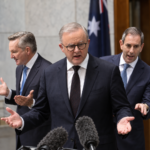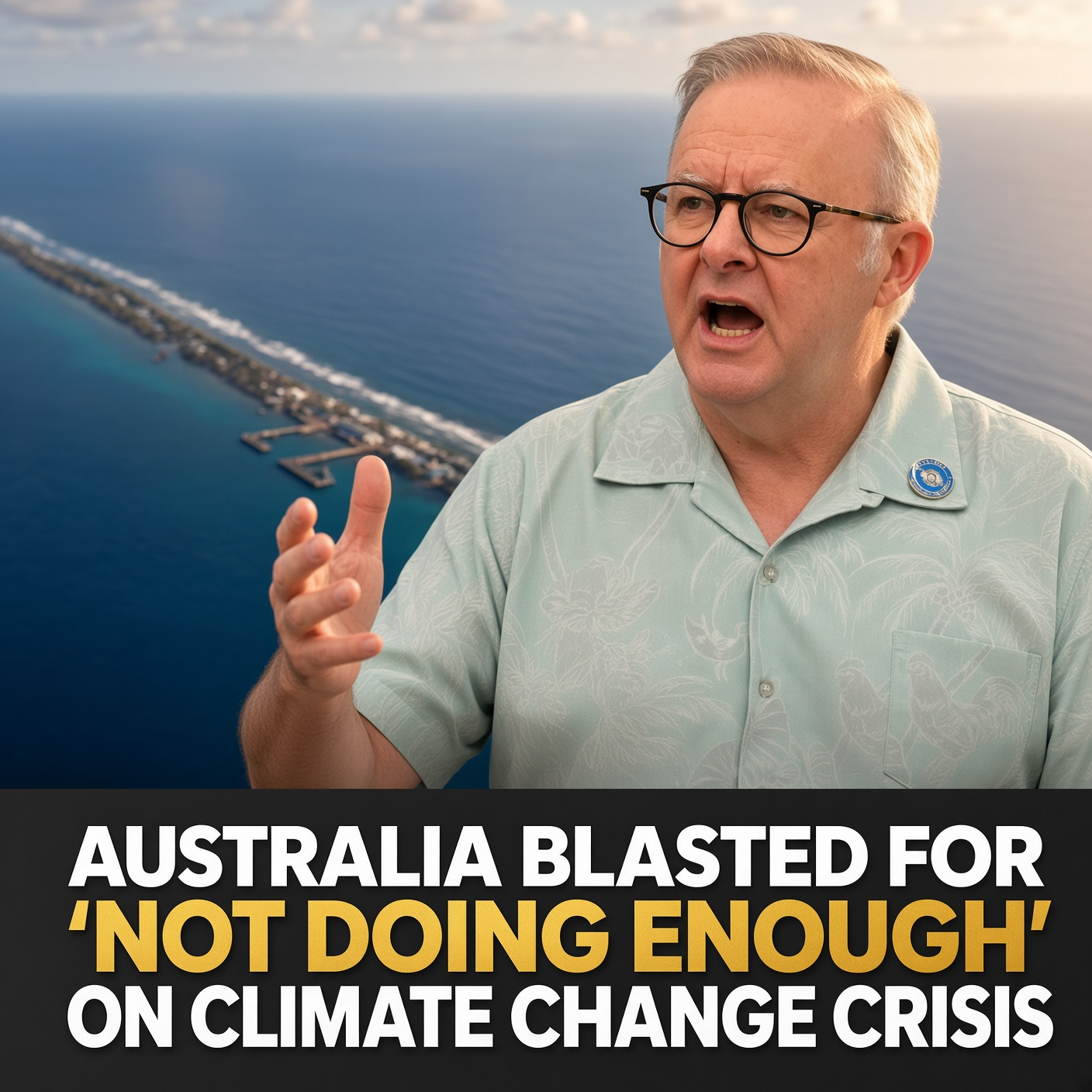
Pacific leaders have confronted Anthony Albanese with an uncomfortable contradiction at the region’s most important political gathering: Australia is investing heavily in climate resilience and renewable energy across the Pacific while continuing to produce and expand the fossil fuels island nations say are threatening their survival.
The pressure intensified at the 55th Pacific Islands Forum Leaders’ Meeting in Palau after a bleak new United Nations Environment Programme report concluded that global warming is now likely to exceed the critical 1.5C threshold within the next few years.
For Tuvalu’s Minister for Home Affairs, Environment and Climate Change, Dr Maina Talia, the findings were deeply personal.
Talia told reporters in Koror that he had struggled to sleep after reading the report, describing the climate crisis facing low-lying Pacific nations in stark terms.
“It’s real now. It’s here now,” he said.
His fear is that impacts previously discussed as distant threats could arrive much sooner, giving vulnerable communities far less time to adapt than governments had assumed.
Tuvalu’s situation makes those warnings especially powerful. The low-lying island nation has spent years arguing that climate change is not simply an environmental issue but a question of national security, sovereignty, culture and ultimately whether communities can continue living safely on their ancestral land.
The new UNEP report, Limiting Overshoot, has sharpened that concern.
UNEP says temporarily exceeding 1.5C of warming above pre-industrial levels is now widely assessed as unavoidable under current and plausible near-term pathways. Even its most optimistic scenario sees temperatures peaking at about 1.8C, while other pathways exceed 2C.
The difference between those numbers may appear small, but UNEP stresses that every additional fraction of a degree increases the risk of extreme weather, ecosystem damage, sea-level rise and potentially irreversible tipping points.
The remaining task, according to the report, is to minimise how far temperatures overshoot 1.5C, limit how long the world stays above it and cut emissions rapidly enough to eventually bring warming back down.
For Pacific governments, that is not an abstract scientific debate.
Regional scientists told leaders in Palau that additional warming could shift tuna stocks eastwards and out of the exclusive economic zones of some Pacific states, threatening one of their most valuable economic resources.
Pacific Community Deputy Director-General Dr Andrew Jones warned that changes in tuna distribution could eventually cost island governments up to US$90 million a year in access fees.
Coastal fisheries could also be severely affected, with some communities potentially losing as much as 65 per cent of their catch under damaging warming scenarios.
That would hit household food security as well as government revenue.
For families that rely on locally caught fish as an affordable and culturally important source of protein, the consequences cannot simply be addressed by replacing fish with imported food.
It was against that background that Australia came under direct criticism at the forum.
However, the strongest attack was delivered not by Talia, as some reports and headlines suggested, but by Vanuatu Climate Change Minister Ralph Regenvanu.
Regenvanu said Australia was “not doing enough” and argued that a major fossil fuel producer should, at minimum, stop expanding production.
His demand was clear: Australia should move more quickly away from coal, oil and gas rather than approving or supporting additional production while simultaneously asking the rest of the world to raise its climate ambition.
Talia made a related but broader argument, directing his message at all fossil-fuel-producing countries and saying the central question was whether governments possessed the political will to transition.
The criticism places Albanese in a difficult position.
Australia has substantially strengthened its official climate policy since Labor returned to power in 2022.
The government legislated a target to reduce national greenhouse emissions by 43 per cent below 2005 levels by 2030 and reach net zero by 2050.
In September 2025, Australia submitted a new 2035 target under the Paris Agreement committing to a reduction of between 62 and 70 per cent below 2005 levels.
The Climate Change Authority has described that range as achievable and consistent with Australia’s national and economic interests, although its latest progress assessment also says the pace of emissions reductions must accelerate substantially if the targets are to be met.
Australia’s most recent official reporting showed national emissions about 29 per cent below 2005 levels, demonstrating progress but also highlighting the scale of the remaining task.
In Palau, Albanese acknowledged that more action was necessary.
Asked whether Australia had done enough after the UNEP warning, the Prime Minister replied that “we all need to do more”.
He said the science made clear that the further temperatures rose beyond 1.5C, the greater the damage and the more difficult it would become to reverse the overshoot.
But Albanese rejected the suggestion that Australia was viewed by Pacific leaders simply as part of the climate problem.
He argued Australia was highly regarded in the region for its climate engagement and said Pacific leaders understood that transforming an energy system could not happen overnight.
The Prime Minister also defended a continuing role for gas, particularly as firming capacity to support increasing quantities of renewable electricity.
That defence goes directly to the central disagreement.
The Albanese government views gas as part of an orderly transition in which ageing coal generation is progressively replaced by renewables, storage, transmission and other technologies without compromising electricity reliability.
Pacific climate advocates such as Regenvanu argue that continued fossil fuel expansion is fundamentally inconsistent with the urgency demanded by the science.
Australia’s position is further complicated by its status as a major exporter of coal and liquefied natural gas.
Much of the emissions generated when Australian fossil fuels are burned overseas are counted in the importing country’s national inventory rather than Australia’s domestic emissions account. That distinction is consistent with international emissions accounting rules, but it does little to satisfy Pacific governments concerned about total global emissions.
The tension became particularly visible during the Palau summit as the Australian government defended new and continuing fossil fuel activity at home while promoting renewable energy projects across the Pacific.
Albanese pointed to practical projects as evidence that Australia was helping Pacific countries reduce their own reliance on imported fuel.
In Palau, Australia financed the country’s first large-scale solar power plant through a $31.4 million package under the Australian Infrastructure Financing Facility for the Pacific.
A further $16.4 million investment is expanding battery storage and upgrading Palau’s electricity grid.
According to the Australian government, the completed upgrades will lift renewable energy to about 25 per cent of Palau’s electricity generation and displace more than one million litres of diesel each year.
Australia has also committed $1.89 million to establish a Pacific Renewable Energy Commissioner intended to help island nations attract investment and accelerate the region’s ambition to move towards 100 per cent renewable electricity.
These projects matter because many Pacific countries remain heavily dependent on imported diesel.
That leaves them vulnerable not only to climate change but to international oil-price shocks, shipping disruption and geopolitical conflict.
Palau President Surangel Whipps Jr offered a more sympathetic assessment of Australia than Vanuatu.
Responding to questions about the UNEP report and fossil fuels, Whipps acknowledged the seriousness of the overshoot but argued the priority should be reducing global demand for coal, oil and gas rather than simply attacking countries that currently produce them.
Fiji Foreign Minister Sakiasi Ditoka also pushed back against Regenvanu’s criticism, saying Australia had done “quite a lot” for the Pacific and had gone to considerable lengths to support the region.
The differing responses underline an important point: there is no single Pacific view of Australia.
Island governments broadly agree that climate change is their greatest security threat, but they can differ sharply over how Australia’s record should be judged and how quickly fossil fuel production should end.
Nowhere is Australia’s complicated relationship with climate vulnerability clearer than in Tuvalu.
Australia and Tuvalu signed the Falepili Union treaty in November 2023, which entered into force in August 2024.
Through that agreement, Australia became the first country to recognise in a legally binding treaty that Tuvalu’s statehood and sovereignty will continue despite climate-related sea-level rise.
The treaty also commits Australia to help Tuvalu respond to major natural disasters and created a permanent migration pathway allowing up to 280 Tuvaluans a year under current allocations to live, work and study in Australia.
Australia says that pathway is about “mobility with dignity” and giving Tuvaluans a choice rather than treating relocation as inevitable.
Talia has repeatedly stressed the other side of that equation: Tuvaluans should not be forced from their country because the rest of the world failed to reduce emissions.
The treaty itself recognises the desire of Tuvalu’s people to remain on their territory wherever possible and their deep ancestral connection to land and sea.
Australia has also budgeted about $46 million in total official development assistance for Tuvalu in 2026–27, supporting areas including climate adaptation, infrastructure, health, education and economic resilience.
Those commitments explain why Albanese rejects the suggestion that Australia is indifferent to the Pacific climate crisis.
But money for adaptation cannot resolve the fundamental dispute about fossil fuels.
Pacific states argue there is a limit to how much adaptation can achieve if temperatures and sea levels continue rising.
A sea wall can protect a community from some flooding. Better infrastructure can improve resilience. Renewable energy can reduce dependence on imported diesel. Climate finance can help governments prepare.
None of those measures by themselves stop global warming.
That requires greenhouse emissions to fall.
The argument is set to follow Australia beyond Palau.
Australia has a prominent role in the COP31 process, with Climate Change and Energy Minister Chris Bowen serving as President of Negotiations for the talks to be held in Türkiye later this year.
A major pre-COP gathering will be hosted in Fiji in October, accompanied by a smaller leaders’ visit to Tuvalu designed specifically to expose international decision-makers to the reality confronting low-lying island states.
Albanese has confirmed he will attend.
For Australia, the diplomatic objective is to demonstrate that its climate partnership with the Pacific is practical, substantial and worthy of international credibility.
For Talia and other Pacific climate leaders, the test is tougher.
They want the world’s large economies not only to fund adaptation and renewable projects in vulnerable countries, but to reduce the production and use of the fuels driving the warming in the first place.
That leaves Albanese defending a climate record with two very different faces: increasingly ambitious domestic emissions targets and major Pacific investments on one side, continuing fossil fuel production and exports on the other.
The new UNEP warning has made that contradiction harder to manage.
For Australians, 1.5C can still sound like an international target measured on a chart.
For countries such as Tuvalu, it is increasingly a line between adaptation and potentially irreversible loss.