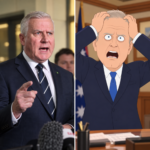
One Nation has broken through in Western Australia with a historic victory in the Secret Harbour by-election, prompting newly elected MP Luke Herdegen to declare there are “no safe Labor seats” left in the state or the country.

The emphatic result in Perth’s outer south has delivered Pauline Hanson’s party its first elected lower-house MP in Western Australia and inflicted a major defeat on Labor in territory it had dominated for decades.
ABC election analysts called the seat for Herdegen a little more than four hours after counting began on Saturday night, with Labor’s Georgia Tree unable to withstand an enormous swing towards One Nation.
For Hanson, the result represents something considerably more important than another favourable opinion poll.
One Nation has now demonstrated it can convert its rapidly rising support into a lower-house victory in a seat previously considered safe for one of Australia’s major parties.
‘There are no safe Labor seats’
Herdegen wasted little time portraying the victory as a warning far beyond the boundaries of Secret Harbour.
“There are no safe Labor seats in this state or in this country anymore,” he told jubilant supporters.
“The people have spoken today.”
He said voters had delivered a message that would send “shock waves across the entire country” and put MPs on notice.
Herdegen described One Nation’s advance as an “orange tsunami”.
The rhetoric was deliberately national.
This was a state by-election triggered by the retirement of a Western Australian Labor MP, but One Nation wants the result interpreted as evidence of a much broader political shift.
Hanson has similarly presented the victory as a message to Prime Minister Anthony Albanese and the major parties that voters are increasingly willing to look elsewhere.
Why Secret Harbour matters
The significance of the result begins with the political history of the area.
Secret Harbour under its current boundaries and name is a relatively new electorate, having been created for the 2025 state election largely from the former seat of Warnbro.
But the broader territory has been held by Labor under different boundaries and names since 1989.
Paul Papalia represented the seat and its predecessors from 2007 until his retirement in July triggered the by-election.
Labor entered the contest defending an 11.5 per cent margin.
That made Secret Harbour the type of electorate a governing party would normally expect to retain even after suffering a substantial mid-term protest swing.
Instead, it changed hands.
And it did not go to the Liberal Party.
It went to One Nation.
Herdegen converts One Nation’s surge into parliamentary power
Herdegen is a gym owner who moved to Western Australia about three years ago.
His campaign ranged from major national questions such as migration and housing pressure to highly local concerns, including the frequency of household red-bin collections.
That combination appears to have proved effective in an electorate where voters repeatedly expressed frustration with governments and the major parties during the campaign.
Before polling day, ABC reporters encountered former Labor voters who said they no longer believed the party represented working and middle-income Australians.
Others spoke about housing costs, population growth and the difficulty younger Australians face trying to establish themselves.
Those frustrations provided fertile ground for One Nation’s campaign.
Herdegen’s victory now gives the party a local representative through whom it can attempt to demonstrate that its political appeal extends beyond protest.
One Nation’s first WA lower-house breakthrough
The historical milestone is unambiguous.
Herdegen will become One Nation’s first elected member of Western Australia’s Legislative Assembly.
That is particularly significant because the party’s resurgence has increasingly been measured through national opinion polling.
Polling support can be volatile.
Seats are different.
To become a durable force in Australian politics, One Nation must translate statewide or national percentages into concentrated support in individual electorates.
Secret Harbour proves that it can do so under at least some conditions.
That will inevitably encourage the party to target other outer-suburban and regional seats with similar voter profiles.
Labor’s enormous campaign machine couldn’t stop the swing
The defeat is particularly painful for WA Labor because it invested heavily in defending the electorate.
According to ABC reporting, a senior Labor figure estimated the campaign cost about $400,000.
Premier Roger Cook said the party knocked on 19,000 doors, held 8,000 conversations with voters, distributed about 210,000 pieces of mail and erected roughly 1,000 signs.
Labor also ran a substantial social media operation.
None of it was enough.
Cook acknowledged after the result that Western Australians were “doing it tough” and promised his government would listen.
He said the campaign had been a reminder of the importance of meeting voters where they were and understanding their concerns.
“We will double down,” Cook said.
The result therefore presents Labor with a more difficult problem than campaign organisation alone.
The party had resources, volunteers and an established political network.
What it could not overcome was the willingness of enough voters to abandon it.
Cost of living and housing loom over the result
Secret Harbour’s demographics are one reason the result is attracting attention outside Western Australia.
The beachside outer-suburban electorate contains many young working families and rapidly developing residential areas.
These communities are particularly exposed to mortgage costs, housing affordability, transport pressures, access to services and household bills.
ABC reporting during the campaign repeatedly encountered voters who linked their dissatisfaction to cost-of-living and housing pressures.
That does not mean every One Nation voter supported the party for the same reason.
Migration, distrust of the major parties, local issues and Hanson’s broader political message all formed part of the contest.
But the economic pressures facing outer-suburban households provide an important backdrop.
For Labor, the danger is that voters who once regarded it as the natural party of working families may no longer feel that attachment.
The Liberals have an equally uncomfortable problem
Secret Harbour was a Labor loss, but it was hardly a Liberal victory.
The Liberal candidate finished a distant third.
That matters because the traditional assumption in Australian politics is that when a government suffers a large protest swing, the principal opposition benefits.
Secret Harbour produced a different pattern.
Working-class and outer-suburban voters unhappy with Labor did not automatically move to the Liberals.
Enough moved towards One Nation to give Hanson the seat.
ABC analysis described this as one of the central implications of the result: families frustrated by housing and living costs now have another political destination.
For the Liberals, that represents a strategic problem every bit as serious as Labor’s.
Andrew Hastie’s federal seat is now part of the conversation
The implications become even more interesting because Secret Harbour overlaps with the federal electorate of Canning.
Canning is held by prominent Liberal MP Andrew Hastie.
Hastie had already criticised the WA Liberal approach to One Nation before polling day, insisting his party should fight for every vote rather than treating Hanson’s success as indirectly beneficial to the Liberals.
The by-election has strengthened his argument.
One Nation now possesses a local parliamentary foothold inside territory overlapping his federal electorate.
ABC analysis noted that this does little to improve Hastie’s position if One Nation decides to target Canning aggressively at the next federal election.
That does not mean Canning will fall.
State and federal contests operate differently, candidates matter and preference flows can dramatically change outcomes.
But One Nation has established an organisational and electoral presence in an area the Liberals cannot afford to ignore.
Hanson says voters are looking for hope
Hanson interpreted the result as evidence Australians increasingly want a political alternative.
Speaking after the victory, she said voters were looking for representatives who would listen to them and fight to change the country’s direction.
One Nation’s WA leader Rod Caddies went further, declaring Australia’s traditional two-party political system “dead”.
Like Herdegen’s claim that no Labor seat is safe, that is political rhetoric rather than a conclusion established by one by-election.
Labor and the Coalition remain the dominant forces in Australia’s parliaments and possess vastly larger organisational structures than One Nation.
But Secret Harbour does demonstrate why those claims are receiving more attention than they once would have.
A party previously unable to win a WA lower-house seat has just taken one from Labor.
Albanese responds to the broader One Nation challenge
The political repercussions quickly reached federal Labor.
Speaking at the Queensland Labor State Conference on Sunday, Prime Minister Anthony Albanese warned about the rise of hard-right populist movements.
He described their politics as “dangerous, divisive and downright dishonest” and argued parties such as One Nation offered grievance rather than serious solutions.
Albanese did not simply dismiss Hanson’s rise.
He told Labor members that populist opponents had to be defeated and argued the best way to do so was to offer Australians genuine hope for a better future.
The response illustrates how seriously Labor now takes the challenge.
One Nation is no longer regarded simply as a party capable of taking votes from the Coalition.
Secret Harbour demonstrates it can take votes — and seats — from Labor as well.
But a by-election is not a general election
There is an important limitation to every attempt to extrapolate Secret Harbour nationally.
By-elections can produce unusually large protest swings.
Voters know the government will remain in office regardless of the result, making it easier to experiment with another party or send a warning without changing who governs.
Local issues can also become disproportionately important.
ABC analysis specifically noted that matters such as red-bin collections featured in Secret Harbour in ways that may not carry the same weight in a state or federal general election.
Labor had also promised to honour its local campaign commitments regardless of who won, potentially reducing the perceived risk for voters considering One Nation.
For those reasons, Herdegen’s claim that there are no safe Labor seats should be understood as a victory declaration, not an electoral forecast.
The official count is also not finished
There is another technical qualification.
The Western Australian Electoral Commission says counting remains in progress.
The commission warns that election-night results are indicative and that the full count will only be completed after the deadline for eligible postal votes at 9am on September 3.
That does not change the fact that the seat has been called for Herdegen and Labor has accepted defeat.
It does mean election-night percentages should not be treated as final certified totals while counting continues.
What Secret Harbour actually proves
The most useful conclusion from the result is narrower than the victorious rhetoric — but still politically significant.
Secret Harbour does not prove that every Labor stronghold can fall to One Nation.
It does not prove Hanson is on the verge of replacing Labor or the Coalition as a party of government.
And it does not establish that a similar swing will occur at coming state or federal elections.
What it proves is that a seat with decades of Labor history can become vulnerable when voter dissatisfaction becomes strong enough.
It proves One Nation can capitalise on that dissatisfaction.
And it proves the Liberal Party cannot assume voters leaving Labor will automatically move into its column.
Those are substantial developments.
The next contests will determine whether this was a breakthrough or an exception
One Nation now faces the challenge that accompanies success.
Winning Secret Harbour raises expectations.
Herdegen must demonstrate he can effectively represent the electorate, while the party must recruit credible candidates and build the organisational capacity required to compete across many more seats.
Labor must decide how much of the result was driven by local circumstances and how much reflects deeper dissatisfaction among working and outer-suburban voters.
The Liberals must confront an equally difficult question: why did an electorate rejecting Labor choose One Nation rather than them?
Those questions will be tested again in coming state and federal contests.
For now, the historical fact is clear.
One Nation has broken into Western Australia’s lower house.
It has done so by taking territory Labor had controlled for decades.
And Herdegen’s declaration that “there are no safe Labor seats” ensures the result will be used by Hanson and her party as evidence that Australia’s old political assumptions are beginning to break down.
Whether Secret Harbour proves to be the beginning of an “orange tsunami” or an exceptional by-election result will take much longer to establish.
But after Saturday night, neither Labor nor the Liberals can afford to assume the answer.