Pauline Hanson has accused Prime Minister Anthony Albanese and Treasurer Jim Chalmers of crossing a dangerous line in Australia’s political debate, warning that describing One Nation as a threat to the country could encourage political violence.
The One Nation leader launched the extraordinary accusation on Monday after Albanese and Chalmers used speeches to Queensland Labor faithful to intensify their attacks on the surging minor party.
Hanson argued that Labor’s rhetoric had moved beyond normal political criticism and risked portraying democratically elected political opponents — and by extension their supporters — as legitimate threats.
“No matter how worried Jim and Albanese are about losing their jobs, telling Australians that their democratically elected opponents are ‘dangerous’ and a ‘threat to our country’ invites people to treat them as a threat,” Hanson wrote.
“Words have consequences. That is how political violence is incited.”
The accusation represents a significant escalation in the increasingly bitter confrontation between Labor and One Nation as Hanson enjoys one of the strongest periods of political momentum in her party’s history.
It is important, however, to distinguish Hanson’s allegation from an established fact.
There is no evidence presented with her statement establishing that Albanese or Chalmers has caused or directed political violence. Her argument is that their choice of language risks contributing to a more hostile political environment.
Labor, for its part, argues that One Nation’s politics itself threatens Australia’s social cohesion and that confronting the party’s policies is a legitimate part of democratic debate.
What Albanese actually said
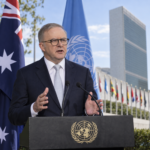
The confrontation followed Sunday’s Queensland Labor State Conference, where the Prime Minister directly addressed One Nation’s growing electoral strength.
Albanese warned Labor supporters that “hard-right populists are on the march”, placing Hanson’s party within what he described as a broader international political trend.
“Parties like One Nation have no serious answers to our problems,” Albanese told the conference.
He accused the party of exploiting grievances rather than solving them and argued that populist movements were prepared to distort facts, spread misinformation and turn Australians against each other in pursuit of votes.
He characterised that style of politics as “dangerous, divisive and downright dishonest”.
Albanese also attacked specific positions and comments associated with One Nation, arguing that the party did not represent the interests of Australian workers despite its growing support among working-class and outer-suburban voters.
The Prime Minister’s criticism was not entirely new.
In July, when questioned about Hanson’s comments concerning Australia’s Muslim community and Islam, Albanese said Hanson had been “undermining social cohesion for 30 years”.
He traced his criticism back to the circumstances surrounding Hanson’s first election to federal parliament in 1996, when she had been disendorsed as a Liberal candidate before winning the Queensland seat of Oxley as an independent.
But Sunday’s speech came in a dramatically different political environment.
One Nation is no longer simply rising in opinion polls.
It has just taken a previously safe Labor seat.
Chalmers also sharpened the attack
Treasurer Jim Chalmers addressed the Queensland conference shortly before Albanese and made clear that the government was treating One Nation as a serious political challenge.
“We took this threat seriously before yesterday’s byelection in the west, and we will take it seriously after it,” Chalmers said.
He warned of what he described as a dangerous and divisive combination of the Liberals, Nationals and One Nation.
Hanson seized on those remarks alongside Albanese’s comments.
Her central argument was that political leaders cannot simultaneously call for moderation in public debate while describing democratic opponents in language suggesting they pose a danger to the country.
“Anthony Albanese says we need to turn down the heat and violent rhetoric in our political discourse,” Hanson said.
“Meanwhile, he and his Treasurer are pouring petrol all over it.”
She added that Australians were entitled to vote for One Nation without being told their democratic choice represented a danger to the nation.
Secret Harbour transformed the argument
The timing is impossible to separate from Saturday’s extraordinary result in Western Australia.
One Nation candidate Luke Herdegen won the Secret Harbour by-election in Perth’s outer south, taking a seat that Labor had previously held with an 11.5-point two-party-preferred margin.
The result represented One Nation’s first lower-house seat in the Western Australian Parliament.
It was also a severe blow for Premier Roger Cook’s Labor government, which had entered the contest with an overwhelming parliamentary majority and had governed the area represented by retiring MP Paul Papalia for years.
Labor candidate Georgia Tree conceded on Saturday night after a swing of roughly 17 percentage points towards One Nation made the outcome clear.
The Liberal Party finished behind both Labor and One Nation.
That detail will be closely studied nationally.
One Nation did not merely take votes from Labor. Its performance demonstrated that it could potentially displace the Coalition as the principal conservative challenger in particular outer-suburban and regional electorates.
Hanson described the Secret Harbour result as evidence that Australians were increasingly willing to consider One Nation as a viable electoral alternative rather than merely a protest vote.
Labor reached the same conclusion from the opposite direction.
Its senior leaders emerged from the result treating One Nation as a political force that must be confronted directly.
Then came a remarkable Newspoll
The political stakes rose again on Monday with the publication of a new national Newspoll.
The survey put One Nation on 30 per cent of the primary vote.
Labor was on 29 per cent.
The Coalition had fallen to 19 per cent, while the Greens were on 13 per cent.
Primary-vote polling does not translate directly into seats in Australia’s preferential voting system, and an election result would depend heavily on individual electorates and preference flows.
But the headline number is politically extraordinary.
A party that has spent most of its history outside Australia’s major-party duopoly is polling above both the governing Labor Party and the Coalition on first preferences.
The numbers also help explain why rhetoric surrounding One Nation has intensified so sharply.
For Labor, Hanson increasingly represents competition for working-class and outer-suburban voters who have traditionally been central to the party’s electoral coalition.
For the Coalition, the threat may be even more immediate.
If One Nation can continue attracting voters who would once have naturally supported Liberal or National candidates, the conservative side of Australian politics could become increasingly fragmented.
The Secret Harbour result showed what that possibility looks like at the ballot box.
Hanson says the language carries real risks
Hanson’s response went beyond arguing that Labor’s language was politically unfair.
She explicitly connected heated political rhetoric with the possibility of violence.
Her position is that repeatedly presenting political opponents as dangerous can change the way supporters and opponents perceive them.
That argument deserves to be reported precisely.
Hanson is not alleging that Albanese has ordered, organised or directly encouraged an act of violence.
She is alleging that rhetoric portraying One Nation as a threat can contribute to an atmosphere in which political violence becomes more likely.
That remains her contention.
Albanese and Labor are entitled to an equally important democratic principle: governments and political parties must be free to describe policies or political movements as dangerous if they genuinely believe those movements pose a threat to social cohesion, economic interests or democratic institutions.
The dispute is therefore partly about where legitimate political criticism ends and irresponsible demonisation begins.
Australia has reason to take political threats seriously
The argument is occurring against a wider backdrop of concern about threats directed at Australian politicians and increasing hostility in political discourse.
Albanese himself has repeatedly called for Australians to lower the temperature of political debate.
Politicians across the ideological spectrum have faced threats, abuse and increasingly aggressive confrontations, particularly online.
Hanson has also been the target of threats during her political career.
A Perth man appeared in court this year accused of using Facebook posts to threaten to kill the One Nation leader. He was charged with two counts of using a carriage service to make a threat, and the court ordered that he not contact Hanson.
Those circumstances make the language used by political leaders a legitimate subject for scrutiny.
They do not prove Hanson’s accusation against Albanese.
But they help explain why claims about “danger”, “threats” and political violence now carry a significance extending beyond ordinary campaign rhetoric.
Labor sees a different threat
The government’s argument is fundamentally different.
Albanese has consistently presented his criticism of One Nation as a defence of Australian social cohesion.
He argues that Hanson’s political movement thrives by dividing Australians and offering simplistic answers to complex problems.
In his Queensland conference speech, the Prime Minister attempted to connect One Nation with a wider international movement of hard-right populism.
For Labor, therefore, using strong language is not an attempt to encourage hostility towards Hanson personally.
It is an attempt to convince voters that One Nation’s policies and political approach would be damaging if given greater power.
That is an argument voters will ultimately assess for themselves.
But the electoral calculation behind Labor’s new intensity is increasingly obvious.
Ignoring One Nation is no longer an option.
The political map is changing
For decades, Australian federal politics has been organised around a familiar contest.
Labor occupied one side.
The Liberal-National Coalition occupied the other.
Minor parties influenced Senate outcomes and occasionally won lower-house seats, but governments were built around those two major blocs.
The latest polling and the Secret Harbour result raise the possibility of something more unstable.
One Nation’s support is now substantial enough that both major political camps must consider where Hanson could take seats, whose voters she is attracting and what preference arrangements might mean in individual electorates.
Barnaby Joyce, who joined One Nation after his long career with the Nationals, argued on Monday that voters were responding to what he called the party’s “dry pragmatism”.
He suggested Australians were increasingly dissatisfied with what they saw as a political “closed shop” offering only two conventional alternatives.
Whether One Nation can sustain its current polling is unknown.
Minor-party support can be volatile, national polling does not automatically produce lower-house victories and an actual federal election remains a far more complex contest than a single by-election.
But 30 per cent primary support cannot simply be dismissed.
Nor can taking a formerly safe Labor seat.
The argument now is about more than Pauline Hanson
That is what makes the confrontation between Hanson and Albanese significant.
On the surface, it is another fierce exchange between two politicians who have profound ideological disagreements.
Underneath it is a struggle over a changing Australian electorate.
Albanese wants voters to see One Nation as a divisive political force offering anger rather than credible solutions.
Hanson wants voters to see Labor’s attacks as evidence that the political establishment is frightened by her party’s growing support.
Labor says One Nation poses a threat to Australia’s cohesion.
Hanson says language portraying democratically elected opponents as threats can itself create danger.
Both arguments are now being made in an environment where One Nation has tangible electoral momentum rather than merely favourable headlines.
The challenge for Australia’s political leaders is to prosecute those arguments forcefully without turning political disagreement into personal hostility.
Hanson’s allegation that Albanese is inciting political violence remains exactly that — an allegation.
But her warning about the consequences of political language has ensured Labor’s words will now be examined just as closely as One Nation’s.
And with One Nation sitting on 30 per cent in the latest Newspoll after an historic Western Australian victory, neither side appears likely to lower the temperature soon.