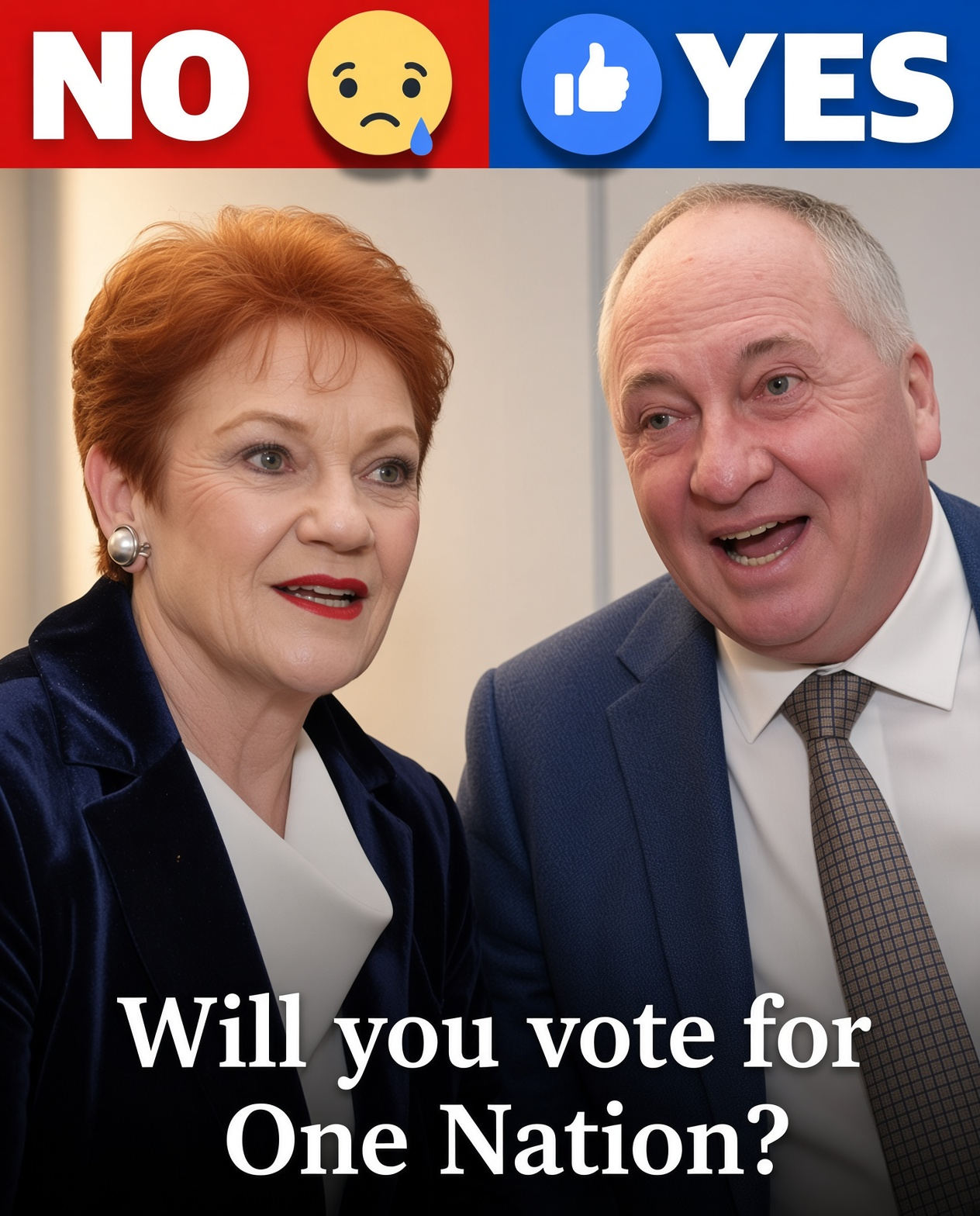
Australians turning to Pauline Hanson have again been portrayed as conspiracy-driven, angry or seduced by “nutty populism”, but polling on One Nation’s extraordinary rise points to a considerably more complicated story: immigration, economic insecurity and collapsing trust in the major parties are pushing voters towards an alternative they believe is finally listening to them.
The latest argument was prompted by columnist Paul Williams, who asked how Australia reached a point where voters were gravitating towards what his headline described as Pauline Hanson’s “nutty populism”.
His commentary came after another extraordinary week in Australian politics, including confrontations over Hanson, nationwide student protests and increasingly polarised political rhetoric.
There is nothing illegitimate about a columnist condemning Hanson or criticising voters attracted to populist politics.
But there is a danger in treating the description as the explanation.
Calling voters crazy does not explain why they changed their vote.
Calling a political movement populist does not explain why it is growing.
And dismissing supporters as conspiracy theorists risks overlooking something the polling increasingly makes difficult to ignore.
A substantial share of Australian voters is dissatisfied with the political choices it has traditionally been offered.
One Nation’s rise has become one of the defining developments in Australian politics in 2026.
The exact number changes substantially between pollsters and from week to week, but the broader trend is unmistakable.
Hanson’s party has moved from minor-party status into territory where it can compete with — and in some surveys surpass — one or both traditional major-party blocs on primary support.
Roy Morgan recorded One Nation at an extraordinary 31.5 per cent primary vote in June.
That survey had Labor on 27 per cent and the Liberal-National Coalition on just 17.5 per cent.
One Nation subsequently dropped sharply, recovered, and then fell again, illustrating just how volatile its new support remains.
But even after those fluctuations, the party has remained at levels that would have been almost unimaginable only a few years ago.
The latest Newspoll reported this week placed One Nation at 29 per cent, level with Labor’s primary vote and well ahead of the Coalition on 18 per cent.
Guardian Essential has recently measured One Nation at 25 per cent, compared with 22 per cent for the Coalition.
Different methodologies produce different numbers, but they are pointing towards the same political disruption.
Millions of Australians are at least considering Hanson.
Why?
There is now unusually useful evidence addressing that question directly.
Roy Morgan surveyed One Nation supporters about their reasons for backing Hanson and identified several recurring themes.
Immigration and national identity were prominent.
So was deep dissatisfaction with Labor and the Coalition.
Respondents expressed concern about Australia’s economic and cultural direction.
They objected to what they described as “woke” politics, climate policies and international institutions.
Many believed One Nation was putting Australians first.
And Hanson herself was repeatedly viewed by supporters as authentic, direct and honest.
The dominant emotional currents identified in those responses included frustration, distrust, anger towards the political establishment and a desire for significant change.
That gives Australia a much better starting point for understanding One Nation’s rise than simply diagnosing its voters as irrational.
The first factor is immigration.
Hanson has made immigration central to her political identity for three decades.
But the environment in which Australians are hearing that argument has changed dramatically.
Housing affordability has become one of the country’s dominant economic problems.
Renters are under pressure.
First-home buyers face enormous barriers to entry.
Infrastructure is struggling to keep pace with population growth in some areas.
Hospitals, roads, schools and transport networks are under pressure.
Migration is not the sole cause of those problems.
Housing supply, planning restrictions, construction costs, taxation, interest rates, infrastructure investment and years of policy choices all matter.
But population growth obviously affects demand.
Voters do not need to accept every One Nation claim to conclude that migration levels should form part of the discussion.
Hanson has occupied that territory consistently.
The major parties have therefore found themselves confronting a question they spent years struggling to discuss without immediately turning it into a cultural argument.
For One Nation voters, immigration is often connected to much more than raw population numbers.
It intersects with wages, housing, infrastructure, national identity and the belief that governments prioritise economic aggregates over the lived experience of citizens.
That does not make every claim about immigration accurate.
It does explain why simply labelling immigration concerns xenophobic can fail politically.
If a renter believes population is increasing faster than housing supply, telling that voter the concern itself is illegitimate does not make the rent cheaper.
If a worker believes labour-market competition is suppressing wages, the argument must be answered with evidence.
If regional communities believe infrastructure has failed to keep pace with population, governments need to demonstrate otherwise or fix it.
Political condemnation is not a substitute for policy performance.
The second factor is economic frustration.
Australia’s political debate is increasingly being shaped by voters who do not believe headline economic statistics describe their lives.
A government can point to employment.
Economists can discuss aggregate growth.
Treasury can produce forecasts.
But households experience the economy through mortgage repayments, rent, groceries, electricity bills, insurance, fuel and whether their wages stretch to the end of the month.
When those experiences deteriorate, voters look for someone to blame.
Populist parties prosper when established political institutions appear unable to provide convincing answers.
Hanson’s economic message is built around that frustration.
She repeatedly argues Australians are becoming poorer while governments spend too much, immigration remains too high and political elites focus on priorities disconnected from ordinary households.
Critics can dispute her proposed solutions.
But the grievances she is targeting are real enough to appear across virtually every major political party’s messaging.
Labor talks constantly about cost-of-living relief.
The Coalition attacks government spending and falling living standards.
The Greens campaign on housing and corporate power.
One Nation attacks all three.
That brings us to the third factor: distrust.
This may ultimately be more important than any single One Nation policy.
Many Hanson supporters do not merely disagree with Labor or the Coalition.
They have stopped trusting them.
Roy Morgan’s research repeatedly found dissatisfaction with the major parties among One Nation voters.
That creates a very different political environment from a conventional contest between centre-left and centre-right.
A voter who dislikes Labor but trusts the Liberal Party can switch between them.
A voter who believes both are fundamentally failing is looking outside the traditional system.
One Nation is benefiting from that search.
So are independents and other minor parties.
The Coalition’s current weakness makes the phenomenon particularly consequential.
For decades, conservative voters dissatisfied with Labor had an obvious destination.
Today, some no longer see the Liberal-National Coalition as sufficiently different from Labor on the issues they care most about.
Hanson’s advantage is that nobody can plausibly accuse her of suddenly discovering political rebellion in 2026.
She has spent three decades attacking immigration policy, multiculturalism, political correctness, global institutions and the major parties.
That consistency is a liability with voters who strongly oppose those positions.
It is an asset with voters who value political authenticity.
Supporters often describe Hanson as someone who says publicly what others are unwilling to say.
That perception survives even when her claims are disputed, her policies encounter practical problems or she makes obvious mistakes.
It also explains why conventional political attacks do not always damage her in the way opponents expect.
A politician perceived as part of the establishment calling Hanson irresponsible may simply reinforce her anti-establishment appeal.
A media commentator describing her supporters as foolish can have the same effect.
Every attack can be incorporated into a story in which Hanson and her voters are being dismissed by institutions that never respected them anyway.
That does not mean Hanson is politically bulletproof.
Far from it.
Her polling during 2026 demonstrates that support can move rapidly when voters encounter specific policies or statements they dislike.
Roy Morgan recorded One Nation at 31.5 per cent following Hanson’s National Press Club appearance in June.
A week later, after heavy scrutiny of her comments about a “monocultural” Australia, the party fell 5.5 points to 26 per cent.
By mid-July, Roy Morgan had it back at 28 per cent.
The following week it dropped to 22.5 per cent as the Coalition recovered to 23 per cent.
That volatility is revealing.
It suggests One Nation has accumulated a large pool of persuadable voters without necessarily converting all of them into committed long-term supporters.
They can move towards Hanson.
They can also move away.
There is another important warning in the polling: liking One Nation does not mean liking every One Nation policy.
A Guardian Essential survey found significant resistance to some of Hanson’s positions even while large numbers remained willing to consider voting for her party.
In that poll, 29 per cent said they would definitely vote for One Nation at the next election.
Another 23 per cent said they were open to doing so.
Combined, 52 per cent were either committed or potentially receptive.
That was slightly higher than the equivalent figure for Labor.
Yet respondents simultaneously rejected some prominent One Nation policy positions.
This apparent contradiction makes sense if many voters are using One Nation less as a comprehensive ideological package and more as a vehicle for dissatisfaction.
A voter can disagree with Hanson on abortion.
Another can dislike her language about multiculturalism.
Another can question her foreign-policy knowledge.
They may still consider voting One Nation because immigration or economic dissatisfaction outweighs those objections.
Recent events demonstrate precisely how complicated the relationship has become.
This week Hanson was unable to name the leaders of Japan and Indonesia when questioned about foreign affairs during an interview with Chris Kenny.
The leaders were Japanese Prime Minister Sanae Takaichi and Indonesian President Prabowo Subianto.
Hanson could identify Chinese President Xi Jinping but could not recall the other two.
For critics, the episode raised an obvious question about whether someone presenting herself as capable of national leadership possesses sufficient command of foreign affairs.
Prime Minister Anthony Albanese seized on it.
So did Liberal figures.
Hanson responded that she was tired of “gotcha” questioning and pointed out that she was not the prime minister.
Whether voters regard the episode as disqualifying, embarrassing or irrelevant will reveal something important about the durability of her support.
At the same time, thousands of students have marched through Australian cities specifically to stop Hanson’s political momentum.
Thursday’s nationwide anti-One Nation protests drew school and university students into Sydney, Melbourne, Brisbane, Adelaide, Perth and other centres.
Organisers accused Hanson of racism and warned about what they called the “rise of the far right”.
The demonstrations showed that One Nation’s growth is generating genuine alarm among younger progressive Australians.
They also demonstrated something Hanson can use to her advantage.
Politicians on the margins are rarely confronted by nationwide protests.
Politicians perceived as capable of wielding real power are.
One Nation’s opponents are therefore simultaneously condemning Hanson and confirming that she has become politically significant enough to mobilise against.
Labor has also escalated its response.
Foreign Minister Penny Wong used a major Lowy Institute speech this week to attack Hanson’s call for a more monocultural Australia, describing the idea as a “melancholic fantasy”.
Wong argued multiculturalism strengthens Australia economically, diplomatically and strategically, particularly in the Indo-Pacific.
That represents a substantive disagreement rather than simply a character attack.
It asks voters to choose between competing ideas of Australian identity.
Hanson believes immigration and multiculturalism have gone too far and weakened social cohesion.
Wong argues Australia’s multicultural character is itself a strategic national advantage.
That is a debate capable of being tested through evidence and democratic argument.
It is considerably more useful than assuming people on either side are irrational.
The Coalition faces an even more uncomfortable problem.
One Nation’s growth has come substantially at its expense.
The latest Newspoll placed the Coalition at just 18 per cent primary support while One Nation and Labor each recorded 29 per cent.
That is an existential warning for Australia’s traditional centre-right parties.
Yet the Coalition cannot simply declare Hanson unacceptable and move on.
On some issues, it is already finding common ground with her.
This week Coalition figures indicated support for elements of One Nation’s proposed legislation dealing with Australians linked to foreign terrorist organisations.
They want the proposal examined for constitutional robustness.
That produces an awkward political dynamic.
The Coalition argues voters should reject One Nation because it lacks credible policy depth while simultaneously acknowledging that some One Nation proposals deserve support.
Hanson can exploit that contradiction.
The geographical pattern of One Nation’s support provides another clue to what is happening.
Recent tracking in New South Wales has found dramatic gains in regional areas and on Sydney’s outer fringes.
Support was reported at 38 per cent federally in regional NSW, 34 per cent across the Hunter and Newcastle and 31 per cent in outer and middle Sydney.
The growth was particularly strong among lower-income voters, although it was not confined to them.
Those areas often sit at the intersection of several pressures One Nation emphasises.
Housing and infrastructure matter.
Energy and industrial employment matter.
Migration matters.
Regional services matter.
And distrust of metropolitan political institutions can be particularly strong.
Again, describing those voters as conspiracy-driven may identify something about some individuals.
It does not explain the electoral geography.
Populism succeeds when it can connect diverse grievances to one simple story.
Hanson’s story is straightforward.
Australia’s political establishment has stopped putting Australians first.
Immigration is too high.
Government is too large.
Energy is too expensive.
National identity has been weakened.
Ordinary people are ignored.
Elites protect themselves.
And anyone who objects is dismissed as racist, ignorant or extreme.
Whether that diagnosis is accurate in whole, in part or not at all, it has an obvious political advantage.
It converts a collection of separate frustrations into a single explanation.
That is what successful populist movements do.
The responsibility of Hanson’s opponents is therefore more demanding than proving she sometimes gets things wrong.
They need to offer better explanations for the problems her voters are experiencing.
If immigration is not the principal cause of housing unaffordability, explain the relative contribution and fix the larger causes.
If renewable energy is not responsible for industrial electricity pressure, demonstrate how affordable and reliable power will be delivered.
If Australia benefits from high migration, show how infrastructure and housing will keep pace.
If multiculturalism strengthens the country, demonstrate those benefits while honestly confronting integration problems when they occur.
If voters are being misled by misinformation, correct the misinformation without treating the voters themselves with contempt.
That last distinction matters enormously.
Democratic politics becomes dangerous when disagreement turns into disdain for the electorate.
One Nation voters are not a single psychological category.
They include former Coalition voters, former Labor voters and people previously disengaged from politics.
They include high-income and low-income Australians.
They include people motivated primarily by immigration and others motivated by economic dissatisfaction.
Some undoubtedly believe conspiracy theories.
So do some supporters of other parties.
That observation tells us little about why a political party is capable of polling in the twenties nationally.
At that scale, the explanation has to reach beyond individual eccentricity.
Nor should One Nation’s rise be romanticised simply because its voters have genuine grievances.
A political party must ultimately be judged on whether its policies work.
Hanson’s increased support raises the standard she should be expected to meet.
If One Nation wants to be considered a potential party of government rather than a protest vehicle, its policies require detailed costing.
Its foreign policy requires depth.
Its candidates require scrutiny.
Its economic proposals require modelling.
Its migration policies require examination of consequences for businesses, universities, health care, construction and the broader economy.
Its promises should receive exactly the same scepticism applied to Labor and the Coalition.
That is the difference between taking voters seriously and merely flattering them.
Hanson herself increasingly invites that scrutiny.
She has openly discussed her ability to lead Australia.
One Nation is presenting candidates across the country.
The party is pursuing ambitious policies on migration, national security, energy and government spending.
It cannot simultaneously demand recognition as a serious alternative government and dismiss difficult questions as hostile attacks.
The closer a politician moves towards power, the more demanding the questions should become.
That applies to Hanson as much as Albanese or any Coalition leader.
But serious scrutiny and voter contempt are not the same thing.
That distinction may determine whether Australia’s established political class understands what is happening before it is too late.
One Nation’s polling could fall.
Its volatile support may return to the Coalition.
Controversial Hanson statements could repel soft voters.
Candidate problems could emerge.
The pressure of detailed policy scrutiny could expose weaknesses that protest politics previously allowed the party to avoid.
None of that changes the message already delivered by the electorate.
A substantial number of Australians have demonstrated that they are willing to abandon the traditional parties.
Some are prepared to consider Pauline Hanson instead.
The most important question is not whether commentators approve of that decision.
It is why voters reached it.
The available evidence points to three broad answers: immigration and national identity, economic insecurity, and deep distrust of the political establishment.
Those motivations overlap.
A voter struggling with rent may connect housing pressure with migration.
A worker facing rising electricity bills may connect economic insecurity with energy policy.
A citizen who believes neither major party will change either policy may conclude the entire political establishment has stopped listening.
Hanson then becomes not merely a preferred politician but a means of registering rejection.
That does not make every One Nation policy correct.
It does not make every criticism of Hanson unfair.
And it certainly does not mean voters should stop scrutinising her.
It means Australia’s political establishment would be making a serious mistake if it confused condemnation with understanding.
If millions of Australians are prepared to contemplate a political revolt, calling the revolt “nutty” is the easy part.
Understanding what produced it is harder.
Fixing the conditions behind it is harder still.
And if Labor and the Coalition cannot do that, Pauline Hanson will continue having the most powerful argument available to any populist politician:
The people who dismiss you are the same people who failed to listen to you.