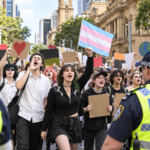
Thousands of Australian students walking out of class to protest Pauline Hanson have ignited a fierce argument over political activism in schools, with One Nation accusing left-wing groups of influencing children while education leaders insist students should have remained in class.
The nationwide “Students Say No to Hanson” demonstrations on Thursday brought schoolchildren and university students into city centres across Australia to protest One Nation and what organisers described as the “rise of the far right”.
Thousands participated nationally.
More than 2,000 students from around 40 schools and colleges were reported at the Adelaide demonstration, while hundreds of students from more than 100 Victorian schools participated in Melbourne.
Large crowds also assembled in Sydney and Perth, while approximately 500 students and supporters gathered in Brisbane.
The scale of the action has given organisers exactly what they wanted: national attention.
It has also generated an entirely different debate.
Were these simply politically engaged young Australians exercising their democratic rights — or were organised adult political movements using school students to advance an ideological campaign?
Pauline Hanson has emphatically chosen the second interpretation.
“Schools should teach young Australians how to think, not what to think,” the One Nation leader said as the protests unfolded.
Hanson accused elements within the education system of pushing political ideology rather than equipping students to form their own conclusions.
Other conservative politicians have raised similar concerns.
Their argument has been strengthened by the fact that Thursday’s walkouts were not spontaneous demonstrations.
They were organised in advance.
The National Union of Students played a central role in coordinating the national day of action.
Socialist Alternative activists and High School Anti-Capitalists were also involved in promoting and organising demonstrations.
The protests were scheduled across multiple Australian cities and students were actively encouraged to participate.
Organisers framed the demonstrations as a campaign against racism and the growing political influence of Hanson and One Nation.
They also explicitly linked their campaign to broader left-wing causes involving migration, LGBTQ+ rights, workers’ rights and opposition to what they call far-right politics.
That organisational background is important.
It demonstrates that politically committed activist groups deliberately sought to mobilise school students.
But it does not establish the broader claim that Australian schools themselves indoctrinated those students.
There is an important distinction between political activism occurring around schools and political indoctrination being conducted by schools.
The evidence presently available establishes the former much more clearly than the latter.
In Victoria, for example, hundreds of students left classes to attend the Melbourne rally.
Some arrived in school uniform.
But education authorities discouraged students from missing class.
Balwyn High School specifically stated that absences for the demonstration were not sanctioned.
Victorian Premier Ben Carroll and Education Minister Gabrielle Williams also stressed the importance of students remaining at school.
That matters because the sight of school uniforms at an ideological demonstration can easily create an impression of institutional involvement that may not exist.
A student attending a rally while wearing a school uniform does not necessarily mean the school endorsed the rally.
Likewise, an external activist approaching or recruiting students does not prove their teachers instructed them to participate.
That does not mean the influence of political organisations on schoolchildren is an illegitimate subject for scrutiny.
Quite the opposite.
Many of the students participating on Thursday were minors.
Some were in their early teens.
Organisations attempting to recruit children into political campaigns should expect questions about how that recruitment occurs, what material is distributed, whether schools facilitate access and whether parents understand what their children are being encouraged to attend.
Those questions can be asked without assuming the answers in advance.
Schools also have obligations regarding attendance.
Political enthusiasm does not automatically convert an absence into an authorised one.
That principle has received support from politicians who are hardly natural allies of One Nation.
Federal Education Minister Jason Clare acknowledged students’ democratic right to express political views but said high-school students should be at school during school hours.
That position separates two issues frequently collapsed together during the controversy.
Young Australians have political rights.
They can hold views about Pauline Hanson.
They can disagree with immigration policy.
They can campaign against racism.
They can join demonstrations.
But governments can simultaneously expect compulsory-school-age students to attend scheduled classes.
Those positions are not contradictory.
The argument becomes more complicated when elected politicians actively encourage students to participate in a school-hours protest.
Greens Senator Mehreen Faruqi became a central figure in that controversy before the walkout even began.
Faruqi publicly supported the campaign and backed students protesting against Hanson and One Nation.
Her involvement attracted fierce criticism from conservatives, who argued an elected federal senator should not be encouraging children to leave school for an explicitly political demonstration.
For supporters of the protests, Faruqi was encouraging democratic participation.
For critics, she was lending parliamentary legitimacy to organised truancy for an ideological cause.
That is a legitimate political disagreement.
Describing Faruqi as a “left-wing loon”, however, is plainly political invective rather than information that establishes whether the protests were appropriate.
The more useful question is what she encouraged students to do and whether that was consistent with expectations around school attendance.
The same standard should apply to the accusation of “indoctrination”.
It is a powerful word.
It implies students are being taught political beliefs in a manner designed to prevent critical examination or independent thought.
Proving that requires considerably more than demonstrating that students hold progressive political opinions.
A teenager opposing One Nation does not prove indoctrination.
Neither does a teenager supporting One Nation prove successful conservative political education.
The relevant evidence would concern what happens inside schools.
Are teachers presenting partisan political positions as unquestionable facts?
Are students being pressured to support particular parties or causes?
Are schools officially facilitating political campaigns?
Are alternative viewpoints discouraged or punished?
Are activist organisations receiving privileged access to students?
Those are testable questions.
Thursday’s demonstrations alone do not answer them.
What the protests do establish is that organised left-wing groups are actively attempting to mobilise young Australians.
That is not unusual in a democracy.
Political parties, unions, environmental organisations, religious groups, campaign organisations and ideological movements all attempt to persuade younger generations.
The additional sensitivity arises when the people being mobilised are schoolchildren rather than voting-age adults.
High School Anti-Capitalists makes its ideological position explicit in its name.
Socialist Alternative is an openly revolutionary socialist organisation.
The National Union of Students has a long history of political campaigning extending well beyond university administration.
None of those facts needs to be hidden or sensationalised.
They provide readers with the information required to understand the political character of the movement.
Students participating in its events can then explain for themselves why they chose to attend.
And many students did exactly that on Thursday.
Participants interviewed at rallies gave detailed reasons for opposing Hanson.
Some cited her immigration policies.
Others were concerned about LGBTQ+ rights.
Some accused One Nation of racism and scapegoating migrants.
Others said they feared the party’s increasing electoral popularity.
In Brisbane, protesters accused One Nation of blaming migrants and international students for economic problems such as housing affordability.
In Adelaide, students spoke about immigration, transgender rights and workers’ issues.
In Sydney, protesters explicitly presented their demonstration as an anti-racist movement.
Those statements do not prove that every student had independently researched every policy involved.
But neither are they consistent with portraying thousands of participants simply as passive children with no understanding of why they were there.
The rhetoric at some rallies was considerably less sophisticated.
Students chanted obscenities about Hanson.
Some signs and slogans attacked her personally rather than challenging individual One Nation policies.
For critics, those scenes provided ammunition for the argument that students were being encouraged towards hostility rather than critical political thinking.
For organisers, the language reflected genuine anger at a politician they regard as threatening minority communities.
Neither explanation changes the educational question.
If schools are supposed to teach students how to evaluate evidence, distinguish claims from facts and debate controversial ideas, then those principles should apply regardless of which political movement is being discussed.
A classroom should be capable of examining Hanson’s arguments critically.
It should also be capable of examining the arguments made against her.
That is the strongest version of Hanson’s “how to think, not what to think” principle.
Applied consistently, it would not require schools to become politically conservative.
It would require them to avoid becoming politically partisan.
Students studying immigration should encounter evidence about its economic benefits as well as its effects on population growth, housing demand and infrastructure.
Students studying Indigenous policy should be able to examine competing arguments about recognition, Treaty and equality before the law.
Students studying climate policy should encounter the scientific evidence alongside genuine policy disagreements over energy costs and implementation.
And students discussing One Nation should be able to criticise the party vigorously without being instructed that there is only one permissible political conclusion.
The same principle protects students who disagree with Hanson and students who support her.
The events in South Australia are now pushing the argument beyond rhetoric.
More than 2,000 students from roughly 40 schools and colleges participated in Adelaide’s demonstration.
One Nation’s South Australian organisation has responded by calling for an investigation into the circumstances surrounding student involvement.
The party wants greater scrutiny of whether schools or teachers played any role in encouraging attendance.
That request does not itself establish wrongdoing.
An investigation, if undertaken, would provide an opportunity to determine whether there is evidence behind the accusation.
The distinction is important.
If teachers used their positions to recruit students into a partisan political protest, that would raise serious questions.
If students were independently recruited by external activists and left school against official advice, the story is different.
If individual parents authorised their children’s absence, that adds another layer again.
Those scenarios should not be treated as interchangeable.
Organisers, meanwhile, are not retreating.
Following Thursday’s turnout, activists have indicated they intend to continue campaigning and have discussed further demonstrations.
In South Australia, organisers have said they expect to return with an even larger mobilisation.
That ensures schools may soon confront the same practical questions again.
How should an absence for a political protest be recorded?
Can students promote demonstrations on school grounds?
What rules apply when outside political organisations distribute material to students?
Can teachers discuss an upcoming protest without appearing to endorse it?
How should schools respond when students wear uniforms to partisan demonstrations?
Clear rules would protect students, teachers and schools from accusations of selective political treatment.
Consistency matters.
If leaving school to attend an anti-Hanson rally is considered an unauthorised absence, the same rule should apply to a student leaving school to attend a pro-One Nation rally.
If political organisations are restricted from recruiting students on campus, the restriction should not depend on whether the organisation is socialist, conservative, environmentalist or religious.
If teachers are expected to maintain political neutrality while performing their professional duties, that standard should apply across the ideological spectrum.
Such rules provide a stronger safeguard against indoctrination than simply arguing over which political faction currently dominates education.
They protect pluralism.
The wider dispute also exposes a generational political contest.
Many young Australians are deeply frustrated.
Housing affordability has deteriorated.
Rents are high.
Cost-of-living pressures remain severe.
University students worry about debt and employment.
Young people are also highly engaged with debates about climate, race, gender and migration.
Political movements are competing to explain why those problems exist.
The activists behind Thursday’s demonstrations argue Hanson directs legitimate economic frustration towards migrants and minorities.
Hanson argues exactly the reverse.
She says Labor and the Greens have presided over worsening economic conditions and that young people are being encouraged to blame One Nation instead of the governments responsible for policy.
That contest cannot be resolved by declaring one side brainwashed.
It is resolved by evidence, argument and ultimately elections.
There is also a danger for both sides in exaggerating what Thursday proved.
Anti-Hanson activists cannot credibly claim that several thousand demonstrators speak for every Australian student.
Australia has millions of school and university students with widely differing political beliefs.
A protest measures the ability to mobilise supporters, not the opinion of an entire generation.
Likewise, One Nation cannot establish widespread school indoctrination simply by pointing to a large group of students holding left-wing views.
Evidence of organised socialist participation establishes political organisation.
Evidence of students missing class establishes an attendance issue.
Evidence of Greens politicians supporting the demonstrations establishes political backing.
None automatically establishes what individual teachers have been teaching inside classrooms.
The distinction may become increasingly important as One Nation pushes for formal scrutiny.
If investigations uncover evidence that schools officially promoted the rallies or that teachers pressured students to participate, the debate will change substantially.
That would provide concrete evidence for concerns about institutional political activism.
If investigations instead show schools discouraged participation and recorded absences normally, the stronger allegation of school-directed indoctrination would become harder to sustain.
Either result would be more informative than assumption.
For now, the evidence supports a narrower but still significant conclusion.
Organised political groups on the left successfully mobilised thousands of school and university students to demonstrate against Pauline Hanson.
Some elected Greens politicians openly supported the action.
Many schoolchildren missed lessons to participate.
Education authorities and politicians told them they should be in class.
And Hanson has turned those events into a national argument about what schools are supposed to do.
Her formulation — teach students how to think rather than what to think — is likely to resonate far beyond One Nation’s existing supporters.
The harder part is determining whether Australian schools are actually violating that principle.
Thursday’s protests provide reasons to ask questions about political activism around students.
They do not, by themselves, provide the answer.
If governments want to settle the argument, the solution is straightforward: establish what happened.
Determine whether teachers encouraged students to leave class.
Determine how absences were recorded.
Determine what access external political organisations had to students.
Then publish the findings.
If the evidence demonstrates political indoctrination, parents deserve to know.
If it does not, politicians should not claim that it does.
Either way, Australian students deserve an education that equips them to challenge Pauline Hanson, Mehreen Faruqi, One Nation, the Greens — and anyone else asking for their political allegiance.