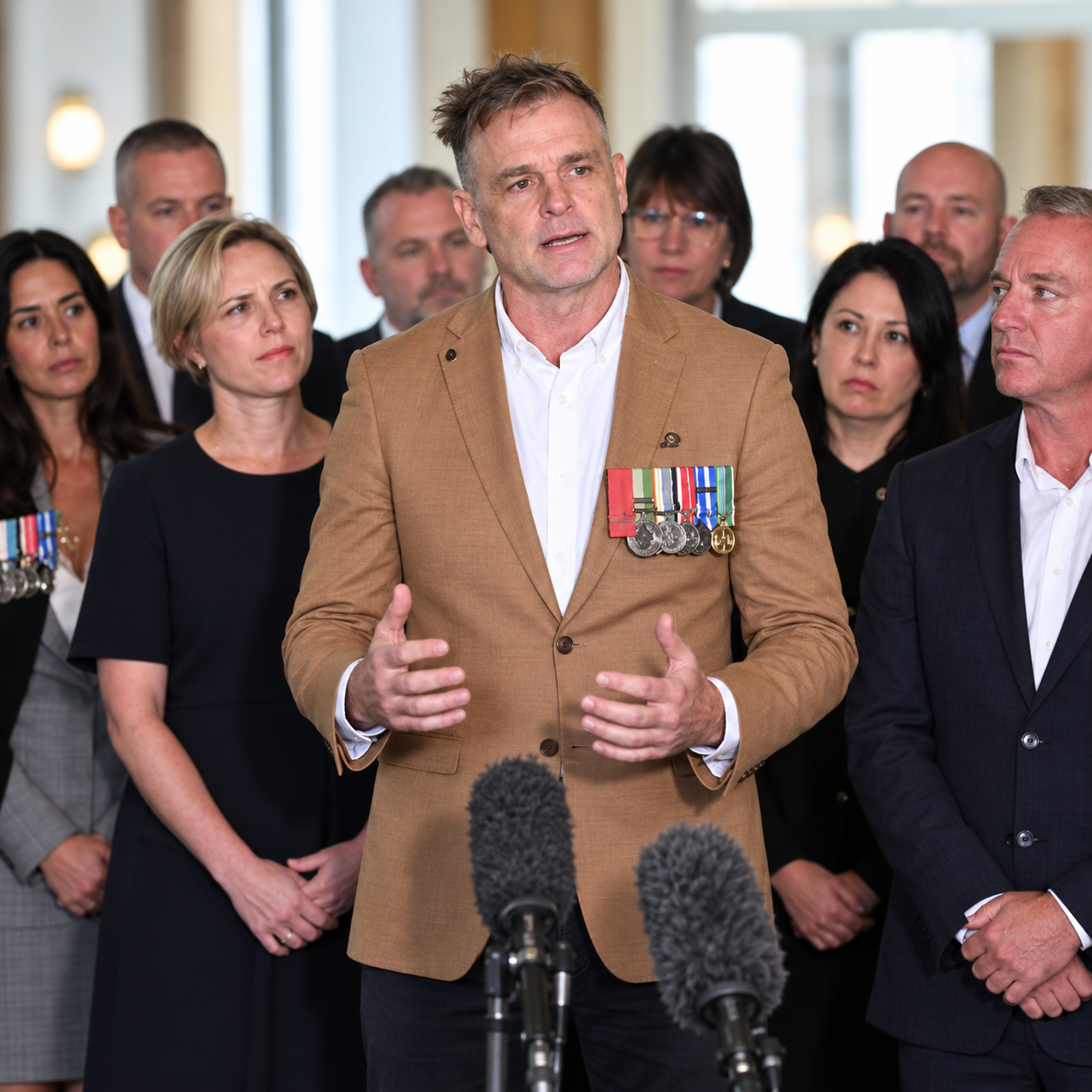
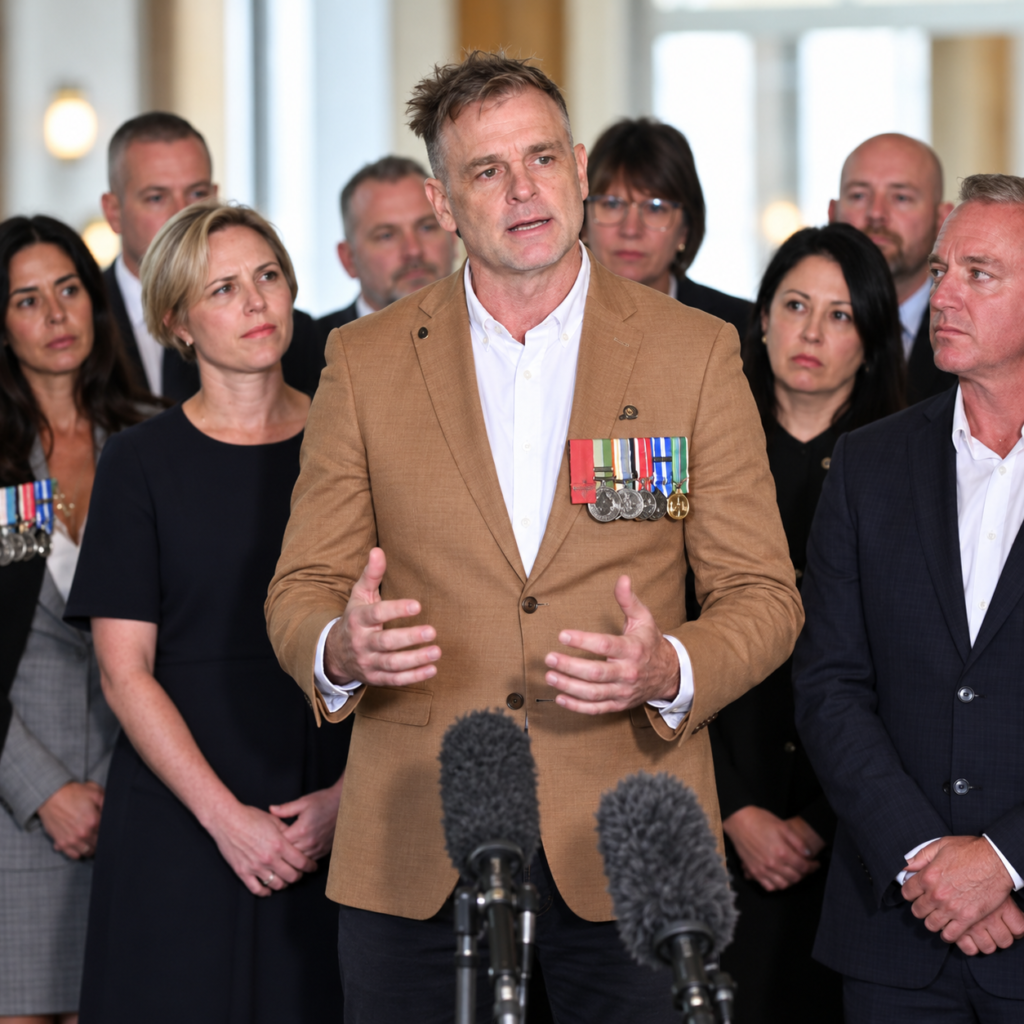
Decorated Australian veterans have laid down their service medals outside Parliament House and demanded the Albanese government abandon its controversial $5,000 annual allied-health threshold, escalating a dispute over whether the planned reforms will improve access to treatment or place another bureaucratic hurdle in front of injured former service personnel.
Veterans gathered at Federation Mall in Canberra on Monday morning in a symbolic protest before holding meetings with politicians and publicly calling on Veterans’ Affairs and Defence Personnel Minister Matt Keogh to “scrap the cap”.
The protest included former service members placing medals earned during their military careers on the ground, in a gesture intended to convey their belief that the covenant between Australia and those who serve in uniform is being undermined.
The Coalition of Veterans’ Voices is campaigning against changes announced in the May federal Budget that will introduce a $5,000 annual review point for eligible allied-health treatment from 1 July 2027.
Advocates argue that veterans with serious and chronic injuries should not have to prove again that treatment is necessary simply because the cost of their care passes a financial threshold.
The government strongly disputes suggestions that treatment will stop at $5,000.
DVA now says veterans who require more than that amount will continue to receive clinically necessary care, including while an application for further treatment is being considered.
That disagreement — over whether the policy is effectively a cap or merely a review point — has become the centre of an increasingly bitter political fight.
Veterans lay down medals at Parliament House
The Canberra demonstration brought together veterans including John Armfield, Dr Tim Nelson, Ian Lindgren, Melanie Annand, Gordon Traill and Sean Smith, with the group placing their medals down as federal Parliament returned for another sitting fortnight.
The protest fell in the week of the second anniversary of the Royal Commission into Defence and Veteran Suicide’s final report, adding particular significance to complaints that veterans still face unnecessary barriers when seeking care.
Army veteran Andy Cullen, co-founder of PTSD Resurrected, was among the advocates campaigning against the changes.
Cullen has served for 17 years across the Royal Australian Infantry and Royal Australian Engineers and received a Commendation for Distinguished Service for his work in Afghanistan.
Following discussions with Keogh, Cullen said he had left feeling disappointed and betrayed.
He told reporters the dispute had affected how he viewed his own family’s relationship with military service.
Cullen said his 18-year-old son was considering joining the Australian Defence Force, but he was now actively discouraging him because he could no longer be confident the government would adequately support him if he suffered an injury through service.
For Cullen, that was a particularly painful position to take as a fourth-generation soldier who remained proud of his own military career.
He urged Keogh to “scrap the cap, stop the pain”.
What the $5,000 policy actually does
The terminology surrounding the proposal has shifted since the Budget.
When it was announced in May, official Budget material described a $5,000 Annual Monetary Limit for allied-health services.
DVA’s latest material instead describes it as a $5,000 annual review threshold.
Under the updated explanation, a Veteran Card holder could use allied-health services until their annual cost approached $5,000. If their clinical needs required treatment beyond that point, their care would be reviewed with their treating health team and additional DVA funding could be approved.
DVA says treatment will be allowed to continue while a request for extra care is being considered, with the intention of avoiding a break in services.
The department has also stressed that the threshold applies only to specified allied-health treatment.
Relevant services include physiotherapy, psychology outside Open Arms, occupational therapy, exercise physiology, podiatry, social work, speech therapy and several other allied-health professions.
GP visits, medical specialists such as psychiatrists, dental care, optical services and hearing services are outside the threshold.
Psychological and counselling treatment delivered through Open Arms also does not count towards the $5,000 figure.
Some veterans will be exempt entirely
The government has also introduced exemptions for veterans it considers particularly vulnerable.
The threshold will not apply to Veteran Card holders receiving the Special Rate Disability Pension or the Totally and Permanently Incapacitated Pension, or to veterans who have been formally determined to be catastrophically injured.
Those changes have won qualified support from some established veterans’ organisations.
RSL Australia national president Peter Tinley has acknowledged that the latest arrangements are different from the policy as many veterans initially understood it, noting that the most vulnerable groups have been excluded, the existing treatment cycle will disappear and clinical need will remain the basis for further treatment.
Other advocates remain deeply sceptical.
Their concern is not simply whether an exemption mechanism exists, but whether veterans with complex physical and psychological injuries will be forced into another approval system run by a department many already find difficult to navigate.
Tim Nelson questions why a threshold is needed at all
Dr Tim Nelson, a former RAAF fighter pilot who later became a doctor, has emerged as one of the strongest critics of the reform.
Nelson said discussions with Keogh had failed to answer what he considers the fundamental question: why a monetary threshold is necessary in the first place.
The government argues the threshold will provide greater oversight of treatment effectiveness and reduce cases of overservicing.
DVA has said it has observed examples in which billing records indicated veterans were receiving treatment from multiple allied-health professionals at an unusually high frequency, including cases approaching daily treatment.
The department says most providers behave appropriately, but argues a review mechanism is needed to protect veterans and the integrity of the system from excessive or unnecessary servicing.
Nelson argues mechanisms for clinical oversight already exist and says another approval point risks complicating the system rather than improving it.
He has repeatedly called for the threshold to be abolished completely.
The policy is also designed to end the 12-session treatment cycle
The government says critics are overlooking another major part of the reform.
Under the existing system, veterans generally need to return to a GP after each cycle of 12 allied-health sessions to obtain another referral.
From July 2027, that repeated 12-session referral requirement will be removed.
A veteran will still need an initial GP referral, but will not have to return to a doctor automatically after every 12 appointments.
Keogh argues the $5,000 review point will therefore reduce bureaucracy for the great majority of veterans.
DVA data shows median annual allied-health expenditure was about $1,900 per Veteran Card holder in 2024–25. Once the planned provider fee increases are incorporated, the median is expected to rise to about $2,600.
Keogh has previously told Parliament that roughly nine in 10 veterans would remain below the $5,000 level based on existing patterns of care.
That means the most contentious review process is expected to affect a relatively small proportion of users — but critics point out that those are likely to include veterans with some of the most significant and persistent health needs.
$748 million in Budget savings
The financial dimension has fuelled suspicion within parts of the veteran community.
Official Budget documents show the $5,000 measure is expected to generate $748 million in savings over three years from 2027–28, followed by estimated ongoing savings of $340.2 million a year.
At the same time, the government is investing $169.7 million over five years to increase the fees paid to allied-health providers treating veterans.
Those fee increases respond to Recommendation 71 of the Royal Commission into Defence and Veteran Suicide, which called for DVA fee schedules to be increased to improve veterans’ ability to find healthcare providers willing to treat them.
The Royal Commission said DVA’s fees should at least align with the National Disability Insurance Scheme and recommended measures to address shortages of health services.
Labor argues the overall reform therefore addresses two problems simultaneously: providers will receive better remuneration, making it easier for veterans to find treatment, while unusual levels of servicing will receive greater scrutiny.
Critics see the Budget figures differently.
They question how a change that is forecast to save substantially more than the government is spending on higher provider fees can be characterised primarily as an access improvement.
Earlier meeting with Keogh intensified the dispute
The relationship between the minister and some veteran advocates had already deteriorated before Monday’s demonstration.
A delegation travelled to Parliament House in August seeking a meeting with Keogh over the policy.
The minister initially declined the request because of other commitments before reversing that decision following political pressure.
Several people who attended the subsequent meeting accused Keogh of appearing dismissive, alleging he crossed his arms, rolled his eyes and initially failed to shake hands.
Keogh disputed aspects of that account, and his office described the meeting as useful.
He later conceded that he had made a mistake in initially declining to meet the delegation and has continued to say he respects the views being expressed by veterans.
The episode nevertheless damaged confidence between the minister and some of the campaigners now leading the opposition to the $5,000 proposal.
Consultation remains open
Despite the political language surrounding the measure, important parts of its operation have not yet been finalised.
DVA opened formal consultation on 31 August and is seeking submissions from veterans, families, providers, ex-service organisations and other stakeholders until 30 October.
The process is examining how requests for treatment above $5,000 will work, who should provide supporting clinical information and how veterans with complex or ongoing healthcare needs can move through the system without interruption.
The arrangements are not scheduled to commence until 1 July 2027.
Health Minister Mark Butler defended the reforms on Monday, arguing that $5,000 represented a substantially longer period of treatment than the existing 12-session referral cycle and repeating the government’s assurance that further care would remain available where there was a clinical need.
He also acknowledged the anxiety the proposal had generated and said consultation was intended to ensure the final system operated in veterans’ interests.
For protesters, reassurance is not enough
The veterans outside Parliament House are asking the government to go further than redesigning the approval mechanism.
They want the financial threshold removed altogether.
Their argument is that veterans injured because of their service should have clinical decisions made by their treating professionals without a dollar figure triggering another layer of departmental scrutiny.
The government insists no veteran will be denied necessary care merely because their treatment costs exceed $5,000 and says the policy should no longer be characterised as an absolute cap.
The Budget savings, the original language of an “Annual Monetary Limit” and the remaining uncertainty about how reviews will work have ensured many advocates remain unconvinced.
Monday’s medal protest gave that distrust a powerful visual symbol.
The next test for Keogh will be whether the consultation process can persuade veterans that the final system genuinely removes red tape rather than simply replacing one form of bureaucracy with another.