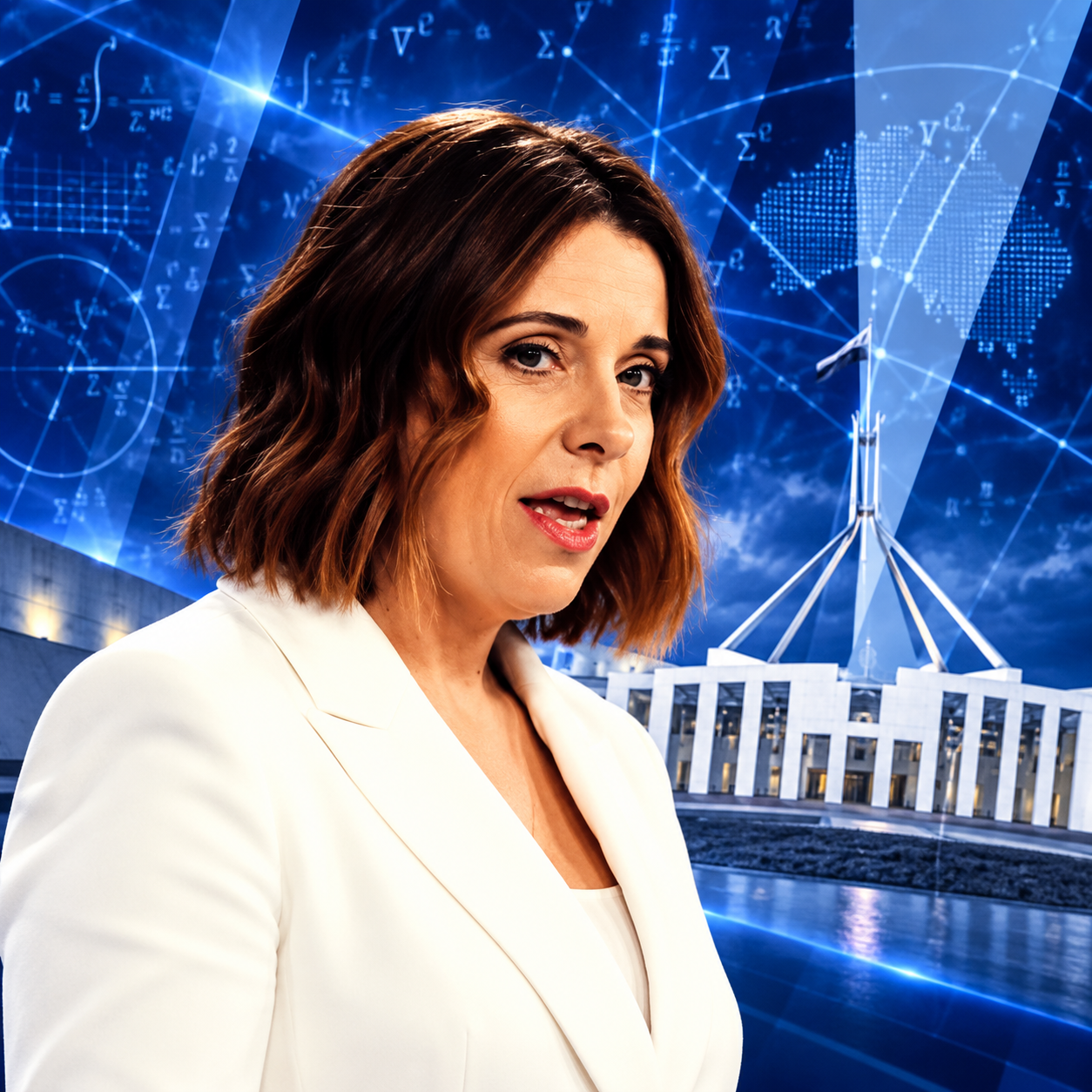
Communications Minister Anika Wells has warned that powerful social media algorithms are increasingly eroding Australians’ trust in politicians and public institutions as the Albanese government prepares a major new attempt to regulate the way online platforms expose users to harmful material.
Wells said her concern had become personal after a recent conversation with a constituent who refused to accept her assurance that claims the woman had encountered online about the government were false.
In an interview with The Saturday Paper, Wells described how she had previously relied on face-to-face conversations with voters to overcome distrust of politics.
She said that approach no longer appeared as reliable as it once had.
“I look you in the eye and I tell you that will never happen in this government and she didn’t believe me,” Wells said of the encounter.
She argued that the influence of online recommendation systems had become powerful enough to challenge traditional institutions and the information they provide.
“The power of the algorithm is so strong that it is overwhelming our public institutions,” Wells said, describing declining trust as a problem extending beyond any single government or political party.
Her remarks come as Labor prepares to release an exposure draft of its long-promised Digital Duty of Care, which would shift greater responsibility for online harms from individual users to the technology companies that design and operate digital platforms.
Trust is falling — but the cause is contested
There is evidence that Australians are increasingly sceptical of their elected representatives.
New research released by the Centre for Policy Development last week found 58 per cent of Australians believed their elected representatives did not serve their interests.
That figure had risen six percentage points since March 2023.
The same survey found only 37 per cent believed elected parliaments were effective at dealing with the country’s major challenges, while 68 per cent thought politics was too focused on short-term gains rather than long-term problems.
Government research has also shown fluctuating confidence in democratic institutions. An Australian Public Service Commission survey earlier this year recorded federal government trust at 45.8 per cent in February, down from 49.8 per cent a month earlier.
None of those results establishes that social media algorithms are the cause of political distrust.
Australians can lose confidence in governments for many reasons, including economic conditions, housing affordability, policy reversals, political scandals, dissatisfaction with public services and perceptions that governments have failed to keep promises.
Algorithms may amplify criticism, misinformation or outrage, but determining how much they contribute to political distrust compared with real-world government performance is much more difficult.
That distinction has become central to the political fight surrounding Labor’s online-safety agenda.
Wells argues that platforms have enormous influence over what Australians encounter and that opaque recommendation systems can repeatedly expose users to harmful, false or inflammatory material.
Critics of Labor’s approach fear that giving government agencies greater authority over online platforms could ultimately influence what political material Australians are able to see.
What Labor’s Digital Duty of Care would do
The proposed Digital Duty of Care has been in development for more than a year and follows a recommendation from the statutory review of Australia’s Online Safety Act.
The government’s May issues paper describes the basic principle as requiring online services to take reasonable steps to prevent foreseeable serious harms.
Rather than relying only on removing individual posts after damage has occurred, the model is intended to make platforms examine risks created by the design of their services.
That could include recommendation systems, addictive features, exposure of children to pornography, grooming risks and other serious or psychosocial harms.
Wells describes the approach as “safety by design”.
She argues that technology companies should face expectations similar to companies selling cars, food, toys and other products in Australia: identify foreseeable dangers before they cause harm and take reasonable measures to reduce them.
“This isn’t about censorship,” Wells said in an interview on Monday.
She said the intention was to require big technology companies to identify risks on their own platforms and mitigate them rather than waiting for governments or users to respond after harm occurred.
For adults, Wells said the government’s focus included illegal online content. For children, the framework would also address serious and psychosocial harms, including exposure to pornography and online grooming.
Australians could get more control over algorithms
One of the most significant elements under consideration would give users greater control over algorithmically recommended feeds.
Most major social media platforms currently decide much of what a user sees through automated recommendation systems that analyse behaviour such as clicks, viewing time, likes, shares, searches and previous interactions.
Those systems can be useful.
They can introduce people to local businesses, news, entertainment and communities they would never have discovered by simply viewing posts chronologically from accounts they already follow.
But the same systems have been criticised for promoting content that generates strong emotional reactions because outrage, fear or controversy can keep users engaged for longer.
Labor is considering requiring platforms to offer Australians a meaningful choice about whether they use those recommendation systems.
Exactly how that choice will operate has not yet been settled.
Asked on Monday whether the government favoured an opt-in system, in which users would have to actively choose algorithmic recommendations, or an opt-out system, where they would receive them by default but could switch them off, Wells said the government was still working through the model.
“We want Australians to make that choice and we want social media companies to respect that choice,” she said.
She also acknowledged that many Australians enjoy and value personalised feeds and may choose to keep them.
The government’s concern is therefore not necessarily to abolish algorithms but to prevent technology companies from having complete control over whether and how those systems operate for each user.
The Greens want Labor to go further
The Greens have been campaigning for an opt-in approach.
In April, Greens communications spokeswoman Sarah Hanson-Young introduced the Online Safety Amendment (Fix Our Feeds) Bill, seeking both a digital duty of care and stronger user control over algorithmic feeds.
The Greens argue recommendation systems are at the core of social media companies’ commercial models and can promote extreme or addictive material because maximising engagement increases advertising revenue.
They want Australians to make an affirmative choice before a platform places them into an algorithmically curated feed.
That position could become important if Labor needs Greens votes to pass its legislation through the Senate.
Wells has not committed to the Greens’ preferred design and said technical questions would need to be resolved after the exposure draft was released.
Coalition warns of censorship risk
The Coalition is approaching the plan from the opposite direction.
Opposition Leader Angus Taylor has said he is “deeply sceptical” of the government’s proposals and fears the framework could become a mechanism for censorship.
Taylor has also acknowledged that the final legislation has not yet been released.
That means key questions about ministerial discretion, the powers of the eSafety Commissioner and the legal definition of relevant harms cannot yet be conclusively answered.
Whether the legislation ultimately regulates particular political views, or primarily regulates platform systems and clearly defined categories of harmful content, will depend on the text of the exposure draft and the amendments eventually presented to Parliament.
Labor maintains the target is platform behaviour rather than political opinion.
Wells has said all relevant laws will face parliamentary scrutiny and has rejected claims that ministers intend to decide whether ordinary criticism of the government can appear in people’s feeds.
The $100 million fine needs an important distinction
The government is pursuing several online-safety reforms at the same time, which has created confusion about the penalties involved.
A separate bill already before Parliament would strengthen enforcement of Australia’s social media minimum-age regime, which requires covered platforms to take reasonable steps to prevent children under 16 from holding accounts.
That legislation proposes doubling the maximum civil penalty to 60,000 penalty units.
At current penalty-unit values, the maximum for a corporation is approximately $109 million.
Those penalties relate to breaches of the under-16 regime and associated age-verification obligations.
The Digital Duty of Care is a separate reform.
Wells has said technology companies breaching the future duty will face significant financial penalties comparable with those available under major Australian consumer laws.
But as of Monday morning, the exposure draft had not been released and the minister had not publicly confirmed the final maximum corporate fine.
It is therefore premature to say that any occasion on which an algorithm directs a user towards harmful material would automatically expose a company to a $100 million penalty.
The eventual legislation will need to set out the duty, threshold for breach, available enforcement action and how penalties are calculated.
A separate fight over the under-16 social media law
Labor is simultaneously pressing Parliament to approve stronger powers for the eSafety Commissioner to enforce Australia’s social media minimum age.
That regime began operating in December 2025.
The government says millions of under-16 accounts have since been removed, restricted or deactivated, but critics and parents continue to report that young people can find ways around platform controls.
Wells said on Monday that five investigations were underway and accused both the Coalition and Greens of delaying amendments that would give the eSafety Commissioner stronger information-gathering and enforcement powers.
The Greens have criticised the age-ban model itself and argue that making platforms safer for all users would be more effective than concentrating primarily on keeping teenagers off them.
The Coalition has also questioned the effectiveness of implementation while maintaining that parents should have greater control.
A much bigger argument about who controls the public conversation
Behind the technical debate is a broader political question.
Social media platforms now play a central role in Australian political communication. They determine which speeches, news stories, campaign videos, advertisements, rumours and commentary appear in front of millions of voters every day.
The companies operating those platforms are private businesses, but their algorithms increasingly perform a function once partly controlled by newspaper editors, television producers and other traditional media gatekeepers.
Wells argues that this gives a small number of technology companies extraordinary influence over public discourse without the democratic accountability imposed on governments.
Her critics counter that government regulation can create its own risks if politicians or regulators gain too much influence over online speech.
Both concerns can exist at the same time.
Algorithms can amplify misleading or harmful content without that meaning every criticism of government is misinformation. Governments can legitimately regulate serious online harms without receiving an unrestricted power to determine which political ideas Australians encounter.
The test for Labor’s legislation will be whether it can draw that boundary clearly.
Wells’ comments about voters no longer believing politicians provide a striking illustration of why the government believes reform is urgent.
They do not, by themselves, prove that algorithms caused the loss of trust.
When the exposure draft is released, Parliament will have to decide whether Labor’s solution gives Australians genuine control over powerful digital systems — or gives government too much control over the online environment in which political debate now occurs.