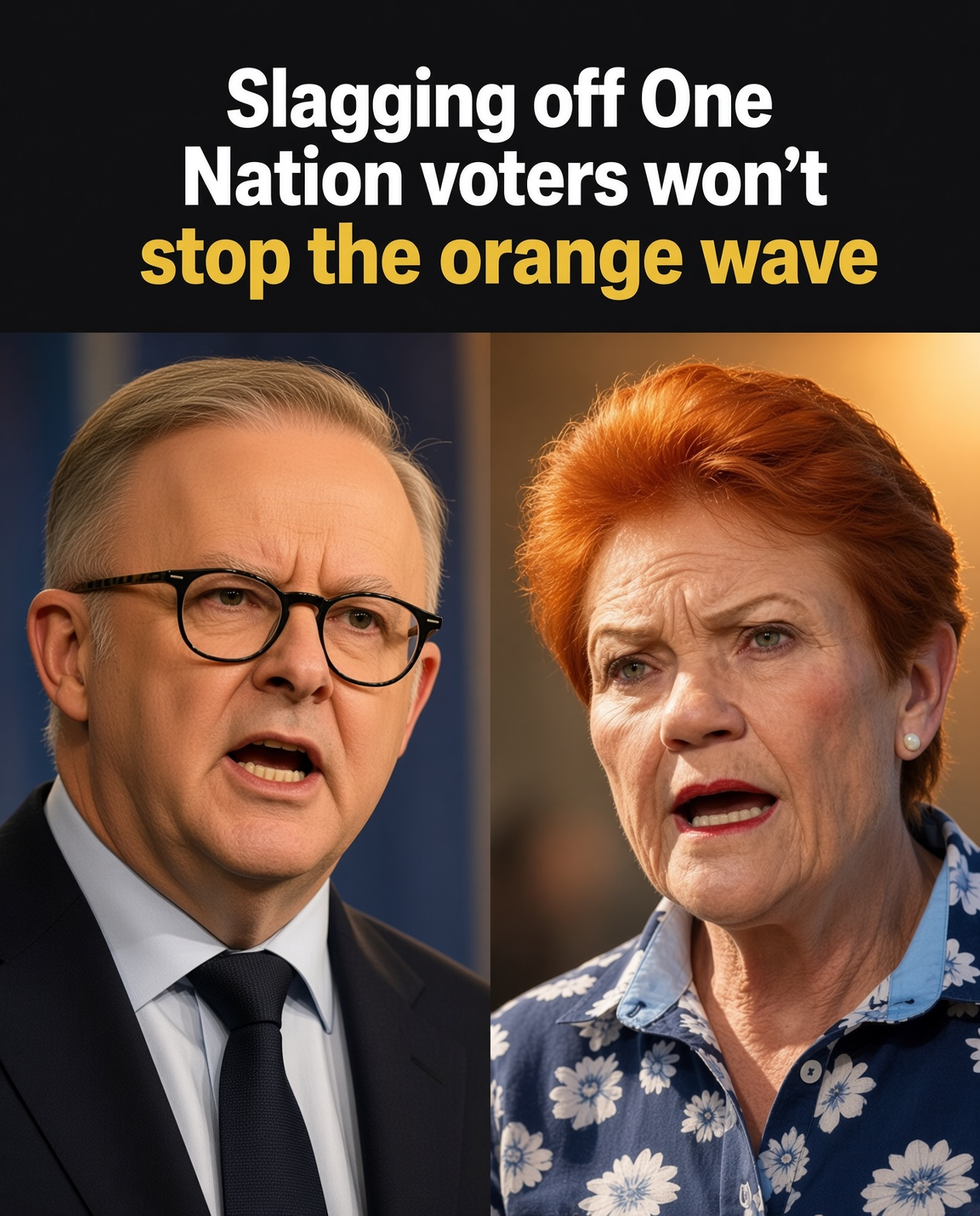
Pauline Hanson’s extraordinary political resurgence has left Labor and the Coalition facing a problem neither can solve simply by attacking One Nation: millions of Australians are now telling pollsters they are prepared to vote for the party, and recent election results suggest at least part of that support is hardening into something more durable than a protest.
The latest Newspoll has One Nation on 30 per cent of the national primary vote, narrowly ahead of Labor on 29 per cent and an extraordinary 11 percentage points ahead of the Coalition on 19 per cent.
It is a result that would have been almost unimaginable only a few years ago.
But one widely repeated description of the poll needs qualification.
Nearly six million Australians were not individually surveyed and asked whether they would vote One Nation. The Newspoll interviewed 1,243 voters between August 24 and 28 and produced an estimated national primary vote of 30 per cent.
Australia had about 18.37 million people enrolled to vote at the end of June and an estimated 18.79 million eligible electors. Applying a 30 per cent polling result across those populations gives a rough equivalent of about 5.5 million enrolled voters, or 5.6 million eligible Australians.
That is the origin of the “nearly six million” figure.
It is a useful way of illustrating the scale of One Nation’s support, but it remains an extrapolation from an opinion poll rather than a count of six million declared supporters.
There is another reason for caution.
Newspoll is not the only national survey being conducted.
A RedBridge/Accent poll completed on the same date had One Nation on 28 per cent. YouGov recorded 26 per cent four days earlier. Roy Morgan’s polling at the end of August put the party lower again, at 23.5 per cent.
The exact level of support therefore remains uncertain.
What is much harder to dispute is the broader trend: One Nation is attracting a level of support that can no longer be dismissed as a temporary fringe phenomenon.
And unlike polling alone, election results are beginning to demonstrate that shift in actual ballot boxes.
At the Secret Harbour by-election in Western Australia on August 29, One Nation’s Luke Herdegen won a seat drawn largely from territory Labor had controlled for decades.
With 79 per cent of the count processed in the latest ABC tally, Herdegen had secured 39.1 per cent of first preferences against Labor candidate Georgia Tree’s 24.1 per cent.
After preferences, One Nation led Labor by 57.2 to 42.8 per cent, with an 18.8 percentage-point swing away from Labor on the final count.
The Liberals managed only 17.2 per cent of first preferences.
That result matters because it demonstrates the threat facing both sides of mainstream politics.
Labor lost a working-family electorate that should once have been among its strongest territory. The Liberals failed to become the natural destination for voters abandoning Labor.
One Nation took the opportunity instead.
Secret Harbour is also the type of electorate strategists across the country will now be examining closely.
It contains young working families, large numbers of voters with vocational rather than university qualifications and outer-suburban communities dealing with housing, migration, household costs and pressure on infrastructure.
Those characteristics can be found in marginal and traditionally safe seats across Queensland, New South Wales, Victoria and Western Australia.
The political question is no longer simply why Hanson appeals in traditionally conservative rural communities.
It is whether One Nation can establish itself in working-class outer suburbs that previously moved primarily between Labor and the Coalition.
That possibility explains the dramatically different responses coming from Anthony Albanese and Opposition Leader Angus Taylor.
Albanese has chosen a direct ideological confrontation.
Addressing the Queensland Labor State Conference in Brisbane on August 30, the Prime Minister warned that “hard right populists” were advancing around the world and accused them of promoting politics that was dangerous, divisive and dishonest.
“We simply must defeat them,” Albanese told Labor delegates.
He specifically named One Nation, accusing the party of bending facts, spreading misinformation and turning Australians against one another.
The Prime Minister’s argument was not that One Nation voters themselves were dangerous.
His attack was directed at the party and its political strategy.
That distinction is important, particularly given claims from Hanson and commentators that Labor is insulting Australians simply because they support One Nation.
There is no evidence Albanese told One Nation voters they were stupid, racist or unworthy of being heard.
But politics is not decided solely by the literal wording of a speech.
If voters already believe the political establishment does not respect them, attacks on the party they have chosen can easily be interpreted as attacks on their judgment as well.
That is the political risk highlighted by critics including News Corp columnist Samantha Maiden.
Her argument is that describing One Nation as dangerous will not automatically persuade its supporters to return to Labor or the Coalition. In some cases, it may reinforce the very anti-establishment sentiment that drove them to Hanson.
Taylor has adopted a noticeably different tone.
Asked what lessons he drew from the Secret Harbour result, the Liberal leader said no side of politics was immune from voter “anger and frustration”.
“We have to respect the voters’ anger and frustration,” Taylor said.
It is an understandable strategy for a Coalition whose immediate electoral danger may be even greater than Labor’s.
At 19 per cent in Newspoll, the Coalition is not merely competing against One Nation for preferences. It is polling well behind Hanson’s party on first preferences.
The distinction matters because the Coalition traditionally relied on being the dominant centre-right force, with minor conservative parties operating around its edges.
That hierarchy is now being challenged.
The response has already begun to influence policy competition.
On illicit tobacco, for example, both One Nation and the Coalition are advocating dramatic reductions in tobacco excise as part of efforts to undercut organised crime’s illegal cigarette market.
The Coalition has proposed an 80 per cent reduction, while One Nation has advanced its own 75 per cent cut alongside a freeze on indexation.
Taylor has attacked One Nation’s version as insufficiently developed and argued the Coalition has produced a more detailed plan.
That is a very different strategy from simply declaring Hanson unacceptable.
It attempts to compete with One Nation on the issues motivating its voters while arguing that the Coalition is better equipped to govern.
Labor faces another challenge.
Some of One Nation’s strongest themes — housing pressure, migration, energy prices, distrust of institutions and frustration among regional and working-class voters — overlap with constituencies that were historically important to Labor.
Recent research suggests the appeal is increasingly rooted in something deeper than dissatisfaction with an individual government.
The Australia Project 2026 found 79 per cent of respondents believed society was stacked against ordinary people, compared with 58 per cent in the previous year.
Sixty-five per cent said they felt they could not get ahead no matter how hard they worked.
In the same study, Hanson recorded a higher trust result than Albanese and Taylor, although the researchers emphasised that trust was not the same as voting intention.
Separate new research focused specifically on One Nation voters points to an electorate that may also be becoming more committed.
A survey of 1,014 One Nation supporters reported that 52 per cent described themselves as absolutely certain to vote for the party again, while another 26 per cent regarded their support as firm.
An overwhelming majority said Hanson articulated what many Australians were thinking and defended ordinary people.
That presents an uncomfortable reality for those waiting for One Nation support simply to collapse.
Some voters are certainly protesting against Labor or the Coalition and could move again before the next federal election.
But others increasingly appear to identify positively with One Nation rather than merely using it as a temporary vehicle for anger.
That does not mean current polling can be converted directly into parliamentary seats.
Australia uses preferential voting in the House of Representatives, and a nationwide primary-vote percentage says little about exactly where those votes are concentrated.
A party can win a large national vote yet perform poorly in seat terms if its support is spread inefficiently across electorates.
One Nation also needs candidates, campaign organisations, volunteers, funding and disciplined preference strategies across a much larger number of seats than it has historically contested seriously.
The Newspoll itself demonstrates the limits of interpreting a 30 per cent primary vote as a straightforward path to government.
Albanese continues to outperform Hanson when voters are asked who they prefer as national leader, and Labor remains competitive after preferences under several current polling models.
Support for One Nation is also volatile between pollsters.
Those are significant obstacles.
But none of them makes the political problem disappear for the major parties.
For Labor, the danger is treating every One Nation voter primarily as someone who needs to be warned about Pauline Hanson.
For the Coalition, the danger is responding by adopting so much of One Nation’s agenda that voters conclude they may as well support the original.
Both parties need to understand what sits beneath the numbers.
A voter worried about immigration may also be worried about whether infrastructure and housing construction can keep pace with population growth.
A voter angry about renewable energy may be thinking about electricity bills, the value of farmland or the future of a regional job.
A renter supporting One Nation may be motivated by housing affordability rather than traditional conservative politics.
A former Liberal voter may believe the Coalition has abandoned issues important to them. A former Labor voter may feel the party no longer represents the working class they identify with.
None of those concerns requires the major parties to agree with One Nation’s proposed solutions.
But dismissing the concerns themselves is politically dangerous.
That may be the most important lesson from Secret Harbour.
Labor once held the territory comfortably. The Liberals believed disaffected Labor voters would naturally move towards them. One Nation demonstrated that both assumptions could fail simultaneously.
The phrase “orange wave” may prove exaggerated if current polling retreats before the next federal election.
But the voters behind it are real.
The party that best understands why they are moving — rather than simply telling them why their choice is wrong — is likely to be in the strongest position when Australia next goes to the polls.