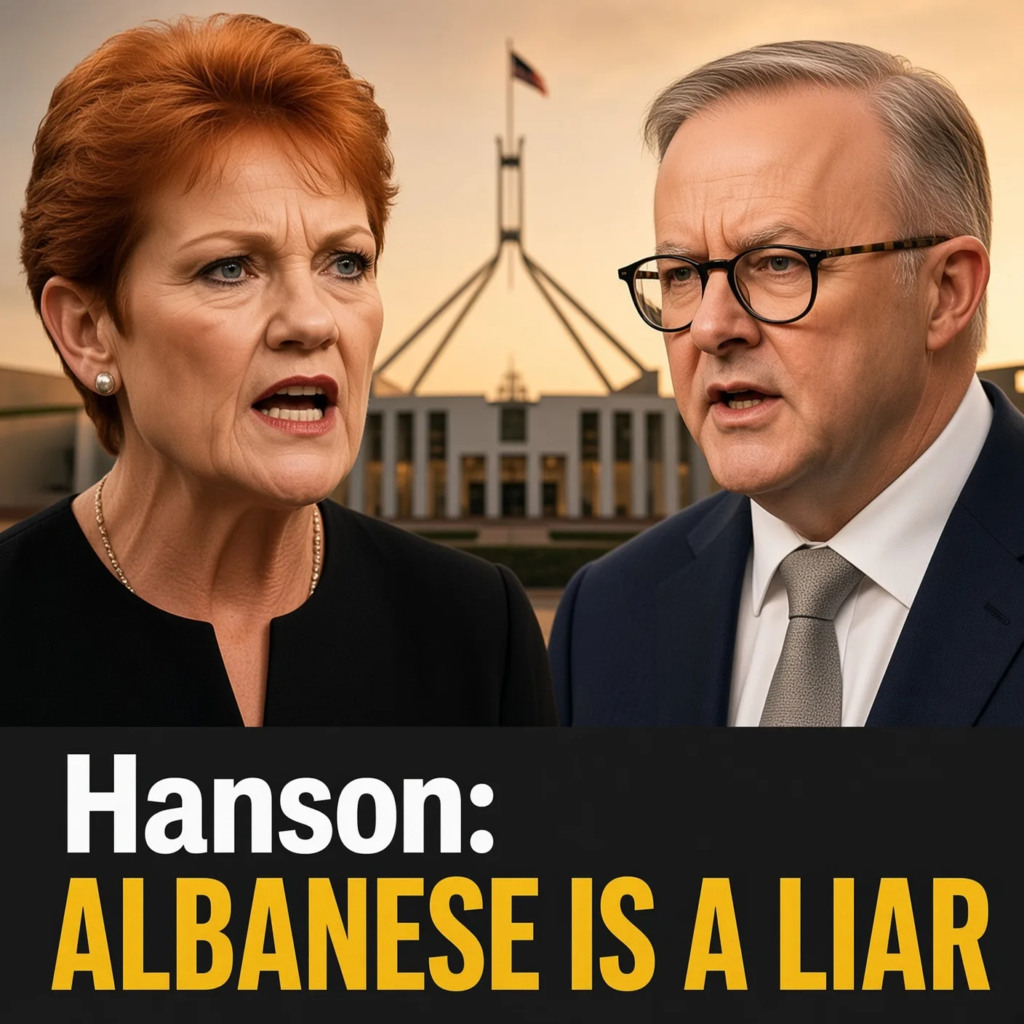
Pauline Hanson has turned Anthony Albanese’s latest attack on One Nation back on the Prime Minister, accusing him of hypocrisy over misinformation and warning that Australia must not give governments excessive power over what people can see, say and share online.
The clash follows an unusually forceful speech by Albanese to the Queensland Labor Conference in Brisbane, where he urged party members to confront the rise of hard-right populist movements and accused them of building political support through division and misinformation.
“Peddling politics that is dangerous, divisive, and downright dishonest,” Albanese told delegates.
He said such movements would “say anything and do anything to win votes”, bend facts, spread misinformation and disinformation and turn Australians against one another.
He then explicitly named One Nation among the parties he said offered no serious answers to the problems facing the country.
Hanson responded with a direct attack on Albanese’s own credibility, arguing the Prime Minister had no standing to lecture Australians about misinformation when, in her view, Labor repeatedly painted an unrealistically positive picture of economic conditions while households were struggling with mortgages, rent, food and other essential costs.
She also revived a long-running argument over online regulation, warning that measures designed to deal with harmful content could ultimately give governments and regulators too much influence over political speech.
The dispute is politically potent because it combines three issues that are already driving Australian politics: distrust of government, cost-of-living pressure and uncertainty over how far the state should go in regulating large technology platforms.
But the competing claims also require some important distinctions.
Albanese did accuse One Nation and other populist movements of misinformation. Hanson did accuse him of dishonesty and excessive regulation. Australians are still facing substantial cost pressures.
However, the controversial federal misinformation bill that dominated the free-speech debate in 2024 is no longer before Parliament, and the online-safety reforms now being developed by the government are not the same legislation.
What Albanese actually said about One Nation
Albanese’s remarks came during his August 30 address to the Queensland Labor conference.
In a section of the speech devoted to the international growth of hard-right populist movements, the Prime Minister said Labor had a responsibility to defeat political forces he described as dangerous, divisive and dishonest.
He accused them of bending facts and promoting misinformation and disinformation in pursuit of votes.
“We simply must defeat them. We owe it to history,” Albanese said.
The rhetoric was unmistakably political. It was delivered to Labor members at a party conference, not as a neutral government assessment of whether individual One Nation statements had met a specific legal definition of misinformation.
The speech came at a particularly sensitive moment for Labor.
One Nation has enjoyed a sharp improvement in polling and recently won the Western Australian state seat of Secret Harbour in a by-election that produced a dramatic fall in Labor’s primary vote.
The result has intensified debate inside both Labor and the Coalition over whether voters who feel ignored by the major parties are becoming increasingly willing to support Hanson’s movement.
For Albanese, the political response has been to draw a sharp ideological line. For Hanson, the answer has been to portray Labor’s language as proof that the government is trying to delegitimise voters who reject its policies.
Hanson says Albanese should look at his own record
Hanson’s counterattack focuses heavily on economic credibility.
She argues that Australians struggling with repayments, rents and supermarket bills are entitled to question optimistic statements from the government about the condition of the economy.
Her broader accusation is that Albanese applies the label of misinformation to political opponents while using selective economic statistics himself.
Calling the Prime Minister a liar is Hanson’s political judgement, rather than an independently established fact.
The latest economic figures illustrate why both sides can construct very different narratives from the same country.
Australia’s economy expanded by 0.4 per cent in the June quarter and 2.1 per cent over the year, according to the Australian Bureau of Statistics. Treasurer Jim Chalmers described the figures as evidence of resilience in difficult global conditions, pointing to private-sector growth, business investment and stronger household incomes.
Those are genuine positive indicators.
But they exist alongside significant household pressure.
Annual inflation was still running at 3.5 per cent in July. Housing costs were 5 per cent higher than a year earlier, rents were up 3.6 per cent and food and non-alcoholic beverages were 3.2 per cent higher.
The unemployment rate was 4.5 per cent in July.
Most importantly for mortgaged households, the Reserve Bank’s cash rate stood at 4.35 per cent in August after three increases earlier in 2026.
The RBA has said financial conditions remain restrictive and scheduled mortgage repayments are relatively high as a share of household disposable income.
ABS living-cost data paints an equally complicated picture.
Depending on household type, living costs rose between 3.7 and 4.7 per cent in the year to the June quarter. Employee households experienced a 1.5 per cent increase in living costs in just three months, driven largely by an 8.2 per cent rise in mortgage interest charges during the quarter.
Food and housing were also among the largest contributors across household groups.
It therefore would be misleading to claim Australia’s economy is collapsing simply because households are under pressure. It would be equally misleading to treat positive GDP growth as evidence that the cost-of-living problem has disappeared.
Both conditions can be true at once: national output can grow while individual households feel financially worse off.
The crucial misinformation-law distinction
The second part of Hanson’s argument requires an even more important clarification.
Australia did have a highly controversial piece of legislation specifically aimed at misinformation and disinformation.
The Communications Legislation Amendment (Combatting Misinformation and Disinformation) Bill 2024 would have imposed obligations on major digital communications platforms dealing with information considered reasonably verifiable as false, misleading or deceptive and reasonably likely to contribute to specified serious harms.
It would also have expanded the compliance and enforcement powers of the Australian Communications and Media Authority.
The proposal drew extensive criticism over freedom of speech, the scope of its definitions and the danger of legitimate political or scientific debate being affected by regulatory pressure.
The Senate inquiry received more than 100 public submissions, many raising censorship and free-expression concerns.
But the legislation did not become law.
After it became clear the government did not have sufficient Senate support, the bill was discharged from the Senate notice paper on November 25, 2024.
Parliament currently records its status as “Not Proceeding”.
That matters because public debate can easily blur the abandoned 2024 proposal with the different online-safety reforms now under development.
There is currently no federal law descended from that bill that simply empowers the government to determine whether ordinary political opinions are true or false and then decide what Australians are allowed to say.
What the government is doing now
The Albanese government has not abandoned broader regulation of large digital platforms.
In April this year, it formally responded to an independent review of the Online Safety Act and committed to introducing a Digital Duty of Care.
The concept is designed to shift greater responsibility onto online services to identify foreseeable risks and take reasonable steps to prevent serious harms arising from their systems and products.
The government’s May 2026 framework document says providers could be required to conduct risk assessments, put mitigation systems in place and build safety-by-design principles into their services.
The stated model is focused on platform systems and foreseeable harm rather than recreating the precise misinformation framework proposed in 2024.
The government has also said the framework should include protection for freedom of expression and minimise unnecessary regulatory complexity.
Nevertheless, critics are entitled to examine how broad concepts such as “harm” are ultimately defined.
The final legal drafting will determine how much discretion regulators and platforms receive and whether requirements could indirectly encourage companies to remove lawful material to minimise regulatory risk.
That is a legitimate free-speech debate.
But at this stage, presenting the Digital Duty of Care as already giving ministers a general power to decide which political claims Australians are permitted to see or share would go beyond what the published framework establishes.
An exposure draft of the broader duty-of-care legislation has been expected during 2026, meaning scrutiny will intensify once the precise text is publicly available.
Online safety powers are still expanding in other areas
There are separate online-safety changes already before Parliament.
The government’s 2026 legislation strengthening enforcement of the social-media minimum-age regime would expand information-gathering powers available to the eSafety Commissioner and increase potential civil penalties for platforms that fail to comply with requirements covering users under 16.
That bill is before the Senate.
Again, it is not a general misinformation law.
The distinction is important because debates about social media regulation now encompass several different issues: child access, algorithmic recommendations, harmful material, privacy, platform accountability and misinformation.
Combining them all under the label of “government censorship” can obscure what individual laws actually do.
Why authoritarian comparisons are powerful — and problematic
Hanson has compared government control over information with censorship systems used in countries including China, Iran, Russia, Pakistan, Saudi Arabia and Myanmar.
Those comparisons are rhetorically powerful because each of those states has faced serious criticism over restrictions on expression or state control of information.
But Australia’s constitutional system, independent courts, parliamentary process and judicial review are fundamentally different.
In countries such as Myanmar, authorities have proposed or used laws allowing punishment for vaguely defined misinformation and content deemed harmful to the state, alongside broader restrictions on political dissent.
Australia’s proposed digital regulation must still pass Parliament and remains subject to constitutional limitations and judicial challenge.
That does not mean regulatory overreach is impossible in Australia.
Indeed, the controversy surrounding the abandoned 2024 bill demonstrates why precise definitions, proportionality and independent scrutiny matter.
It does mean that equating any regulation of social platforms with authoritarian censorship is too broad to describe the legal position accurately.
Who decides what counts as misinformation?
Beneath the political insults sits a difficult democratic problem that neither side can resolve with a slogan.
Modern digital platforms can distribute false information to millions of people faster than traditional institutions can correct it.
Artificial intelligence, bots and highly personalised recommendation algorithms make manipulation increasingly cheap and scalable.
At the same time, governments are themselves political actors.
Giving state institutions overly broad authority to determine disputed truth creates obvious risks, particularly in areas such as elections, public policy, scientific debate and criticism of those in power.
The challenge is therefore to address demonstrably harmful manipulation without allowing governments or technology companies to become unquestionable arbiters of legitimate political discussion.
Australia has already experienced that tension with the 2024 misinformation legislation.
The government argued stronger platform accountability was needed. Critics argued the definitions and enforcement structure created an unacceptable danger to lawful speech.
Ultimately, the bill failed politically.
The next test will be whether the Digital Duty of Care can avoid repeating those controversies while still addressing genuine online harm.
A political argument built for the next election
For Hanson, the fight is larger than one piece of legislation.
Her message is aimed at voters who believe established political institutions increasingly dismiss dissenting views as misinformation, extremism or populism.
For Albanese, One Nation’s growing popularity presents a different risk: a political movement he argues prospers by turning frustration into division while offering simplistic solutions to complex problems.
Both are now accusing the other side of dishonesty.
The evidence does not support a simple verdict that one politician is telling the truth about everything while the other is lying about everything.
Australia’s economy is growing, but households remain under significant pressure. Misinformation is a genuine challenge, but poorly designed regulation can threaten legitimate speech. The government is pursuing stronger digital regulation, but its abandoned 2024 misinformation bill is not currently law.
Those distinctions matter precisely because the argument is about truth.
As the political contest between Labor and One Nation becomes increasingly bitter, Australians will have to judge the competing claims on their details rather than their slogans — including claims made by politicians who insist everyone else is misleading them.