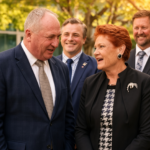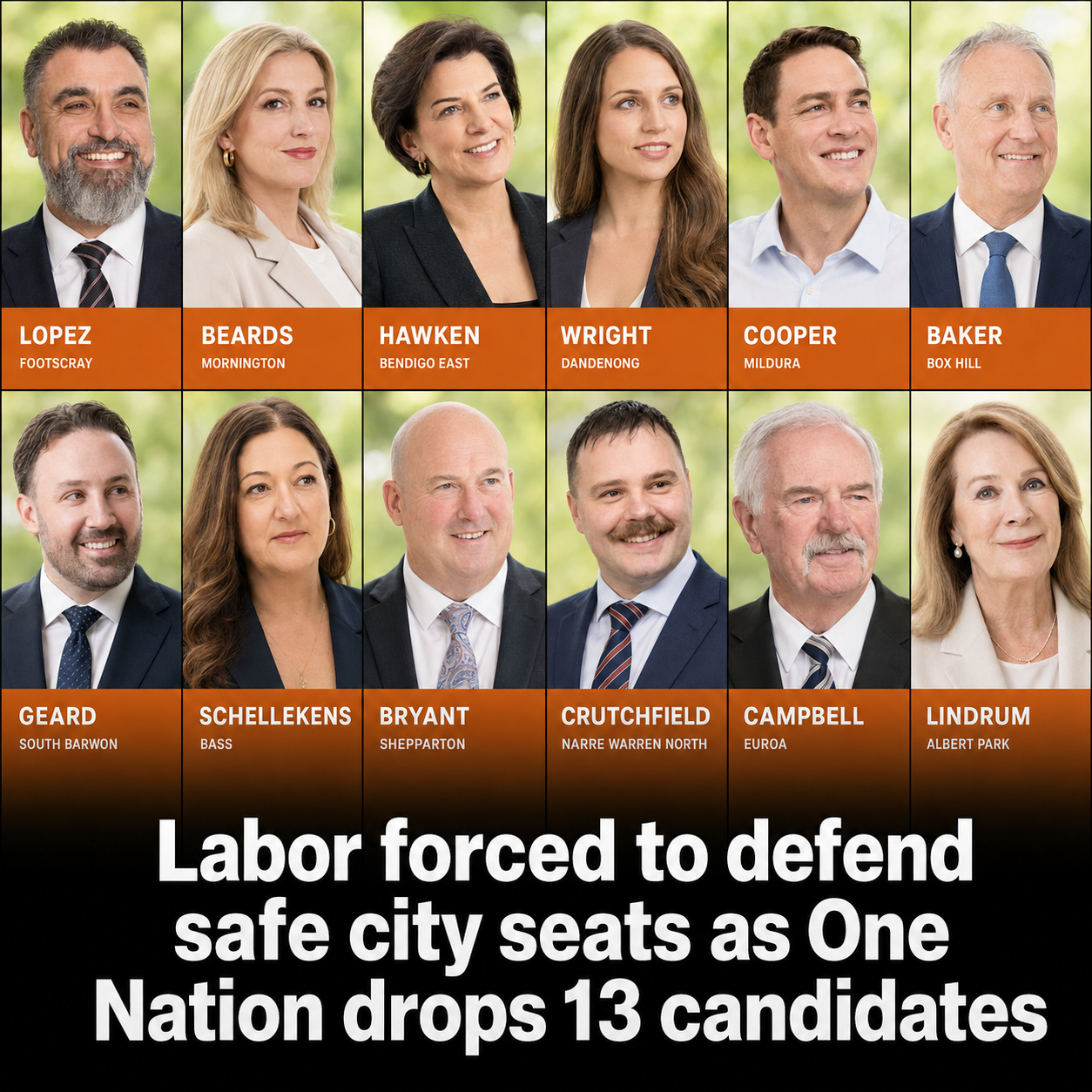
One Nation has announced another 13 candidates for Victoria’s November state election, taking its publicly endorsed lower-house team to 29 as the party attempts to convert a surge in polling support into a serious statewide campaign.
The latest group stretches from tightly held regional and outer-suburban electorates to some of Labor’s traditionally stronger metropolitan territory, but the slate is broader than a simple assault on the government.
Eight of the 13 seats are currently held by Labor, while three are held by the Nationals, one by the Liberals and one by the Greens.
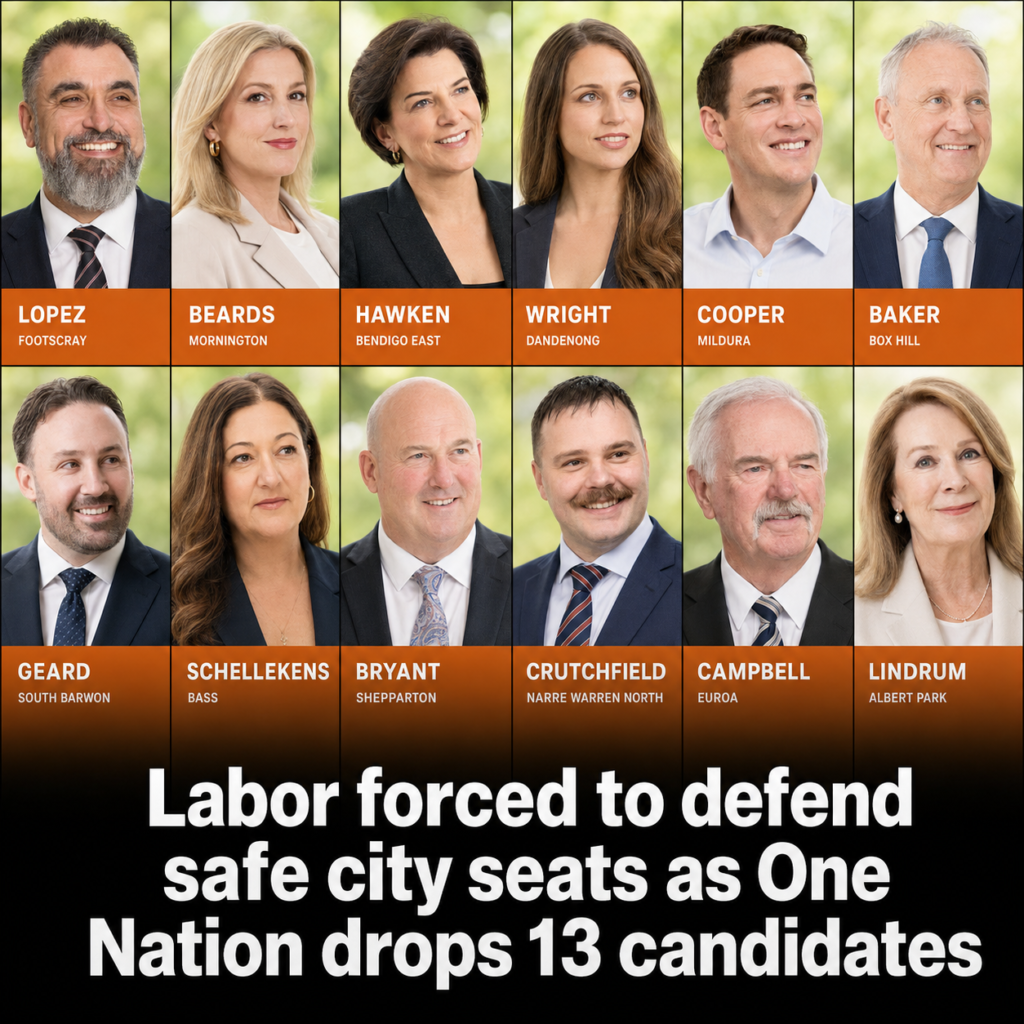
The new endorsements are Guy Cooper in Mildura, Ashli Beards in Mornington, Glenda Wright in Dandenong, Cheryl Hawken in Bendigo East, Phillip Bryant in Shepparton, Nikole Schellekens in Bass, Josh Geard in South Barwon, Steve Campbell in Euroa, Harrison Rindfleish in Richmond, Jamie Baker in Box Hill, Alexander Lopez in Footscray, Sebastian Crutchfield in Narre Warren North and Tammy Lindrum in Albert Park.
One Nation’s official candidate profiles emphasise that most are political newcomers drawn from farming, business, construction, law, community services, health administration and the defence force rather than existing parliamentary careers.
The backgrounds form an important part of the party’s campaign pitch.
Schellekens, contesting Bass, is described by One Nation as a farmer, mental-health social worker and small-business owner with more than 20 years of experience across mental health, education and community services.
She lives on a multi-generational beef farm within the electorate and has been campaigning on infrastructure, housing, healthcare and the protection of farmland as population growth continues through Melbourne’s south-east.
Bass is by far the most obvious target in the new group if the 2022 result is used as the starting point.
Labor’s Jordan Crugnale retained the seat against Liberal Aaron Brown by just 202 votes after preferences.
Crugnale finished with 20,803 votes to Brown’s 20,601, equivalent to 50.24 per cent against 49.76 per cent.
That made Bass the most marginal district in Victoria following the 2022 election.
The contest will look different this year.
Labor, Liberal, the Greens, One Nation and other parties are fielding new combinations of candidates, meaning the previous Labor-Liberal margin cannot simply be treated as the number One Nation itself must overturn.
Preferences and the distribution of primary votes can radically change the final two-candidate contest.
That is particularly important when a third party enters an electorate with substantially higher statewide support than it had at the previous election.
One Nation barely contested Victoria’s lower house in 2022.
Its current campaign is on an entirely different scale.
A Victoria-wide Roy Morgan poll conducted from August 5 to 7 placed Labor and the Liberal-National Coalition level on 26 per cent primary support, with One Nation close behind on 23.5 per cent.
That poll should not be read as a seat forecast, but it explains why the party is now investing in electorates that would once have been regarded as implausible targets.
Mornington provides another example of a highly competitive seat, although it is Liberal-held rather than Labor-held.
Chris Crewther won the electorate in 2022 after an unusually strong independent challenge from Kate Lardner.
After preferences, Crewther received 21,326 votes to Lardner’s 20,736 — a margin of 590 votes, or 0.7 percentage points above the 50 per cent line.
One Nation has endorsed practising lawyer Ashli Beards, a Mornington Peninsula resident of more than 14 years.
Her party profile focuses on crime, housing affordability, homelessness and government accountability.
Mildura was another knife-edge non-major-party contest in 2022.
Nationals candidate Jade Benham defeated independent Ali Cupper by 19,520 votes to 18,620 after preferences, a difference of 900 votes.
One Nation’s Guy Cooper enters that race with a background in agribusiness banking and a campaign calling for a new regional hospital, tougher responses to crime and relief from cost-of-living pressure.
Those results illustrate why the latest candidate rollout cannot accurately be described simply as One Nation forcing Labor to defend its safest seats.
The party is simultaneously trying to take votes from Labor, the Coalition, the Greens and independents.
That broad strategy is consistent with Pauline Hanson’s claim in July that One Nation had prospective candidates lined up for roughly 74 to 76 of Victoria’s 88 lower-house electorates.
The party’s public candidate list has not yet reached that number, but the latest additions take the confirmed lower-house endorsements to 29.
One Nation has also announced candidates across all eight Legislative Council regions.
Its existing Victorian parliamentary presence comes from upper-house MP Rikkie-Lee Tyrrell, who was elected to Northern Victoria Region in 2022.
Bendigo East will attract particular attention because of the collapse of Jacinta Allan’s premiership less than four months before polling day.
Allan stepped aside as Labor leader and Premier on July 28 after being told she had lost the support of colleagues in caucus.
Ben Carroll was elected unanimously as Labor leader and became Victoria’s 50th Premier.
Allan subsequently announced on August 14 that she would not contest the November election, ending a parliamentary career that began in 1999.
She remains the sitting member for Bendigo East until the election.
The distinction matters because the electorate is not presently vacant.
Instead, it will be an open contest in November without Allan seeking another term.
In 2022, Allan received 48.3 per cent of the primary vote in Bendigo East.
One Nation’s Ben Mihail received 5.7 per cent.
The party has now replaced him with cattle farmer Cheryl Hawken, whose profile describes experience as a single parent, carer, small-business owner, dairy farmer and administrator.
Hawken is campaigning on hospitals, roads, schools, state debt and government accountability.
The Nationals have also been campaigning heavily in Bendigo East after Allan’s decision to leave politics, making the seat one of the more unpredictable regional contests heading towards November.
Labor-held South Barwon is another electorate where One Nation is attempting to turn dissatisfaction with public services into votes.
Labor’s Darren Cheeseman won 59.8 per cent after preferences against Liberal Andrew Katos in 2022, giving Labor a margin of 9.8 per cent.
One Nation candidate Josh Geard says more than two decades working in a corporate capacity across Victoria’s health system gave him direct exposure to pressures within hospitals and health services.
He is campaigning on health, roads, policing and infrastructure in rapidly growing communities including Armstrong Creek and Charlemont.
Claims that Victoria’s health system has simply “collapsed”, however, go beyond the available data.
The latest Victorian Agency for Health Information figures show significant pressure but also continuing high volumes of treatment.
There are about 68,000 patients on the planned-surgery waiting list, while 84.5 per cent of planned surgery patients are being treated within clinically recommended times.
In emergency departments, only about half of patients are leaving within four hours, demonstrating continuing access and flow problems.
Health performance is therefore likely to remain politically potent without requiring the stronger claim that the system is no longer functioning.
Crime is another central theme across the new One Nation profiles.
Victoria experienced a significant increase in recorded offending through 2025.
Crime Statistics Agency data for the year to December 2025 showed 630,592 recorded offences, up 4.2 per cent, while criminal incidents reached their highest level since the agency’s current series began in 2004–05.
The picture became more mixed in the next quarter.
For the year to March 2026, recorded offences fell 0.2 per cent and criminal incidents fell 1 per cent, although alleged-offender incidents increased 8.6 per cent.
That makes crime a legitimate election issue but means descriptions such as “skyrocketing crime” should be treated as political characterisation rather than a complete account of the latest trend.
One Nation’s urban candidates are also entering electorates with sharply different political histories.
Glenda Wright will contest Dandenong, where Labor’s Gabrielle Williams won an outright majority of first preferences in 2022.
Jamie Baker will run in Box Hill, where Labor’s Paul Hamer defeated Liberal Nicole Werner with 57.2 per cent after preferences.
Alexander Lopez is taking on Footscray, where Labor’s Katie Hall defeated Greens candidate Elena Pereyra 54.2 per cent to 45.8 per cent after preferences.
Sebastian Crutchfield will contest Narre Warren North, a seat Labor has held continuously since 2002, while Tammy Lindrum will run in Albert Park against Labor MP Nina Taylor.
Richmond is different again.
It is held by Greens MP Gabrielle de Vietri, who defeated Labor candidate Lauren O’Dwyer 57.3 per cent to 42.7 per cent after preferences in 2022.
One Nation has endorsed law-and-commerce graduate Harrison Rindfleish there.
In regional Victoria, Phillip Bryant will contest Nationals-held Shepparton after a 7.5-year career in the defence force and more than 30 years as a CFA volunteer.
Steve Campbell, a tradesman and former construction-business owner, will run against Nationals MP Annabelle Cleeland in Euroa.
The mix reinforces the party’s attempt to present itself as a challenger to the political establishment generally rather than an appendage of either side of the traditional Labor-Coalition divide.
There is one further procedural qualification to the candidate announcements.
None of these names is formally guaranteed a place on the November ballot simply because a party has endorsed them.
The Victorian Electoral Commission says candidate nominations for the 2026 state election will open on November 4 and close at noon on November 9.
Registered political parties will lodge their endorsed nominations directly with the VEC during that period.
Until then, the 29 names on One Nation’s public list are party-endorsed candidates rather than formally nominated candidates certified for the ballot.
The election itself will be held on Saturday, November 28.
For One Nation, the challenge between now and then is substantially greater than simply announcing enough candidates.
Statewide polling does not translate evenly into electorates, and a party with limited local infrastructure must still recruit volunteers, raise money, staff booths, organise preference strategies and build recognition for candidates who are mostly unknown outside their communities.
Labor, meanwhile, is approaching the election under a Premier who took office only four months before polling day, while the Liberals and Nationals face their own pressure from One Nation on the right.
That makes the 13-candidate announcement significant even where One Nation is unlikely to win.
A primary vote large enough to alter the order of elimination can change who reaches the final preference count and which major party ultimately takes a seat.
Bass, Mornington and Mildura show how small the final margins can become.
Bendigo East shows how quickly a supposedly secure political landscape can change when an incumbent leaves and a government changes leader.
The November election will determine whether One Nation’s polling surge becomes actual lower-house representation or whether its expanded candidate slate primarily reshapes preference flows between Labor, the Coalition, the Greens and independents.
For now, one thing is clear: the party is preparing to contest Victoria on a scale far beyond anything it attempted at the 2022 state election.