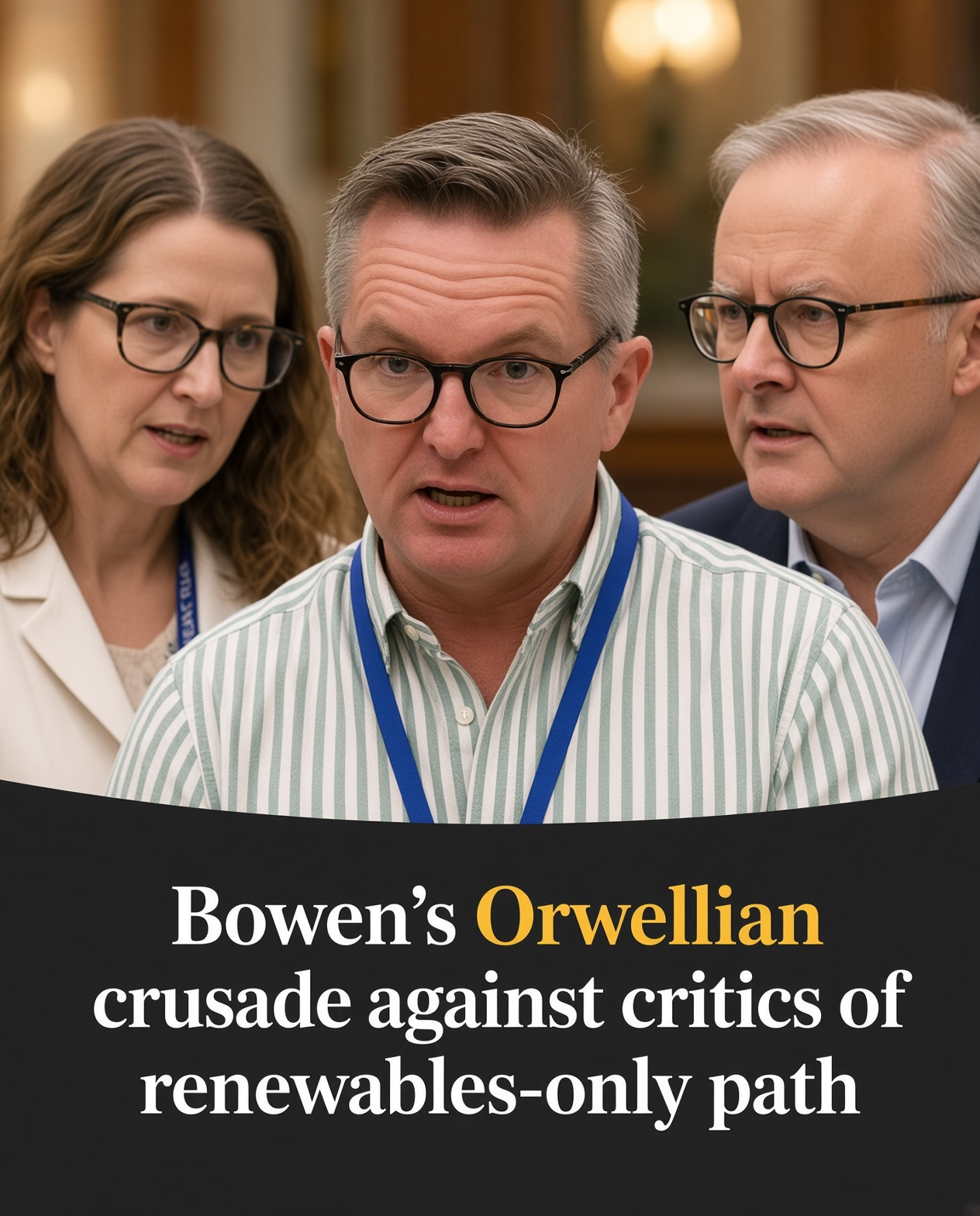
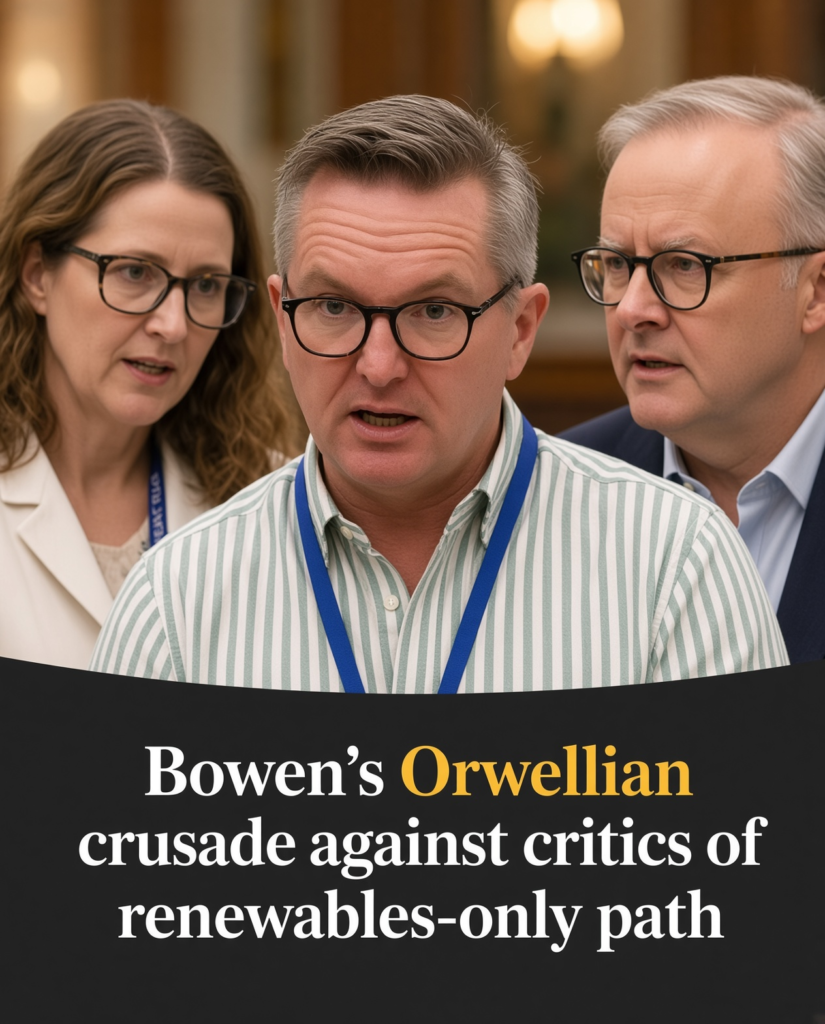
The Albanese government’s attempt to counter climate and energy misinformation has opened a new political front over free speech, government trust and the cost of Australia’s energy transition — with critics invoking George Orwell as Labor continues to be haunted by its undelivered promise to cut household power bills by $275.
The dispute comes after the Department of Climate Change, Energy, the Environment and Water established a cross-agency communications and stakeholder engagement working group intended to improve the government’s response to misinformation surrounding climate and energy policy.
Critics have quickly branded the initiative a taxpayer-funded “Ministry of Truth”, arguing that Canberra should not be deciding which arguments about electricity prices, renewable energy, jobs or reliability are legitimate.
The comparison with George Orwell’s dystopian novel Nineteen Eighty-Four is deliberately provocative.
There is currently no evidence that the working group has powers resembling censorship.
No publicly identified authority allows it to order social media companies to remove criticism, punish Australians for challenging government policy or prohibit political arguments about renewable energy.
The more credible question is subtler: when government agencies begin formally categorising information around highly contested policies as misleading, how do they ensure legitimate criticism is not caught in the same net?
That concern has been sharpened by an August paper from the independent Climate Change Authority titled Misinformation: A climate policy risk.
The authority argues that climate misinformation has evolved.
It says the modern problem is increasingly not straightforward denial that climate change exists, but narratives designed to create uncertainty or resistance around particular climate and energy policies.
The paper identifies cost of living, electricity prices and reliability, jobs, regional impacts, biodiversity and questions about whether Australian emissions reductions matter globally as areas where misleading narratives can emerge.
Every one of those issues is also a legitimate subject for robust political debate.
That overlap explains why the report has become controversial.
Someone can question the cost of transmission lines without denying climate science. A regional community can oppose the location of a wind farm without rejecting renewable energy altogether. An economist can disagree with the design of a subsidy while supporting emissions reduction.
Determining where policy disagreement ends and misinformation begins can therefore become difficult very quickly.
The Climate Change Authority acknowledges that problem.
It explicitly says freedom of expression and debate are fundamental to democracy.
However, its definition of “misinformation” is unusually broad.
For the purposes of the paper, the term incorporates misinformation — false material circulated without necessarily intending deception — as well as deliberate disinformation and “malinformation”.
Malinformation is defined as information that may be true but is used with an intention to mislead.
It is that final category that presents the greatest challenge.
Identifying whether a statement is factually wrong can often be tested against evidence.
Deciding whether somebody has used a true fact with a misleading intention can require officials to make judgments about context, motive and political persuasion.
That is precisely the kind of territory in which government involvement will attract scrutiny.
The Senate Select Committee on Information Integrity on Climate Change and Energy recognised the danger when it released its report in March.
The committee accepted evidence that coordinated false and misleading material could damage public debate, increase community conflict and slow major energy projects.
But it also warned that governments had to distinguish misinformation from genuine disagreement and legitimate community concern.
The committee said dismissing or silencing debate could itself damage trust in government and institutions.
That warning is particularly relevant because trust has already become one of Labor’s vulnerabilities on energy.
Before the 2022 federal election, Anthony Albanese repeatedly promoted modelling behind Labor’s Powering Australia plan showing household electricity bills would be $275 lower by 2025 than under the policy settings prevailing before the election.
“Our plan will reduce energy costs by $275 by 2025,” Albanese said during the campaign.
The figure was not presented as an immediate $275 cheque or rebate. It was a modelled reduction in annual household bills that Labor expected its energy policies to produce.
But whatever the precise modelling assumptions, the promised outcome did not materialise in the way voters were encouraged to expect.
Energy prices were subsequently hit by Russia’s invasion of Ukraine, coal and gas market disruption, generator outages, network investment costs and inflation.
The government has repeatedly pointed to those circumstances when explaining why its original modelling did not survive contact with the energy shock that followed.
Treasurer Jim Chalmers has said the $275 projection reflected modelling completed in 2021, before the Ukraine war and the dramatic increase in wholesale energy prices.
That explanation provides important context.
It does not erase the political problem.
By 2025, regulators were again approving increases in benchmark electricity prices in several states rather than announcing anything resembling the nationally recognisable $275 reduction voters had heard about during the campaign.
The ACCC reported that calculated annual residential electricity prices as at August 2025 were 6 per cent higher than a year earlier for plans without controlled loads and 4.7 per cent higher for plans with controlled loads.
Its latest billing analysis, published in July this year, found household bills excluding government rebates had risen between the third quarter of 2024 and the third quarter of 2025 across the four eastern-market regions examined.
In New South Wales, the median quarterly bill excluding rebates rose 15 per cent. It increased 11 per cent in South Australia, 9 per cent in south-east Queensland and 6 per cent in Victoria.
The figures do not prove renewable energy caused those increases.
Electricity bills reflect wholesale generation, networks, environmental costs, retail margins, consumption and numerous other factors.
But they explain why voters may be sceptical when governments tell them the transition will ultimately reduce costs.
Labor responded to rising prices partly through direct rebates.
Those payments lowered what households actually had to pay during eligible periods, but rebates are funded by government and are conceptually different from the structural $275 price reduction Labor originally modelled.
That distinction matters politically.
A household may welcome a rebate while still concluding that the underlying price of electricity has not fallen as promised.
It is in that environment that the government is now asking Australians to trust official information about the next stage of the energy transition.
Critics argue that creates a fundamental credibility problem.
If Canberra got a politically important forecast wrong, they ask, should Canberra also be given a central role in determining which criticisms of future energy forecasts are misleading?
That is a legitimate question.
It is not the same as proving that the government has created a censorship apparatus.
The Albanese government’s actual electricity policy also differs from the description of a strict “renewables-only” system frequently used by opponents.
Labor is targeting 82 per cent renewable electricity by 2030.
Its Capacity Investment Scheme is underwriting large amounts of new wind and solar generation, along with dispatchable storage such as batteries.
The scheme was expanded to target 40 gigawatts of new generation and storage capacity by 2030, including 26GW of renewable generation and 14GW of clean dispatchable capacity.
Fifteen battery projects selected in June alone are expected to provide 4.2GW and 16.1GWh of dispatchable capacity across the National Electricity Market.
The government argues the combination of renewables, batteries and transmission will replace increasingly unreliable ageing coal generators while reducing emissions and, over time, lowering wholesale electricity costs.
Official data offer some support for part of that argument.
During the first quarter of 2026, renewables supplied a record 47 per cent of electricity in the National Electricity Market for that period, while average wholesale prices fell 12 per cent compared with a year earlier.
That does not mean retail bills automatically fall at the same speed.
Network charges and other costs can rise even when wholesale generation becomes cheaper, and household contracts can take time to reflect wholesale-market movements.
Nor is Labor planning to eliminate gas immediately.
Bowen has repeatedly said gas retains an important role in electricity firming and peaking, as well as in industries that cannot yet readily electrify.
The government’s own Electricity and Energy Sector Plan says natural gas will remain an important contributor to energy security during the transition, although overall demand is expected to decline over time.
Canberra is also progressing a domestic gas reservation scheme intended to require exporters to make an amount equivalent to 20 per cent of exports available to Australian users from July 2027.
Bowen has argued that more renewable generation and batteries should mean gas-fired power stations operate less frequently, while remaining available when the grid needs flexible backup.
Critics are entitled to argue that this approach places too much reliance on intermittent renewable generation or that the transition is becoming too expensive.
But calling the government’s existing policy literally “renewables only” obscures the continued role assigned to batteries, hydro, gas and other firming capacity.
The nuclear question adds another layer.
The Coalition and One Nation argue nuclear energy should be available as a low-emissions source of firm generation.
Labor rejects that approach, citing the time and cost required to establish an Australian civilian nuclear power industry and arguing renewables backed by storage and gas are cheaper.
Reasonable people can disagree about those assumptions.
A credible government information-integrity strategy must leave space for precisely that disagreement.
The same principle applies to taxes and other costs associated with the transition.
The phrase “sneaky taxes”, used in political commentary attacking Labor, is not itself a defined tax measure and should not be presented as one.
There are, however, genuine debates underway over policies that could affect the cost of carbon-intensive activity.
The future of Fuel Tax Credits, post-2030 settings under the Safeguard Mechanism and the wider use of carbon-market incentives are all being discussed across government, industry and advisory bodies.
Mining groups have characterised some proposed changes as disguised carbon taxes. Climate advocates argue existing concessions can slow the shift towards cleaner technology.
Those are political and economic arguments that need evidence, not labels.
That ultimately exposes the danger for both sides of the misinformation debate.
Opponents of Labor weaken their argument when they describe a communications working group as an established censorship machine without evidence that it possesses censorship powers.
The government, equally, would undermine itself if it allowed a broad concept such as “malinformation” to become a shortcut for dismissing inconvenient facts or hostile interpretations of its policies.
The test should be straightforward.
When a claim is false, government should be able to publish the evidence showing why.
When a claim is an opinion, a projection or a disputed interpretation of costs and benefits, it should be answered through ordinary democratic debate.
That standard becomes even more important when the government itself has made forecasts that did not come true.
The $275 power-bill promise does not prove Labor’s entire renewable-energy strategy has failed, just as falling wholesale prices in one quarter do not prove every household will soon receive cheaper electricity.
Both are pieces of evidence that deserve context.
Australians do not need a government ministry deciding which political conclusions they must draw from those facts.
They need access to the facts themselves — including the uncomfortable ones — and enough transparency to decide whom they believe.