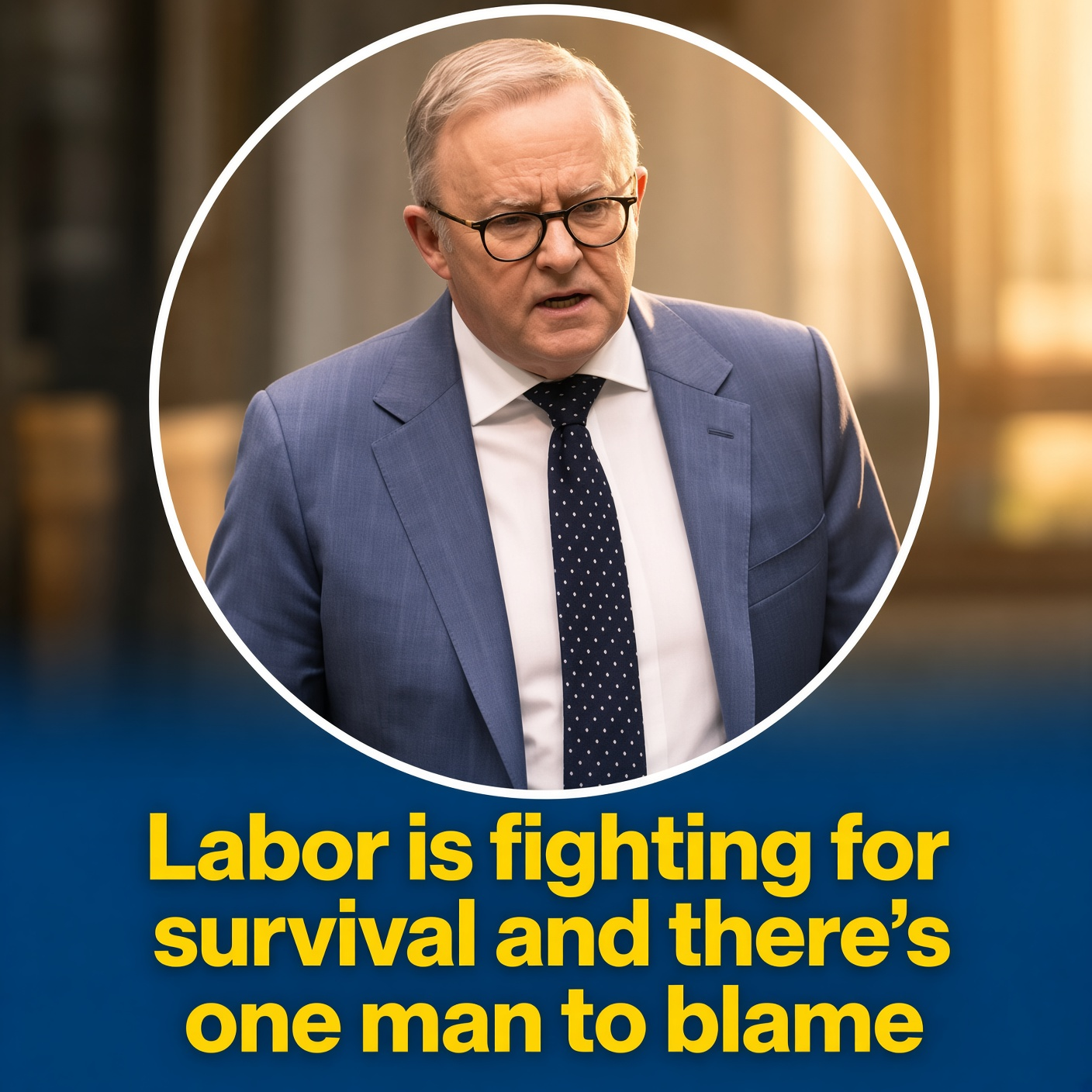
Anthony Albanese should, on paper, be in a considerably stronger political position than the one in which he now finds himself.
That is the contradiction at the heart of veteran political journalist Mark Riley’s latest assessment of the Albanese government.
There is an old Canberra maxim that good policy ultimately produces good politics: get the policy right and the politics will sort themselves out.
Riley’s contention is that Albanese is increasingly demonstrating the opposite.
Labor has the advantages of government, a badly weakened traditional Opposition and policy territory on which it believes it can fight. Yet instead of dominating the political landscape, it is being dragged into an increasingly unpredictable three-way contest involving Labor, the Coalition and Pauline Hanson’s One Nation.
Riley puts Albanese at the centre of Labor’s problem
Riley’s argument is not simply that the government has encountered difficult circumstances.
Governments always do.
His criticism goes to Albanese’s political management.
Labor’s difficulties, in this reading, cannot continually be attributed to hostile media, an opportunistic opposition, difficult global conditions or Pauline Hanson’s extraordinary political resurgence.
The Prime Minister himself has made decisions that have created unnecessary problems and then struggled to regain control of the political conversation.
Riley argues that this has left Labor fighting much harder than its circumstances should require.
The strangest part is the weakness of Labor’s traditional opponent
Ordinarily, an unpopular or politically vulnerable government would face a strengthening alternative government.
That is not what has happened.
The Coalition has experienced profound difficulties rebuilding after its federal election defeat, while One Nation has increasingly occupied political territory once dominated by the Liberals and Nationals.
Recent Resolve Strategic polling illustrates just how unusual the landscape has become.
It recorded Labor on 28 per cent of the primary vote, One Nation on 26 per cent and the Coalition on just 23 per cent.
Those figures do not mean One Nation is about to form government.
Australia’s electoral system, preference flows, individual seat contests and the distribution of support matter enormously.
But they demonstrate why the traditional two-party political model is under strain.
Other polling is considerably better for Labor
There is also an important caution against treating any single poll as the national verdict.
YouGov’s recent public polling has painted a substantially more comfortable picture for Labor, projecting it well ahead of both One Nation and the Coalition in a hypothetical federal contest.
That makes Riley’s description of Labor as fighting for survival an argument about political trajectory and government performance rather than a settled prediction that Albanese is about to lose office.
The polls currently differ.
What they agree on more clearly is that One Nation has become a major component of the federal contest.
One Nation has transformed the political battlefield
This is perhaps the biggest change confronting Albanese.
For most of Hanson’s political career, governments could treat One Nation primarily as a disruptive force operating around the edges of the major-party contest.
That is becoming much harder.
One Nation’s current support means its policies on migration, housing, superannuation, energy, regional Australia and national identity repeatedly force responses from both major-party blocs.
Labor has now made a conscious decision to engage Hanson rather than deny her political oxygen.
Recent analysis describes a deliberate strategy in which Labor highlights Hanson and attempts to make her policies a direct electoral issue.
That strategy carries obvious risks
Attacking Hanson can reinforce Labor’s message to progressive and moderate voters.
But every attack also puts Hanson back at the centre of the national conversation.
That matters because much of One Nation’s appeal comes from presenting itself as the target of a political establishment that does not want its arguments heard.
If Labor attacks too softly, Hanson can dominate issues such as migration and cost of living.
If Labor attacks too aggressively, she can argue that the political establishment is frightened by her growing support.
Albanese has to find the line between confronting One Nation and campaigning for it inadvertently.
Hanson is also doing enormous damage to the Coalition
That gives Labor an important strategic advantage.
Much of One Nation’s growth has come at the expense of the conservative side of politics.
Recent political analysis has repeatedly identified Hanson’s ability to attract former Coalition voters, particularly voters dissatisfied with the major parties over immigration, energy policy and the direction of the country.
For Albanese, there is an obvious temptation to encourage that fight.
Every conservative voter who moves from the Coalition to One Nation potentially makes the Opposition’s route to government more complicated.
But there is a catch.
One Nation is no longer drawing exclusively from conservative voters.
Labor cannot assume working-class voters are immune
Hanson’s appeal increasingly intersects with constituencies Labor also wants to retain.
Housing affordability, migration, cost-of-living pressure, distrust of institutions and frustration in regional communities do not fit neatly within traditional left-right boundaries.
A voter worried about rent or unable to buy a home may not experience migration primarily as an ideological question.
They may see it through competition for housing and infrastructure.
A regional voter angry about energy policy may not care which political party traditionally owned the issue.
This is what makes One Nation more complicated for Labor than simply a problem for the Coalition.
Albanese has created distractions of his own
Riley’s central criticism becomes more damaging when viewed against controversies that were not forced upon the government.
Albanese has repeatedly found himself answering questions generated by his own political choices.
Riley made that argument particularly forcefully during the recent “Melongate” controversy, writing that the Prime Minister had only himself to blame for the political explosion surrounding his comments.
The broader point is significant.
A government cannot control every crisis.
It can control whether it manufactures additional ones.
Every self-inflicted controversy has an opportunity cost
Political capital is finite.
Every day a prime minister spends explaining an avoidable remark is a day the government is not talking about wages, housing, health, infrastructure or its economic program.
Every controversy gives opponents an opportunity to define the government.
And every defensive press conference makes it harder for Labor to establish the political agenda it actually wants.
This is especially costly when the traditional Opposition is historically weak.
A government in that position should be setting the terms of national debate.
Instead, Albanese has repeatedly found himself responding to them.
Labor nevertheless has powerful political weapons
The government is not without advantages.
It has already begun constructing a major campaign around superannuation, portraying itself as the defender of compulsory retirement savings against the Coalition and One Nation.
It retains the enormous institutional advantage of incumbency.
And the fragmentation of the conservative vote creates electoral opportunities that raw primary-vote polling does not necessarily capture.
One Nation’s rise can therefore simultaneously hurt Labor politically and help it electorally.
That paradox may determine Albanese’s future
One Nation can take voters from Labor.
But if it takes even more voters from the Coalition, Labor can still emerge ahead.
That is why Hanson’s extraordinary resurgence cannot automatically be interpreted as evidence that Albanese is heading for defeat.
Recent analysis has even argued that Hanson’s authenticity and ability to consume the Coalition’s core vote could ultimately help keep Labor in power.
The problem for Albanese is that relying on opponents to divide themselves is not the same thing as building durable enthusiasm for his own government.
The Coalition faces an even deeper existential problem
If Labor’s position is uncomfortable, the Coalition’s is potentially more dangerous.
It must attack Albanese while simultaneously preventing Hanson from replacing it as the principal vehicle for anti-Labor voters.
Those objectives do not always align.
Move towards One Nation on immigration or energy and Labor can argue the Coalition is becoming more extreme.
Move away from Hanson and One Nation can accuse the Liberals of being indistinguishable from Labor.
The pressure is already visible in Western Australia, where One Nation is aggressively campaigning in Secret Harbour and seeking to convert broader voter dissatisfaction into an electoral breakthrough.
Secret Harbour has become a warning sign
The Western Australian by-election has attracted national attention precisely because it tests whether One Nation’s polling support can be converted into votes in an actual lower-house contest.
One Nation candidate Luke Herdegen has spoken confidently about the party’s prospects, while a large volunteer operation has increased the campaign’s visibility.
One by-election cannot establish a national trend.
But a strong result would increase pressure on both major parties.
For the Coalition, it would demonstrate that One Nation can challenge directly for territory once considered safely conservative.
For Labor, it would show that the Hanson surge is capable of moving beyond opinion polls.
Albanese’s personal standing matters
The Prime Minister cannot completely separate Labor’s position from his own.
The latest Resolve figures cited by Poll Bludger put Albanese’s combined “very good” and “good” performance rating at 37 per cent, against 53 per cent rating him poorly or very poorly.
That is an important warning for a government whose electoral strategy still relies heavily on the Prime Minister’s political judgement and capacity to define its agenda.
Leadership ratings are not election results.
But sustained dissatisfaction with a prime minister can make every subsequent political problem more difficult to contain.
Hanson’s personal position is unusually strong
The same Resolve polling produced another striking result.
Pauline Hanson recorded a 46 per cent positive performance rating and 41 per cent negative.
That helps explain why conventional attacks have struggled to stop One Nation’s momentum.
Hanson has been a national political figure for three decades.
Voters already know her controversies, her positions and her style.
For supporters, longevity has increasingly become evidence of consistency rather than baggage.
That makes her different from a new insurgent politician who can be destroyed simply by exposing previously unknown positions.
Authenticity has become a political asset
Recent analysis of One Nation’s rise identifies Hanson’s perceived authenticity as one of her most powerful political advantages.
Supporters may disagree with individual policies while still believing they know what she stands for.
That is particularly potent during a period in which trust in the traditional parties has weakened.
For Albanese, this presents a messaging problem.
Labor can argue that Hanson’s policies are economically dangerous, socially divisive or practically unworkable.
But telling voters that Hanson is unacceptable is less effective when those voters already know exactly who she is and support her anyway.
Policy depth remains One Nation’s vulnerability
Hanson’s political strength should not be confused with government readiness.
One Nation still faces significant questions about candidate quality, organisational depth, policy development and succession.
Recent reporting notes the party is attempting to field more than 160 federal candidates while questions remain about whether its organisation has developed sufficiently to support such rapid expansion.
That gives both Labor and the Coalition an obvious line of attack.
Protest is one thing.
Administering the Commonwealth is another.
Labor’s challenge is to make government competence visible
This returns the debate to Riley’s original Canberra maxim.
Getting policy right is not enough if voters do not believe their lives are improving.
A government can point to legislation passed, programs created and investments announced.
But voters experiencing expensive housing, high household bills or pressure on public services judge governments through outcomes rather than press releases.
That gap between policy achievement and lived experience is where political insurgencies grow.
Albanese cannot communicate his way around every problem
Nor can the government assume better messaging alone will restore political authority.
Communication matters.
But political communication works best when it amplifies an experience voters already recognise.
If households feel financially secure, a government can credibly claim economic progress.
If they do not, repeatedly telling them the economic numbers are improving can become counterproductive.
The same applies to housing, migration, energy and public services.
The Prime Minister is fighting on too many fronts
Albanese now confronts an unusually fragmented political battlefield.
He must defend Labor against the Coalition while preventing One Nation from gaining working-class voters.
He must decide when to confront Hanson and when to deny her attention.
He must protect Labor’s progressive flank without allowing cultural debates to dominate the government’s economic message.
And he must do all of that while preventing avoidable controversies from consuming yet more political oxygen.
This is why Riley’s criticism lands harder than a conventional argument about polling.
Labor’s problem is not simply whether it can win
On several current polling models, Labor remains entirely capable of winning another election.
Some polling still gives it a commanding advantage over its fragmented opponents.
The deeper question is why a government facing such a weakened traditional Opposition is having to fight so hard to maintain political authority.
That is the uncomfortable question Riley directs at Albanese.
The Prime Minister cannot blame Angus Taylor for every difficulty when the Coalition itself is struggling.
He cannot blame Hanson for political controversies generated by his own decisions.
And he cannot assume that legislative achievements will automatically translate into public support.
The next phase will test whether Labor has learnt that lesson
Labor’s political strategy is clearly changing.
It is confronting One Nation more directly.
It is attempting to bind Hanson and the Coalition together on issues such as superannuation.
And it is increasingly framing the next election as a choice between the stability of Labor government and an unpredictable conservative opposition divided between the Coalition and One Nation.
That strategy may work.
But it depends on Albanese maintaining discipline.
Another sequence of self-inflicted controversies could again allow his opponents to determine what Australians are talking about.
Riley’s warning ultimately comes back to leadership
The Prime Minister still possesses advantages many political leaders would envy.
The Coalition is weak.
Its conservative vote is divided.
One Nation’s organisational capacity remains far less developed than either major party.
Labor controls government and can choose policy battlegrounds on which it believes it has public support.
Yet Australian politics feels increasingly volatile rather than settled.
That is why Riley’s criticism is more damaging than simply saying Labor’s polls should be better.
His argument is that Albanese has repeatedly failed to convert favourable political circumstances into political dominance.
One Nation’s rise is part of that story.
The Coalition’s weakness is part of it too.
So are cost-of-living pressures, declining attachment to the major parties and the Prime Minister’s own avoidable controversies.
There is still no polling basis for declaring Labor doomed.
There is, however, ample evidence that the political system Albanese is trying to manage has become far less predictable.
And if a government with a fractured opposition cannot persuade Australians that it deserves to be comfortably ahead, the question Riley poses becomes difficult to avoid.
How much of that problem belongs to the man at the top?