1 | Chapter 1: The Dinner at Corinne’s House

By the time dessert was served, Maren Mercer had already counted four separate occasions when Helena had spoken about her as though she were not sitting three chairs away. The dining room itself was almost aggressively beautiful, washed in pale gold from the late-afternoon sun and softened by the cream walls, polished oak, and chandelier that Corinne had once mentioned cost more than her first car. Everything in the room suggested ease: linen napkins folded into neat fans, stemmed glasses that caught the light, flowers arranged low enough that nobody had to lean around them to speak. Yet Maren had spent most of the evening with one hand resting beneath the curve of her stomach, feeling the baby move while the conversation passed over her in small, carefully sharpened pieces.
Helena was telling Corinne about Easter brunch, although everyone at the table had already heard some version of the story. Maren had left that brunch early after becoming dizzy in the kitchen, and Graham had driven her home before dessert. Helena had never directly accused her of anything that day, but she had since transformed the incident into evidence of a larger problem, polishing the details each time she retold them until Maren could barely recognize the afternoon she had actually lived through.
“She was tired,” Helena said now, lifting her coffee cup with both hands. “Of course, pregnancy is exhausting. I remember. I simply think there are times when family comes before comfort.”
Corinne’s husband, Matthew, glanced toward Maren and then lowered his eyes to his plate. Across the table, Corinne gave her mother the solemn little nod Maren had come to recognize, the one that meant the two women had discussed this before and agreed on what it meant. Maren felt the familiar urge to explain that she had nearly fainted beside the sink that afternoon, that Graham had been the one who insisted they leave, that she had apologized to Helena twice before going home. She let the explanation die before it reached her mouth because correcting Helena in front of everyone had never corrected anything; it merely produced a new story about Maren being defensive.
“You should have seen Mom when she was pregnant with me,” Corinne said, cutting another piece from her tart. “She worked right up until the end.”
Helena smiled with modest satisfaction. “Different generation.”
Maren took a sip of water and felt the baby shift again. She was thirty-one weeks pregnant, far enough along that sitting too long made her lower back ache and standing too quickly sent a hard pull through her pelvis, yet not far enough along for anyone in Graham’s family to regard those discomforts as anything but character tests. Her obstetrician had told her to avoid lifting anything heavy after a bout of abdominal pain the previous week. Maren had not mentioned that at dinner because she had learned that medical facts, once carried into Helena’s orbit, were often returned as moral judgments.
“I’m sure Maren is doing what her doctor recommends,” Matthew said, offering the sentence with the cautious neutrality of a man stepping between two dogs he hoped would not notice him.
Corinne gave her husband a look that was quick enough to be socially deniable. “Nobody said she wasn’t.”
Maren smiled because there were children at the table and because she had promised Graham she would try. He had been called back to the office barely twenty minutes before they were supposed to leave for Corinne’s house, and he had apologized three times while changing his shirt, torn between canceling altogether and asking Maren to go ahead without him. She had been the one who insisted. It was Corinne’s birthday dinner, the invitation had been on the calendar for weeks, and Maren knew how Helena would interpret an absence. Graham had kissed her forehead before leaving, told her he would be there as soon as he could, and asked her to text him if she wanted to go home.
For the first hour, she had almost believed the evening might pass peacefully. Corinne’s children had shown Maren a school project and a new gymnastics medal, Matthew had kept the wine moving, and Helena had confined herself to compliments that sounded ordinary until Maren examined them too closely. She had admired Maren’s dress, then wondered aloud whether maternity clothes were becoming “very forgiving.” She had praised the nursery photographs Graham had sent her, then remarked that young couples spent an astonishing amount of money preparing for babies who would not remember any of it. Each comment could have been dismissed in isolation, which was precisely why Maren had stopped trying to describe them to anyone.
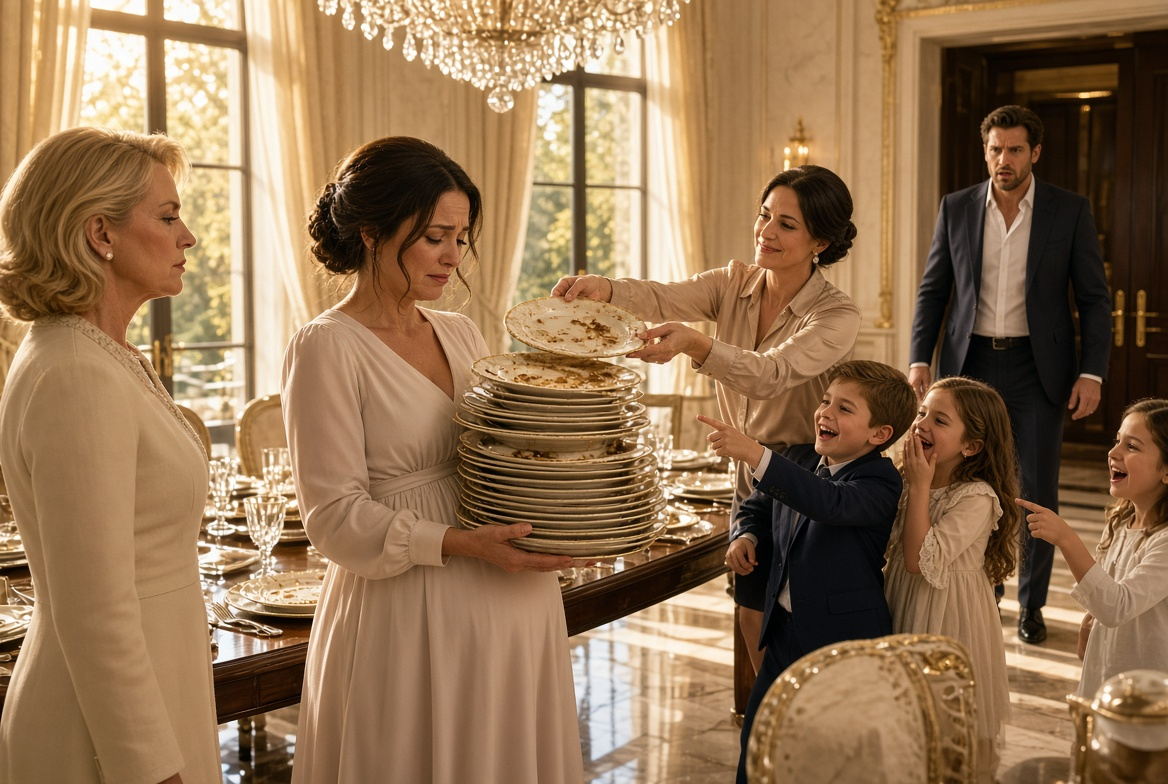
After dessert, chairs began scraping softly against the floor as the adults stood. The children scattered toward the adjoining family room, where a movie was already paused on the television, and Corinne began gathering wineglasses from her side of the table. One of the household staff, a woman named Rosa whom Maren had met twice before, entered quietly from the kitchen and reached for the nearest stack of plates.
Corinne stopped her.
“Rosa, leave those.”
The woman hesitated with her hands a few inches above the table. “Mrs. Bell?”
“I said leave them. You’ve been working since this afternoon. Go take care of the kitchen.”
Rosa looked from Corinne to the dishes, then toward Maren with an uncertainty that immediately tightened something in Maren’s stomach. Helena remained seated at the head of the table, folding her napkin into smaller and smaller squares while watching her daughter. No one said anything for a moment, and because the room was still bright with the last sunlight, Maren could see every expression clearly.
Corinne turned toward her.
“Maren can help.”
Maren thought at first that she meant they would clear the table together. She shifted her chair back and pushed herself upright carefully, keeping one palm against the edge of the table until the pressure in her lower abdomen eased. She had no objection to carrying a glass or two into the kitchen; what unsettled her was the way Corinne watched her stand, as though she had been waiting to see whether Maren would refuse.
“Of course,” Maren said. “I can take some of the lighter things.”
Corinne’s mouth tightened almost imperceptibly. “The lighter things.”
Helena let out a small breath that might have been amusement.
Maren looked at her. “My doctor asked me not to lift anything heavy for a while.”
“And there it is,” Corinne said.
The children had drifted back toward the dining room after hearing the adults’ voices change. Corinne’s twelve-year-old daughter, Paige, leaned against the doorway beside her younger brother and cousin, all three watching with the alert curiosity children developed when they sensed adults approaching a conflict. Matthew had gone toward the kitchen with two empty bottles, leaving the space around the dining table suddenly and inconveniently intimate.
Maren kept her voice level. “There what is?”
Corinne picked up a dirty dinner plate and held it against her palm. “An excuse. There is always an excuse.”
“Corinne,” Helena murmured, though the word contained no real warning.
“No, Mom. You spend half your life making allowances for people who wouldn’t do the same for you.” Corinne looked directly at Maren now. “She can carry a few plates.”
Maren felt heat rise beneath the neckline of her dress. “If this is about something else, then say what it’s about. I came here because it was your birthday and because I wanted tonight to be pleasant. I’m not interested in fighting with you over dirty dishes.”
“That’s exactly what I mean.” Corinne’s voice remained calm, which somehow made the hostility more unsettling. “Everything becomes a performance of how reasonable you are. Mom says something, you act wounded. We ask you to come to dinner, you leave early. Graham used to show up for things without checking whether you were tired first. Now every family plan depends on what you feel like doing.”
Helena stared at the napkin in her lap.
Maren looked between them and understood, with a cold clarity, that she had entered a conversation that had been taking place without her for months. The details were familiar, but their arrangement was not. She could hear pieces of her own life inside Corinne’s accusations—Easter brunch, missed Sunday dinners, Graham declining a weekend trip when Maren had been sick—but all of them had been stripped of context and rebuilt into a portrait of someone selfish enough that Corinne no longer felt obligated to be polite.
“Graham makes his own decisions,” Maren said. “If he tells you he can’t come somewhere, that is not me sending him a message through his phone.”
“Please.” Corinne gave a humorless laugh. “My brother didn’t suddenly stop caring about this family for no reason.”
“I never asked him to stop caring about anyone.”
“You didn’t have to.”
The answer came so quickly that Maren knew it had been rehearsed, if not aloud then somewhere inside Corinne’s head. She looked at Helena, waiting for the older woman to correct her daughter or at least acknowledge that Graham had always been capable of deciding where he spent his time. Helena’s face remained composed.
Corinne placed the dirty plate into Maren’s hands.
The gesture was so deliberate that Maren almost laughed from disbelief. Grease from the roast had cooled along one edge of the china, and a streak of sauce slid toward her thumb when the plate tilted. Before she could set it back on the table, Corinne picked up another and placed it on top.
“There,” she said. “Two plates. I think you’ll survive.”
Paige covered a smile with her hand.
Maren’s embarrassment arrived before her anger because there was something uniquely humiliating about being tested in front of children. She could have put the dishes down immediately, but she could already imagine Helena’s version of that scene being repeated at the next family gathering: Maren had refused to carry two plates. Maren had made Corinne’s birthday about herself. Maren had embarrassed everyone.
Then Helena rose from her chair and added a small dessert plate to the stack.
“You know, sweetheart,” she said, using the affectionate tone that somehow made the action worse, “sometimes helping is simply helping. It doesn’t have to mean anything more than that.”
Maren stared at her.
The baby shifted low against her abdomen, and a dull ache moved across her back. She adjusted the plates against her forearms, intending to carry them the few yards to the kitchen and end the spectacle before it could grow. Then Corinne’s cousin Rebecca, who had been hovering near the buffet with a wineglass in hand, walked over and placed another plate on top.
“Since you’re going that way.”
Paige laughed.
Her brother laughed because Paige had.
Within seconds the three children were giggling openly, enjoying the simple visual absurdity of an increasingly pregnant woman balancing dirty dishes while the adults around her treated it as entertainment. Corinne made no effort to stop them. Rebecca added a bowl. Someone at the other end of the table said, “Careful, don’t drop Mom’s china,” and more laughter followed.
Maren’s hands began to shake.
She tried to shift the weight against her body, but her stomach prevented her from holding the stack close enough to stabilize it. The porcelain edges pressed into the soft skin near her wrist, and the ache in her back sharpened into a thin line that made her inhale through her nose. She knew she should put everything down. She knew the doctor’s instructions mattered more than these people’s opinion of her, yet the room had taken on the ugly momentum of a schoolyard dare, and some stubborn part of her refused to give Corinne the satisfaction of seeing her break.
“Go on,” Corinne said. “My brother already provides for you. The least you can do is clean up after dinner.”
That did it.
Maren lowered her eyes to the stack in her hands, partly because she did not trust her face and partly because she suddenly understood there was no graceful way out of the scene. She had spent months trying to be careful with Helena, careful with Corinne, careful with Graham’s complicated loyalties, and none of that care had protected her from standing in a beautiful dining room while children laughed at her trembling hands.
“Corinne,” Matthew said from the kitchen doorway. He had returned unnoticed and was staring at the table. “That’s enough.”
His wife did not turn toward him. “She’s carrying plates, Matt. She’s not digging a trench.”
“She’s pregnant.”
“So was Mom.”
The front door opened somewhere beyond the foyer.
Maren did not hear it at first because Paige was still laughing and one of the plates had begun to slide slightly against the one beneath it. She tightened her grip, and pain shot along the base of her thumb. Rosa appeared at the kitchen entrance, took in the scene, and immediately stepped forward.
“Mrs. Mercer, let me take those.”
Corinne raised her hand again. “Rosa.”
That was when Graham walked into the dining room.
He had loosened his tie during the drive, and the top button of his shirt was undone, details Maren noticed only because his arrival changed the room so abruptly that her mind began recording everything. His gaze moved first to his mother, then to Corinne, then to the children gathered near the doorway. When he saw Maren, he stopped.
For a fraction of a second he simply looked at her. His eyes dropped to the stack of dishes pressed against her arms, then to the tremor running visibly through her fingers. Whatever expression he had carried into the house disappeared.
“What is she doing?”
Nobody answered.
Graham crossed the room in several fast steps and reached Maren before she could speak. He took the entire stack from her arms and set it hard enough on the table that silverware jumped against porcelain. Then he looked at her hands.
“They’re shaking.”
“I’m okay,” Maren said automatically.
His eyes rose to hers. “No, you’re not.”
The children had gone silent. Paige stood with her mouth slightly open, no longer amused now that an adult had entered the room who did not share the joke. Corinne folded her arms.
“Oh, for God’s sake, Graham. We asked her to help clear the table.”
He turned toward his sister. “You asked her to help?”
Corinne’s chin lifted. “Yes.”
Graham looked at the stack he had just removed from Maren’s arms, then at Rebecca, then at his mother. “That’s what this was?”
Helena finally stepped forward. “Lower your voice.”
“I’m asking a question.”
“And I’m telling you that nobody hurt her,” Helena replied. “Your sister asked your wife to contribute after dinner. Maren chose to turn it into something larger.”
Maren stared at Helena because even now, with the evidence sitting in a crooked stack on the table, the story was already changing.
Graham heard it too.
He looked at his mother for a long second, but whatever he might have said to her remained unspoken. Instead he turned back to Corinne.
“What the hell were you thinking?”
Corinne laughed once, sharply. “There it is. Exactly what Mom said would happen.”
“What did Mom say would happen?”
“That you would walk in here, see your wife looking unhappy, and decide the rest of us must have attacked her.”
Graham’s face hardened. “Her hands were shaking.”
“She’s pregnant, Graham, not helpless.”
The sentence settled over the room with such casual cruelty that Maren felt something inside her go still. Graham looked at his sister, then at the plate nearest his hand. It still held scraps of roast beef, vegetables, and the remains of a sauce that had gone cold during dessert.
He picked it up.
“Graham,” Maren said.
Corinne barely had time to register the movement before he stepped toward her and shoved the plate against her face.
Food slid down her cheek, onto the neckline of her blouse, and across one shoulder. Rebecca gasped loudly. Matthew swore under his breath, a fork hit the floor somewhere behind them, and all three children recoiled at once as the room filled with shocked voices.
Corinne stood motionless.
A piece of roasted carrot dropped from her hair onto the floor.
Graham set the empty plate down.
“No one gets to disrespect my wife,” he said, his voice controlled now in a way that was more frightening than shouting. “No one.”
Helena’s face had gone pale. “Have you lost your mind?”
“I walked in and found my pregnant wife being laughed at while all of you piled dishes into her arms.”
“That does not give you the right to assault your sister in her own home.”
“No, it doesn’t.”
The immediate admission startled everyone, including Maren.
Graham looked at Corinne, whose shock was beginning to collapse into furious humiliation. “I should not have done that. I’m angry enough right now that I’m not going to pretend I regret stopping it, but what I just did was wrong. I will answer for that when I can speak to you without wanting to break every plate in this room.”
Corinne wiped sauce from beneath one eye with trembling fingers. “You think apologizing while insulting me makes you noble?”
“I don’t think there is anything noble about this evening.”
“You always do this,” she snapped. “You always come in here acting like you’re the one being mistreated.”
Graham turned away from her and reached for Maren’s hand.
She flinched when his fingers closed around hers, not because he hurt her but because her wrists were still aching. He noticed immediately and loosened his grip.
“Come on, honey,” he said, quieter. “I’ve got you.”
Maren looked toward Helena. She did not know why she did it, except that some part of her had spent the entire evening waiting for the older woman to acknowledge what had happened. Helena stood beside the table with one hand pressed against the back of a chair, looking less angry than exhausted now, yet she offered neither defense nor apology.
Maren let Graham guide her toward the foyer.
Behind them, Corinne’s voice broke across the room.
“Of course you’re leaving.”
Graham stopped but did not turn.
“You always leave when she wants you to. Every single time.”
Maren felt his hand tighten slightly around hers.
Corinne took several steps after them, still wiping food from her blouse. “Mom spends years making space for you, and this is what she gets. You walk into my house, humiliate me in front of my children, then take her hand and run away like we’re strangers.”
“Corinne,” Helena said.
“No, Mom. I’m done pretending.”
Graham turned then. Whatever anger had been visible on his face a moment before changed when he looked at his sister, replaced by something Maren could not immediately identify.
Corinne saw it and seemed to hate him more for it.
“You have always been so good at acting like you’re the injured one,” she said. “Even when you were a kid, everything in this family had to bend around you. Mom had to bend around you.”
Graham stared at her.
Matthew moved closer to his wife. “That’s enough.”
Corinne ignored him. “And now she comes along, and suddenly we all have to bend around her too.”
Maren felt Graham go completely still beside her.
He spoke carefully. “What exactly are you talking about?”
Helena’s answer came before Corinne could give one.
“She doesn’t know what she’s saying.”
Corinne looked at her mother.
For the first time that evening, uncertainty crossed her face.
Graham saw it.
So did Maren.
The silence that followed lasted only a few seconds, yet something inside it shifted. Until that moment, Maren had believed the evening was about her: Helena’s criticisms, Corinne’s resentment, the family’s conviction that pregnancy had made her demanding. Now she realized the anger in the room had simply found her because she was standing close enough to Graham to be reached.
He did not ask another question.
Instead he opened the front door and led her outside.
The air had cooled while they were eating, and Maren breathed more easily as soon as they reached the driveway. Graham helped her into the passenger seat, crouched beside the open door, and examined her hands beneath the porch light. Red lines crossed the inside of one wrist where the plates had pressed into her skin.
“Does your stomach hurt?”
“A little. Mostly my back.”
“We’re calling the doctor.”
“Graham, I’m fine.”
“I’m not taking that chance.”
She watched him type the number into his phone and saw that his hands were shaking now too, though for an entirely different reason. The anger had not disappeared; it had settled deeper, tangled with something he was working very hard not to show her.
Maren reached out and touched his wrist.
“Thank you, honey.”
He looked up.
“For what?”
“For coming when you did.”
Graham closed his eyes briefly and pressed his lips to her knuckles. When he opened them again, the tenderness was still there, but the expression beneath it had changed.
“I should’ve gotten here sooner.”
“You didn’t know.”
“No,” he said. “I didn’t.”
He stood, closed her door gently, and walked around the front of the car. Through the windshield, Maren could see the bright windows of Corinne’s house behind him, every room still glowing warmly against the evening even though nobody inside appeared to be moving.
Graham climbed into the driver’s seat but did not start the engine immediately.
Maren waited.
Eventually she said, “What did Corinne mean?”
His fingers rested on the steering wheel.
“About what?”
“About your mother making space for you when you were a kid.”
He looked through the windshield toward his sister’s house. The hesitation lasted long enough that Maren understood the answer would not be simple, yet he did not look like a man trying to invent an explanation. He looked like someone who had just heard an old door open somewhere behind him and had spent his entire life pretending it was locked.
“We’ll talk about it,” he said quietly. “Just not tonight.”
Maren nodded because her back was aching and because she could see that asking again would not bring them closer to the truth. Graham started the engine and pulled away from the curb, one hand remaining near hers on the center console as the house disappeared behind them.
For the first time since marrying him, Maren understood that Helena and Corinne’s hostility had not begun with her. She had simply stepped into a family argument that was older than her marriage, older than Graham’s adulthood, and perhaps older than his memory. Whatever had happened in that house before she ever knew his name was still alive enough to reach across decades and put dirty plates into her hands.