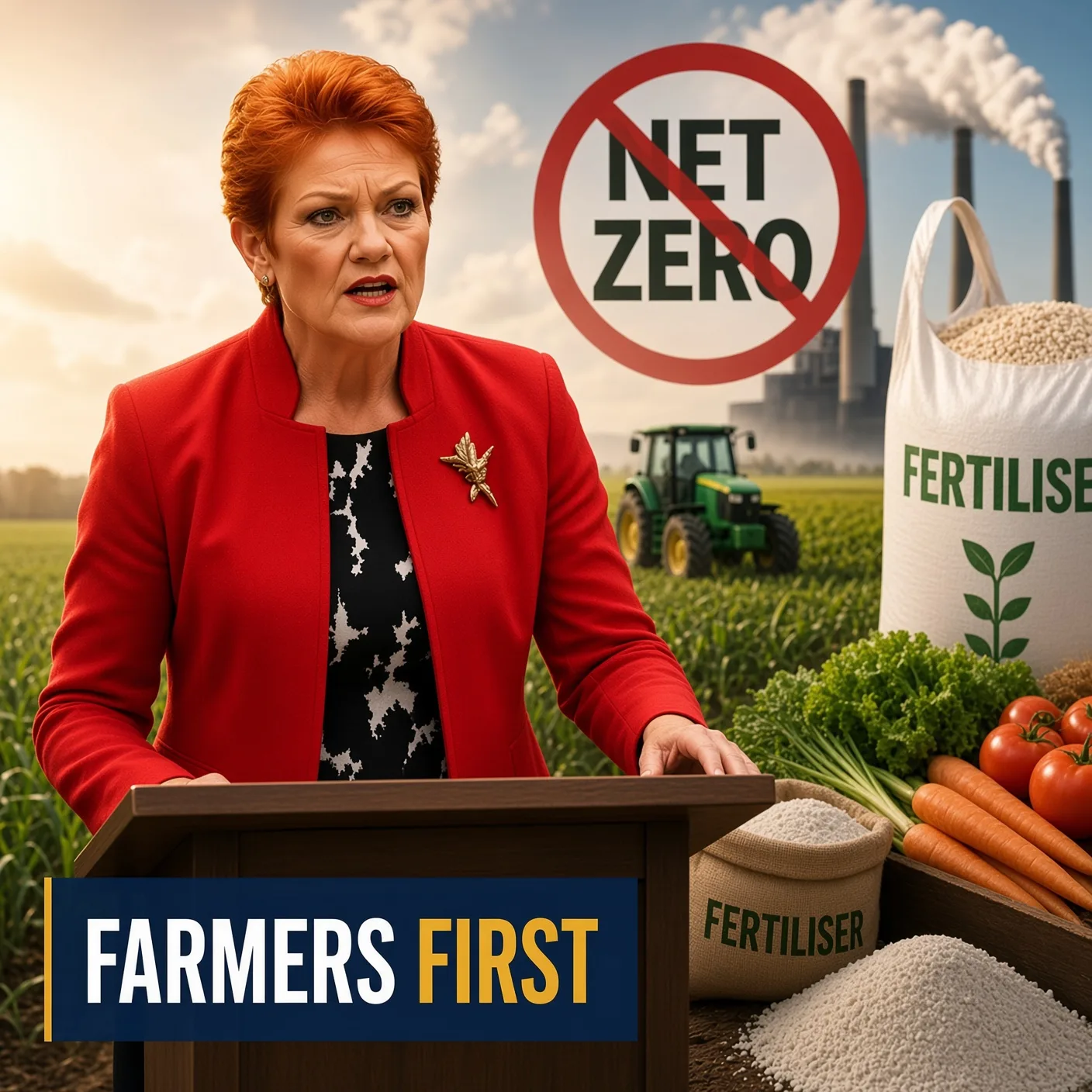
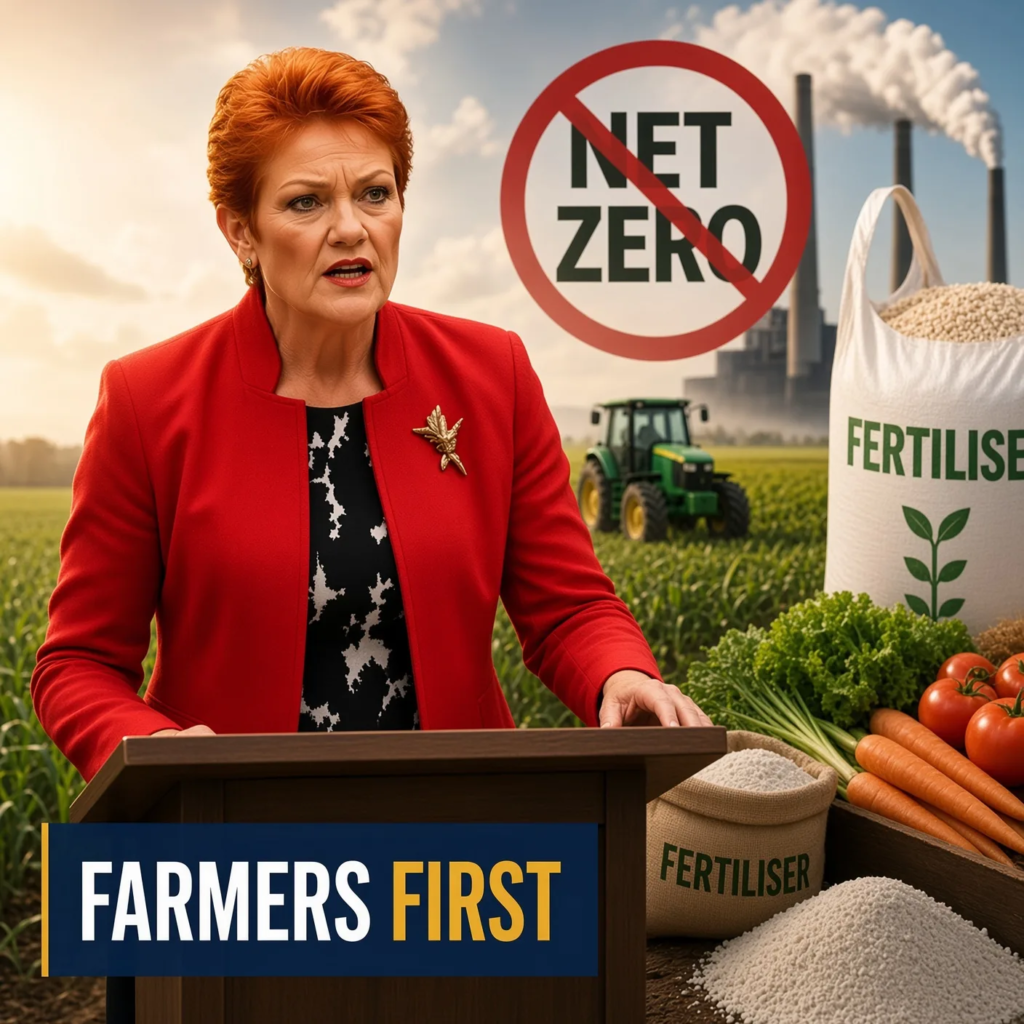
Pauline Hanson is pushing for Australia to rebuild its domestic fertiliser industry using locally produced natural gas, arguing the country should no longer depend so heavily on overseas suppliers for one of the most important inputs in Australian agriculture.
The One Nation leader says greater fertiliser self-reliance would strengthen Australian farmers, make the food supply chain more resilient and ultimately help reduce pressure on grocery prices.
Her proposal also fits into One Nation’s wider energy agenda: expand Australian gas production, prioritise domestic access to resources and abandon Australia’s net-zero emissions policies.
Some of those claims are politically contested, particularly the promise that the strategy would necessarily produce cheaper food.
But the underlying problem Hanson is targeting is real.
Australia has become heavily dependent on imported fertiliser, particularly urea, leaving farmers exposed to international conflicts, disruptions to shipping routes and sudden movements in global energy and fertiliser prices.
The vulnerability has become so significant in 2026 that the federal government established a dedicated Fertiliser Supply Working Group to monitor supply risks.
One Nation wants fertiliser self-reliance
Hanson formally outlined One Nation’s Fertiliser Self-Reliance Plan in July, arguing Australia should use more of its own gas resources to support domestic fertiliser production.
“Australia cannot be truly self-reliant if our farmers depend on imported fertiliser to grow the food that feeds the nation,” the party said in announcing the plan.
The proposal is based on a straightforward supply-chain argument.
Fertiliser is critical to modern agriculture. If international prices rise or supplies are interrupted, Australian farmers face higher costs or reduced access to the nutrients needed to maintain crop yields.
Those pressures can flow through agricultural supply chains.
One Nation argues a country with Australia’s natural resources should therefore produce a larger share of its own fertiliser instead of depending on ships arriving from overseas.
“True self-reliance begins with securing the inputs needed to grow our own food,” the party said.
Australia is now entirely reliant on imported urea
Recent government figures demonstrate how far Australia’s dependence has progressed.
The Department of Agriculture, Fisheries and Forestry says Australia is entirely import-reliant for urea fertiliser.
It also says 62 per cent of Australia’s fertiliser imports currently come from the Middle East, while much of the remaining supply depends on Middle Eastern gas as a manufacturing feedstock.
That creates a major concentration risk.
Urea is one of the world’s most widely used nitrogen fertilisers and is particularly important to Australian cropping.
When supplies are readily available and shipping routes operate normally, an international supply chain can provide Australian farmers with competitive products from large overseas producers.
But when conflict disrupts production or transport, the same dependence can become a weakness.
Australia experienced exactly that problem in 2026.
Middle East disruptions exposed Australia’s vulnerability
Conflict in the Middle East disrupted fertiliser production and shipping through the Gulf, forcing Australian suppliers to search for alternative sources.
Incitec Pivot Fertilisers, one of Australia’s major suppliers, reported that cargoes were disrupted and alternative shipments had to be sourced from other markets.
The federal government and industry responded by securing additional supply and establishing mechanisms intended to reduce the risk of Australian farmers running short.
Australia sourced additional urea from Indonesia, while suppliers also looked to markets including Nigeria.
By early July, Incitec Pivot reported that about 85 per cent of Australia’s forecast fertiliser-grade urea requirement for the 2025-26 cropping year had been imported.
A further 400,000 tonnes was estimated to be required over the following months.
The immediate supply situation had improved, but the episode exposed how quickly an international conflict thousands of kilometres from Australia could affect a basic input used on Australian farms.
The government formed a fertiliser working group
The Albanese government responded to those pressures by establishing a Fertiliser Supply Working Group bringing together federal departments and industry representatives.
Members include the Department of Agriculture, Fisheries and Forestry, the Department of the Prime Minister and Cabinet, the Department of Industry, Science and Resources, the Department of Foreign Affairs and Trade and Export Finance Australia.
Industry is represented by Fertilizer Australia and the National Farmers’ Federation.
The group’s purpose is to monitor supply restrictions and identify options for dealing with immediate and longer-term risks.
Its existence is important in assessing Hanson’s argument.
The government may disagree with One Nation’s solution, but Canberra itself accepts that fertiliser supply has become a food-security and agricultural resilience issue.
The disagreement is therefore less about whether Australia faces a vulnerability and more about what should be done about it.
CSIRO has also warned about Australia’s dependence
CSIRO has highlighted the same structural problem.
The national science agency reported this year that Australia’s synthetic nitrogen fertiliser arrives by ship.
In 2025, 56 per cent of Australian nitrogen fertiliser imports originated in the Middle East, according to CSIRO research.
That represented an increase of more than 20 percentage points compared with 2011.
CSIRO researchers noted the unusual position this creates for Australia.
The country is a major agricultural exporter, sending enormous quantities of grain into international markets, while simultaneously relying on international supply chains for the nitrogen fertiliser required to produce much of that grain.
Australia is therefore exposed at both ends of the agricultural trade system.
Disruption to fertiliser imports can raise farmers’ costs or affect production, while disruptions to export markets can affect the prices farmers receive for their crops.
Why gas matters to fertiliser production
Hanson’s emphasis on natural gas is not incidental.
Natural gas plays a central role in conventional nitrogen fertiliser manufacturing.
Ammonia, the foundation for many nitrogen fertilisers, is traditionally produced using hydrogen derived from natural gas.
Gas also supplies substantial amounts of the energy required by the manufacturing process.
The economics of nitrogen fertiliser production are therefore closely connected to gas prices.
Australian parliamentary research into the fertiliser industry has previously found natural gas can account for as much as 90 per cent of the cost of manufacturing ammonia, depending on market conditions and plant configuration.
This is one reason large-scale fertiliser manufacturing has historically gravitated towards regions with abundant and competitively priced gas.
It also helps explain One Nation’s argument that Australia should connect its substantial gas resources more directly with domestic agricultural production.
Hanson links fertiliser policy to One Nation’s gas strategy
The fertiliser proposal is part of a broader One Nation plan to reshape Australia’s gas industry.
The party wants increased gas and oil development, greater domestic access to Australian resources and changes to the way governments tax resource production.
One Nation argues Australians should receive the first benefit from resources extracted domestically rather than competing with international buyers for their own gas.
Hanson has also pledged to end net-zero policies, which One Nation argues increase energy costs, restrict development and undermine energy-intensive manufacturing.
Her fertiliser plan makes the same case.
One Nation says net-zero policies have restricted affordable gas development and made Australian fertiliser production more difficult and expensive.
That claim is considerably more contentious than the basic proposition that gas is important to conventional nitrogen fertiliser production.
Australia’s fertiliser manufacturing economics depend on multiple factors, including gas prices, plant scale, capital costs, international competition, transport, labour, taxation and long-term certainty over supply.
It cannot be established simply from Australia’s fertiliser import dependence that net-zero policy is the principal cause.
Australia has lost domestic urea production
One development behind the current debate was the closure of Incitec Pivot’s Gibson Island manufacturing facility in Brisbane.
The plant ceased producing urea in 2022, contributing to Australia’s present reliance on imported supplies.
The company had previously pointed to difficulties securing an economically viable long-term gas supply as a major factor affecting the plant’s future.
Its closure left Australia without domestic production of fertiliser-grade urea at a time when global supply chains were becoming increasingly volatile.
That history strengthens the argument that gas availability and pricing matter when considering whether Australian manufacturing can compete.
It does not necessarily establish that simply increasing gas production would be sufficient to make every Australian fertiliser plant commercially viable.
New manufacturing facilities require very large capital investments and long-term confidence that they can compete with major international producers.
A major new Australian urea plant is already coming
There is, however, a significant change on the horizon.
The Perdaman urea project in Western Australia’s Burrup Peninsula is expected to begin manufacturing in the second half of 2027.
The multibillion-dollar project is designed to convert natural gas into urea on a major scale.
Incitec Pivot Fertilisers says it expects access to up to 700,000 tonnes of product annually from the plant.
The facility has the potential to restore a significant domestic source of urea and reduce some of Australia’s exposure to overseas supply disruptions.
That does not necessarily make Australia completely self-sufficient.
Australian agriculture uses millions of tonnes of fertiliser and relies on several different fertiliser products, including nitrogen, phosphate and potassium-based inputs.
But the Perdaman project demonstrates that the concept at the centre of Hanson’s proposal — using Australian gas to manufacture fertiliser domestically — is already being pursued commercially.
Could domestic fertiliser make groceries cheaper?
This is where the political claim requires greater caution.
Hanson argues fertiliser self-reliance means “cheaper groceries and stronger farmers”.
The second part of that proposition is easier to understand.
If domestic manufacturing provides farmers with more reliable fertiliser supplies and reduces their exposure to extreme international price spikes, it could improve agricultural resilience and reduce one source of farm-cost volatility.
Whether that translates into noticeably cheaper supermarket prices is much harder to establish.
Fertiliser is only one component of the cost of producing food.
Australian grocery prices are influenced by labour, electricity, fuel, transport, packaging, processing, weather, land and finance costs, wholesale markets, retailer costs and margins, and international commodity prices.
For some foods, fertiliser has a stronger influence than others.
Grains and other fertiliser-intensive crops can be particularly exposed to nitrogen prices.
The connection between fertiliser and a supermarket product can also be indirect.
Higher grain prices, for example, can affect livestock feed costs, which can eventually influence meat, eggs or dairy production.
But a reduction in one farm input does not automatically produce an equivalent reduction at the checkout.
Hanson’s cheaper-groceries argument should therefore be understood as an expected outcome of One Nation’s policy rather than a guaranteed result.
Farmers nevertheless have a genuine price problem
Even if the supermarket impact is uncertain, the consequences of fertiliser volatility for farmers are much clearer.
Nitrogen is essential for achieving high yields in many cropping systems.
When fertiliser becomes expensive, growers face difficult decisions about how much to apply.
Reducing application can lower costs in the short term but can also reduce yield potential.
That creates a direct relationship between fertiliser availability, farm profitability and national agricultural production.
CSIRO has pointed to major international events — including the Arab Spring, Russia’s invasion of Ukraine and recent Middle East tensions — as examples of disruptions that have driven fertiliser price spikes.
Unlike some strategic commodities, nitrogen fertiliser is also difficult to stockpile indefinitely on a national scale.
That makes diversification of supply particularly important.
The government is pursuing diversification rather than One Nation’s model
The federal response during the 2026 disruption has concentrated heavily on keeping international supply routes open and finding alternative sources.
Government and industry worked to secure additional shipments from Indonesia.
Export Finance Australia provided support through the Fuel and Fertiliser Facility to help procure additional cargoes.
Incitec Pivot also sourced product from alternative markets including Nigeria.
The strategy effectively treats diversification as a way to manage import risk while domestic production capacity develops.
One Nation wants to go further.
Its argument is that diversification between foreign suppliers still leaves Australian farmers dependent on events and governments overseas.
Hanson wants greater emphasis placed on domestic manufacturing supported by Australian resources.
Self-reliance would require more than gas
There is another important distinction in the debate.
“Fertiliser” is not a single commodity.
Australian farmers use a range of nitrogen, phosphorus and potassium products.
Urea is particularly important, but complete fertiliser self-reliance would require access to multiple raw materials and manufacturing processes.
Australia is a relatively small participant in the global fertiliser market, accounting for just over 1 per cent of global consumption on a nutrient basis, according to Fertilizer Australia.
Imports account for less than 2 per cent of total world fertiliser trade.
That means Australia can benefit from enormous global production networks during normal conditions.
It also means domestic facilities must compete with very large overseas plants operating close to cheap feedstocks and huge markets.
Full self-sufficiency and improved resilience are therefore not necessarily the same objective.
Australia could reduce its vulnerability substantially by rebuilding strategic domestic capacity while continuing to import fertiliser where international suppliers remain competitive.
A debate sharpened by events rather than theory
Hanson’s fertiliser proposal arrives at a politically useful moment for One Nation because events in 2026 have made the supply-chain argument easier for voters to understand.
Australia has experienced disruption to fertiliser imports.
The government has acknowledged the risk.
Industry has been forced to find alternative cargoes.
Farmers have faced price uncertainty.
And a new gas-fed Australian urea plant is already being built.
Those facts provide substantial support for a national debate about whether Australia should manufacture more of its own agricultural inputs.
They do not settle the debate over how that should be achieved.
One Nation says the answer is more domestic gas, an end to net zero and policies explicitly designed to restore Australian manufacturing.
The government is pursuing supply diversification while supporting measures intended to manage immediate shortages and longer-term resilience.
The Perdaman project will add a significant domestic source from 2027.
The remaining question is how much further Australia should go.
Food security gives the issue political power
For Hanson, fertiliser provides a way to connect three of One Nation’s most prominent political themes: energy, manufacturing and cost of living.
The party’s argument is that Australia’s natural resources should be used first to strengthen Australian households and industries.
In this case, that means using Australian gas to manufacture an input Australian farmers need to produce food.
The slogan is simple: Australian gas, Australian fertiliser, stronger Australian farmers and cheaper Australian food.
The economics are more complicated.
Domestic production could reduce exposure to geopolitical shocks and international shipping disruptions, particularly if it creates genuine competition and reliable long-term supply.
But whether it would consistently undercut imported fertiliser depends heavily on gas prices, capital costs and the efficiency of Australian plants.
And whether any savings would ultimately reach supermarket shoppers depends on many more stages of the food supply chain.
What is no longer seriously in doubt is the vulnerability that triggered the argument.
Australia exports enough agricultural produce to help feed millions of people overseas, yet remains heavily dependent on international suppliers for the fertiliser required to maintain that production.
The shocks of 2026 have exposed the strategic risk in that arrangement.
Hanson’s proposed solution will remain contested, particularly her attempt to make fertiliser manufacturing part of the broader political campaign against net zero.
But the question underneath it is increasingly difficult for Australian governments to avoid: how much of the nation’s food-production capacity should depend on critical inputs arriving by ship?