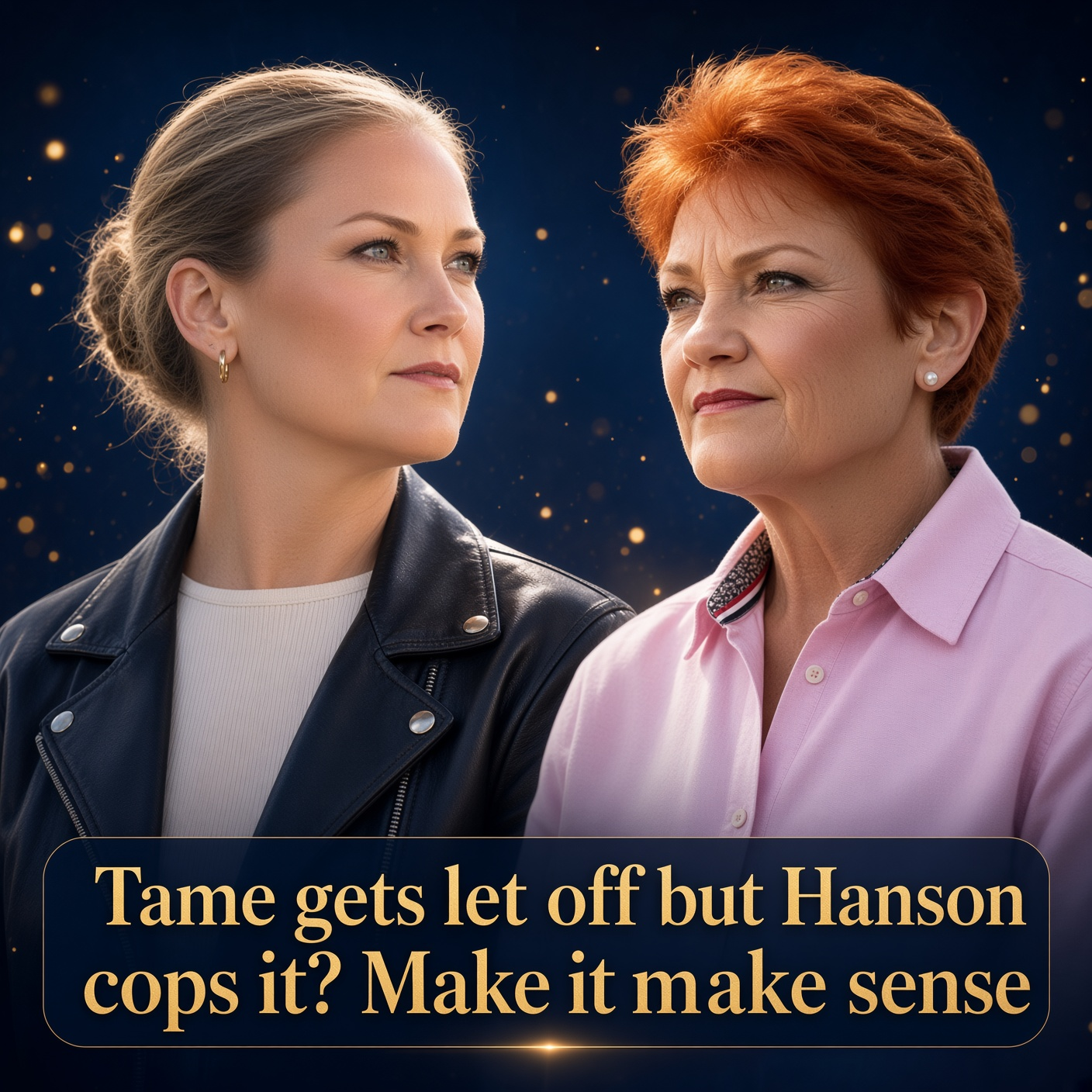
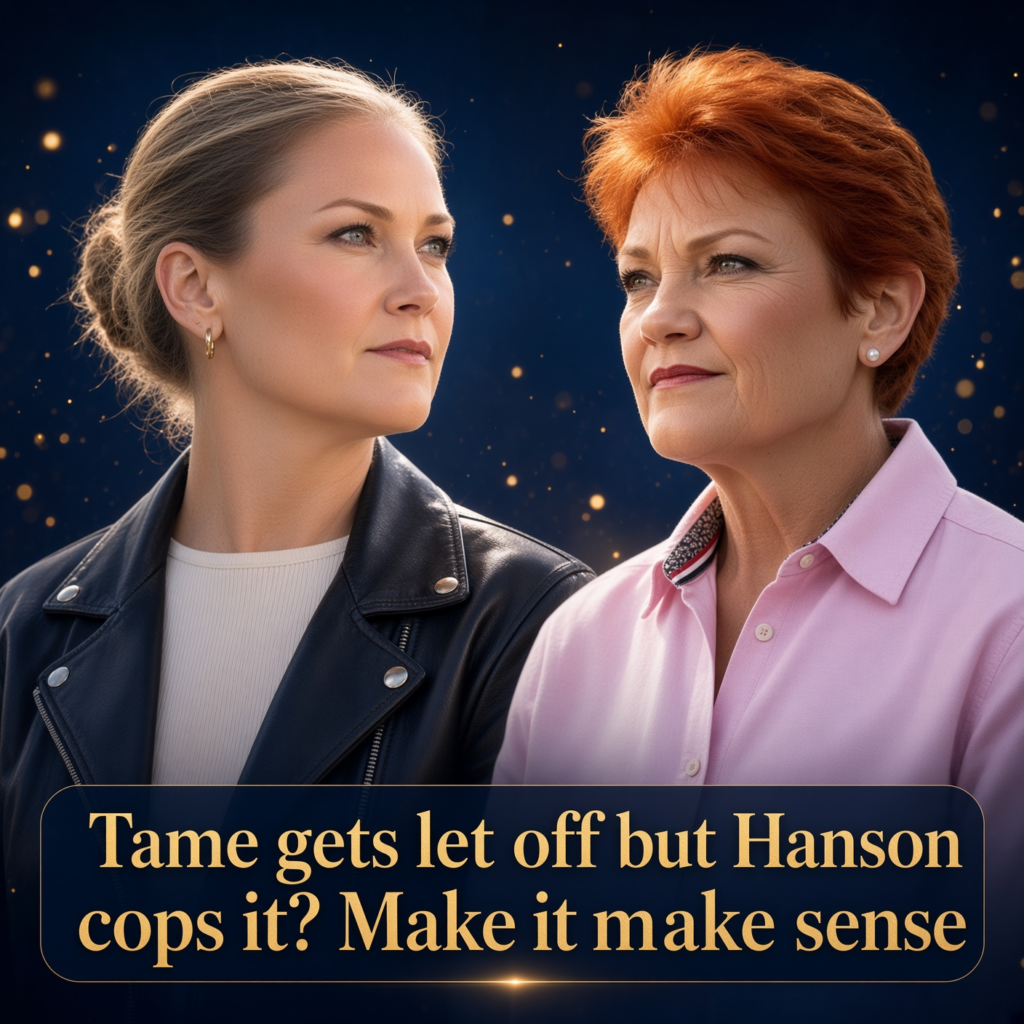
Pauline Hanson’s latest court fight has reopened one of Australia’s most difficult free-speech arguments, with critics asking why the One Nation leader faced a successful racial discrimination action while Grace Tame faced no comparable legal consequences after leading a controversial “globalise the intifada” chant at a Sydney protest.
That comparison is at the centre of a new commentary by columnist Kylie Lang, who argues the contrast exposes a double standard in the way offensive political expression is treated in Australia.
It is a powerful political argument.
Legally, however, the comparison is considerably more complicated.
Hanson’s case arose under a specific provision of the federal Racial Discrimination Act after Greens senator Mehreen Faruqi personally brought proceedings against her.
Tame’s February remarks occurred at a political protest and generated intense condemnation, but the words, circumstances and applicable laws were different.
Understanding whether the two cases demonstrate hypocrisy therefore requires separating three questions that are often collapsed into one: whether speech is offensive, whether it is socially harmful and whether it is unlawful.
Those are not necessarily the same thing.
What Hanson actually lost in court
The Hanson case began with an exchange on Twitter, now X, following the death of Queen Elizabeth II in September 2022.
Faruqi wrote that she could not mourn the leader of what she described as a “racist empire built on stolen lives, land and wealth of colonised peoples”.
Hanson responded angrily.
She told Faruqi that her attitude “appals and disgusts me” and said the Greens senator should “pack your bags and piss off back to Pakistan”.
Faruqi subsequently brought Federal Court proceedings alleging Hanson’s response contravened section 18C of the Racial Discrimination Act.
In 2024, Justice Angus Stewart ruled against Hanson.
The court concluded her post constituted unlawful racial discrimination under section 18C and ordered the offending post removed.
The judgment did not simply hold that Hanson had been rude or that Faruqi had been offended.
The court had to consider the elements contained in the legislation and determine whether the conduct fell within them.
Justice Stewart also rejected Hanson’s constitutional argument concerning the implied freedom of political communication.
Hanson then lost her appeal
Hanson challenged the decision.
On July 27 this year, a three-judge Full Federal Court unanimously dismissed her appeal.
Justices Melissa Perry, Geoffrey Kennett and Elizabeth Bennett found that none of Hanson’s seven grounds of appeal had been established.
The Full Court upheld the primary judgment’s analysis that Hanson’s remarks targeted groups including immigrants and people of colour and satisfied the relevant statutory test.
Faruqi described the decision as a victory for Australians who had been told to “go back where you came from” and argued that hate speech should not be protected as free speech.
Hanson took the opposite view.
She said Australians needed the freedom and courage to express opinions on important political questions even when other people found those views offensive.
Her legal team began reviewing the Full Court decision with a view to pursuing the matter in the High Court.
The dispute therefore extends well beyond the original argument between two senators.
Hanson wants Australia’s highest court to confront the relationship between section 18C and the Constitution’s implied freedom of political communication.
What section 18C actually does
This is where much of the public argument becomes confused.
Section 18C does not make every offensive statement unlawful.
Broadly, it applies to conduct done otherwise than in private that is reasonably likely, in all the circumstances, to offend, insult, humiliate or intimidate another person or group where the conduct is done because of race, colour or national or ethnic origin.
The legislation also contains exemptions under section 18D, including protections applying in specified circumstances to artistic works, academic and scientific debate, fair and accurate reporting and fair comment on matters of public interest where the statutory requirements are met.
Section 18C has been controversial for decades, particularly because of the words “offend” and “insult”.
Critics argue those concepts create an excessively low threshold for restricting speech.
Supporters argue the provision has an important role in protecting Australians from serious racial abuse and that judicial interpretation is more demanding than simply proving somebody’s feelings were hurt.
Attempts to substantially change the provision have repeatedly become politically contentious.
Hanson’s case could return that debate to the centre of national politics.
Then there is Grace Tame
Lang’s argument draws its force from a completely different controversy.
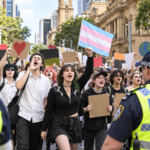
In February, former Australian of the Year Grace Tame addressed a large pro-Palestinian demonstration in Sydney during the visit of Israeli President Isaac Herzog.
At the rally, she led protesters in the chant:
“From Gadigal to Gaza, globalise the intifada.”
The words produced immediate political backlash.
NSW Premier Chris Minns described the episode as distressing, while federal politicians including Barnaby Joyce and Julian Leeser strongly criticised the chant.
Some members of Australia’s Jewish community regard “globalise the intifada” as a threatening expression associated with violence against Jews and the history of Palestinian uprisings against Israel.
The phrase became especially sensitive in Australia’s already tense political environment.
But its meaning is contested.
Tame says she was not advocating violence
Tame rejected the interpretation that she had called for violence or antisemitism.
After the controversy erupted, she publicly described herself as opposed to violence and racism and said she did not advocate antisemitism, Islamophobia or hatred.
She argued that “intifada” literally means “shaking off” and accused critics of deliberately applying the most sinister possible interpretation to her words.
The Arabic term has historically been used to describe Palestinian uprisings against Israel, including periods involving serious violence and terrorism.
But it can carry different meanings depending on speaker and context.
For some Palestinians and supporters, it signifies resistance or struggle for Palestinian self-determination.
For many Jewish Australians, particularly when combined with the instruction to “globalise” it, the phrase evokes violent attacks associated with previous intifadas.
That disagreement over meaning is central to the controversy.
It is therefore inaccurate to simply convert Tame’s chant into an uncontested statement that she called for people to be killed.
That is an interpretation advanced by some of her critics.
Tame explicitly rejects it.
So why wasn’t Tame treated like Hanson?
This is the question Lang’s column asks.
But there is a legal complication that any comparison must acknowledge.
Section 18C is not a general-purpose prohibition against offensive political speech.
The legal test requires particular statutory elements.
Hanson’s case involved a statement directed at an identifiable individual — Faruqi — telling her to return to Pakistan.
Faruqi then pursued a discrimination complaint and ultimately Federal Court proceedings.
Tame’s statement occurred in a different context, involved different words and was directed through a political protest chant.
Whether somebody finds one statement more offensive than another does not determine whether both satisfy the same statute.
That distinction is fundamental.
The law does not operate by ranking offensive remarks from least offensive to most offensive and prosecuting whichever one appears worst.
Different laws contain different elements, defences and enforcement mechanisms.
That does not make the double-standard debate disappear
The legal distinction does not necessarily answer the broader political criticism.
Critics of section 18C are asking a different question.
They argue Australians see apparently severe or inflammatory political rhetoric tolerated in some contexts while other remarks lead to lengthy litigation.
That perception can damage public confidence even where lawyers can explain why different statutes produce different outcomes.
Lang argues that ideological orientation influences which forms of offensive speech attract institutional consequences.
Her contention is that speakers on the political right face greater risks for controversial statements about race or immigration than figures on the left face for inflammatory language associated with anti-Israel activism.
That is an argument about consistency, culture and enforcement rather than a judicial finding.
It is contested.
But the political potency of the argument is obvious.
Queensland shows the law is already moving
There is also an important development that complicates any suggestion that “globalise the intifada” is simply beyond the reach of Australian law.
Queensland has enacted hate-speech legislation restricting the use of that phrase and “from the river to the sea” in specified circumstances.
The laws apply where prohibited expressions are used in a manner captured by the legislation, including circumstances involving menacing, harassment or offence.
They carry a maximum prison term of two years.
More than 20 people have already been charged under the Queensland provisions.
That does not mean Tame committed an offence in NSW in February.
It does demonstrate that Australian governments are actively attempting to regulate precisely the type of expression at the centre of her controversy.
And those Queensland laws are heading to the High Court too
Remarkably, the debate is now producing constitutional litigation from both directions.
A group of pro-Palestinian protesters has launched a High Court challenge against Queensland’s restrictions.
The challengers argue the legislation impermissibly burdens Australia’s implied constitutional freedom of political communication.
More than 20 people have been charged since the provisions took effect in March.
So while Hanson seeks to invoke constitutional political communication protections against section 18C, pro-Palestinian activists are relying on related constitutional principles to challenge restrictions on slogans including “globalise the intifada”.
That symmetry is significant.
Both controversies ultimately raise a similar constitutional question: how far can Australian governments go in restricting political expression in order to protect other members of the community from racial hostility, intimidation or social harm?
Australia does not have an American-style free-speech right
Much of the public confusion surrounding these disputes comes from importing assumptions from the United States.
Australia has no equivalent to the US First Amendment providing a broad constitutional right to free speech.
The High Court has instead recognised an implied freedom of political communication derived from Australia’s constitutional system of representative and responsible government.
It is not a personal right to say anything.
It operates as a restriction on legislative power in circumstances where laws impermissibly burden political communication.
That distinction is critical to Hanson’s proposed challenge.
She cannot simply argue that section 18C offends a general constitutional right to free speech, because Australia does not have one in that form.
Her constitutional argument must operate within the High Court’s implied-freedom jurisprudence.
The High Court could inherit two very different speech battles
If Hanson’s case proceeds, the nation’s highest court could find itself considering section 18C at the same time Australia is wrestling with challenges to newer hate-speech restrictions.
The political positions surrounding those cases are not always comfortable or predictable.
Conservatives who want stronger restrictions on “globalise the intifada” may simultaneously support Hanson’s argument for greater freedom from racial-vilification laws.
Progressives who defend protest slogans as political expression may simultaneously defend section 18C’s restrictions on racial speech.
That tension exposes the hardest part of the free-speech debate.
Most people support free expression most strongly when the speech involved is expression they sympathise with.
The genuine test arrives when the speaker is someone they dislike and the message is something they find offensive.
Political consequences are different from legal consequences
Tame did not emerge from the February controversy without consequences of any kind.
She faced extensive public and political criticism.
There were calls for her Australian of the Year honour to be revoked and demands that authorities investigate her conduct.
Events involving her also came under political pressure.
But those are reputational and political consequences, not equivalent to a Federal Court judgment.
Hanson, meanwhile, has faced both.
Her original tweet generated political condemnation and ultimately produced an adverse legal judgment that survived a unanimous Full Federal Court appeal.
The distinction matters when assessing claims that one woman “got away with it” while another did not.
Faruqi’s role cannot be ignored either
Another difference is often missing from the comparison.
Hanson’s litigation did not simply materialise because the government selected her for punishment.
Faruqi pursued the complaint.
The Greens senator was the person directly targeted by Hanson’s tweet and took legal action under the mechanisms available to her.
That matters because civil discrimination law depends in significant part on complaints and litigation being initiated.
Two apparently comparable statements can therefore produce very different legal histories depending on who was targeted, which laws potentially apply, whether a complaint is made and whether proceedings are pursued.
That may produce outcomes the public perceives as inconsistent without proving that judges or governments deliberately applied one ideological standard to one speaker and another standard to somebody else.
But consistency remains a legitimate public question
None of those legal distinctions means Australians should stop asking whether speech laws are coherent.
If governments prohibit racial abuse, citizens are entitled to ask where the boundaries sit.
If lawmakers criminalise some threatening political slogans, they must explain why those phrases qualify while others do not.
If political communication is protected in one context, courts must explain why restrictions remain constitutionally valid in another.
And if legislation uses concepts such as offence, insult, humiliation or intimidation, Parliament should expect continuing debate over whether those concepts draw the line in the right place.
That is ultimately where the Hanson–Tame comparison becomes most useful.
Not because the two cases are legally identical.
They are not.
But because together they expose how difficult Australia finds the task of balancing political expression against protection from racial hostility and intimidation.
The coming court fights could reshape the debate
Hanson wants her case to become a major test of section 18C and political communication.
Pro-Palestinian activists are simultaneously challenging Queensland restrictions on protest slogans.
Both sides are invoking freedom of political expression while arguing over very different forms of speech.
The eventual outcomes could clarify how much latitude governments have to regulate inflammatory political language.
They could also force Australia’s political parties to confront inconsistencies in their own approaches to free speech.
For now, Kylie Lang’s “double standards” argument should be understood for what it is: a forceful opinion about the apparent asymmetry between two controversial speakers, rather than proof that the two women committed legally equivalent acts and received ideologically different judgments.
Hanson’s conduct has been tested in the Federal Court and found unlawful under section 18C.
Tame’s chant provoked widespread condemnation, but she rejects claims that it advocated violence and her conduct has not produced an equivalent judgment.
Meanwhile, governments are already legislating against the very slogan at the centre of her controversy — and those laws are themselves heading towards constitutional scrutiny.
That makes the real story larger than either Hanson or Tame.
Australia is entering a consequential argument about what political speech should remain lawful, what should carry consequences, and whether the principles applied to one side of politics can survive when the speaker comes from the other.