yan Evans kept one hand buried in Max’s fur.
He did not seem capable of letting go.
Neither did Max.
The German Shepherd stood with his front paws beside Ryan’s hospital bed, neck stretched forward, head pressed beneath the man’s chin.
Emily remained near the door.
She felt strangely intrusive.
This was her dog.
Her Max.
The animal who slept beside her bed.
Who waited outside the bathroom.
Who knew which kitchen cabinet held the treats.
Who could distinguish the sound of her car from every other vehicle on the street.
Yet she was watching him greet someone from a life she had never known existed.
Ryan whispered again.
“Bear.”
Max’s tail thumped against the bed frame.
Claire wiped both cheeks.
“Oh my God.”
Ryan looked at his sister.
Then at Emily.
His expression became confused.
“Where did you find him?”
Emily stepped closer.
“I adopted him almost six years ago.”
Ryan’s hand stopped.
“Six years.”
“Yes.”
He looked back at Max.
“You’re not a puppy anymore.”
Max licked his wrist.
Ryan laughed.
Then winced.
The monitor beside him beeped faster.
Claire immediately said, “You need to calm down.”
“I’m calm.”
“You almost passed out again saying that.”
A nurse entered.
She checked Ryan’s blood pressure and asked everyone to give him a little room.
Max complied only after Emily touched his collar.
This time he listened.
Barely.
He lay beside the bed instead, his body facing Ryan.
The nurse looked down.
“He yours?”
Ryan glanced at Emily.
“No.”
The word came slowly.
“He used to be.”
Emily felt that sentence.
Used to be.
She sat in the chair beside the window.
“Can you tell me what happened?”
Ryan nodded.
Then shook his head.
“Not all of it.”
Claire folded her arms.
“Start with why you never told me Bear survived.”
Ryan looked guilty.
“That part takes some explaining.”
The doctor returned first.
Ryan’s collapse had not been a heart attack.
He had been dehydrated, severely sleep-deprived, and his blood sugar had dropped after almost an entire day without eating.
There was also an abnormal heart rhythm they wanted a cardiologist to evaluate.
Nothing immediately catastrophic.
Enough to keep him overnight.
Claire glared.
“You told me you were taking care of yourself.”
“I was.”
“You collapsed on a sidewalk.”
“Temporary inconsistency.”
Emily almost smiled.
Claire did not.
The doctor left.
Ryan looked at Max again.
“You called him Max?”
“Yes.”
“Good name.”
“He seems to like it.”
Ryan scratched behind the dog’s ear.
“I called him Bear because his paws were ridiculous.”
Emily looked down.
“They still are.”
That finally made everyone laugh.
Then Ryan began.
Six years earlier, he had been working as an emergency veterinary technician while volunteering with a regional animal-rescue transport group.
Not glamorous work.
Early mornings.
Nighttime pickups.
Driving injured animals from rural shelters to veterinary clinics and foster homes.
During a February ice storm, a transport van carrying nine dogs skidded off Interstate 90.
No human fatalities.
Several dogs were injured.
One crate ruptured.
A five-month-old German Shepherd puppy disappeared into freezing brush beside the highway.
Ryan joined the search.
They found the puppy almost twelve hours later beneath an abandoned equipment shed.
Hypothermic.
Cut paw.
Terrified of people.
“He tried to bite me,” Ryan said.
Emily looked at Max.
“This dog?”
“Repeatedly.”
Max yawned.
“Revisionist history,” Emily said.
Ryan smiled.
“He was scared.”
The rescue had no open foster home suitable for a large, fearful adolescent Shepherd.
Ryan volunteered.
“Temporary,” Claire said.
Ryan gave his sister a look.
“That’s what they said.”
“How long?”
“Four months.”
Claire turned to Emily.
“He sent me pictures constantly.”
“You knew about Bear?”
“I knew he had a foster puppy.”
Claire shrugged.
“Ryan always had some animal around.”
“Then why did you recognize Max?”
Claire looked at the white patch.
“That marking.”
She remembered because Ryan once sent a photograph of the puppy with yogurt under his chin.
Claire thought the white patch was yogurt.
Ryan replied:
Nope. Built-in milk mustache.
Emily laughed.
“That sounds like him.”
Ryan’s expression softened.
“Bear was a mess at first.”
He could not tolerate closed crates.
Panicked at diesel engines.
Flattened himself whenever someone lifted an arm too quickly.
Refused food unless Ryan left the room.
For the first week, he slept behind Ryan’s couch.
Ryan did not pull him out.
Did not corner him.
Did not demand affection.
He left water.
Food.
A blanket.
Sat on the floor and read.
“Read what?” Emily asked.
“Crime novels.”
“To a dog?”
“I didn’t say the books were for him.”
Claire snorted.
“They were absolutely for him.”
Eventually Bear began appearing while Ryan read.
First across the room.
Then six feet away.
Then three.
One night Ryan fell asleep on the floor.
He woke with the puppy’s head across his ankle.
“That was the first time he touched me voluntarily.”
Ryan looked at Max.
The dog watched him intently.
Emily knew that look.
Max still used it when she was upset.
“What happened after four months?”
Ryan’s face changed.
The answer was obviously not as pleasant.
“I got injured.”
Emily straightened.
“At work?”
“Car accident.”
Ryan had been driving home after an overnight shift.
Another driver ran a red light.
Ryan’s truck rolled.
Broken femur.
Pelvic fracture.
Three ribs.
Concussion.
Multiple surgeries.
Weeks in hospital.
Months of rehabilitation.
He lived alone.
Could not walk without assistance.
Could not handle a large adolescent Shepherd.
“The rescue moved Bear.”
Emily’s chest tightened.
“To where?”
“A foster family.”
“Did you get him back afterward?”
Ryan shook his head.
“I tried.”
Claire looked surprised.
“You told me he’d been adopted.”
“He was.”
Ryan looked at Emily.
“By the time I could safely take him, the rescue said he had been transferred into an adoption program.”
Emily thought back.
The organization she adopted Max from was not the same rescue Ryan named.
“How did he move from yours to Spokane?”
Ryan shook his head.
“I don’t know.”
The organizations had partnered during overcrowding.
Dogs moved between foster networks.
Records were sometimes fragmented, especially when volunteer groups merged or dissolved.
Bear apparently became Max somewhere in that process.
Ryan continued.
“I asked if I could adopt him.”
“What did they say?”
“He had already been matched with someone.”
Emily’s stomach twisted.
“With me.”
“Probably.”
Ryan smiled.
“I was angry for about two days.”
“And after that?”
“I realized the entire point was for him to have a stable home.”
Ryan looked around the hospital room.
“I didn’t exactly qualify at the time.”
Emily studied him.
“You never tried to find out who adopted him?”
“I asked whether he was safe.”
“And?”
“They said yes.”
“That was enough?”
Ryan looked at Max.
“It had to be.”
Something in Emily shifted.
She had expected jealousy.
Possessiveness.
A claim.
You have my dog.
Instead Ryan seemed almost relieved.
“How did he end up with you?” he asked.
Emily told him.
She had been twenty-nine.
New city.
New job.
Recently divorced.
She went to a rescue event intending to “just look.”
Max sat at the back of a kennel.
Seven or eight months old.
Quiet.
No jumping.
No barking.
He watched every person who passed.
Emily sat in front of him for twenty minutes.
Eventually he walked over and placed one paw on her shoe.
Ryan closed his eyes.
“He used to do that.”
“What?”
“One paw.”
Emily nodded.
“He still does.”
The adoption coordinator warned that Max needed patience.
Traffic made him anxious.
Crates were difficult.
Diesel trucks triggered trembling.
Emily spent months working with a trainer.
She changed his crate setup.
Then eventually stopped using one except for travel emergencies.
She learned his thresholds.
His signals.
His routines.
“Was he ever afraid of you?” Ryan asked.
“Not exactly.”
She thought.
“Cautious.”
Ryan smiled.
“That sounds like him.”
“He slept outside my bedroom for two months.”
“Outside?”
“Wouldn’t come in.”
“Then?”
“One night I woke up and he was beside the bed.”
Ryan laughed softly.
“Same dog.”
Max placed his head on Ryan’s hand.
Emily watched.
The resemblance between their experiences felt almost eerie.
But there was nothing mystical about it.
Traumatized animals carried patterns.
Safety built slowly.
Once learned, some strategies remained.
Ryan had begun the process.
Emily had continued it.
The doctor interrupted again.
Visiting time needed to end.
Ryan looked genuinely distressed when Emily stood.
“You’ll bring him back?”
Emily hesitated.
Not because she wanted to withhold Max.
Because the question carried weight.
“Tomorrow.”
Ryan nodded.
“Thank you.”
Emily clipped Max’s leash.
“Come.”
Max stayed beside the bed.
“Max.”
Nothing.
Ryan smiled.
“Bear.”
Max looked at him.
Emily stared.
“Traitor.”
Ryan laughed.
Then he touched Max’s cheek.
“Go with Emily.”
The German Shepherd stood immediately.
Emily’s mouth opened.
Ryan looked guilty.
“Sorry.”
“No.”
She narrowed her eyes.
“I’m offended.”
Claire laughed.
Outside the hospital, Max stopped.
Looked back at the doors.
Emily crouched.
“You have some explaining to do.”
Max licked her face.
“Unacceptable.”
But she smiled.
At home that night, Emily could not stop thinking about the four months of Max’s life she had never known.
She pulled out the folder the rescue had given her at adoption.
Vaccination records.
Neuter documentation.
Basic behavioral notes.
Approximate age.
Transferred from Inland Northwest Canine Response.
There it was.
INLAND NORTHWEST CANINE RESPONSE.
Ryan’s organization.
Emily had seen the name hundreds of times.
It had never meant anything.
Now she searched through old documents.
One page included foster initials.
R.E.
She stared.
Ryan Evans.
Max lay beside her.
“You really did know him.”
Tail thump.
Emily searched her phone for photographs from the first months after adoption.
Max skinny.
Huge ears.
White patch under chin.
Nervous eyes.
Then she thought about Ryan in the hospital.
The way Max had recognized him while unconscious.
Or perhaps before he collapsed.
Smell.
Voice.
Body odor.
Something.
People underestimated canine memory because dogs could not explain it.
Research suggested dogs could retain long-term associations with humans, especially strong scent and emotional experiences.
Emily did not need supernatural explanations.
Ryan had been part of Max’s earliest experience of safety.
Six years disappeared in a second.
The next morning Emily brought Max back.
She also brought the adoption folder.
Ryan was sitting upright eating breakfast.
Claire had clearly forced him.
“Look what I found.”
Emily handed him the transfer page.
Ryan stared at the initials.
“R.E.”
“Yours?”
“Yes.”
His eyes filled.
“I filled this out.”
The page contained notes.
NO FORCED CRATING.
STARTLES AT DIESEL ENGINES.
FOOD MOTIVATED AFTER TRUST ESTABLISHED.
SLEEPS BETTER WITH HUMAN PRESENCE NEARBY.
GOOD WITH CALM DOGS.
SEEK POSITIVE-REINFORCEMENT HOME.
Emily looked at him.
“You wrote the instructions that taught me how to live with him.”
Ryan swallowed.
“I forgot about this.”
“I didn’t.”
She smiled.
“I just didn’t know who wrote it.”
That affected him more than seeing Max.
He turned away.
Claire squeezed his shoulder.
Ryan whispered:
“I always wondered whether anyone read those notes.”
Emily sat.
“I read every word.”
He looked at her.
“When he panicked in the crate, I went back to the page.”
Ryan pressed his lips together.
“I spent months feeling like I failed him.”
“You didn’t.”
“I disappeared.”
“You were hit by a car.”
“He didn’t know that.”
“No.”
Emily looked at Max.
“But somebody made sure what you learned about him followed him.”
Ryan nodded slowly.
That mattered.
Not everything had been lost in the transfer.
The best part of Ryan had traveled with Max in four lines of foster notes.
The cardiologist eventually diagnosed Ryan with an intermittent rhythm disturbance complicated by extreme stress, dehydration, and lack of sleep.
Manageable.
Medication.
Monitoring.
Actual meals.
Claire took this last instruction personally.
She filled Ryan’s refrigerator before discharge.
Emily and Max came to his apartment two days later.
This time Max entered as if he had been visiting for years.
He sniffed.
Kitchen.
Living room.
Bedroom doorway.
Then stopped at a framed photograph.
Young Ryan.
Maybe thirteen.
A German Shepherd beside him.
Duke.
Emily remembered the source of Claire’s first association.
“Is that your childhood dog?”
Ryan nodded.
“Duke.”
The Shepherd was dark sable.
Very different from Max.
“He died when I was thirteen.”
“You never got another?”
“Not permanently.”
“Why?”
Ryan shrugged.
“Losing him wrecked me.”
That answer sounded simple.
Too simple.
Emily waited.
“My parents offered.”
“I said no.”
He looked at Duke’s photograph.
“Then I started volunteering with animals in college.”
“Which is basically owning many dogs temporarily.”
Ryan smiled.
“Exactly.”
Max sat beneath the photograph.
Ryan looked at him.
“Bear was the closest I came.”
Emily noticed he switched naturally between Bear and Max.
At first she thought it might confuse the dog.
It did not seem to.
Max responded to both when Ryan used them.
Dogs were apparently less concerned with administrative naming continuity than humans.
Over the next few weeks, Ryan recovered.
Emily did not bring Max every day.
That mattered.
Ryan never asked her to.
He understood Max belonged to Emily now.
Sometimes they walked together.
Sometimes Ryan came to Emily’s neighborhood.
Max behaved differently with each person.
With Emily, he checked in constantly.
Looked back.
Matched her pace.
With Ryan, he became younger.
More playful.
Pulled toward familiar games Emily had never taught him.
One was ridiculous.
Ryan would hide behind a tree.
Max would search.
Then jump.
Emily watched the first time.
“You taught him this?”
“Kind of.”
“Why?”
“He was afraid of people appearing unexpectedly.”
“So you turned it into a game.”
Ryan nodded.
“Predictable disappearance.”
Emily understood.
Hide.
Return.
Reward.
An old training exercise.
Max remembered.
That evening Emily sat on her porch with him.
“You have been keeping secrets.”
Max sighed.
She scratched beneath the white patch.
For the first time, she realized something important.
Learning Max had loved someone before her did not make their bond smaller.
She had felt a flicker of jealousy in the hospital.
Embarrassing.
Human.
The dog she believed belonged wholly to her had an emotional history.
Of course he did.
Every rescued animal did.
People simply lacked access to most of it.
The unknown years did not begin when adoption paperwork was signed.
One afternoon Ryan asked a difficult question.
“Can I see the place you adopted him from?”
The Spokane rescue had changed locations.
New staff.
But records remained.
Emily contacted them first.
They agreed to meet.
Ryan did not expect recognition.
He got some.
A volunteer named Marsha had been there six years.
When she saw the old intake number, she gasped.
“Oh, Bear.”
Ryan laughed.
“You remember?”
“He was a nightmare.”
Emily looked offended.
Marsha smiled.
“In a loving way.”
She remembered receiving him from Inland Northwest.
He would not enter the kennel building.
They sat outside for two hours.
A young volunteer eventually brought another calm dog.
Bear followed.
“He was supposed to stay with us three days.”
“How long?” Ryan asked.
“Six weeks.”
“Why?”
“Every potential adopter wanted a German Shepherd.”
Marsha rolled her eyes.
“Then they met an adolescent German Shepherd who panicked around vans, hated confinement, and needed slow introductions.”
Ryan nodded.
“So Emily was the first good match.”
Marsha smiled.
“Emily was the first one who sat down and stopped trying to impress him.”
Emily laughed.
“That’s how I remember it.”
Marsha retrieved the archived adoption notes.
One evaluator had written:
POTENTIAL ADOPTER SAT QUIETLY 18 MINUTES. DOG APPROACHED VOLUNTARILY. NO PRESSURE. GOOD RESPONSE.
Ryan read it.
Then looked at Emily.
“You did what I did.”
“What?”
“Waited.”
She smiled.
Apparently Max had chosen people with patience.
The rescue had one old photograph.
Bear at six months.
Ryan was visible in the background.
Not posing.
Sitting on the floor in a sweatshirt.
Bear asleep against his leg.
Emily stared.
“That’s you.”
Ryan nodded.
The photograph hit harder than expected.
Max’s life suddenly possessed continuity.
Not a blank beginning.
Someone had been there.
Someone had stayed awake when he cried.
Someone had written the instructions.
Someone had lost him without choosing to.
Marsha offered Ryan the photograph.
He shook his head.
“Emily should have it.”
Emily disagreed.
“Make copies.”
That became the solution.
No symbolic ownership contest.
Copies.
Ryan eventually asked:
“Do you think he recognized me before I collapsed?”
Emily had wondered too.
They knew Max had run toward Ryan moments before he went down.
Maybe Ryan’s scent reached him.
Maybe a posture.
Maybe voice.
Maybe coincidence first, recognition second.
There was no way to know precisely.
What they did know was Max immediately behaved toward Ryan with unusual attachment.
The rest could remain uncertain.
Ryan liked that answer less than Emily.
“I want to know.”
“You work with animals.”
“You should be comfortable with uncertainty.”
“I’m terrible at it.”
“Clearly.”
He smiled.
Their friendship grew.
People occasionally assumed romance.
It was not.
Ryan was dating no one.
Emily had been happily single for years.
Their relationship formed around Max but expanded into something sibling-like.
Claire teased them anyway.
Max did not care.
A year after the sidewalk collapse, Ryan returned to rescue volunteering.
Not because Max “healed” him.
Because nearly dying from self-neglect forced him to reconsider how he lived.
He reduced work hours.
Saw a cardiologist.
Went to therapy.
Cooked badly.
Started sleeping.
Claire monitored all of this aggressively.
One Saturday Emily joined him at an adoption event.
Max wore a volunteer bandanna.
Ryan worked with frightened dogs.
He had not lost the skill.
A young Shepherd mix named Toby refused to leave the back of his kennel.
A couple waited outside.
Ryan sat sideways.
Did not stare.
Tossed treats.
Talked to the adopters instead of the dog.
Twenty minutes.
Thirty.
Toby crept forward.
Emily watched.
“That’s what you did with Max.”
Ryan nodded.
“Fear gets louder when everyone makes it the center of attention.”
Toby eventually approached the couple.
Not adopted that day.
Good.
Ryan liked adopters who went home to think.
A week later they returned.
Then adopted.
Ryan did not call it fate.
He called it appropriate matching.
Max approved by sniffing Toby once and then becoming interested in a trash can.
Two years passed.
Ryan became a foster again.
His first foster was not a Shepherd.
He deliberately chose a tiny senior Beagle named Ruthie because Claire said he was “emotionally typecasting.”
Ruthie had six teeth.
Hated rain.
Snored like construction equipment.
Ryan adored her.
She was adopted by a retired librarian after three months.
Ryan cried for two days.
Emily said:
“Welcome back.”
He understood.
Fostering required learning that grief could accompany success.
He fostered again.
And again.
Never immediately adopted one.
He did not need to possess every animal he helped.
Max’s history had taught him that too.
Ryan could love an animal and still be one chapter.
Emily could be the next.
No betrayal.
No replacement.
Continuity.
At eight, Max developed degenerative changes in one hip.
Nothing severe.
Management.
Weight control.
Swimming.
Ryan had access to a canine rehabilitation facility through rescue contacts.
Max began hydrotherapy.
He hated the treadmill.
Loved the treats afterward.
Ryan called him manipulative.
Emily defended him.
At nine, Max’s muzzle began graying.
Ryan noticed first.
“Bear is getting old.”
Emily looked at him.
“Max.”
“Both.”
She smiled.
“Both.”
The two names had stopped competing.
Bear belonged to the puppy.
Max belonged to the life after.
Same dog.
At ten, Claire found an old box in Ryan’s mother’s attic.
Inside were photographs of Duke.
Collar.
Vet records.
And a composition Ryan wrote at age thirteen after Duke died.
Title:
THE BEST DOG IN THE WORLD.
Claire read it aloud without permission.
Ryan threatened legal action.
Emily laughed until she cried.
The essay contained lines like:
Duke understood me better than any human and possibly possessed advanced intelligence.
Ryan groaned.
“I was thirteen.”
Emily pointed.
“You literally believed your dog was smarter than people.”
“Some people.”
Still plausible.
The essay ended differently.
I don’t want another dog because another dog would mean Duke is replaceable.
Ryan went quiet.
So did Emily.
That belief had followed him.
Not consciously.
But there.
He had fostered because temporary animals felt safer emotionally.
He could love them without fully saying this is mine.
Bear had challenged that.
Then the car accident removed the decision.
Ryan looked at Max.
“I think I spent years telling myself the rescue taking him was practical.”
“It was.”
“Yes.”
“But?”
“It was also convenient.”
Emily frowned.
“How?”
“I never had to test whether I could love another dog permanently.”
Max rested his chin on Ryan’s shoe.
Emily asked:
“Do you want one now?”
Ryan looked at Ruthie’s empty old bed.
“I don’t know.”
“Good answer.”
Another year passed.
Then a rescue contacted him about a dog named Atlas.
Five-year-old mixed-breed Shepherd.
Owner died.
Adult children could not take him.
Stable temperament.
No major behavior issues.
Just grief and displacement.
Ryan agreed to foster.
Atlas arrived.
Large.
Black-and-tan.
Not like Duke exactly.
Not like Max either.
He spent the first night by the front door.
Waiting.
Ryan recognized it.
Did not drag him away.
Placed a bed nearby.
Sat on the floor.
Read.
Crime novel.
Emily saw a photograph the next morning.
Atlas lying six feet from Ryan.
She texted:
YOU ARE DOING THE THING.
Ryan:
WHAT THING?
Emily:
THE FLOOR THING.
Ryan:
CLINICALLY VALID TECHNIQUE.
Three weeks later Atlas slept beside Ryan’s couch.
Six weeks later he put one paw on Ryan’s shoe.
Ryan stared.
Then called Emily.
“No.”
“What?”
“He did the paw.”
Emily immediately understood.
“Oh.”
“I’m in trouble.”
“Yes.”
Atlas became Ryan’s first permanent dog since Duke.
He did not replace Duke.
Or Bear.
That was the lesson Ryan finally accepted.
Love did not work by vacancy.
A new attachment did not evict an old one.
Max and Atlas became friends.
Not instant best friends.
Adult German Shepherd-type dogs did not necessarily become cinematic brothers on sight.
They tolerated.
Then walked together.
Then played.
Then eventually shared water bowls despite having two.
One Thanksgiving, Emily brought Max to Ryan’s apartment.
Claire came.
Atlas lay under the table.
Max beside him.
Claire looked at the dogs.
“Duke would’ve hated this.”
Ryan laughed.
“He hated other dogs.”
“Exactly.”
Emily raised her glass.
“To Duke’s continuing disapproval.”
Ryan smiled.
“To Duke.”
The strange day on the sidewalk became a story people around them repeated.
Over time, details mutated.
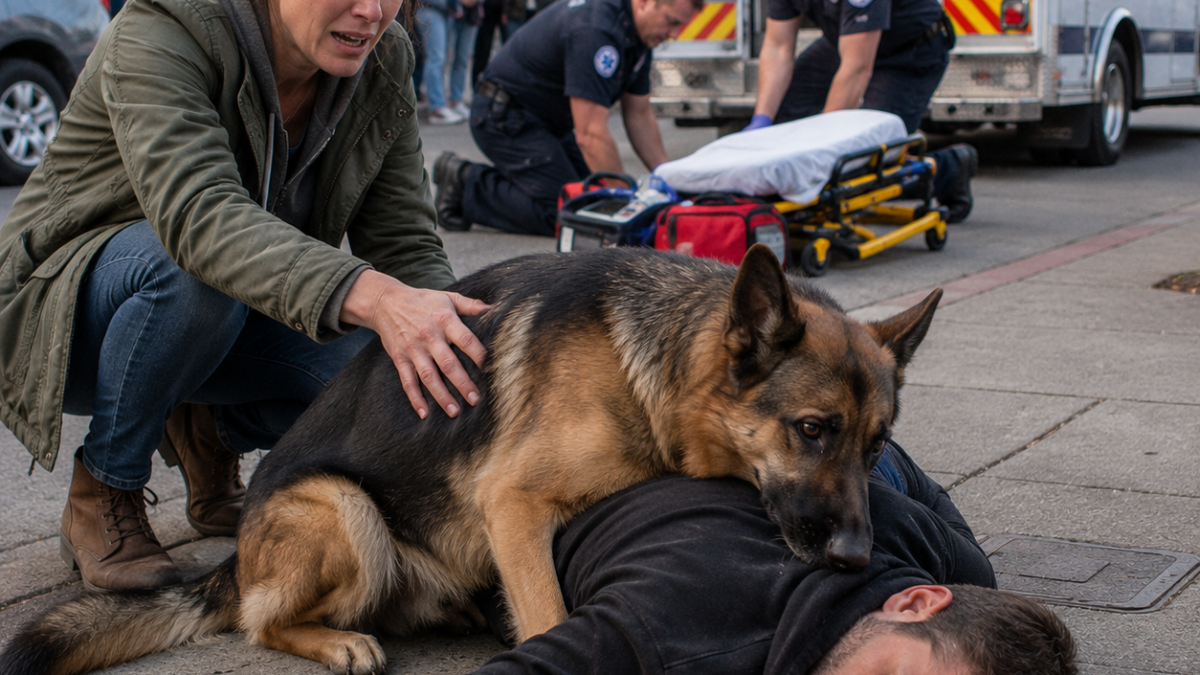
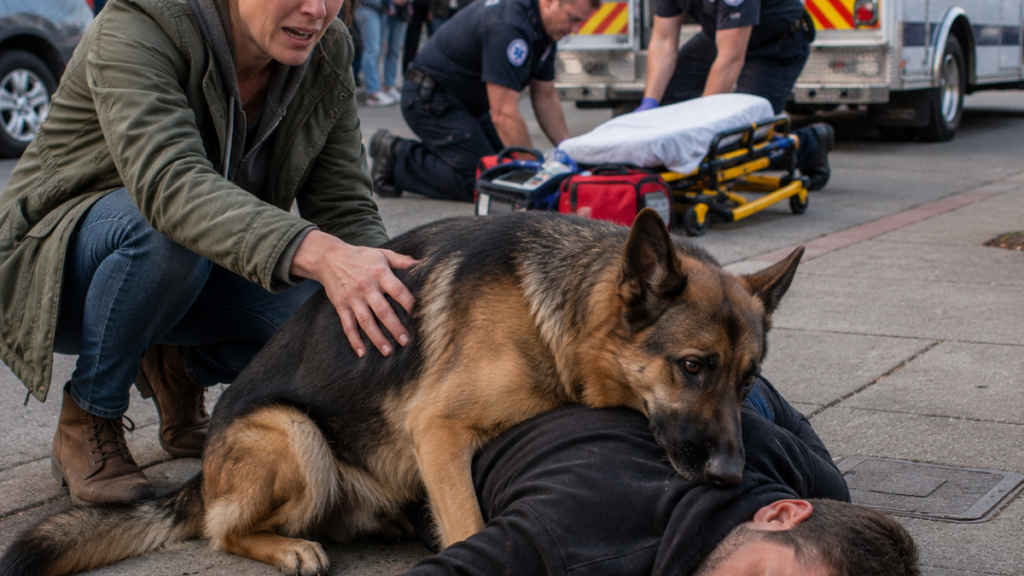
Someone said Max had laid on Ryan’s chest and stopped paramedics.
False.
Someone claimed Max barked until Ryan woke.
False.
One rescue volunteer said Ryan had originally owned Max for two years.
False.
Emily corrected people so often Claire told her to give up.
“I hate inaccurate stories.”
“You’re losing a war against human memory.”
Emily sighed.
The true version was good enough.
Max saw an unconscious man.
Would not leave.
The man had fostered him during a formative, frightening period of puppyhood.
Six years later the dog apparently recognized him.
No reincarnation.
No supernatural guardian.
No dead childhood dog possessing Max.
Ryan sometimes joked that Duke had sent him.
Emily allowed the joke.
Only the joke.
Because emotional meaning and factual explanation could coexist without becoming the same thing.
Ryan could feel as if Duke somehow echoed through the experience.
But the actual animal beside him was Max.
A dog with his own history.
That distinction became especially important as Max aged.
At eleven, his hips worsened.
At twelve, arthritis medication became daily.
At thirteen, hearing faded.
His nose remained excellent.
Ryan visited one afternoon after not seeing him for nearly four months.
Max was asleep.
Ryan entered quietly.
No reaction.
He crouched ten feet away.
Max’s nose moved.
Then his head lifted.
He stood painfully.
Walked directly to Ryan.
Pressed against him.
Ryan cried.
“You still know me.”
Emily leaned against the doorway.
“Of course.”
But both understood nothing was “of course” anymore.
Time was shortening.
At fourteen, Max was diagnosed with chronic kidney disease.
Early.
Manageable.
For a while.
Emily adjusted food.
Medication.
Fluids eventually.
Ryan came over to help with subcutaneous fluids because his animal-care experience made him useful.
Max hated the needle.
Loved Ryan’s cheese bribery.
“Traitor,” Emily said again.
Full circle.
At fifteen, Max stopped climbing stairs.
Emily moved her bedroom downstairs.
Ryan helped build a ramp.
Atlas was ten now and visited less because Max tired easily.
They took one final walk together in spring.
Half a mile.
Forty-five minutes.
Mostly sniffing.
Ryan laughed.
“We used to hike five miles.”
Emily watched Max investigate one blade of grass for approximately a geological era.
“He has adjusted his priorities.”
“So have I.”
Ryan had.
He volunteered less physically.
Mentored fosters more.
Helped write behavioral plans.
Fundraised.
Transported.
Claire joked he had finally become management.
He objected.
Then accepted a board position.
The rescue network improved records too.
Ryan had never forgotten how Bear became Max across organizations with fragmented history.
He pushed for transfer packets that followed every animal.
Original name.
Known foster history.
Medical information.
Behavior triggers.
Successful handling methods.
Microchip records.
Photographs.
“Names change,” Ryan told volunteers.
“History shouldn’t disappear just because a dog crosses county lines.”
Emily loved that.
Max’s story influenced something practical.
Not because his separation had been necessary.
Because once it happened, they could prevent parts of it from happening badly to other animals.
One afternoon the updated transfer system reunited a foster dog with a former military family after a microchip discrepancy was resolved.
Ryan called Emily.
“We got one.”
“One what?”
“A history.”
He explained.
The dog had been called Bella at intake.
Maggie at previous foster.
Microchip still under original family.
Instead of assuming the data conflict was clerical noise, staff investigated.
Family located.
Reunion.
Emily smiled.
“Max.”
Ryan paused.
“Bear.”
“Both.”
They laughed.
Max’s final decline came in autumn.
Not dramatic.
He ate less.
Slept more.
Began having difficulty standing.
Then one night he became restless.
Could not settle.
Emily sat beside him until dawn.
At six she called Ryan.
“I think we’re close.”
He understood immediately.
“What does the vet say?”
“Quality-of-life appointment at ten.”
“Do you want me there?”
Emily looked at Max.
“Yes.”
Ryan came with Atlas but left Atlas at home? Better not stress. He came alone.
He brought nothing except a small paper bag.
“What’s that?”
“Roast chicken.”
Emily almost laughed.
“Of course.”
The veterinarian examined Max.
Kidneys significantly worse.
Pain harder to control.
Neurologic weakness emerging in hind legs.
Could they extend life?
Possibly days.
Maybe weeks with aggressive intervention.
Would those weeks likely restore the life Max valued?
Probably not.
Emily cried.
Ryan sat on the floor.
He did not tell her what to choose.
That mattered.
This was her dog.
Not his foster puppy anymore.
Her responsibility.
Her decision.
Emily asked:
“If he were yours?”
The veterinarian answered carefully.
“I would choose comfort before crisis.”
Emily nodded.
Home euthanasia was scheduled for the next morning.
That night Max surprised them.
He ate roast chicken.
Walked into the yard.
Stood in cold grass.
Ryan and Emily sat beside him on the porch.
No dramatic conversation at first.
Then Ryan said:
“I used to wonder whether I should have fought harder to get him back.”
Emily looked at him.
“After your accident?”
“Yes.”
“You could barely walk.”
“I know.”
“He needed stability.”
“I know.”
“You wrote the notes.”
“I know.”
She smiled.
“So what are you actually asking?”
Ryan looked at Max.
“Whether losing him made me less important to him.”
Emily felt the question.
After six years.
After the sidewalk.
After recognition.
After another decade of shared visits.
“You already know the answer.”
Ryan nodded.
“I think so.”
Max slowly walked toward him.
Put his head against Ryan’s knee.
Ryan laughed.
“Show-off.”
The next morning Dr. Celia Morgan arrived.
Max lay on his bed beside Emily’s couch.
Ryan sat on the other side.
Emily’s hand remained on Max’s chest.
Ryan rubbed his ear.
The veterinarian gave the sedative.
Max relaxed.
Emily whispered:
“You’re my best boy.”
Ryan added:
“And a terrible foster.”
Emily laughed through tears.
“Why?”
“He failed to forget me.”
She looked at him.
“You failed too.”
“True.”
The final injection went in.
Max’s breathing slowed.
Stopped.
Emily cried first.
Ryan followed.
No one said Duke had come to get him.
No one said Bear was going home.
No one said his purpose was complete.
Max’s life had not been a mission connecting two humans.
He had lived.
That was enough.
He had been frightened.
Fostered.
Transferred.
Adopted.
Loved.
Reunited with someone from his past.
Grown old.
Stolen food.
Ruined carpets.
Passed training tests.
Failed others.
Protected Emily from exactly zero actual burglars despite treating every delivery driver as an existential threat.
He had become ordinary.
That was success.
Emily kept his ashes.
Ryan kept one thing.
A copy of the old foster photograph.
Puppy Bear asleep against his leg.
Emily took another copy.
Years later, those two photographs sat in different homes.
Same dog.
Different chapters.
Atlas lived another four years with Ryan.
When Atlas died, Ryan did not swear off dogs.
That was progress.
He waited.
Grieved.
Then fostered again.
Sometimes adopted.
Usually did not.
He became known locally for taking dogs that needed patient transitions.
Not miraculous cases.
Difficultly ordinary ones.
Dogs whose owners died.
Dogs displaced by housing.
Dogs frightened by crates.
Dogs who did not behave perfectly on adoption day.
Ryan told new fosters:
“The first thing you know about a dog is almost never the first thing that happened to them.”
That became his rule.
Emily volunteered too.
Not constantly.
One Saturday a family met a shy Shepherd mix.
The dog stayed beneath a chair.
The father looked disappointed.
“He doesn’t like us.”
Emily said:
“You don’t know that yet.”
They waited.
Twenty minutes.
The dog emerged.
One paw on the father’s shoe.
Emily’s throat tightened.
She looked away.
The family adopted him a week later.
No fate.
No reincarnation.
No mystical circle.
Learned patience moving from one dog to another.
That was enough.
Ryan eventually wrote a short piece for the rescue newsletter.
Not a book.
Not a viral memoir.
Title:
THE DOG I LOST TWICE.
Emily objected.
“You did not lose him twice.”
Ryan explained.
“First when I was injured.”
“And second?”
“When he died.”
She considered.
“Fine.”
The piece described Bear/Max.
Not as a story about miraculous recognition.
As a story about foster care.
Ryan wrote:
Fosters sometimes worry that letting an animal go means the animal will forget them.
Adopters sometimes worry that a dog’s previous attachments make the new bond less special.
I have lived on both sides.
Both fears misunderstand love.
A dog can remember the person who helped him survive and still belong completely to the person who gave him the rest of his life.
Emily read that line twice.
Then kept going.
Ryan ended:
I did not get Bear back.
I got something better.
I learned he had been loved when I could no longer care for him, and years later I was allowed to know him again as Max.
The newsletter circulated widely among foster groups.
People wrote to Ryan.
One woman said she had cried for weeks after her foster dog was adopted because she believed the dog would think she abandoned him.
Ryan replied:
You were the bridge, not the destination. Bridges matter.
Another adopter worried her rescue dog still became excited whenever his former foster visited.
Ryan replied:
Good. Your dog has more than one safe person in the world.
That phrase stayed.
More than one safe person.
Emily loved it.
Because that was Max.
Ryan first.
Then her.
Then both.
Not competition.
Expansion.
Years after Max died, Emily walked past the same sidewalk where Ryan had collapsed.
The bus stop had been replaced.
New bench.
Different advertisement.
Nothing marked the place.
She preferred that.
Ryan was sixty now.
Healthy enough.
Still stubborn.
Claire still monitored his diet like a federal agency.
Emily texted:
WALKING PAST YOUR FAMOUS SIDEWALK.
Ryan:
PLEASE OBSERVE A MOMENT OF SILENCE FOR MY DIGNITY.
Emily:
MAX HAD MORE.
Ryan:
FACTUALLY FALSE.
She smiled.
For a second she could picture Max there.
Not guarding.
Not supernatural.
Just refusing to move.
The detail people always asked was:
How did he know?
Emily had stopped trying to answer beyond what they could support.
Dogs recognize scent.
Voice.
Movement.
Emotional memory.
Ryan had cared for Max through a formative period.
Years later something about him remained identifiable enough for Max to respond.
Maybe several things.
No laboratory test could reconstruct that second on the sidewalk.
It did not need to.
The deeper truth was simpler.
Ryan thought he had disappeared from Bear’s life without leaving anything behind.
Emily thought Max’s story began the day she signed his adoption papers.
Both were wrong.
The dog had carried pieces of every safe chapter forward.
The frightened puppy who once slept behind Ryan’s couch became the dog who chose Emily’s shoe.
The foster notes became Emily’s roadmap.
The trust Ryan started became the trust Emily expanded.
And six years later, when Ryan fell on a sidewalk, Max apparently found something familiar beneath the smell of pavement, sweat, strangers, and ambulance exhaust.
He stayed.
Not because Ryan still owned him.
Not because Max belonged more to the past than the present.
Because attachment does not require ownership to survive.
That was the part Emily finally understood.
The most remarkable thing was never that her German Shepherd refused to leave a stranger.
It was that the man had never truly been a stranger to him at all.