Australia’s long-running superannuation wars have suddenly exploded back into federal politics, with Treasurer Jim Chalmers declaring the next election could become a “referendum on superannuation” as Pauline Hanson demands Australians be given greater control over their retirement savings.
The fight has now become personal.
Labor is accusing Hanson and sections of the Coalition of threatening Australia’s compulsory super system.
Hanson says Labor is running a scare campaign and fundamentally misrepresenting what she is proposing.
And economists, superannuation experts and consumer advocates are warning that seemingly simple proposals to let Australians access more of their own money could produce consequences ranging from lower retirement balances to higher house prices.
What began as a discussion about Australians struggling to pay their mortgages has rapidly become a battle over one of the largest pools of private retirement savings in the world.
Chalmers says the next election could decide the future of super
Chalmers dramatically raised the political stakes this week when he argued Australia’s compulsory superannuation system was now becoming an election issue.
“The stakes are high at the next election for a range of reasons and one of them now is the future of Australia’s compulsory superannuation system,” he said as Parliament returned.
The Treasurer then went further in an interview with Nine.
“What this means really is that the next election will be a referendum on superannuation,” Chalmers said.
He presented the emerging contest in stark terms: Labor defending workers’ wages and retirement savings against opponents he says are undermining compulsory super.
Hanson says the system is ‘broken’
The immediate confrontation began after Hanson questioned whether Australians should be forced to keep so much of their earnings locked away while struggling with financial problems today.
Australia’s Superannuation Guarantee requires employers to contribute 12 per cent of eligible workers’ ordinary time earnings into super.
Hanson described the system as “broken” and argued that people facing serious mortgage and cost-of-living pressure should have greater flexibility to access their savings.
“A lot of Australians are doing it tough now and struggling to pay off their mortgages,” Hanson said.
She argued there were circumstances where people should be able to receive their money now to help them survive financial hardship.
“It is their money,” she said.
But Hanson says she is not abolishing compulsory super
This is where the political argument requires an important correction.
Hanson’s original comments triggered suggestions that One Nation was contemplating dismantling compulsory superannuation altogether.
She subsequently rejected that interpretation.
Hanson said she continues to support compulsory contributions and accused opponents of taking her comments “out of context”.
Her current argument is about access.
She wants the rules loosened so Australians experiencing sufficiently serious financial circumstances can draw upon more of their retirement savings before reaching preservation age.
That is a significant policy proposal.
It is not the same thing as abolishing compulsory super.
The Hanson-Chalmers fight just turned personal
The dispute escalated sharply after Labor used the issue in a fundraising appeal.
A Labor SMS linked Hanson with Liberal senator Andrew Bragg and warned supporters that political opponents were threatening Australia’s superannuation system.
Hanson responded furiously.
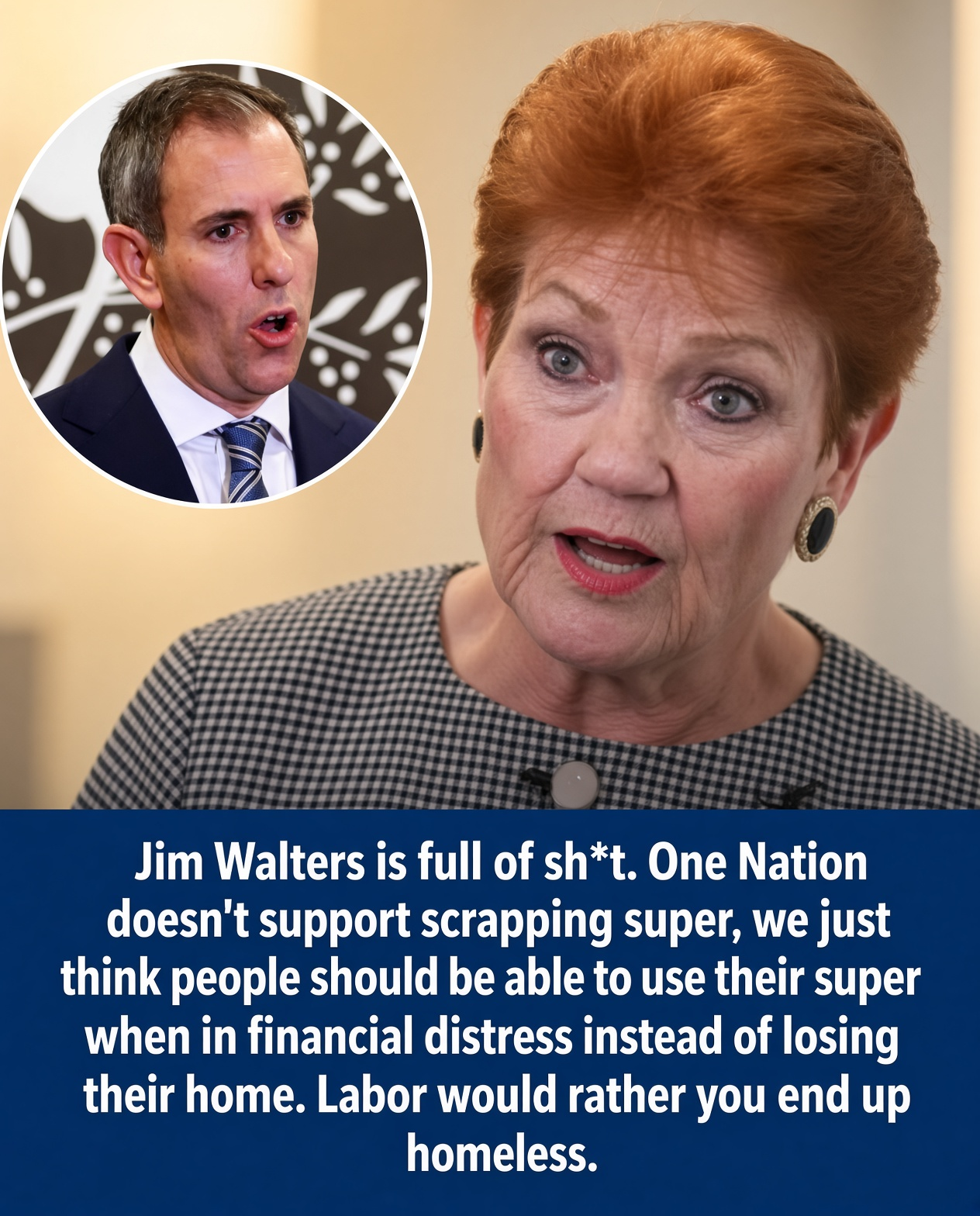
She accused Chalmers of misrepresenting One Nation’s position and called the Treasurer “full of s–t”.
Hanson again insisted she was not proposing the abolition of superannuation.
Instead, she said Australians facing serious financial stress should have greater ability to use money that ultimately belongs to them.
The exchange has transformed what could have been a technical retirement-policy discussion into an increasingly bitter political contest.
Labor sees an opportunity
For Labor, compulsory super is more than another government program.
It is part of the party’s economic identity.
The modern compulsory superannuation system was built through Labor governments and the union movement, and Labor regards it alongside Medicare as one of its most important institutional legacies.
Australia’s super system now contains roughly $4.5 trillion in retirement assets.
Chalmers therefore has a powerful political incentive to portray the emerging argument as a choice between Labor protecting super and its opponents dismantling it.
Whether that characterisation accurately describes what Hanson is proposing is another question.
The Coalition is making Chalmers’ argument easier
Hanson is not the only politician questioning the status quo.
Liberal senator Andrew Bragg has mounted a much broader critique of compulsory superannuation.
Bragg has described compulsory super as a public policy failure and argued Australians deserve greater control over their earnings.
Other Liberals have also supported allowing people to use superannuation for housing.
Deputy Liberal leader Jane Hume has argued home ownership can be more important to financial security in retirement than simply accumulating a larger super balance.
The Coalition has not, however, adopted abolition of compulsory super as formal party policy.
That distinction is crucial as Labor seeks to connect individual Liberal MPs’ comments with the entire opposition.
Barnaby Joyce wants hardship rules expanded
One Nation MP Barnaby Joyce has approached the question from another direction.
Rather than simply abandoning preservation rules, Joyce wants the definition of financial hardship widened.
He has questioned why somebody can access super under particular medical or compassionate circumstances but may be unable to use it when they cannot afford basic necessities.
One Nation’s final policy remains under development, including the amount that could be withdrawn and precisely who would qualify.
That means Chalmers is attacking a proposal whose final architecture has not yet been released.
You can already access super early — but only in limited circumstances
Australia’s super system is not completely locked until retirement.
Existing rules allow early access in specific situations.
These include severe financial hardship and compassionate grounds covering certain medical treatment, palliative care, funeral expenses and circumstances involving the potential loss of a person’s home.
The rules are deliberately narrow because superannuation is intended primarily to fund retirement.
Yet early withdrawals are hardly insignificant.
More than $1.4 billion was accessed on compassionate grounds during 2024–25, with the average withdrawal exceeding $22,000.
The real political argument is therefore not whether early access should exist.
It already does.
The argument is how much broader it should become.
The strongest argument for Hanson: what if someone needs the money now?
Hanson’s position taps into a simple problem with compulsory retirement savings during a cost-of-living crisis.
A person can theoretically possess tens of thousands of dollars in super while struggling to meet mortgage repayments.
They can have retirement assets while carrying expensive debt.
They can have money invested for life at 67 while struggling financially at 37.
For households under severe pressure, telling them their future retirement position is improving may provide little comfort if they risk losing their home today.
That is the political force behind Hanson’s argument.
She is asking whether the objective of protecting somebody’s retirement savings should always override their immediate financial circumstances.
The strongest argument against Hanson: money withdrawn today disappears from retirement
Superannuation experts point to the other side of the equation.
A dollar removed from super at 30 does not merely reduce retirement savings by one dollar.
It also eliminates decades of potential investment returns on that dollar.
That compounding effect can make an apparently modest early withdrawal extremely expensive over a working lifetime.
Motley Fool Australia chief investment officer Scott Phillips argues broader access risks damaging the fundamental purpose of the system.
Economist Saul Eslake has similarly warned against policies that weaken compulsory retirement savings.
Their concern is not simply individual account balances.
If people reach retirement with less super, taxpayers may eventually carry more of the burden through the Age Pension.
The COVID experiment provides a warning
Australia has already conducted a huge real-world experiment with early super access.
During the COVID-19 pandemic, eligible Australians were permitted to withdraw up to $20,000 from their superannuation accounts.
Millions took advantage of the scheme.
The policy provided immediate cash at a moment of extraordinary economic uncertainty.
But critics have subsequently pointed to the long-term cost of removing money that would otherwise have remained invested for decades.
Super industry representatives have repeatedly used the COVID scheme as evidence that early access can leave younger workers particularly exposed to substantial retirement losses.
There is another risk: house prices
Housing is perhaps the most politically attractive reason to unlock super.
It is also one of the most economically contested.
If thousands of prospective buyers suddenly gain access to tens of thousands of additional dollars, they have more purchasing power.
But unless the number of homes available also increases, buyers are competing against one another with larger deposits.
Economists warn that some of the extra money can therefore be capitalised into higher property prices.
The seller receives more.
The buyer has withdrawn retirement savings.
And the underlying housing shortage remains.
Critics describe that as a lose-lose outcome for younger Australians.
But owning a home matters enormously in retirement
The counterargument cannot simply be dismissed.
Australia’s retirement system implicitly works much better for homeowners than renters.
A retiree who owns their home outright has dramatically different living costs from somebody paying market rent indefinitely.
That means a person could theoretically reach retirement with a smaller super balance but greater overall financial security if early access helped them purchase a home.
This is why advocates of super-for-housing argue that looking only at the final super balance misses part of the household balance sheet.
A home is also an asset.
And unlike a super account, it provides somewhere to live.
Consumer advocates warn about exploitation
There is another concern that has received less political attention.
If access rules become easier, unscrupulous operators can attempt to convince people to withdraw retirement savings unnecessarily.
Super Consumers Australia has warned that relaxed access can create opportunities for scams, coercion and financial exploitation.
The pandemic period demonstrated some of those risks.
Someone who withdraws super because of fraudulent financial advice may have little opportunity to recover decades of lost compounding.
That makes consumer protections critical to any broader early-access model.
Economist Bob Breunig says compulsory saving exists for a reason
Australian National University economist Bob Breunig has argued against substantially loosening the rules.
The logic behind compulsory super is partly behavioural.
If retirement saving were entirely voluntary, many Australians would understandably prioritise current consumption and expenses over an event decades in the future.
Compulsion removes that decision.
Workers accumulate retirement assets throughout their careers regardless of the immediate pressure to spend.
That ultimately reduces reliance on future taxpayers.
Breunig warns that undermining that discipline can weaken both individual retirement outcomes and the government’s long-term fiscal position.
But is 12 per cent the right number?
There is another debate hiding beneath the argument over early access.
Even among people who support compulsory super, there is disagreement over how high compulsory contributions should be.
The Superannuation Guarantee reached 12 per cent in July 2025.
Because super contributions form part of the overall cost of employing someone, economists have long debated the extent to which increases ultimately come at the expense of wage growth.
For a high-income worker with ample disposable income, directing 12 per cent towards retirement may be relatively painless.
For a low-income household struggling with rent, groceries and electricity bills, the trade-off can feel very different.
That distributional question is one reason the political debate is unlikely to disappear.
Chalmers says the answer is higher wages, not raiding retirement
The Treasurer rejects the argument that today’s cost-of-living problems should be solved using tomorrow’s retirement savings.
Labor’s preferred approach is to increase disposable income through wage growth, tax cuts and other cost-of-living measures while preserving super.
Chalmers argues that allowing broader withdrawals would leave workers worse off in retirement and undermine a system he describes as the envy of the world.
That gives Labor a straightforward political message.
Help Australians today without making them poorer tomorrow.
The difficulty is whether households under severe immediate pressure believe existing assistance is enough.
Hanson says Labor is pretending the money belongs to government
One Nation approaches the issue from almost the opposite philosophical direction.
Its starting point is ownership.
Superannuation is deferred remuneration earned through work.
Hanson therefore argues politicians should stop speaking about retirement savings as though government has a superior claim to determine when Australians can use their own assets.
Her supporters see that as an argument about individual autonomy as much as retirement policy.
Her opponents see the same proposal as dismantling the guardrails that make compulsory retirement saving effective.
That philosophical disagreement cannot easily be solved with a spreadsheet.
Labor is already turning the dispute into an election weapon
Chalmers’ use of the word “referendum” was deliberate.
Labor wants voters to believe the future of compulsory super itself could be at stake at the next federal election.
The fundraising messages attacking Hanson demonstrate the party is already testing that political strategy.
Hanson’s furious response demonstrates One Nation understands the danger.
She does not want voters to hear “abolish super” when her policy is “broaden access to super”.
The distinction could become one of the central factual battles of the campaign.
The Coalition has an uncomfortable decision to make
The fight also creates a strategic problem for the Liberals.
If the Coalition embraces broader early access, Labor can group it together with One Nation and campaign as the sole defender of compulsory super.
If it retreats completely, it risks surrendering the argument about individual control of retirement savings to Hanson.
And if individual Liberal MPs continue proposing substantial reforms without a unified party position, Chalmers can use their comments regardless of what the formal Coalition platform ultimately says.
That explains why a debate initially triggered by Hanson is now reverberating across both major parties.
The question voters may actually face is more nuanced
The next election is unlikely to present Australians with a simple choice between keeping superannuation and abolishing it.
No major political force currently has a formal policy to abolish the entire compulsory super system.
The real questions are likely to be considerably more specific.
Should Australians be able to access super to buy a home?
Should financial-hardship provisions be broadened?
Should somebody facing mortgage stress be allowed to withdraw funds before they reach the point of foreclosure?
Should medical access become easier?
Should compulsory contributions remain at 12 per cent?
And how much freedom should Australians have to choose between financial security today and retirement savings decades from now?
Australia’s super war is only beginning
Chalmers has now drawn the battle line.
Labor intends to defend compulsory superannuation and portray attempts to loosen the system as a threat to workers’ retirement security.
Hanson is refusing to retreat.
She says compulsory super can remain while Australians gain substantially greater control over when they access their money.
Bragg and other Coalition figures are keeping broader reform arguments alive.
And experts are warning both sides that every apparently simple change creates trade-offs.
More access today means less compounding tomorrow.
Using super for housing may help an individual buyer but can also add demand to an already constrained property market.
Locking savings away protects retirement balances but can leave households watching money accumulate in an account while they struggle to keep the roof over their heads.
That is why the fight is becoming so politically potent.
Australians are not really being asked whether superannuation is good or bad.
They are being asked a harder question:
When does protecting your money for the future stop being more important than letting you use it today?
Jim Chalmers believes Labor can win an election defending the existing system.
Pauline Hanson appears increasingly willing to test him on it.