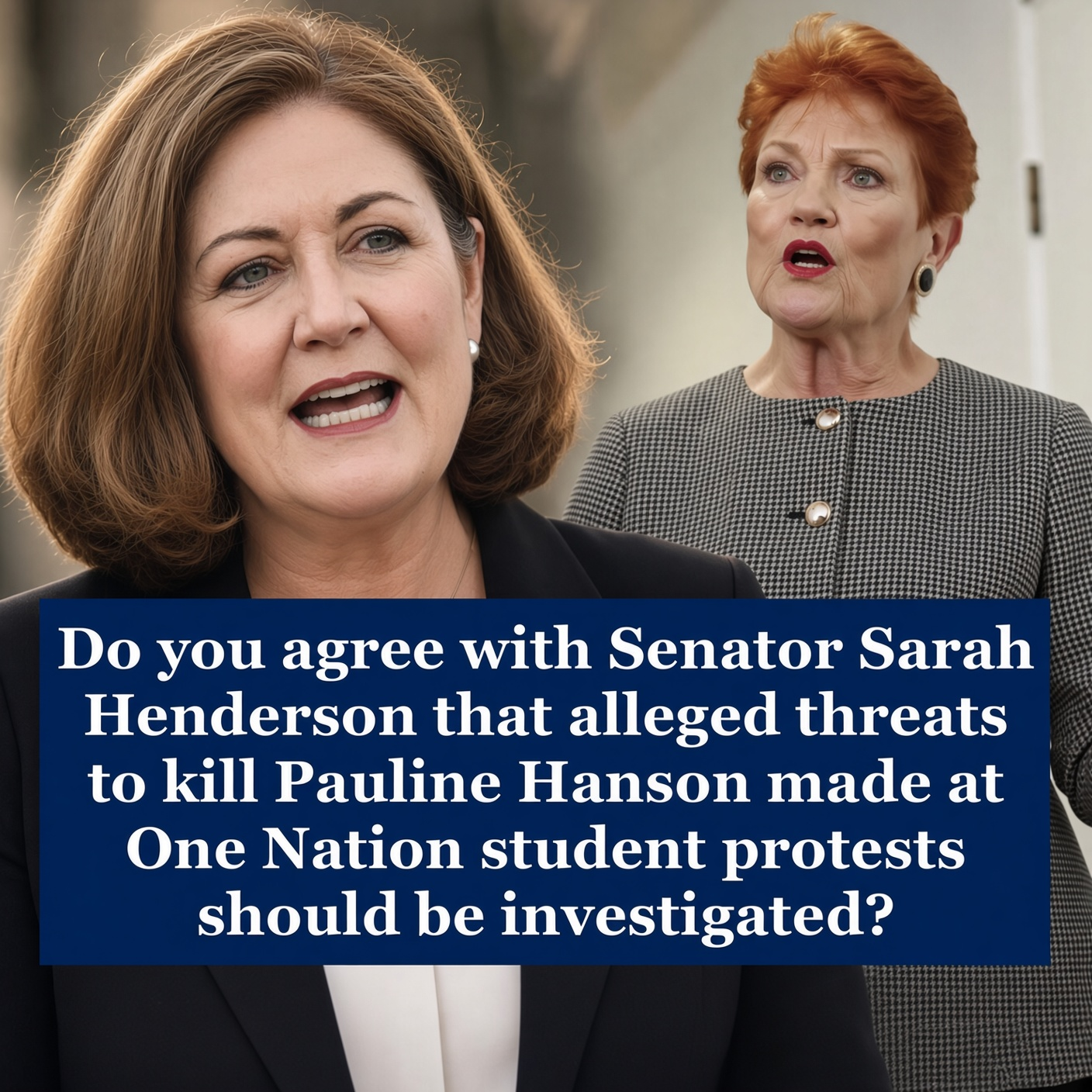
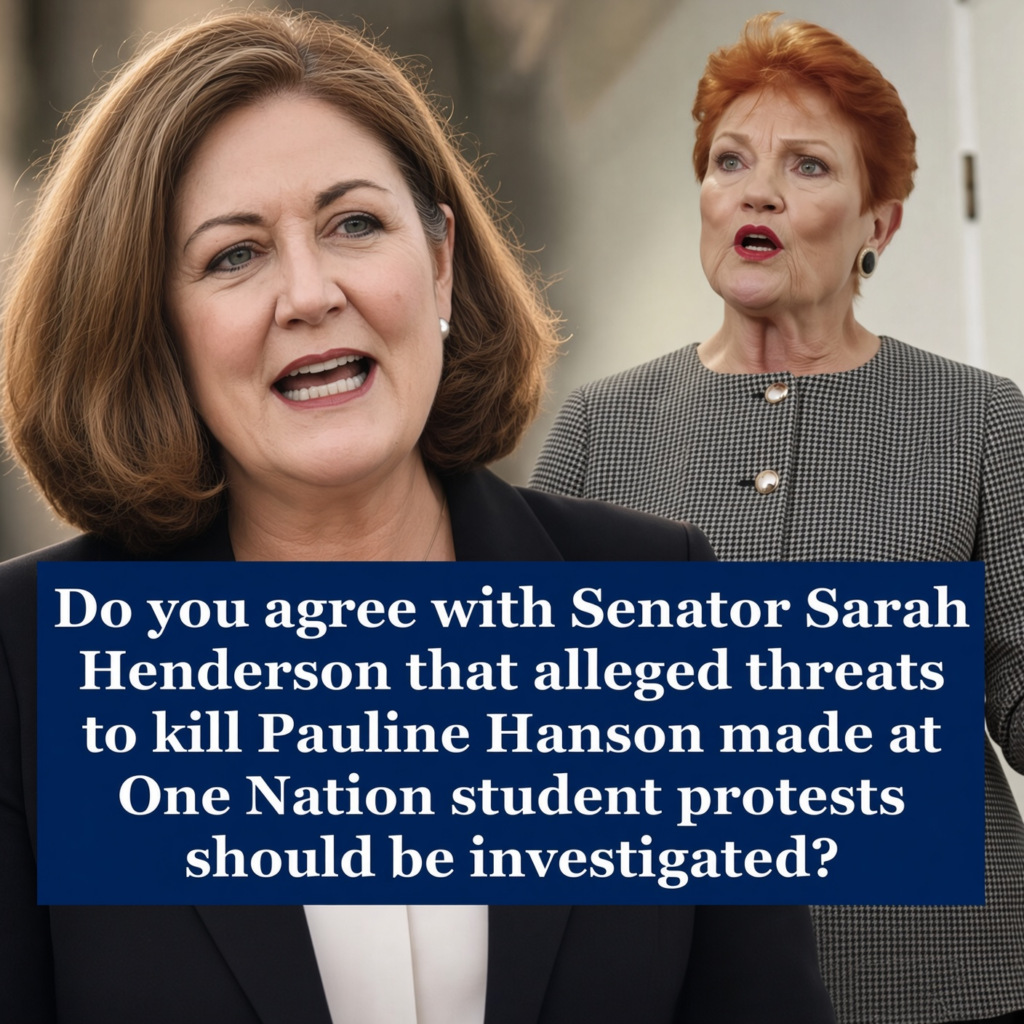
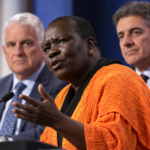
Liberal Senator Sarah Henderson has called for police to investigate alleged death threats directed at Pauline Hanson during the nationwide student protests against One Nation, while demanding scrutiny of schools and teachers accused of encouraging children to leave class for the political demonstrations.
The intervention follows the circulation of disturbing footage associated with the anti-Hanson demonstrations in which young protesters were recorded making comments about killing the One Nation leader and invoking a guillotine.
Henderson said alleged threats of that nature should have consequences regardless of the identity or politics of the person being targeted.
She is now calling for authorities to establish exactly what occurred — and whether adults or schools played any role in facilitating the circumstances surrounding the protests.
Henderson calls for police investigation
The Victorian Liberal senator said the alleged threats against Hanson warranted investigation by police.
Her position was that political disagreement, however intense, cannot excuse threats of violence against an elected representative.
“Whether directed at Senator Hanson or any other Australian, these alleged threats to kill by student protestors must have consequences,” Henderson said.
The important word is “alleged”: no criminal finding should be inferred simply from the circulation of protest footage.
Whether particular comments amount to criminal threats is a question for police and potentially prosecutors, taking into account the words, context, intent and applicable law.
Footage included references to killing Hanson
The controversy escalated after footage emerged containing violent rhetoric directed at the One Nation leader.
Reporting on the videos describes participants making statements about killing Hanson and calling to “bring back the guillotine”.
Other material circulating from the protests contained highly abusive anti-Hanson language.
The rhetoric has shifted attention away from the original political message of the demonstrations and towards questions about whether legitimate protest crossed into threats of political violence.
Political violence is a different issue from political protest
Students have the same basic democratic freedom as other Australians to hold strong political opinions and participate in lawful demonstrations.
They are entitled to oppose Hanson.
They are entitled to criticise One Nation’s policies.
They are entitled to argue that the party is racist, discriminatory or harmful, just as Hanson and her supporters are entitled to reject those accusations.
Threatening violence against a political opponent, however, is not simply a stronger form of political disagreement.
That distinction is central to Henderson’s demand for an investigation.
Schools and teachers are also under scrutiny
Henderson has widened her criticism beyond the individuals shown in protest footage.
She wants scrutiny of whether schools or teachers encouraged students to miss lessons and participate in the demonstrations.
The issue is particularly sensitive because the protests were deliberately organised as school walkouts.
Students were not merely attending political rallies in their own time — many were being encouraged to leave school during normal class hours.
Thousands walked out on August 13
The “Say No to Hanson” demonstrations took place across Australia on Thursday, August 13.
Large groups of high school and university students gathered in cities including Sydney, Melbourne and Adelaide.
The demonstrations were promoted by student activist organisations including the High School Anti-Capitalists and, at a number of rallies, the National Union of Students.
Organisers framed the action as a response to the rise of Hanson and One Nation and what they described as the growth of the far right.
Students cited concerns including racism, immigration policy, LGBTQ+ rights and One Nation’s broader political agenda.
More than 2,000 demonstrated in Adelaide alone
In South Australia, reporting estimated that more than 2,000 students from about 40 schools and colleges gathered outside Parliament House.
Melbourne also saw hundreds of students from a large number of Victorian schools leave class and gather near the State Library of Victoria before marching through the CBD.
Similar demonstrations occurred elsewhere around the country.
The rallies were therefore substantial organised political events rather than a handful of isolated students leaving individual classrooms.
Education authorities had told students to stay in class
The protests went ahead despite warnings that students should attend school.
Federal Education Minister Jason Clare publicly maintained that school students should be at school during class hours.
Victorian education authorities also discouraged unauthorised absences.
At least one Melbourne school publicly confirmed that absences associated with the rally were not sanctioned.
That makes any evidence that individual teachers actively encouraged truancy potentially significant.
But teacher involvement must be established, not assumed
Claims that teachers organised, encouraged or tolerated the walkouts have become a major theme in criticism from One Nation and some conservative commentators.
That does not mean every school or teacher connected to participating students endorsed the protest.
Students can organise independently.
Parents can authorise or support their children’s participation.
And a school’s inability to physically prevent an older student leaving does not necessarily demonstrate political endorsement.
Any investigation would therefore need to distinguish documented teacher involvement from broader political claims about ideological influence in schools.
Hanson says schools should teach students ‘how to think’
Hanson responded to the demonstrations by arguing that classrooms should develop independent thought rather than direct students towards particular political conclusions.
“Schools should teach young Australians how to think, not what to think,” she said.
The One Nation leader also urged young Australians to direct their frustration towards economic conditions affecting their families.
She pointed to living costs and wages rather than One Nation as issues students should be questioning.
Hanson tells students One Nation is ‘fighting for you’
Hanson argued that young Australians will ultimately inherit the consequences of current government policy.
She accused Labor and the Greens of leaving younger generations with a weaker and less prosperous country.
Her response attempted to turn the protests back onto the economic issues driving much of One Nation’s recent political appeal.
“Whether you know it or not, One Nation and I are fighting for you,” Hanson told students.
It was a striking response to demonstrations explicitly organised to mobilise young people against her.
Mehreen Faruqi openly encouraged participation
The controversy surrounding adult involvement is not entirely speculative.
Greens Deputy Leader Mehreen Faruqi publicly encouraged students to participate in the demonstrations before the walkouts occurred.
In a social-media message, Faruqi attacked One Nation’s politics and urged students concerned about the party to join the demonstrations.
When framing the message around students seeking her permission to participate, she replied: “Of course.”
She also told them she hoped they had made a big sign and to “have fun”.
Faruqi’s intervention drew immediate criticism
Supporters saw the senator’s comments as encouragement for young Australians to participate in democracy and stand against policies they considered discriminatory.
Critics saw something different: a sitting federal politician encouraging children to leave school to campaign against an elected political opponent.
The distinction became particularly contentious because the rallies occurred during school hours rather than after classes or on a weekend.
The subsequent emergence of violent rhetoric at the protests has intensified scrutiny of that encouragement.
Faruqi and Hanson have a bitter political history
The confrontation also sits within a much longer dispute between the two senators.
Faruqi previously took legal action over a 2022 social-media post in which Hanson told her to “piss off back to Pakistan”.
The Full Federal Court recently rejected Hanson’s attempt to overturn a racial discrimination finding arising from that post.
The Greens celebrated the decision and again accused Hanson of racism and xenophobia.
That history helps explain why opposition to Hanson has become particularly prominent within the Greens and among progressive activist organisations.
The student organisers had an explicitly political agenda
The High School Anti-Capitalists did not present the walkout merely as a neutral civics exercise.
Organising material circulated around the demonstrations urged students to build political networks inside schools and oppose Hanson and the broader capitalist system.
Reporting on an activist toolkit distributed to students found advice about recruiting classmates, circulating material and organising within campuses.
Students were also encouraged to use school uniforms to increase the visibility of their participation.
That organising strategy has fuelled the argument over where youth political engagement ends and adult political mobilisation begins.
It does not make the students’ views illegitimate
Young people do not need to be politically neutral simply because they cannot yet vote.
Australian history contains numerous examples of students participating in campaigns over war, climate policy, racial discrimination, education and social reform.
Nor does membership in an organised political movement prove that a participant has been manipulated.
Students can sincerely arrive at strong political conclusions of their own.
The more difficult question is whether educational institutions or elected politicians should actively facilitate partisan action during school hours.
The violent rhetoric changes the stakes
Before the footage emerged, much of the controversy concerned truancy and political influence in schools.
Those are important issues, but they are fundamentally different from threats of physical harm.
Once language about killing a political figure or using a guillotine enters the debate, authorities must consider a different set of questions.
The identity of the target should make no difference to the principle involved.
A threat against Hanson should be treated according to the same standards as a comparable threat against a Labor, Greens, Liberal or independent politician.
Australia has seen growing concern about threats to politicians
Political hostility has increasingly spilled from online platforms into confrontations involving elected representatives, candidates and campaign workers.
Public figures routinely receive abuse, and security concerns have become a more visible part of Australian political life.
Most angry political speech never becomes physical violence.
But democratic systems depend on preserving a clear boundary between fierce disagreement and intimidation through threats of harm.
That principle becomes particularly important when rhetoric about violence begins to be treated as humorous or performative.
The Liberal senator has framed the matter as one of consistent standards rather than support for One Nation.
The Liberals and One Nation are electoral competitors and disagree across significant areas of policy.
But Henderson’s position is that alleged threats to kill an Australian political figure cannot be tolerated simply because the target is controversial.
That is an important distinction in a political environment where outrage can otherwise depend heavily on who is being threatened.
The protests also reveal a broader generational divide
Many students attending the demonstrations expressed genuine fear or anger about One Nation’s rise.
Participants told reporters they were concerned about racism, minority rights and the direction of Australian politics.
For them, leaving school was an act of civic participation rather than simple truancy.
Some parents also supported their children’s decisions to attend.
That means the protests cannot accurately be reduced either to spontaneous student rebellion or to a single adult-controlled political operation.
One Nation’s rise gives the protests a new urgency
The demonstrations occurred against a radically different political backdrop from previous anti-Hanson protests.
One Nation is no longer polling as a small party on the margins of federal politics.
Recent national surveys have placed it within striking distance of — and in some polling ahead of — the Coalition on primary support.
A recent Pulse/YouGov poll conducted in late July put Labor on 28 per cent, the Coalition on 22 per cent and One Nation on 25 per cent.
That makes Hanson a far more consequential political figure than her party’s result at the 2025 federal election would have suggested.
One Nation’s growth has been extraordinary
The party secured only around six per cent of the national primary vote at the 2025 federal election.
Polling above 20 per cent represents a multiple of that level of support in little more than a year.
Not every poll produces identical numbers, and voting intention can move substantially before an election.
But the broader trend is unmistakable.
One Nation has become a major participant in Australia’s three-way competition for primary votes.
YouGov polling shows Labor still ahead
One Nation’s primary-vote surge does not mean it would currently defeat Labor in a national election.
YouGov’s July public-data polling had Labor comfortably ahead of One Nation on a two-party-preferred comparison.
Labor led One Nation 56–44 in that survey and also maintained an advantage over the Coalition.
That earlier July poll recorded primary support of 28 per cent for Labor, 26 per cent for One Nation and 20 per cent for the Coalition.
The precise numbers vary between surveys, but they consistently demonstrate how dramatically One Nation’s electoral position has changed.
That rise helps explain the intensity of the student movement
When One Nation was polling in single digits, opponents could treat the party primarily as a protest movement with limited prospects of exercising national power.
That assumption is becoming harder to sustain.
Its current support has generated questions about potential parliamentary alliances, the future of the Coalition and the possibility of One Nation becoming a much larger force at state and federal level.
For anti-Hanson students, the protests were therefore aimed at a political movement they believe has a realistic prospect of gaining substantial power.
But democratic opposition has limits
One Nation’s rise makes scrutiny of its policies more important, not less.
Its opponents are entitled to organise.
They are entitled to campaign.
They are entitled to persuade young Australians that Hanson’s policies are wrong.
None of that provides a democratic justification for threats of violence.
If police conclude particular statements crossed a legal threshold, the political motivation behind them should not provide immunity.
The same standard applies to the other side
Consistency also requires that abusive or threatening behaviour by One Nation supporters towards political opponents be judged by the same standard.
Condemning violent rhetoric cannot depend on party allegiance.
A functioning democracy requires politicians and citizens to be able to participate without credible threats to their physical safety.
That principle protects Hanson and Faruqi alike.
The teacher question remains unresolved
Henderson’s second demand may prove more difficult to establish.
There is evidence that political organisations encouraged students to participate.
There is direct evidence that Faruqi publicly supported their attendance.
There is also evidence that education authorities told students they should remain in school.
What has not yet been established across the country is the extent to which individual teachers or schools actively organised or encouraged students to leave class.
That is precisely why calls for investigation should not be presented as findings of wrongdoing.
Schools now face a difficult question about political participation
Educators routinely encourage students to understand democracy, political institutions and current affairs.
Schools also want young people to develop independent judgement and participate responsibly in civic life.
But institutions must navigate a boundary between teaching politics and promoting a political position.
That becomes especially difficult when students organise protests during compulsory school hours.
The Hanson walkouts have turned that theoretical boundary into a national political controversy.
The next protests will face much greater scrutiny
Organisers in some states have already discussed further student action.
After the controversy surrounding the August 13 rallies, future demonstrations are likely to attract closer attention from schools, politicians, police and media.
Organisers will also face pressure to ensure rhetoric does not cross into threats or incitement.
The political message of a demonstration can quickly be overwhelmed when the most widely circulated footage features fantasies of violence rather than arguments about policy.
For Hanson, the backlash could reinforce her political message
The rallies were intended to mobilise young Australians against One Nation.
Yet footage of violent rhetoric risks producing the opposite political effect.
Hanson has spent years arguing that hostile political and cultural institutions treat her and her supporters according to a different standard.
Images of protesters discussing her death provide powerful material for that narrative.
Whether fair or not, the behaviour of a small number of protesters can therefore shape public perceptions of a much larger movement.
The investigation Henderson wants would clarify where the lines were crossed
There are now several separate questions requiring careful distinction.
Did any protester’s comments constitute a criminal threat?
Were the people shown in the relevant footage school students?
Did teachers or schools actively encourage unauthorised absences?
What role did adult political organisations play in organising the walkouts?
And how should schools balance political engagement with attendance and institutional neutrality?
Those questions cannot responsibly be answered by partisan assumptions alone.
What is already clear is the scale of the political shift
A protest movement involving thousands of students has mobilised specifically to stop Pauline Hanson’s political rise.
A senior Greens senator publicly encouraged participation.
A Liberal senator is now calling for police and education authorities to investigate aspects of what followed.
And Hanson is using the controversy to reinforce her argument that Australian schools should teach young people “how to think, not what to think”.
All of it is unfolding while One Nation records levels of national support that would have seemed extraordinary after the 2025 election.
The students set out to make Hanson the subject of a national debate.
They succeeded.
But after footage emerged containing alleged threats against her, the debate has changed.
It is no longer only about whether students should have left school to protest Pauline Hanson. It is also about where Australia draws the line between political activism, institutional influence and rhetoric that threatens democratic participation itself.