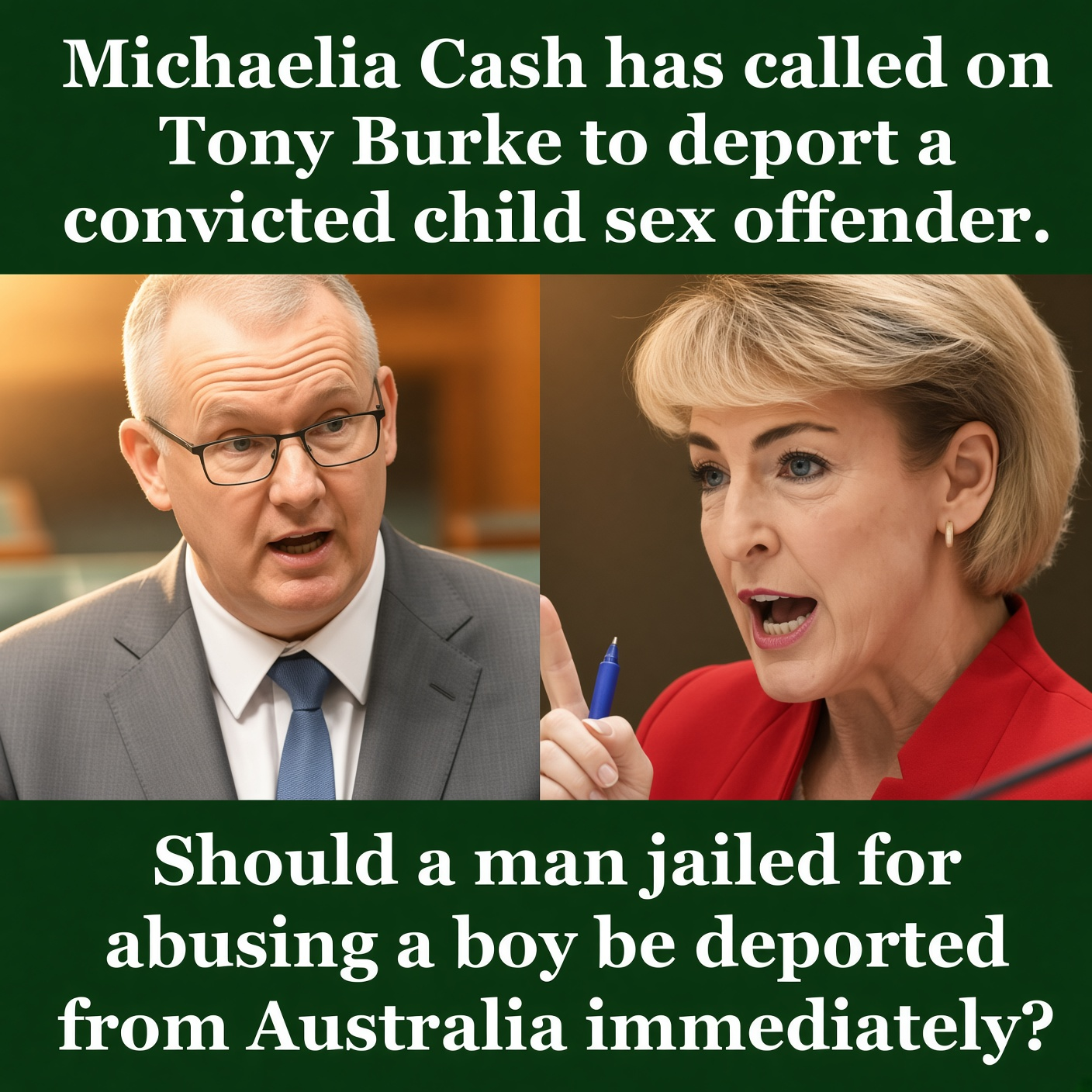
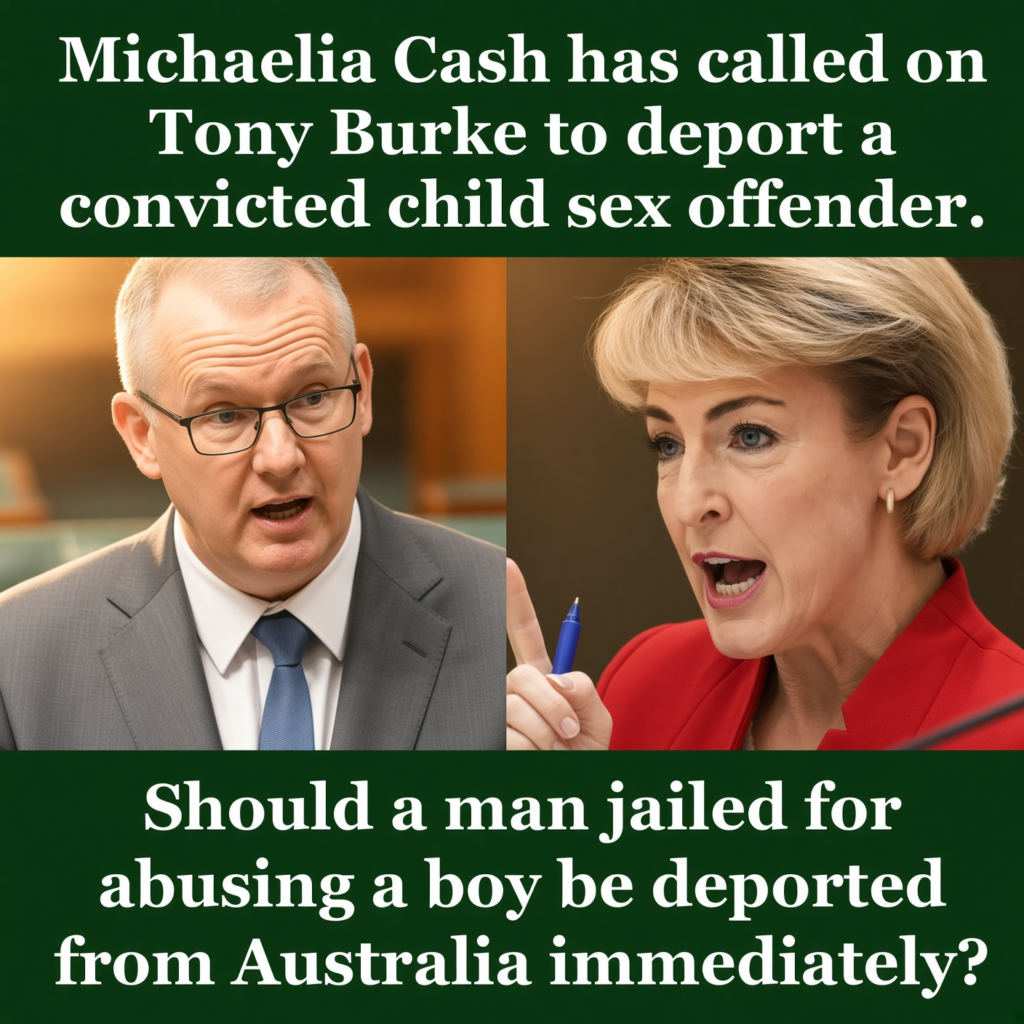
Michaelia Cash has demanded Home Affairs Minister Tony Burke “move heaven and earth” to remove a convicted sex offender from Australia after a Federal Court ruling reopened the possibility of the Sierra Leonean man obtaining a permanent protection visa.
The 50-year-old man, who can only be identified by the pseudonym MFKF, has multiple convictions for sexual offending involving teenage boys and had his Australian visa cancelled in 2018.
Yet his immigration status remains unresolved years later.
The Federal Court last week quashed an Administrative Review Tribunal decision that had refused him a protection visa, finding the tribunal had failed to properly address evidence concerning whether granting him a permanent visa could actually reduce his risk of further offending.
The decision has triggered an explosive political response from the Coalition.
Cash says the case demonstrates an immigration system that has become “stark, raving mad”.
The man arrived in Australia in 2011
MFKF arrived from Sierra Leone on a partner visa in 2011.
His criminal offending began soon afterwards.
In 2012, he was sentenced to six months in prison after being convicted of indecent assault and assault with indecent intent against a 16-year-old boy.
Four years later, he was jailed for another 70 days after being convicted of two further counts of indecent assault.
Reporting on the Federal Court case says drugs and alcohol were involved in the offending.
His visa was eventually cancelled in 2018.
Cash says protecting Australian children must come first
The case has infuriated Shadow Attorney-General Michaelia Cash, who argues the government’s overriding priority should be community safety.
She has challenged Burke to use whatever lawful powers are available to prevent the man from obtaining permanent residency and to remove him from Australia if legally possible.
Cash has also indicated the Coalition would support legislation required to strengthen the government’s ability to deal with cases of this kind.
Her political argument is straightforward.
A non-citizen who commits serious sexual offences after being permitted to enter Australia should not be given greater immigration security at the expense of community protection.
But the Federal Court did not decide he should stay
This is one of the most important distinctions in the case.
The Federal Court did not grant MFKF permanent residency.
Nor did it determine that community protection was unimportant.
Instead, the court quashed the Administrative Review Tribunal’s previous decision because of an error in how it considered relevant evidence.
That means the man’s visa application must be reconsidered according to law.
The distinction may sound technical, but it is fundamental to understanding what actually happened.
A therapist’s evidence became central to the case
The politically explosive element concerned evidence about MFKF’s risk of reoffending.
According to reporting on the judgment, expert therapeutic evidence suggested that providing the man with the stability and security of permanent immigration status could potentially reduce his risk of further criminal or sexual offending.
The Federal Court found the tribunal had not properly compared that scenario with the risk associated with keeping him in the uncertainty of temporary immigration status.
That reasoning has become the centre of the political controversy.
To critics, the idea that a convicted offender could potentially receive greater immigration security partly because it might reduce his risk of offending appears fundamentally backwards.
Legally, however, the issue before the court was narrower: whether the tribunal had properly considered relevant evidence when making its decision.
Cash calls the system ‘stark, raving mad’
Cash has seized on precisely that contradiction.
She argues Australians would struggle to understand how a system designed partly to protect the community could reach a point where granting a convicted offender permanent status becomes relevant to reducing the danger he presents.
Her response places direct political pressure on Burke, whose Home Affairs portfolio has already been forced to navigate a series of contentious cases involving visa cancellations and criminal non-citizens.
Why can’t Burke simply put him on a plane?
This is where the case becomes considerably more complicated than the political slogan.
Visa cancellation and physical removal from Australia are not always the same thing.
A person can fail Australia’s character test and still be protected from being returned to a country where Australia has determined they face certain forms of serious harm or persecution.
Reporting on MFKF’s case says he has been recognised as a refugee and claims he would face persecution in Africa because of his sexuality.
That creates legal issues extending beyond whether Australian authorities consider him a person of good character.
Australia has non-refoulement obligations
Australia is bound by international and domestic legal obligations that can prevent the government from returning a person to a place where they face specified forms of persecution or serious harm.
Those protections do not amount to an endorsement of a person’s conduct.
Nor do they automatically entitle every refugee to permanent residency.
They can, however, restrict the destinations to which the government may lawfully remove someone.
That is why cases involving criminal non-citizens with protection claims can become extraordinarily difficult.
Failing the character test does not solve every legal problem
Australian migration law gives the government powerful mechanisms for cancelling or refusing visas on character grounds.
Serious criminal offending, and particularly sexual offending involving children, weighs heavily against a non-citizen being permitted to remain.
Historically, governments of both political persuasions have used those powers extensively.
For example, Home Affairs figures released under the former Coalition government showed more than 800 non-citizens lost visas for serious offending during 2018 alone, including 100 whose cancellations involved child sex offending, child exploitation or pornography.
But cancelling a visa does not extinguish Australia’s other legal obligations.
That distinction is at the heart of this controversy
There are really two separate questions.
The first is whether MFKF should hold an Australian visa.
The second is whether Australia can lawfully remove him to another country.
Political debate often treats those questions as interchangeable.
Legally, they are not.
A government may determine that a person should not be granted permanent status while still confronting significant barriers to physically removing them from Australian territory.
The permanent visa question is especially politically explosive
That legal complexity explains why the prospect of permanent status has attracted such intense criticism.
There is an obvious difference between a government being legally prevented from deporting someone and the Australian state affirmatively granting that person a permanent visa.
Cash is concentrating her attack on that distinction.
Her position is that even where immediate removal is legally difficult, government policy should not be directed towards making a convicted sex offender’s residence in Australia more secure.
The government and tribunal system, meanwhile, remain required to administer the Migration Act and any applicable protection obligations according to law.
The case revives a much bigger immigration argument
This is not the first criminal visa case to generate outrage in 2026.
Earlier this year, a British man in his 80s who had been jailed for sexually abusing his nine-year-old step-granddaughter successfully challenged the cancellation of his permanent resident visa at the Administrative Review Tribunal.
The tribunal acknowledged the seriousness of his offending and community expectations but also considered his advanced age, serious health problems, decades in Australia and extensive family ties.
ABC subsequently reported that Home Affairs was preparing the case for another potential visa review.
The cases are legally different.
Politically, however, they feed the same argument.
How much discretion should tribunals have?
Successive governments have struggled with the balance between ministerial directions and independent administrative review.
A direction can tell decision-makers which factors deserve particular weight.
But tribunals must still apply legislation, consider individual circumstances and comply with administrative law.
That means governments cannot always guarantee the outcome of every case simply by announcing a tougher political position.
Courts, meanwhile, are not responsible for deciding which immigration policy is politically popular.
Their role is to determine whether decisions were made lawfully.
Direction 110 was supposed to strengthen community protection
The Albanese government introduced Direction 110 after an earlier political crisis involving Direction 99 and tribunal decisions allowing some criminal non-citizens to remain in Australia.
The revised direction strengthened the emphasis placed on protection of the Australian community and community expectations.
Yet MFKF’s case demonstrates that ministerial directions cannot eliminate every difficult legal contest.
The Federal Court challenge concerned how the tribunal dealt with the evidence before it, not simply whether the tribunal’s political priorities matched those of the government.
Burke is now under pressure from both law and politics
For Tony Burke, cases like this produce one of the hardest combinations in government.
The political expectation is simple: remove serious foreign criminals.
The legal framework is not.
Burke must operate within the Migration Act, administrative law, court judgments and Australia’s protection obligations.
If additional powers are genuinely available to Parliament, Cash says the Coalition is prepared to support them.
That effectively challenges the government to identify whether the obstacle is inadequate legislation or a legal limitation that Parliament cannot simply wish away.
Community protection remains the decisive political test
Australians reasonably expect the migration system to distinguish between people who respect the country’s laws and those who commit serious crimes after being permitted to enter.
That expectation is especially strong where sexual offending against minors is involved.
Cash’s intervention taps directly into that sentiment.
But responsible policy also requires governments to distinguish between political demands and actions that are actually available under Australian law.
Saying someone should be deported is straightforward.
Determining where they can legally be deported to can be much harder.
The government now needs to explain what happens next
The Federal Court ruling has not settled MFKF’s future.
It has reopened the administrative process.
The protection visa question must be reconsidered, while the government continues to confront the legal restrictions surrounding his immigration status.
That makes transparency particularly important.
Australians are entitled to know what powers the Home Affairs Minister has.
They are entitled to know what legal barriers prevent removal.
And if existing legislation genuinely prevents the government from adequately protecting the community, Parliament is entitled to debate whether those laws should change.
Cash has now put the challenge directly to Burke
The political message from the Coalition is uncompromising.
Use every lawful power available.
If those powers are inadequate, bring legislation to Parliament.
And put community protection first.
But the government cannot simply ignore a Federal Court judgment or Australia’s protection obligations, regardless of how politically unpopular an individual case becomes.
That is what makes MFKF’s case so difficult — and so politically potent.
A convicted offender has already had his visa cancelled.
A court has now ordered part of the decision-making process to be reconsidered.
And Australia’s Home Affairs Minister is left confronting the question Michaelia Cash has placed squarely before him:
If this man should not remain in Australia, what exactly can the government lawfully do to remove him?