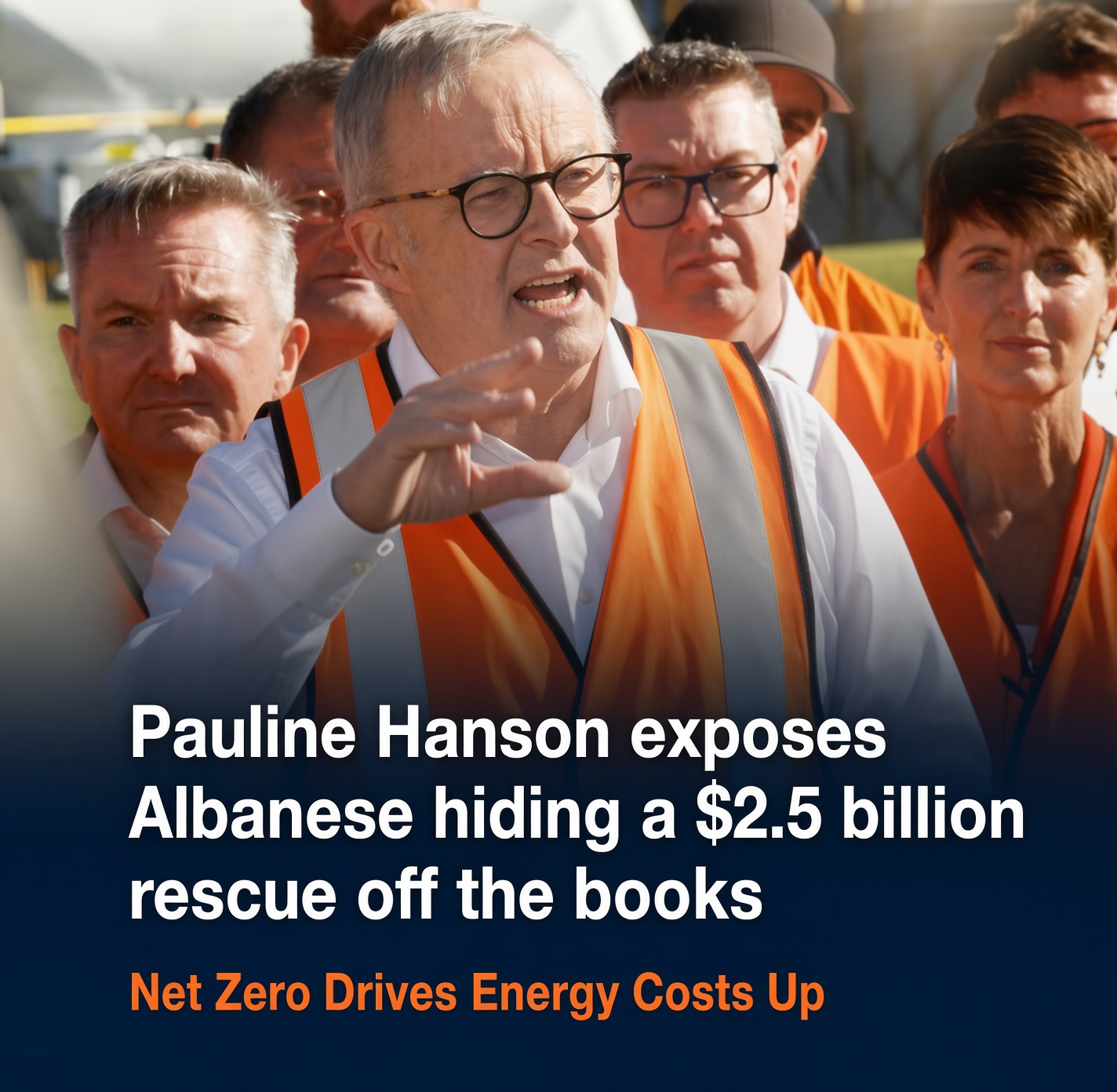
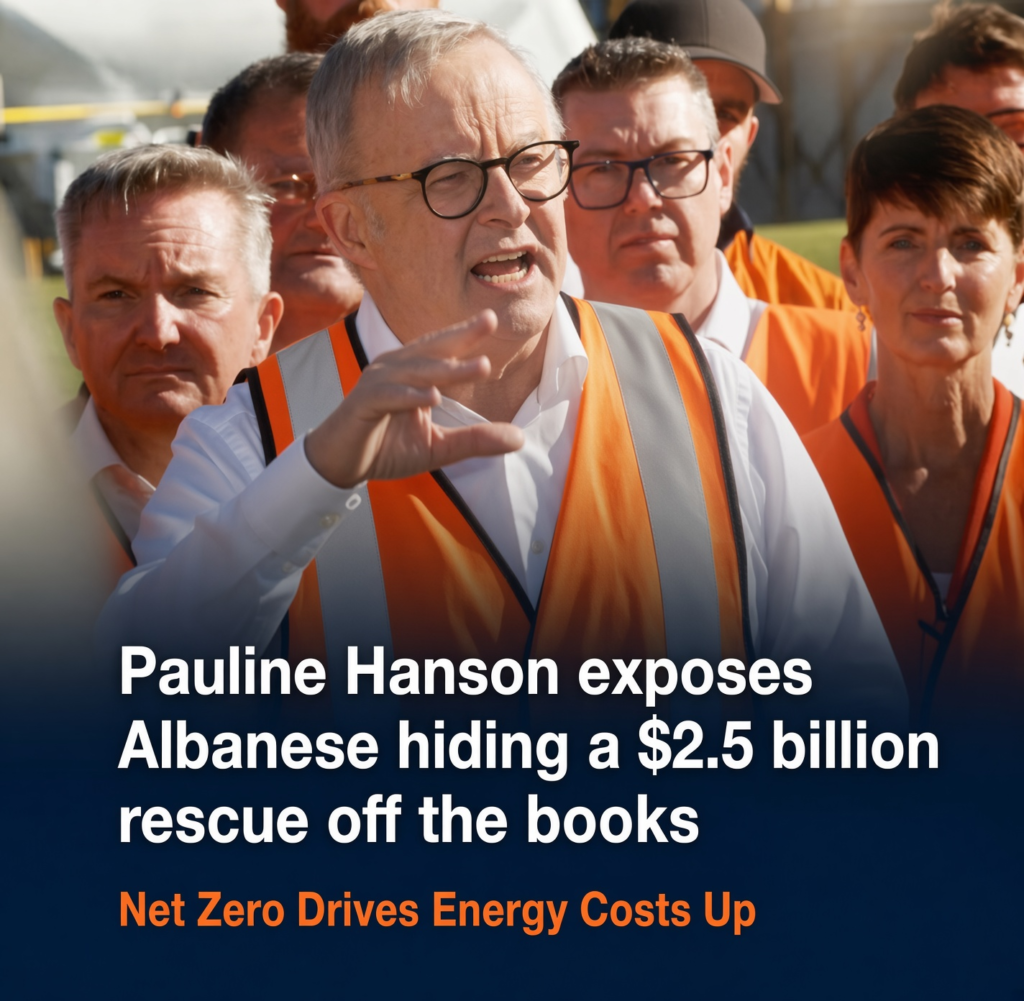
Anthony Albanese and Chris Minns have celebrated a $2.5 billion taxpayer-backed deal to save Australia’s largest aluminium smelter, but the extraordinary intervention has opened an uncomfortable question for Labor: how did a plant that has operated for more than four decades reach the point where government support was needed to keep its furnaces running?
Tomago Aluminium, near Newcastle in the NSW Hunter region, is one of Australia’s most strategically important industrial facilities and the single largest electricity consumer in New South Wales.
Its existing power arrangements expire at the end of 2028.
Without an affordable replacement, the smelter had warned it could close from 2029.
The federal and NSW Labor governments have now responded with a 10-year support package worth up to $2.5 billion — an intervention designed simultaneously to save Tomago, preserve thousands of jobs and shift the enormous facility towards renewable electricity.
Albanese and Minns announce the rescue
Prime Minister Anthony Albanese and NSW Premier Chris Minns travelled to Tomago to announce the agreement alongside senior government and industry figures.
The package will involve support from the Commonwealth and NSW governments over 10 years.
NSW’s contribution is capped at $1.225 billion, while reporting indicates the Commonwealth arrangements contain additional complexity because of the scale of the electricity procurement task.
Rio Tinto, the majority owner of Tomago, has separately committed at least $1.1 billion to the smelter through 2038.
Of that private investment, $100 million has been earmarked for further decarbonisation.
The government says the agreement secures Tomago’s future beyond the expiration of its current electricity contract.
Why does Tomago need government help?
The answer begins with electricity.
Aluminium smelting requires an extraordinary amount of continuous power.
Tomago consumes roughly 10 to 12 per cent of all electricity used in New South Wales.
Its production lines cannot simply be switched on and off whenever renewable generation rises or falls.
An aluminium smelter requires vast quantities of electricity around the clock, making both price and reliability fundamental to its commercial survival.
That requirement becomes especially difficult as the electricity system surrounding Tomago changes.
Its old electricity arrangements are running out
Tomago has historically benefited from electricity supplied under arrangements linked to NSW’s coal-fired generation fleet.
Its existing contract expires at the end of 2028.
That deadline has been known for years.
The problem has been finding a replacement capable of delivering enormous volumes of reliable electricity at a price the aluminium operation can commercially absorb.
Tomago had warned that it could be forced to close from 2029 if that problem was not solved.
The consequences would extend far beyond the company’s shareholders.
More than 1,000 direct jobs are at stake
The smelter employs more than 1,000 full-time workers as well as contractors.
Government and industry estimates put the number of additional jobs supported through the wider Hunter economy and supply chain at approximately 5,000.
Tomago also produces hundreds of thousands of tonnes of aluminium annually.
Allowing the smelter to close would therefore mean losing not only a major employer but a substantial piece of Australia’s remaining heavy industrial capacity.
That is the government’s central justification for intervention.
The raw arithmetic is politically explosive
The headline numbers nevertheless invite an obvious calculation.
A $2.5 billion government package divided by approximately 1,000 direct employees equals roughly $2.5 million for each direct job at the plant.
That calculation is mathematically straightforward.
But describing the package simply as “$2.5 million per job” leaves out important context.
The government support runs over 10 years.
It is intended to preserve thousands of indirect jobs as well as the direct workforce.
And it is designed to help create an entirely new electricity supply portfolio for one of Australia’s largest industrial consumers.
It is therefore not a $2.5 million cheque being paid to each worker.
Tomago’s future electricity system will look very different
The government’s plan is to underpin approximately 3 gigawatts of new electricity generation and firming capacity.
That portfolio is expected to include wind and solar generation backed by storage and other firming technologies.
The ultimate ambition is significant.
Tomago is expected to move to 100 per cent renewable electricity by 2033.
For an industrial facility consuming more than a tenth of NSW electricity, that is an enormous energy transition project in its own right.
Snowy Hydro has a critical role
Government-owned Snowy Hydro is central to the new arrangement.
Energy Minister Chris Bowen has said the Commonwealth worked with Snowy Hydro and the Clean Energy Finance Corporation to develop the electricity portfolio needed to keep Tomago operating.
Snowy is expected to act as a major intermediary in procuring and supplying electricity under the new structure.
That does not mean the government has simply transferred the entire $2.5 billion directly to Snowy Hydro.
The arrangement is more complex, combining government financial support, electricity contracting and new generation investment.
Snowy’s involvement will attract scrutiny
The decision nevertheless puts another major responsibility in the hands of a government-owned energy company already under intense scrutiny.
Snowy Hydro is responsible for Snowy 2.0, the giant pumped-hydro project whose cost has escalated dramatically from its early estimates.
The project was originally promoted at around $2 billion.
Its estimated cost has subsequently climbed to about $12 billion.
That history means Snowy’s role in Tomago will inevitably be watched closely by critics concerned about cost overruns and government exposure.
But the two projects should not be conflated: Tomago’s support arrangement is not simply another stage of Snowy 2.0.
Why wasn’t Tomago in the Budget?
Critics have also questioned why such a large intervention was not explicitly identified in the federal Budget documents before its announcement.
The answer appears to lie partly in how the arrangement has been structured and when it was finalised.
Industry reporting says the investment sits within the broader Future Made in Australia framework, with more specific financial details expected to appear in the Mid-Year Economic and Fiscal Outlook.
Tomago’s absence by name from earlier Budget papers therefore does not establish that the government secretly removed $2.5 billion from an already appropriated Tomago line item.
It does, however, leave legitimate questions about the Commonwealth’s maximum exposure and how transparently the final agreement will be reported.
The Commonwealth exposure deserves particular attention
NSW has placed a cap on its side of the arrangement.
Reporting on the deal indicates the federal component is structured differently because the Commonwealth is supporting what officials describe as a large and complex energy procurement exercise.
The Australian Financial Review has reported that additional federal exposure could arise under some circumstances.
That makes the precise contractual details important for taxpayers.
Much of the commercial arrangement remains confidential.
There is also a taxpayer upside mechanism
The deal is not structured entirely as one-way assistance.
Reporting indicates the Commonwealth has negotiated a revenue-sharing mechanism if aluminium prices rise beyond an agreed threshold.
The precise threshold has not been publicly disclosed because of commercial confidentiality.
That provision means taxpayers could recover some value under favourable market conditions.
How meaningful that protection ultimately proves will depend on aluminium prices and the detailed terms of the agreement.
Critics blame Labor’s energy transition
The political attack began almost immediately.
Coalition figures including Dan Tehan and Andrew Hastie have characterised the Tomago rescue as evidence that Labor’s energy policies are failing heavy industry.
One Nation has made essentially the same argument even more aggressively.
Pauline Hanson says the government would not need a multibillion-dollar intervention if Australia abandoned net zero and maintained access to cheaper conventional electricity.
That is now one of the central political claims surrounding Tomago — but it remains a contested interpretation rather than an established finding.
Energy costs really are the core problem
What is not seriously disputed is that affordable electricity has become an existential issue for Tomago.
ABC reporting says the company faced rising costs from both renewable and coal-fired power as it attempted to secure its post-2028 supply.
The company itself had made clear it could not simply absorb the prices available without jeopardising the smelter’s viability.
The dispute is therefore not over whether Tomago has an electricity-cost problem. It is over why that problem exists and whether government climate policy made it worse.
Australia’s ageing coal fleet complicates the picture
NSW’s electricity system was always going to change as ageing coal generators approached retirement.
Those plants cannot operate indefinitely without major reinvestment.
At the same time, replacing dispatchable coal generation with renewable generation, storage, transmission and firming capacity requires enormous capital investment.
Tomago sits directly in the middle of that transition.
For an ordinary household, electricity-market changes affect bills. For an aluminium smelter consuming roughly one-tenth of the state’s electricity, relatively small changes in wholesale power costs can threaten the entire business model.
Labor’s $275 electricity promise still hangs over the debate
The controversy also revives one of Anthony Albanese’s most politically damaging pre-election commitments.
Before winning government in 2022, Labor repeatedly promoted modelling under which its Powering Australia plan was expected to reduce household electricity bills by $275 by 2025 compared with the relevant baseline.
That outcome did not materialise in household bills as promised.
Electricity prices have instead risen substantially during Labor’s period in office, although rebates have at times temporarily reduced the amounts households actually paid.
The government has attributed much of the increase to global energy-market shocks, Russia’s invasion of Ukraine, ageing infrastructure and other pressures.
The opposition argues Labor’s renewable transition has contributed to higher costs.
Electricity prices have been volatile — and rebates matter
Care is required when comparing electricity-price statistics because government rebates have significantly affected the Consumer Price Index.
ABS data earlier this year showed annual electricity-price increases accelerating sharply as rebates expired in different jurisdictions.
In January, for example, electricity prices were 32.2 per cent higher over the year, according to data cited by Commonwealth Bank from the ABS release.
That does not mean every household’s underlying electricity tariff increased by precisely the same percentage.
The CPI measure incorporates the timing and withdrawal of government rebates, which can produce large annual movements.
Then there is the Safeguard Mechanism
The raw political argument also points to Labor’s Safeguard Mechanism reforms.
The mechanism applies emissions baselines to large industrial facilities producing more than 100,000 tonnes of covered carbon dioxide equivalent emissions annually.
It includes special treatment and policy mechanisms designed to address trade-exposed industries.
The underlying concern is known as carbon leakage.
If producing aluminium or another emissions-intensive commodity becomes significantly more expensive in Australia because of climate regulation, production could move overseas to a jurisdiction with weaker emissions constraints.
Carbon leakage is a real policy concern
The Albanese government did not invent the concept.
Governments internationally face the same problem when imposing carbon constraints on trade-exposed industries.
Australia has undertaken a formal Carbon Leakage Review examining how to prevent domestic climate policies from simply shifting emissions and industrial production overseas.
The existence of those safeguards demonstrates that government itself recognises competitiveness as a serious risk.
It does not, by itself, prove the Safeguard Mechanism caused Tomago’s financial difficulties.
That distinction matters
Critics can reasonably argue that Australia’s climate and electricity policies contribute to the environment in which heavy industry must operate.
They can point to the enormous public subsidy now required to preserve Tomago.
But establishing direct causation requires more.
Tomago’s difficulties involve expiring legacy electricity contracts, ageing coal generation, the cost of replacement supply, wholesale-market conditions, enormous continuous power requirements and Australia’s broader energy transition.
Reducing all of those factors to a single policy slogan would obscure the economics of the problem.
The government sees the same facts very differently
Albanese, Bowen and Minns argue the agreement demonstrates that renewable energy can preserve rather than destroy Australian manufacturing.
Their case is that government intervention gives Tomago enough certainty to remain open while new electricity capacity is built.
That means preserving industrial capability during the transition rather than allowing it to disappear offshore.
For Labor, the $2.5 billion is not a payment for the failure of the energy transition. It is an investment designed to make the transition possible.
Whether taxpayers accept that distinction is another question.
Tomago is not the first heavy-industry rescue
The deal also forms part of a much larger pattern of government intervention in Australia’s metals and manufacturing industries.
The Albanese government has already committed billions of dollars in support for other smelters and industrial facilities.
Reuters estimates that more than $5 billion had previously been pledged to other major smelting and industrial operations before the Tomago announcement.
Adding Tomago pushes the scale of industrial support substantially higher.
That is prompting a fundamental debate about how much taxpayers should spend keeping strategically important but energy-intensive manufacturing onshore.
The alternative could also cost Australia
Allowing Tomago to close would avoid the immediate $2.5 billion government commitment.
But closure would have costs of its own.
More than 1,000 direct employees would face losing their jobs.
Thousands of indirect positions could be affected.
Australia would lose a substantial share of its domestic aluminium-smelting capability.
Regional economic activity would decline.
And if aluminium production simply moved to an overseas facility powered by more carbon-intensive electricity, the global emissions benefit could be limited or even negative.
Those are the arguments underpinning the government’s willingness to intervene.
But subsidies create another difficult question
If Australian heavy industry can survive only when taxpayers absorb part of its electricity cost, critics will ask whether the underlying energy system is genuinely internationally competitive.
That question extends well beyond Tomago.
Steel, aluminium, chemicals and other energy-intensive industries all depend on abundant and reliable power.
A successful energy transition ultimately has to deliver electricity at prices industry can afford without permanent emergency rescues.
Otherwise government support risks becoming structural rather than temporary.
The $2.5 billion therefore buys more than time for Tomago
It buys the Albanese and Minns governments a decade in which to prove their electricity strategy can work for heavy industry.
Three gigawatts of new generation and firming capacity must be assembled.
Tomago must remain internationally competitive.
The electricity needs to be reliable enough for continuous aluminium production.
And taxpayers need evidence that their multibillion-dollar exposure delivered something more durable than postponing an eventual closure.
By 2033, the government expects one of Australia’s largest electricity consumers to be operating entirely on renewable power.
If that succeeds commercially, Labor will have a powerful demonstration of its industrial transition strategy.
If it requires continuing multibillion-dollar support, its critics will have an equally powerful argument.
Hanson’s claim goes further than the evidence
Pauline Hanson says Tomago would not require the bailout if Labor abandoned net zero.
That is a clear and politically potent proposition.
But the currently available evidence cannot establish the counterfactual.
No one can simply demonstrate from the $2.5 billion deal that abandoning net zero would automatically restore Tomago to commercial viability.
Coal plants are ageing regardless of climate targets, legacy contracts are expiring and replacement generation would still have to be financed.
Conversely, Labor cannot point to the bailout itself as proof that renewable electricity is already cheap enough to support Australia’s most energy-intensive industries without government assistance.
That is the contradiction now confronting Canberra
The government argues renewable energy represents Australia’s lowest-cost path to future electricity supply.
At the same time, it has committed billions of taxpayer dollars to prevent Australia’s largest aluminium smelter from closing during that transition.
Both propositions can potentially be true if the problem is the cost and timing of moving from one electricity system to another.
But that makes the transition itself — including who pays for it — the central political issue.
For Tomago workers, the immediate result is straightforward: the smelter has a future beyond 2028.
For Rio Tinto, the deal creates the electricity certainty needed to justify another $1.1 billion of investment.
For Labor, it protects a major industrial asset while advancing its renewable-energy strategy.
For Australian taxpayers, it creates a $2.5 billion question that will take years to answer.
Tomago has become a test of net zero economics
The furnaces at Tomago have operated since 1983.
The smelter survived commodity cycles, recessions and decades of economic change.
Now its next decade depends on one of the largest government industrial interventions in recent Australian history.
That makes Tomago more than a rescued aluminium plant.
It has become a real-world test of whether Australia can replace ageing coal-fired electricity, dramatically reduce industrial emissions and still retain globally competitive heavy manufacturing.
Albanese, Bowen and Minns are betting billions that the answer is yes.
Hanson, Joyce and Coalition critics argue the size of the bailout is evidence that the answer is already no.
Neither side can conclusively claim victory yet.
The government has saved Tomago from an immediate closure threat. It must now prove that the energy system being built to replace the old one can eventually keep it alive without another rescue.